
To lower the elasticity of demand for labor, a labor union might attempt to
a. decrease the availability of substitutes for the products union workers produce.
b. increase the availability of substitutes for the products union workers produce.
c. increase the availability of substitute factors for union labor.
d. a and c
e. b and c
In short-run equilibrium, the perfectly competitive firm may be making __________
economic profits.
a. positive
b. zero
c. negative
d. a or b
e. any of the above
Refer to Exhibit 21-8. A move of the budget constraint from 1 to 2 is caused by a
Exhibit 21-8
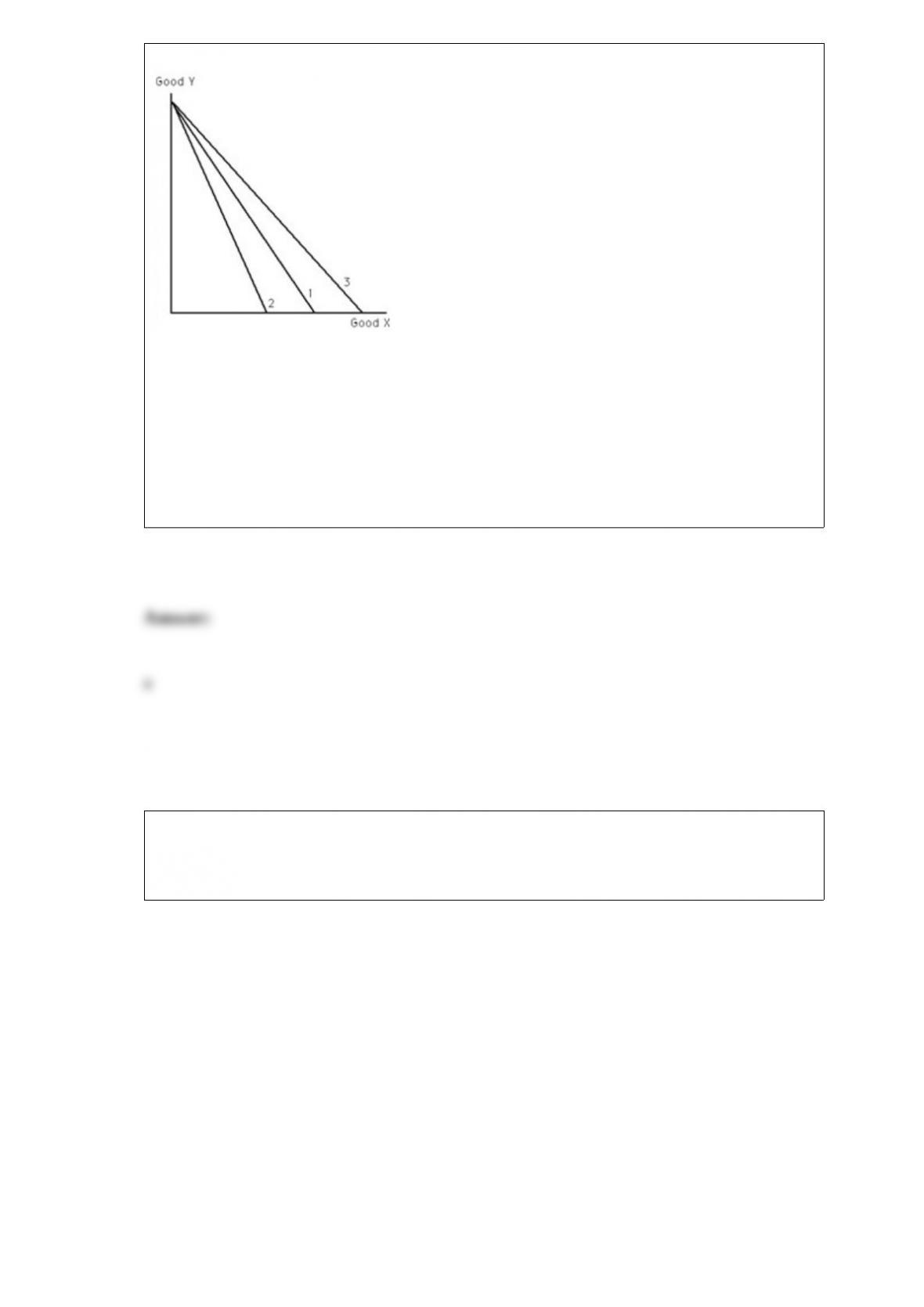
a. rise in the price of good X.
b. fall in the price of good X.
c. rise in the price of good Y.
d. fall in income.
Refer to Exhibit 23-8. What is the profit (loss) of firm A at the profit-maximizing (or
loss-minimizing) level of production?
Exhibit 23-8
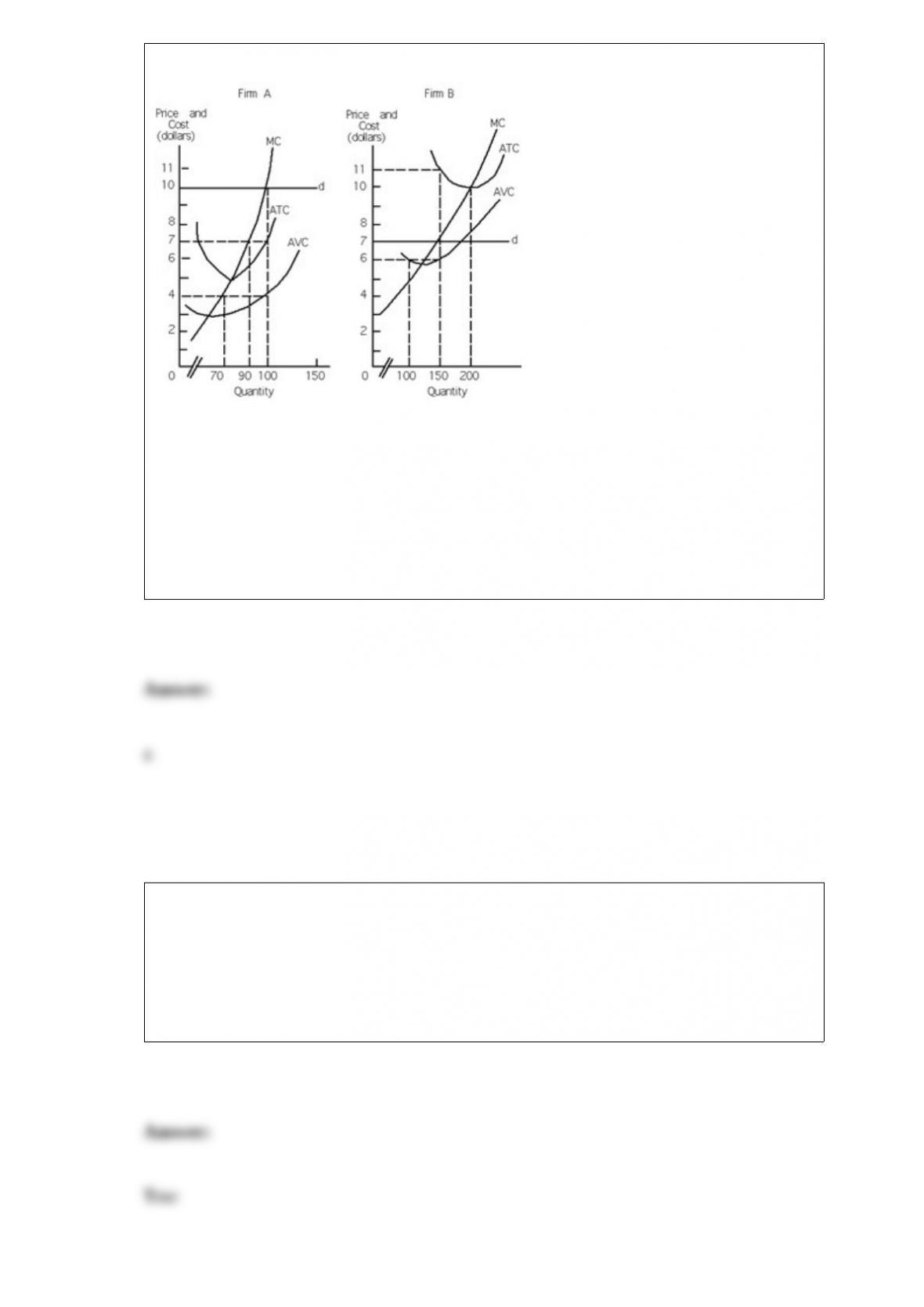
a. $300
b. $270
c. $600
d. $400
e. -$300
When an economy is not using all of its resources, it is producing at a point below its
production possibilities frontier.
a. True
b. False

An inferior good is
a. any good that consumers think is of low quality.
b. a good for which the quantity demanded increases as its price decreases.
c. a good for which the demand rises as income falls.
d. a good for which the demand rises as income rises.
e. any good that a producer cannot sell a large quantity of, even at a low price.
Would we expect the “average” person to take more time to learn about the car he or she
is considering purchasing or about the issues in the upcoming U.S. Senate race in his or
her state?
a. The Senate race, because it is critical that we elect the right people to government.
b. The car, but there is no rational reason for this.
c. The Senate race, because the person who is elected senator today may become
president tomorrow.
d. The car, because a mistake here can potentially cause him or her more harm on a
day-to-day basis; in addition, a person is unlikely to be able to determine the outcome
of a Senate race.
If an asymmetry of information is removed and laborers’ preferences change against

employment, this will shift the equilibrium in the labor market to the
a. northwest.
b. northeast.
c. southwest.
d. southeast.
By itself, knowing a country’s Gini coefficient does not tell one anything about the
income distribution of a particular quintile within that country.
a. True
b. False
In all cases, positive economics deals with
a. what is.
b. what should be.
c. relatively small units in the economy.
d. aggregates or the entire economy.
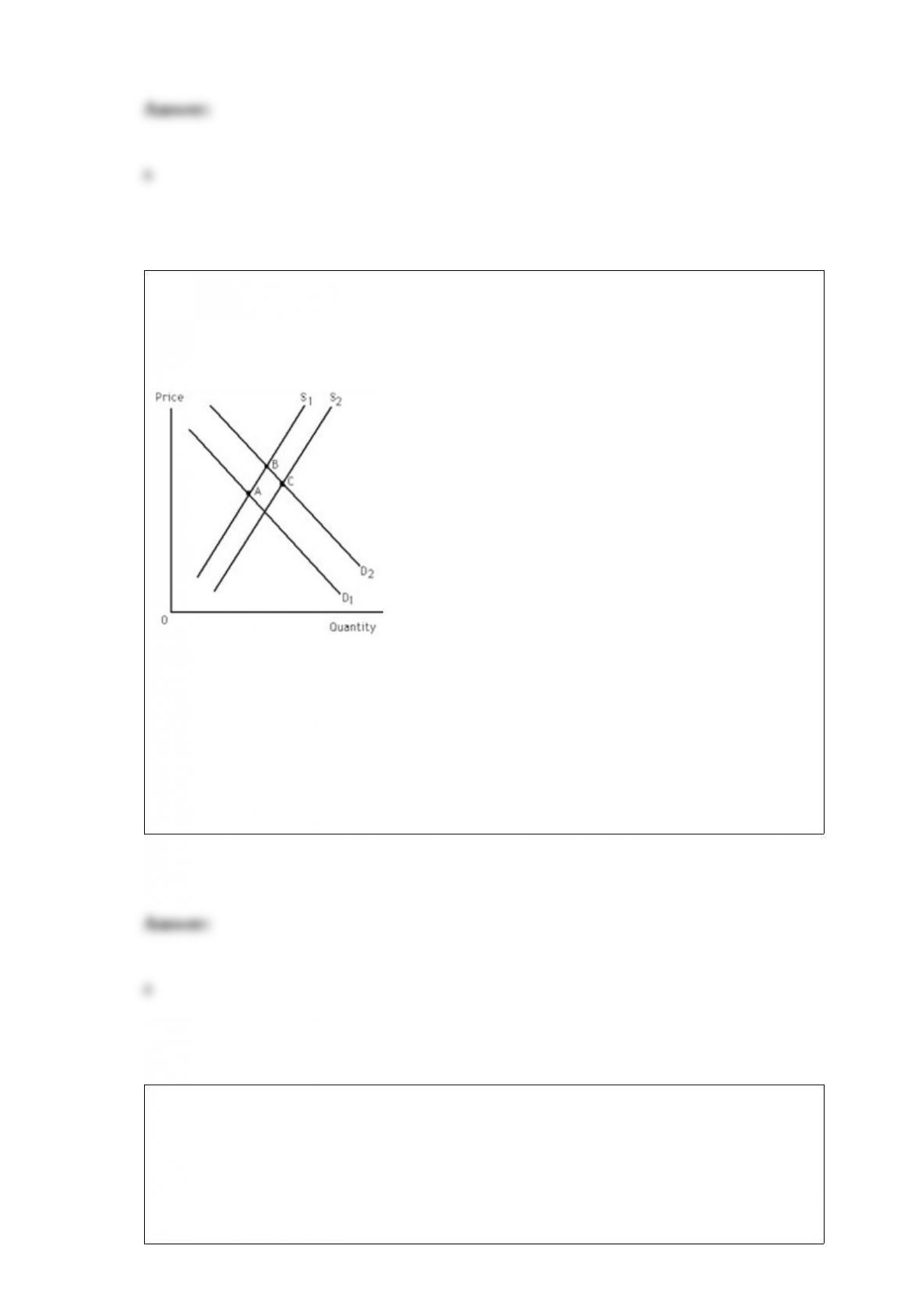
Refer to Exhibit 3-2. Suppose equilibrium is at point C. Something then changes and
equilibrium becomes point B. Which of the following is consistent with the change in
equilibrium from point C to B (assuming that good X is a normal good)?
Exhibit 3-2
Good X a. There was an increase in resource prices and income stayed constant.
b. There was a decrease in resource prices and income stayed constant.
c. There was an increase in resource prices and income decreased.
d. There was a decrease in resource prices and income increased.
A price searcher
a. faces a horizontal demand curve.
b. is a seller that searches for good employees and pays them a low wage.

c. is a seller that searches for the best location to sell its product.
d. is a seller that has the ability to control to some degree the price of the product it
sells.
e. none of the above
The monopolistic competitor has a __________ elastic demand curve than the
monopolist, largely because it faces __________ substitutes for the product it produces
and sells.
a. less; more
b. more; fewer
c. more; more
d. less; fewer
Suppose that a television studio has two shows, X and Z, and that tickets for viewing
the taping of each show is free.The equilibrium price for a ticket to view the taping of
show X is $25 and the equilibrium price for a ticket to view the taping of show B is
-$20.It is likely that tickets to show ________ will need to be rationed on a
first-come-first-served basis, while the producers of show ________ will have a much
more difficult time filling the seats in the studio since the equilibrium price for tickets
to that show is a __________ dollar amount.

a. Z; X; positive
b. Z; X; negative
c. X; Z; positive
d. X; Z; negative
A negative externality is
a. a type of tax.
b. a type of subsidy.
c. a type of money price.
d. linked to external costs.
e. linked to external benefits.
At the level of output at which a single-price monopolist maximizes profit, price is
a. equal to marginal cost.

b. equal to marginal revenue.
c. greater than marginal cost.
d. less than marginal cost.
e. less than marginal revenue.
There is currently a price ceiling in the market for transplanted kidneys, which has
helped to create a shortage of transplanted kidneys.
a. True
b. False
Suppose someone believes that if a per-unit tax is placed on the producers of good Y,
the consumers of good Y will end up paying the full tax. This person assumes that the
demand curve for good Y is
a. elastic.
b. perfectly inelastic.
c. inelastic.
d. perfectly elastic.

e. unit elastic.
You turn to the bond market page of a newspaper and look under the column headed
“Net Chg” and see that it says, “-1/4” this indicates that
a. the closing price for the bond on this particular day was $2.50 lower than on the
previous day.
b. the closing price for the bond on this particular day is $0.25 lower than on the
previous day.
c. the yield for the bond has fallen by 0.25% compared to the previous day.
d. the yield for the bond has fallen by 0.25% compared to exactly one year ago.
Refer to Situation 4-1. An economist would have most likely predicted that the oil
embargo imposed in 1974 would result in a
Situation 4-1
During the winter of 1973-74, a general system of wage and price controls (including a
price ceiling on gasoline) was in force in the United States. At the beginning of 1974,
some oil-producing countries imposed an oil embargo (a legal prohibition on
commerce) on the West. In the spring of 1974, price controls were abolished. a.
leftward shift in the supply (curve) of gasoline.
b. rightward shift in the supply (curve) of gasoline.
c. leftward shift in the demand (curve) for gasoline.

d. rightward shift in the demand (curve) for gasoline.
e. both a and d
Consider a point on a market demand curve. The point represents
a. a single price and the quantity demanded by an individual buyer.
b. a single price and the sum of the quantities demanded by all buyers.
c. various prices and various quantities demanded.
d. a single price and the quantity demanded by an individual buyer at that price and all
other prices.
e. a and c
If variable X goes up as result of variable Y going down, then X and Y are
a. directly related.
b. inversely related.
c. independent.
d. positively related.

If the stock market quote in the newspaper reads 752 in the column headed “Vol 00s”, it
means that 752 shares of this stock were traded on this particular day.
a. True
b. False