
The act which empowered the Federal Trade Commission to deal with false and
deceptive acts or practices was the
a. Wheeler-Lea Act.
b. Federal Trade Commission Act.
c. Robinson-Patman Act.
d. Sherman Act.
e. Clayton Act.
At the minimum wage (set above the equilibrium wage),
a. all individuals who end up working are paid less than if they were paid the
equilibrium wage.
b. none of the workers will lose there jobs or find themselves working fewer hours.
c. none of the individuals who end up working are paid more than if they were paid the
equilibrium wage.
d. there will be fewer people working (or fewer labor hours demanded) than at the
equilibrium wage.
e. none of the above
Exhibit 2-3

If PPF1 is the relevant production possibilities frontier, society may move to PPF2 as a
result of
a. an increase in resources.
b. a decrease in resources.
c. an increase in technology.
d. both a and c
e. both b and c
Exhibit 22-13
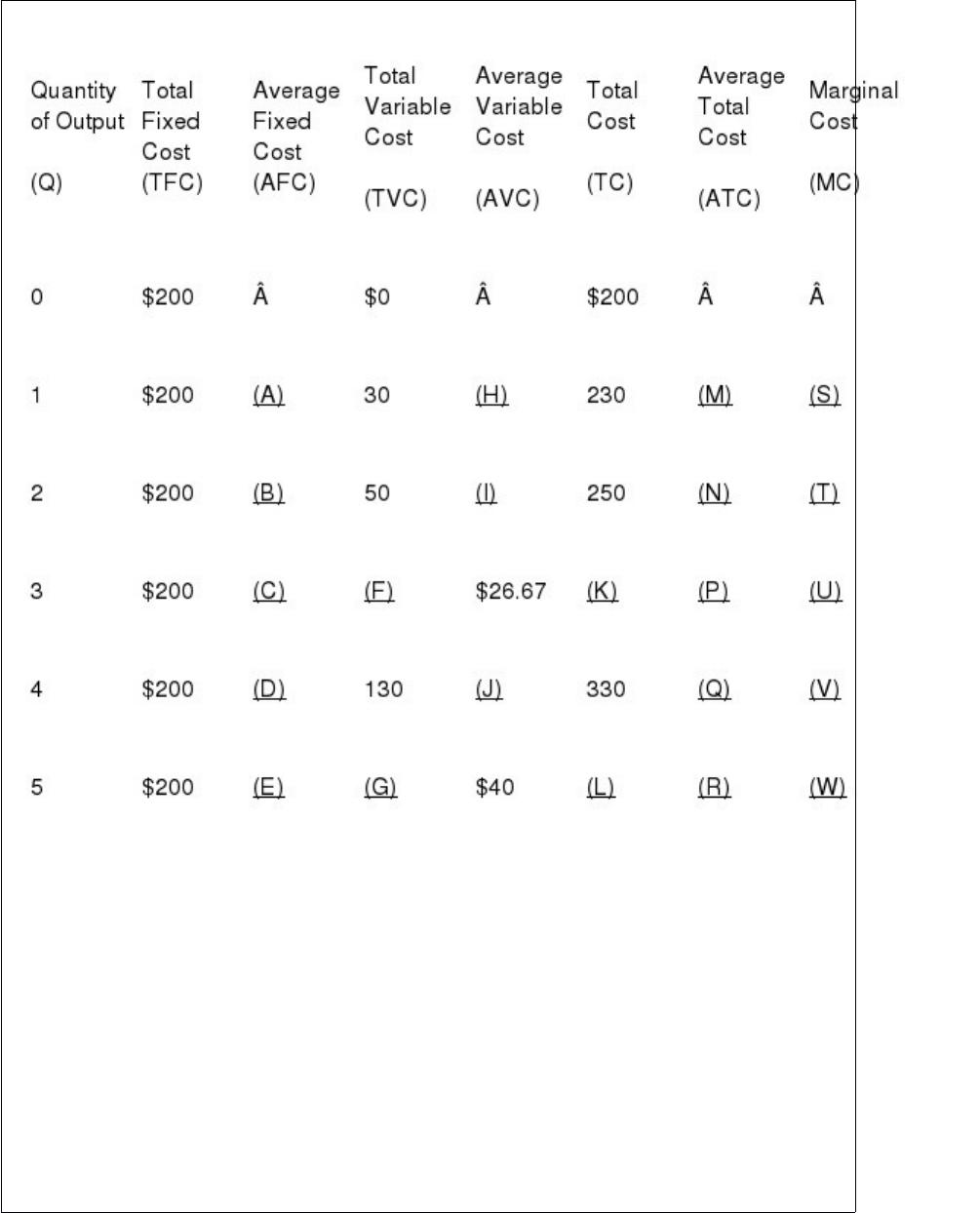
What dollar amounts go in blanks (K) and (L), respectively?
a. $280; $400
b. $28; $40
c. $260; $360
d. $50; $400
e. There is not enough information to answer this question.
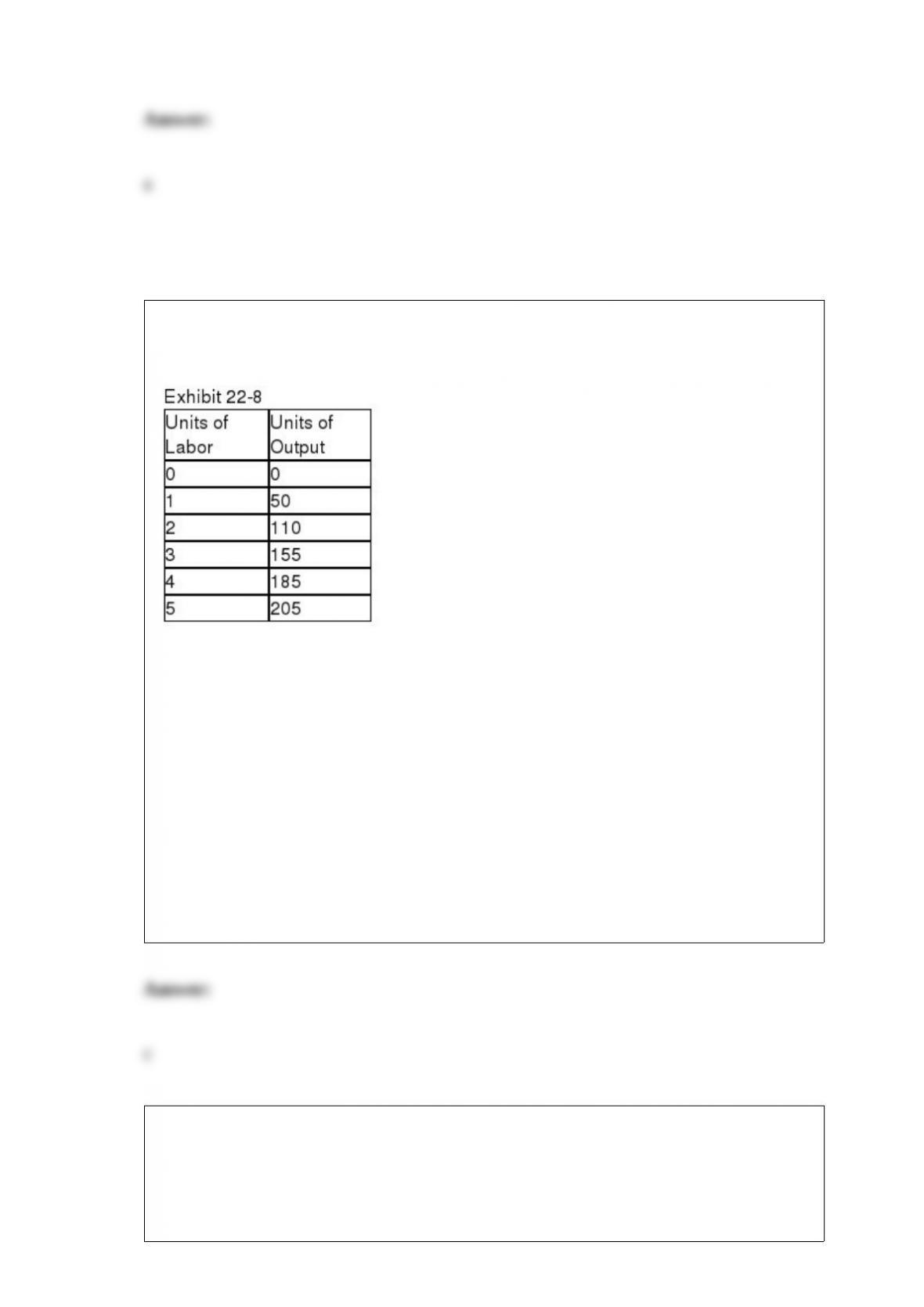
shows how output varies with the only variable input used in its production. The table
indicates that diminishing marginal returns set in with the hiring of which unit of labor?
a. first
b. second
c. third
d. fourth
e. fifth
Unions provide training programs in an attempt to increase the marginal physical
product of union labor, thus shifting the union demand for labor curve rightward.
a. True

b. False
The voting outcome and the most preferred outcome of the median voter are the same
in a simple majority vote where there are several options from which to choose.
a. True
b. False
A graph showing the relationship between the ____________________ and the
________________________ is called the ______________ curve.
a. cumulative percentage of households; cumulative percentage of income; Lorenz
b. cumulative percentage of households; cumulative percentage of income; Gini
c. cumulative percentage of households; cumulative percentage of income; Laffer
d. percentage of households living in poverty; percentage of households living above
the poverty line; Lorenz
e. none of the above

In long-run competitive equilibrium, firms
a. earn positive economic profits.
b. have no incentive to make any changes.
c. earn losses on some units of the good they produce and sell.
d. do not produce the quantity of output at which MR = MC.
e. b and c
Exhibit 2-6
Which graph depicts a technological breakthrough in the production of good X only?
a. (1)
b. (2)
c. (3)
d. (4)
e. none of the above
The law of diminishing marginal returns holds for a situation in which

a. all inputs are variable.
b. all inputs are fixed.
c. some inputs are variable and some inputs are fixed.
d. all inputs are increased in the same proportion.
A constant-cost industry is characterized by
a. an upward-sloping long-run supply curve.
b. a downward-sloping long-run supply curve.
c. a perfectly elastic long-run supply curve.
d. perfectly elastic short-run and long-run supply curves.
e. a perfectly elastic short-run supply curve and an upward-sloping long-run supply
curve.