1) in which of the following cases will total revenue increase?
a.price falls and demand is inelastic
b.price falls and supply is elastic
c.price rises and demand is inelastic
d.price rises and demand is elastic
2) if actual gdp is $340 billion and there is a positive gdp gap of $20 billion, potential
gdp is:
a.$360 billion.
b.$660 billion.
c.$320 billion.
d.$20 billion.
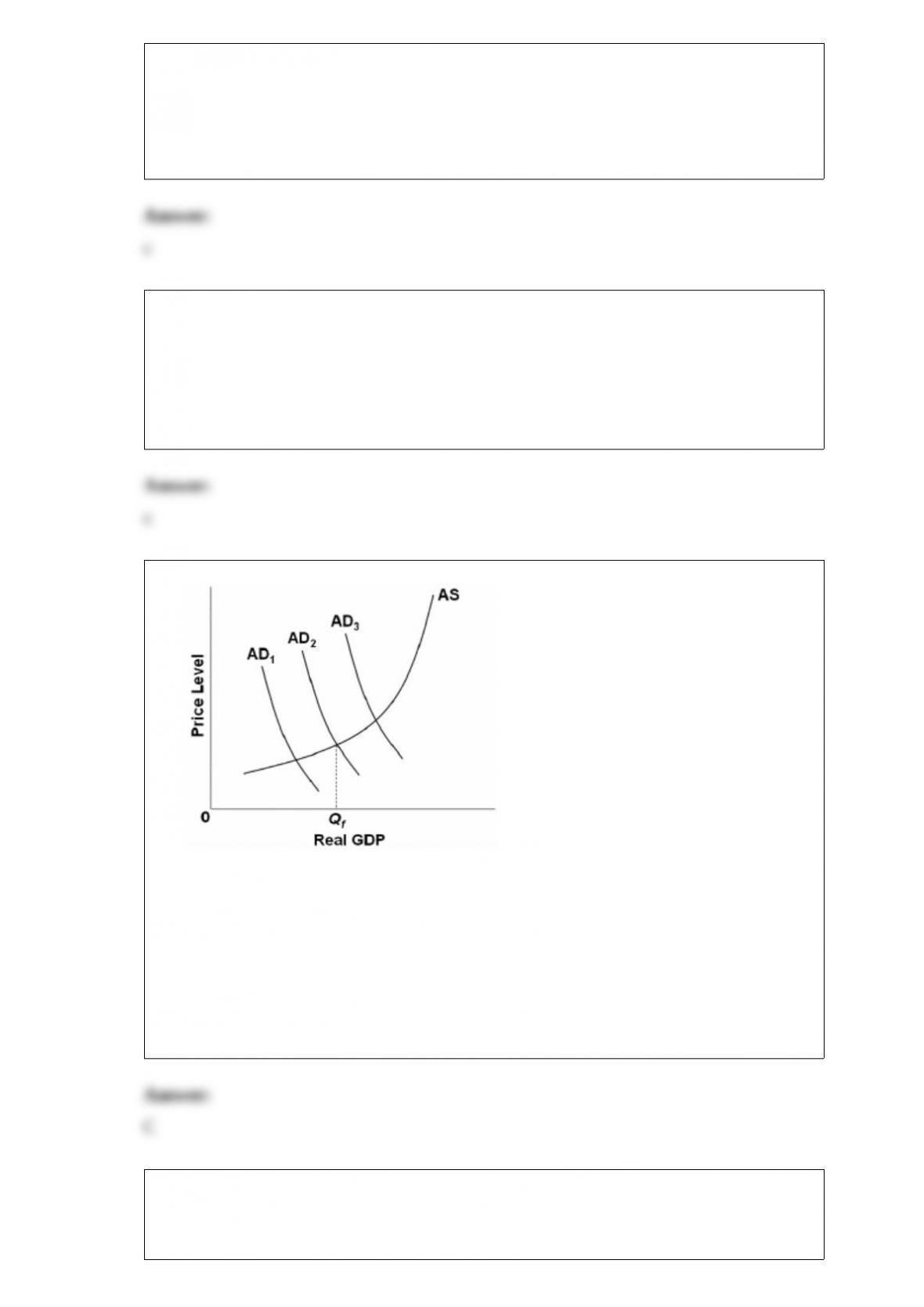
3)
Refer to the above diagram, in which Qf is the full-employment output. If aggregate
demand curve AD1describes the current situation, appropriate fiscal policy would be to:
A.increase taxes and reduce government spending to shift the aggregate demand curve
rightward to AD2.
B.reduce taxes on businesses to shift the aggregate supply curve leftward.
C.reduce taxes and increase government spending to shift the aggregate demand curve
from AD1to AD2.
D.do nothing since the economy appears to be achieving full-employment real GDP.
4) a trade deficit occurs for a nation when it:
a.exports more than it imports.
b.imports more than it exports.
c.receives more foreign currency than it sends out in domestic currency.
d.loans out u.s. dollars to foreign buyers of domestically produced goods.
5) labor productivity is measured by:
a.the ratio of capital to labor.
b.real output per worker hour.
c.real output per capita.
d.the ratio of worker hours to real gdp.
6) if the demand for bacon is relatively elastic, a 10 percent decline in the price of
bacon will:
a.decrease the amount demanded by more than 10 percent.
b.increase the amount demanded by more than 10 percent.
c.decrease the amount demanded by less than 10 percent.
d.increase the amount demanded by less than 10 percent.
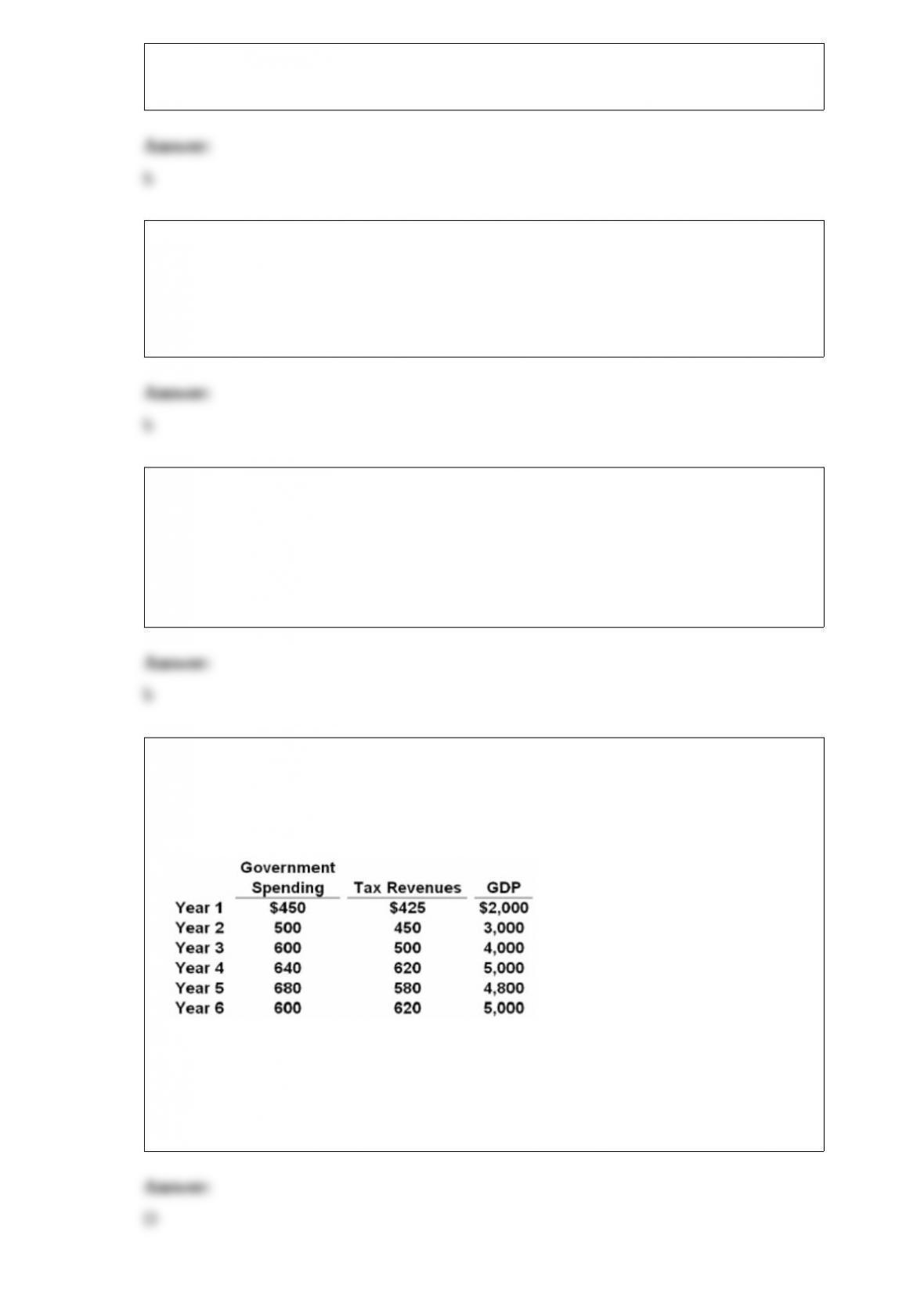
7) Answer the next question(s) using the following budget information for a
hypothetical economy. Assume that all budget surpluses are use to pay down the public
debt.
Refer to the above data. A budget surplus occurred in year:
A.2.
B.3.
C.4.
D.6.

8) Relative to 1800, the living standard of the average person today in the U.S. is about
_____ times higher.
A.5
B.12
C.20
D.42
9) (Last Word) In 1981, IBM introduced its version of the personal computer to
compete with existing personal computers offered by Apple and others. IBM’s action
best exemplifies:
A.invention.
B.scientific determinism.
C.diffusion.
D.technological lag.
10) “Government failure” is a prominent topic in:
A.public choice theory.
B.Keynesian economics.
C.socialist theory.
D.behavioral economics.