
If there is always a three-for-one tradeoff between goods X and Y, then the PPF
between X and Y is
a. a downward-sloping curve that is bowed outward.
b. a downward-sloping curve that is bowed inward.
c. a downward-sloping straight line.
d. an upward-sloping straight line.
When a negative externality exists, _______________________ and thus
_______________ intervention may be needed to achieve efficiency.
a. external costs are necessarily greater than private costs; government
b. social costs equal private costs; no government
c. social costs are less than private costs; government
d. social costs are greater than private costs; government
e. none of the above
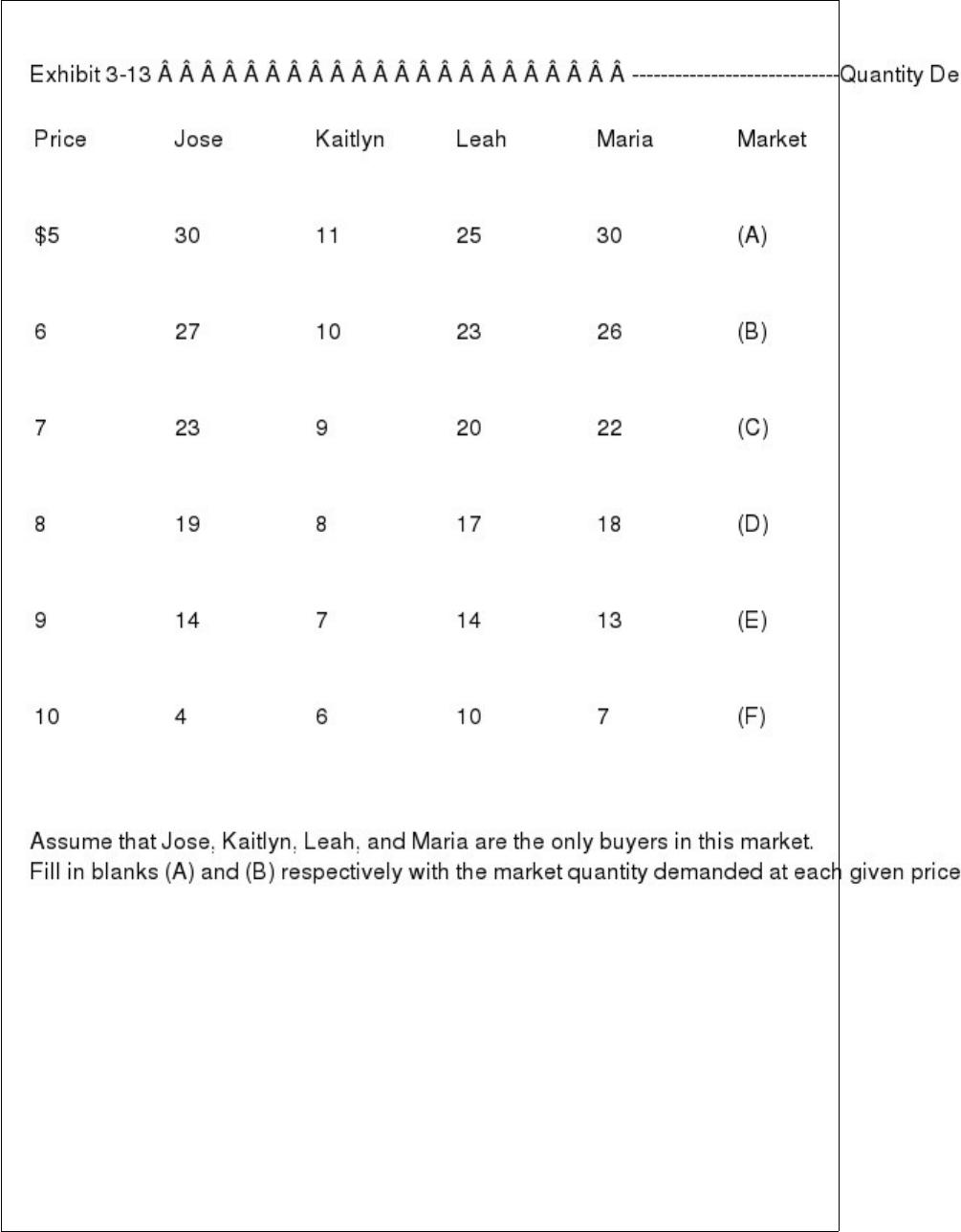
a. 96; 86
b. 24; 21.5
c. 75; 64
d. 82; 72
e. none of the above

A candidate who understands that in a two-person race the person closer to the center of
the voter distribution will win is likely to
a. first take polls to figure out what the voters are thinking and then afterward propose
policies that are consistent with the polls.
b. first put forth his or her views on a whole host of issues and then afterward take polls
to see if the majority of voters agree with him.
c. speak in specific terms about what needs to be done.
d. a and c
e. b and c
Concentration ratios are used to determine
a. the number of firms in an industry.
b. the potential for entry into an industry.
c. the degree of product differentiation.
d. the extent (degree) of oligopoly.
e. none of the above
A seller has some information about a good that the buyer does not have. When would
the seller be most likely to provide the buyer with the currently “hidden” information?
a. When the seller thinks that providing the information will decrease the supply of the
good.
b. When the seller thinks that providing the information will increase the supply of the
good.
c. When the seller thinks that providing the information will decrease the demand for
the good.
d. When the seller thinks that providing the information will increase the demand for
the good.
e. There is not enough information to answer the question.
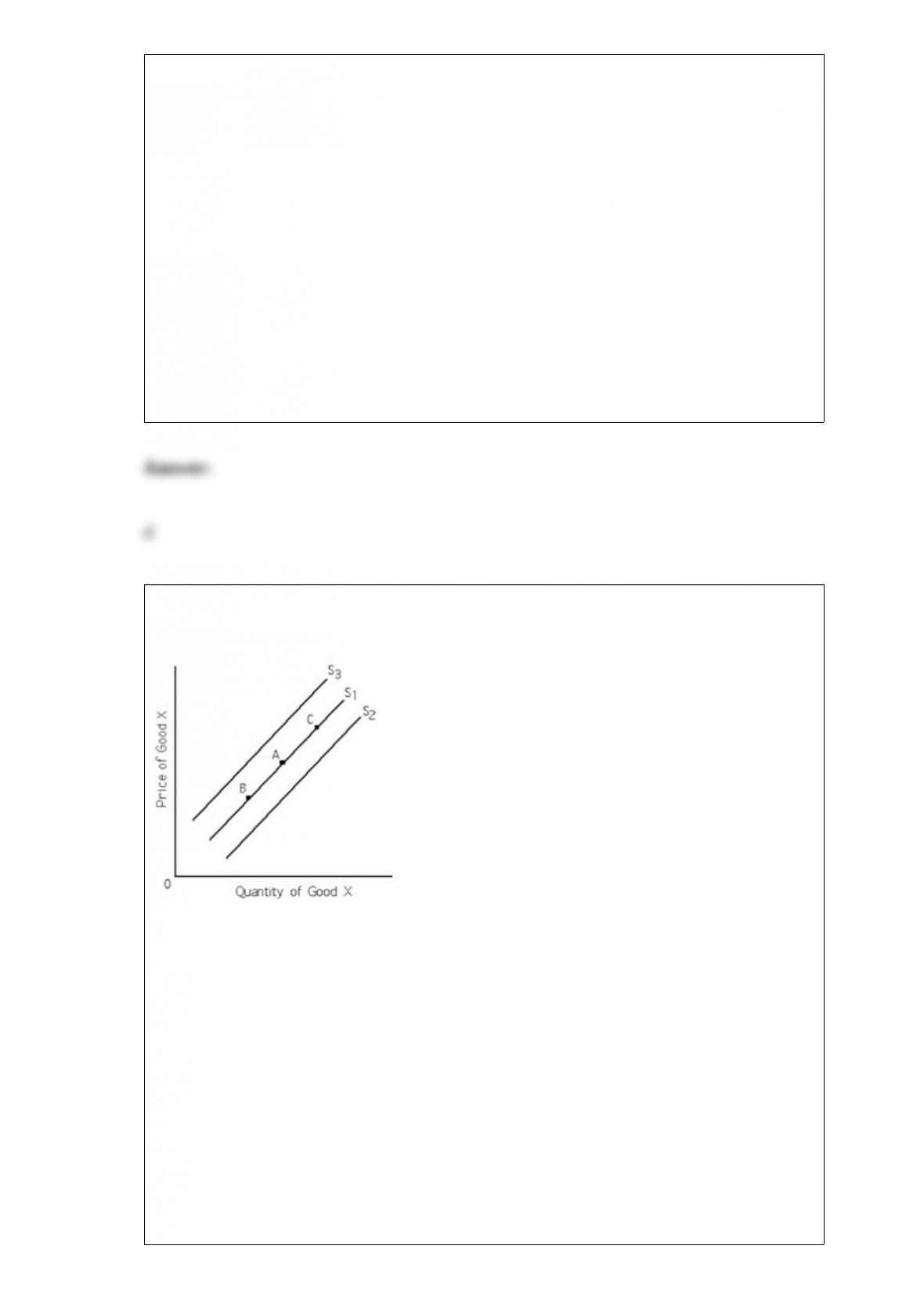
Exhibit 3-7
If S1 is the relevant supply curve, a decrease in the price of a resource that is necessary
for the production of good X causes
a. the supply of good X to shift from S1 to S2
b. the supply of good X to shift from S1 to S3.
c. a movement along S1 perhaps from point A to point B.
d. a movement along S1 perhaps from point A to point C.
e. no change in the supply of good X.

Firm X is a monopolistic competitive firm and a factor price taker. For this firm at the
profit-maximizing factor quantity,
a. VMP = MRP > MFC = factor price.
b. VMP>MRP = MFC > factor price.
c. VMP > MRP = MFC = factor price.
d. VMP < MRP = MFC = factor price.
For a union to be successful in increasing the total wage bill received by its members by
forcing up the wage rate, the demand curve for labor needs to be
a. elastic.
b. perfectly elastic.
c. unitary elastic.
d. inelastic.
Suppose that your school pays one rate for the first one million kilowatts of electricity
and a lower rate for any power it uses over one million kilowatts. What economic

concept is occurring here?
a. perfect price discrimination
b. second-degree price discrimination
c. third-degree price discrimination
d. economies of scale
If the Gini coefficient is 1, there is
a. complete income inequality.
b. complete income equality.
c. relative income equality.
d. relative income inequality.
Cartels are easy to form and to maintain.
a. True
b. False
The opportunity cost of attending college is
a. the money one spends on college tuition, books, and so forth.

b. the highest valued alternative one forfeits to attend college.
c. the least valued alternative one forfeits to attend college.
d. equal to the salary one will earn when one graduates from college.