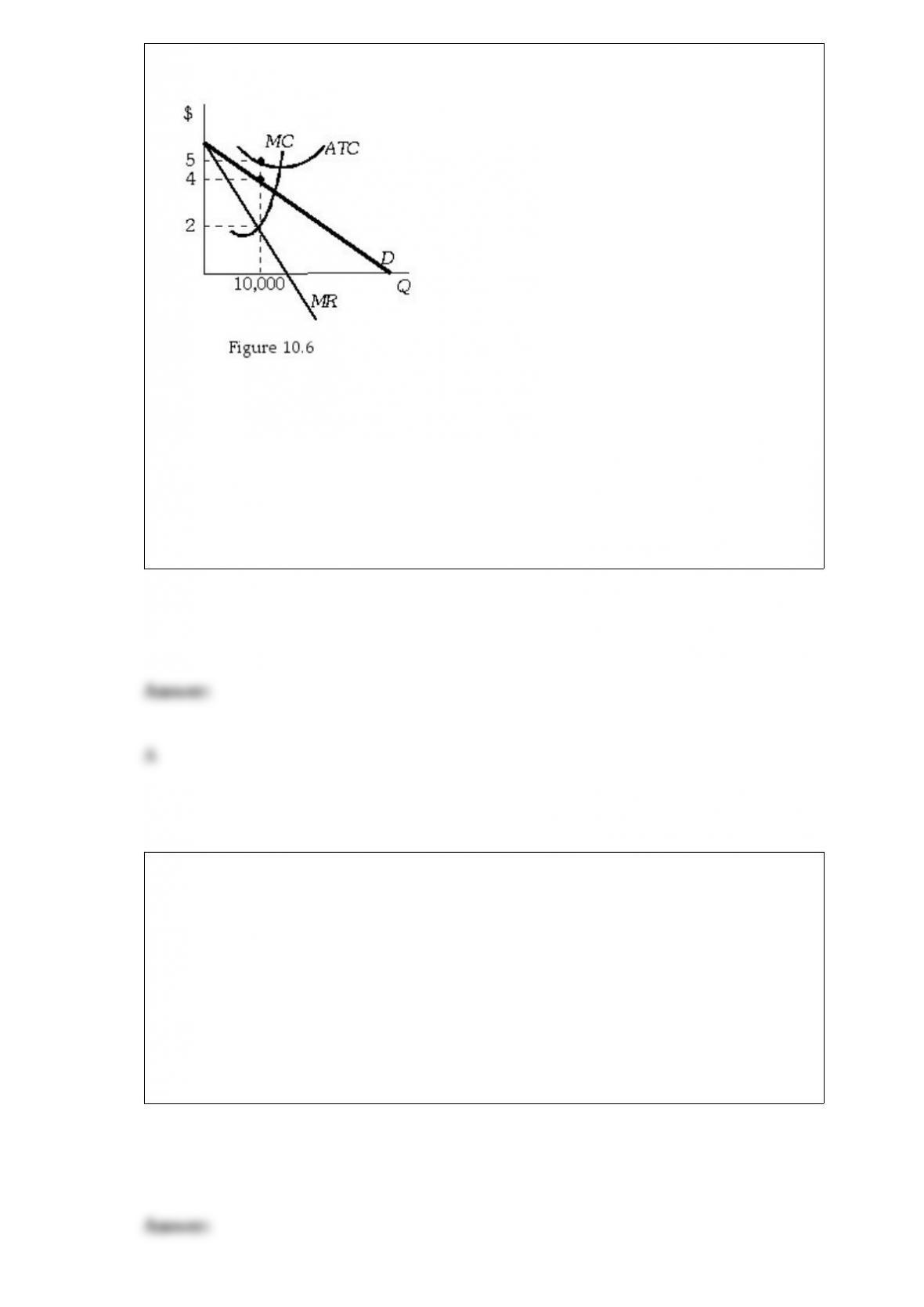
Refer to Figure 10.6. The profit-maximizing (or loss-minimizing) level of output:
A) is 10,000.
B) is 0.
C) is approximately 15,000.
D) is approximately 25,000.
A possible reason a nation might impose a protectionist policy such as a tariff is to:
A) help domestic firms establish a world monopoly in a particular market.
B) increase the level of imports.
C) encourage specialization in the good in which the nation has a comparative
advantage.
D) increase the welfare of domestic consumers.
The supply curve for gasoline will be more elastic in:
A) the short run because of the principle of diminishing returns.
B) the long run because of the principle of diminishing returns.
C) the short run because firms have more time in which to respond to the price change.
D) the long run because firms have more time in which to respond to the price change.
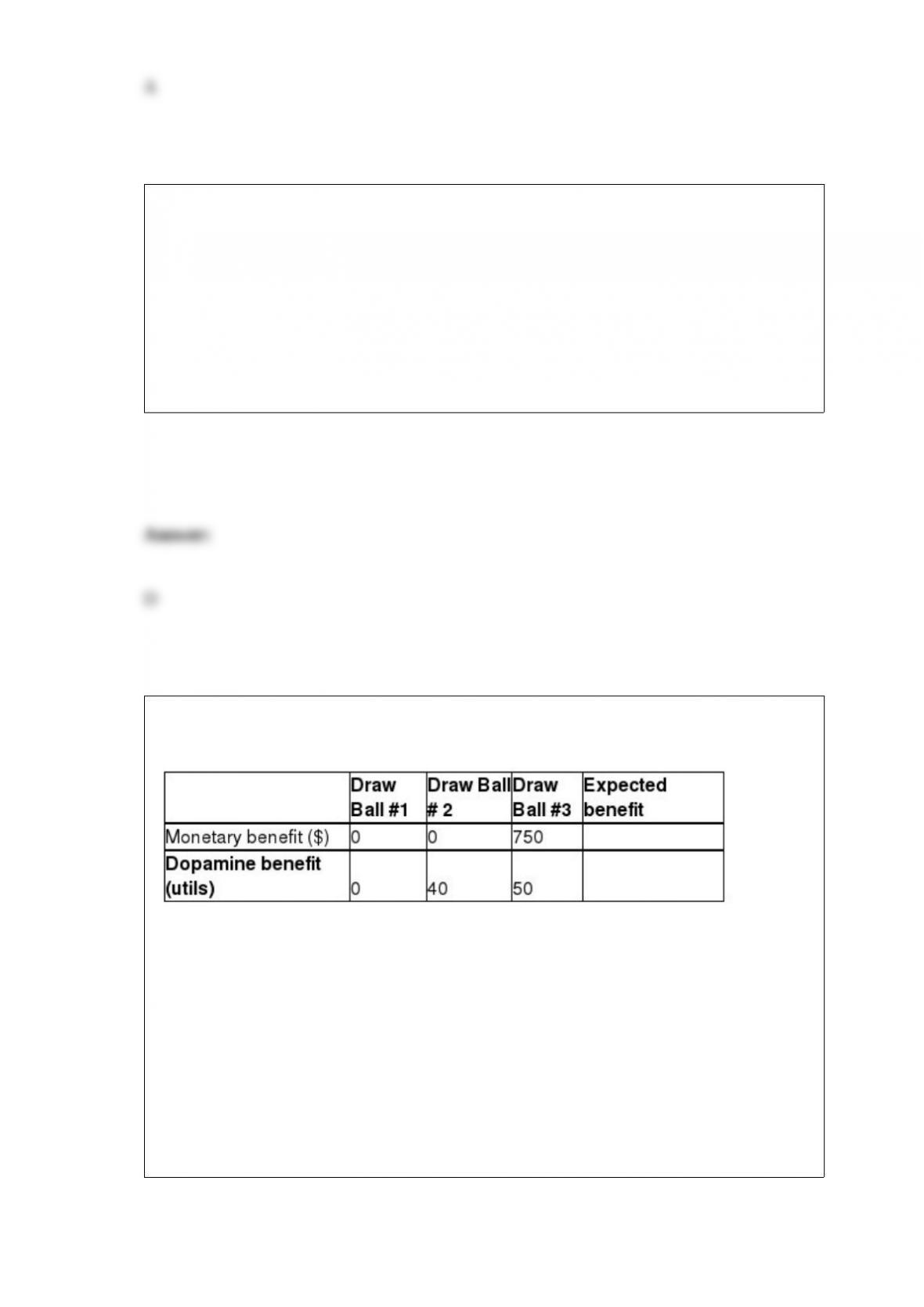
Refer to Table 7.1. For this game, the expected dopamine benefit is:
Table 7.1
The Table represents the payoffs for a gambling game. The player blindly draws
one of three balls, marked 1, 2, and 3, from an urn. The cost to play the game is
$375 per draw.
A) 0 utils.
B) 30 utils.
C) 40 utils.
D) 50 utils.
Taxes may cause deadweight losses because:
A) they transfer purchasing power from buyers to the government.
B) they lower the surplus in the market.
C) they increase consumer surplus at the expense of producer surplus.
D) they transfer purchasing power from sellers to the government.
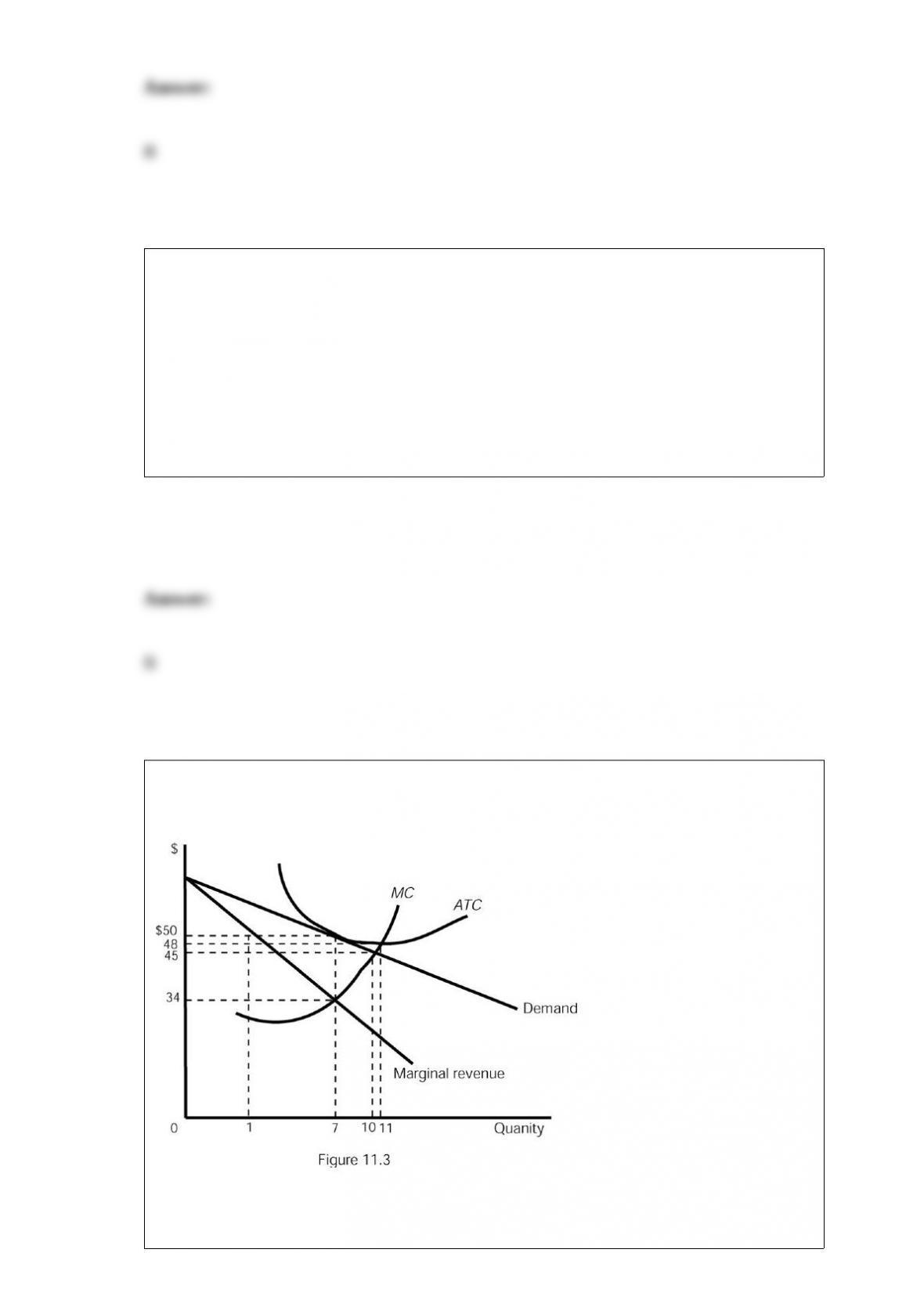
In the long run, the monopolistically competitive firm in Figure 11.3 would generate $
________ of total revenue.
A) 350

B) 450
C) 238
D) 480
If real salaries decrease but nominal salaries do not, this means that:
A) the purchasing power of money has increased.
B) prices have not changed.
C) prices have risen.
D) prices have fallen.
Where it wants to produce the firm in Figure 10.3 will:
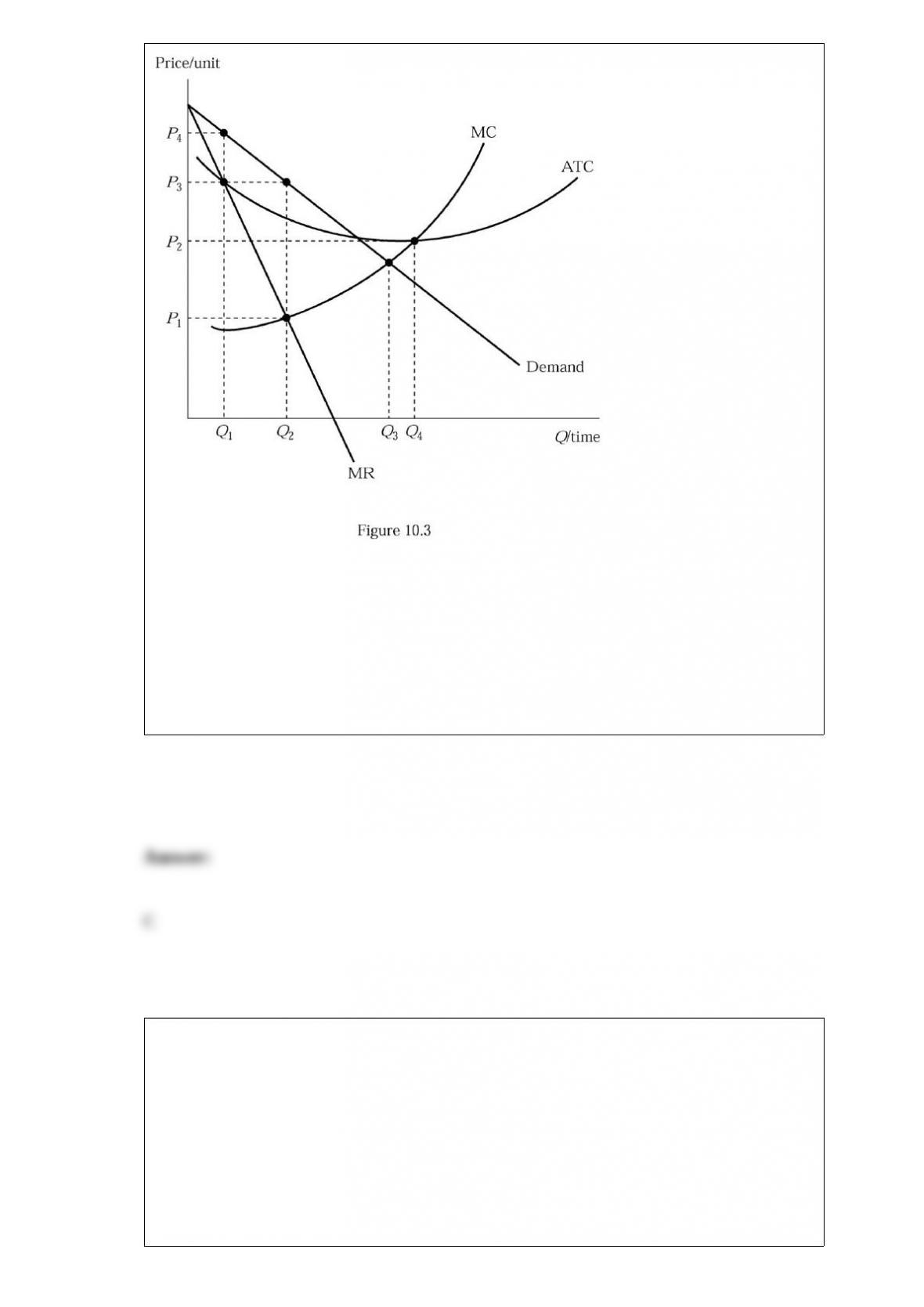
A) make a zero economic profit.
B) suffer a loss.
C) make a positive economic profit.
D) break even.
In order to practice price discrimination a firm must be in a market such that the
consumers in its market:
A) all have identical tastes.
B) all have identical price elasticities of demand.
C) have different price elasticities of demand.

D) have the same demand for its product.
The Nash equilibrium is an outcome of a game:
A) when each player is doing the best he or she can, given the actions of the other
players.
B) each player has a competitive advantage over the other players.
C) in which there are no winners only losers.
D) when all the possibilities are revealed to the players.
In perfectly contestable markets, large oligopolistic firms end up pricing like:
A) monopolistically competitive firms.
B) a monopoly.
C) competitive firms.
D) a cartel.

The relationship between the market price of a good and the quantity supplied of that
good by a firm in the short run is the firm’s:
A) short-run supply curve.
B) average cost schedule.
C) total revenue minus total cost schedule.
D) optimal production level.
Carlos is shopping for a tablet and since he has a relatively high opportunity cost of
search time will spend less time searching for a lower price and will also have:
A) a higher marginal benefit.of search.
B) a higher marginal cost of search.
C) a lower marginal benefit of search.
D) a lower marginal cost of search.

Which of the following is a country whose economy shrank between the 1960s and
2001?
A) Sierra Leone
B) the United States
C) Mexico
D) Canada
A firm scaled up its operation by increasing all inputs by 100%. If the firm experienced
150% increase in the output, the firm’s long-run average cost exhibits:
A) economies of scale at the current output level.
B) diseconomies of scale at the current output level.
C) a constant long-run average cost at the current output level.
D) diminishing marginal returns at the current output level.
A firm’s objective is to maximize its economic profit, which is:
A) total revenue minus economic cost.
B) total profit minus total cost.

C) economic cost minus profit.
D) economic cost minus total revenue.
The additional cost resulting from a small increase in some activity is called the:
A) opportunity cost.
B) marginal benefit.
C) marginal cost.
D) diminishing returns of the activity.
The most important reason for money income growing more unequal in recent decades
is an increase in:
A) government transfers.
B) the demand for skilled labor.
C) the number of high school graduates.
D) none of these.
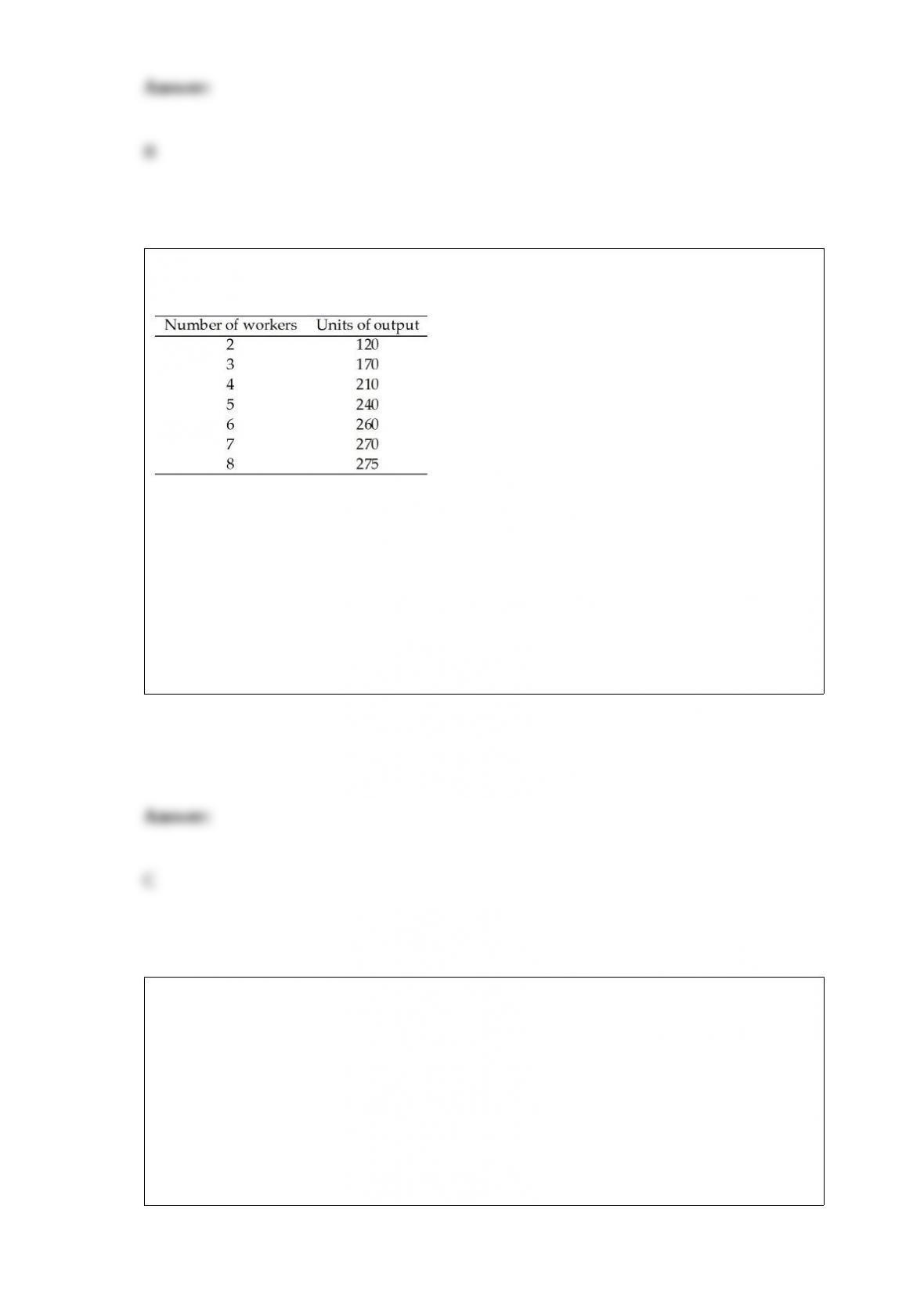
Refer to Table 17.2. If the price of output is $10 per unit, the marginal revenue product
of the third unit of labor is:
Table 17.2
A) $50.
B) $60.
C) $500.
D) $600.
If the supply curve is a vertical line, it means that:
A) regardless of price, the quantity supplied is a constant amount.
B) regardless of quantity, the price is a constant amount.
C) the good is inferior.
D) the good has many substitutes.

One factor which was responsible for roughly one-fifth of hybrid vehicles purchased in
2007 was a federal subsidy of up to $3,400 per hybrid vehicle, the average cost of
abating one ton of CO2 emissions through the hybrid subsidy is $177, but a switch from
coal to natural gas in power plants would reduce CO2 emissions at less than one-third
the cost of the hybrid subsidy. The amount of e-mail spam would significantly decrease
if:
A) the cost of sending spam exceeded its profitability.
B) states passed laws making spam illegal.
C) e-mail filters were developed to separate spam from legitimate e-mail.
D) more people responded to spam e-mails.
Which of the following is most accurate?
A) In all cases, competitive markets yield more consumer surplus than would be
enjoyed in a monopoly market with the same cost structure.
B) In all cases, competitive markets yield less consumer surplus than would be enjoyed
in a monopoly market with the same cost structure.
C) In some cases, competitive markets can yield less consumer surplus than would be
enjoyed in a monopoly market with the same cost structure.
D) In all cases, competitive markets yield the same consumer surplus that would be
enjoyed in a monopoly market with the same cost structure.

Which of the following is the least likely example of asymmetric information?
A) King Solomon and two women who claim to be the mother of a baby
B) a job applicant and a prospective employer
C) an auto mechanic and a transient customer
D) a retailer of used books and prospective customers
The physical and mental effort people use to produce goods and services is a
description of which factor of production?
A) physical capital
B) human capital
C) labor
D) entrepreneurship

Assume a non-price discriminating monopolist can sell 20 units of a good for 4.00 each
and can sell 21 units of that good for $ 3.85 each. The marginal revenue of the 21st unit
is:
A) $85.
B) $ -85.
C) $ .85.
D) $ -.85.
If producers have an expectation of higher future prices, the supply of the good that is
currently available:
A) will be all that is produced.
B) will increase.
C) will decrease.
D) will not change.
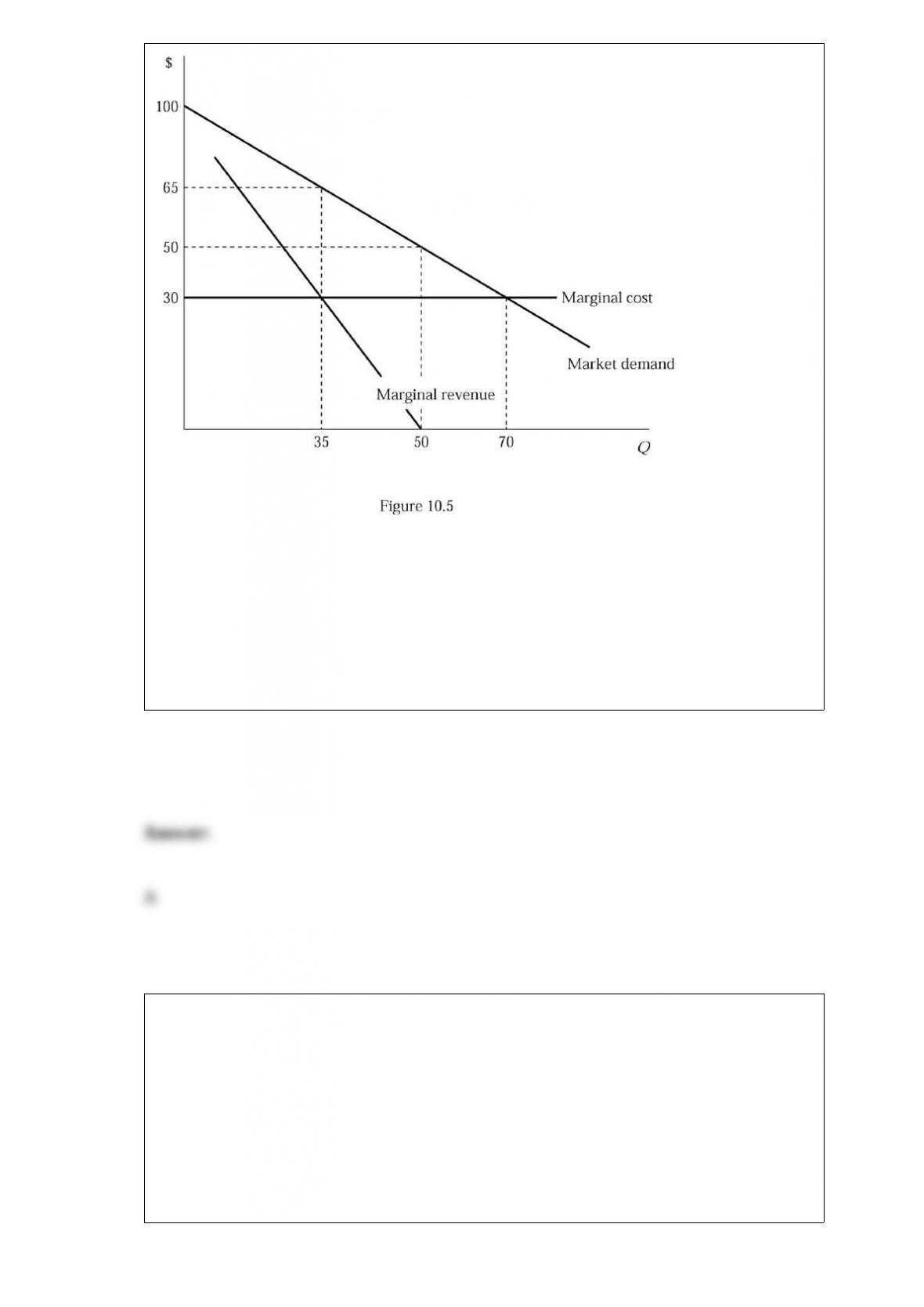
Suppose that Figure 10.5 shows an industry’s market demand, its marginal revenue, and
the production costs of a representative firm. If the industry was perfectly competitive,
the consumer surplus would be:
A) $2,450.
B) $1,225.
C) $612.5.
D) $262.5.
Which of the following is a question answered with positive economic analysis?
A) If we had more money, should the college offer free parking for students?
B) If we can afford it, should the college provide more financial aid assistance?
C) If the college increased tuition, by how much will class sizes decline?
D) As a result of the recession, should the college cut tuition to stimulate enrollments?
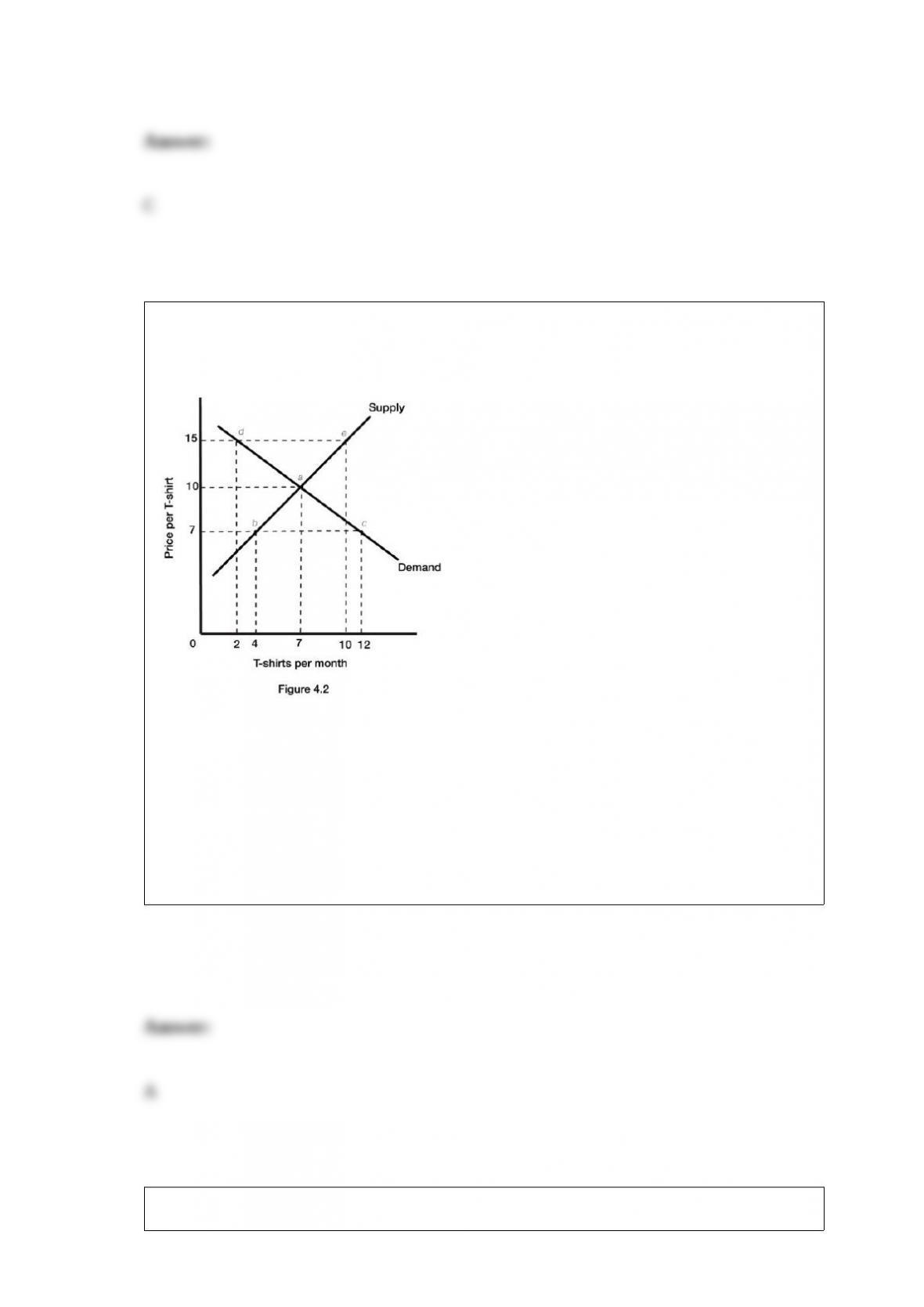
Figure 4.2 illustrates the supply and demand for t-shirts. If the actual price of t-shirts is
$7, there is an:
A) excess demand of 8 t-shirts.
B) excess supply of 8 t-shirts.
C) excess demand of 10 t-shirts.
D) excess supply of 10 t-shirts.
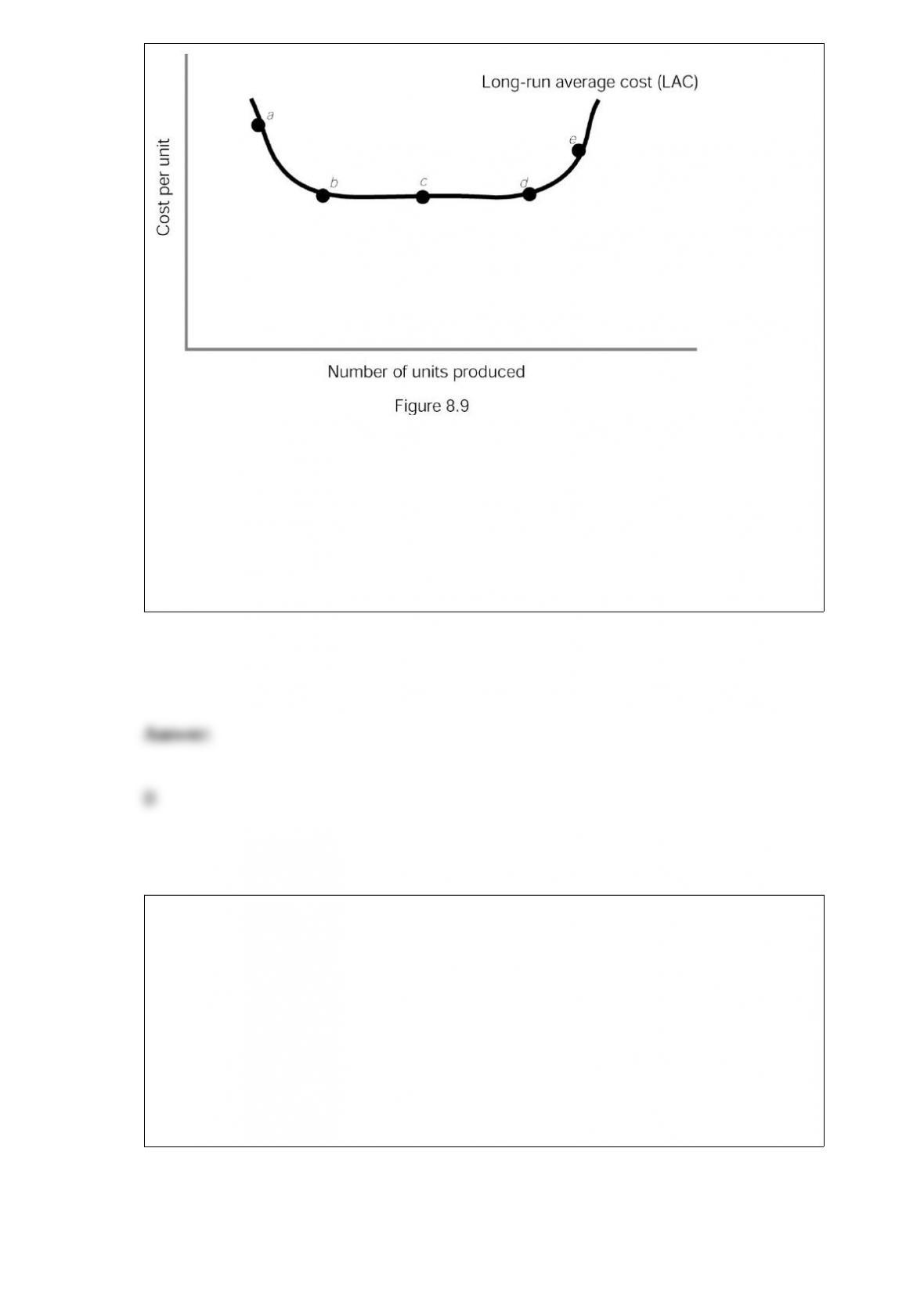
Refer to Figure 8.9. Which point of the LAC represents minimum efficient scale?
A) a
B) b
C) c
D) e
Which of the following situations will arise in the domestic market following the
imposition of a voluntary export restraint?
A) imports increase, domestic production increases, prices increase
B) imports decrease, domestic production increases, prices increase
C) imports increase, domestic production decreases, prices decrease
D) imports decrease, domestic production increases, prices decrease

Additional Application
For many years North Carolina-based Krispy Kreme Doughnuts have been the choice
of many Southerners. But now rival Dunkin’ Donuts is working on changing the way
Southerners expect a doughnut to taste. The Northeastern-based Dunkin’ Donuts has
plans to become a national brand in the next 15 years by tripling the number of stores in
the U.S. The difference is in the doughnut itself. Krispy Kreme offers a glazed, hot,
lighter doughnut while the product of Dunkin’ Donuts can be described as “thicker and
cakier.” Do consumers notice the difference? Rosemary Evans from Alabama states,
“Dunkin’ Donuts just don’t have much flavor.” And Jack Lehnhart from Ohio says
Krispy Kremes are “wax doughnuts.” As the size of the industry grows the efforts to
differentiate each product remain strong. Dunkin’ Donuts focuses on coffee and baked
goods as important components in its long term business plan. When discussing the two
companies and their approaches to success, the brand officer at Dunkin’ Donuts
succinctly said, “We’re very different.” Just take note of the different ways they spell the
product they produce!
Source: Beth Rucker, “Dunkin’ Donuts Raids Krispy Kreme’s Turf,” October 22, 2006,
http://hosted.ap.org/dynamic/stories/D/DONUT_WARS, accessed 10/30/2006.
What market structure best describes the doughnut industry discussed in the article
above?
A) monopolistic competition
B) monopoly
C) governmental
D) perfect competition