
1) as an economy opens up to international trade, domestic prices:
a.become lower
b.become more aligned with international prices
c.stabilize
d.none of the above; what will happen cannot be predicted
2) the first wave of globalization was brought to an end by
a.the great depression
b.the second world war
c.the first world war
d.the smoot-hawley act
3) suppose that brazil faces domestic inflation and a current account deficit. should
brazil devalue its currency, one would expect the:
a.inflation to become more severe–deficit to become less severe
b.inflation to become more severe–deficit to become more severe
c.inflation to become less severe–deficit to become less severe
d.inflation to become less severe–deficit to become more severe
4) according to the normal-trade-relations (most-favored-nation) principle, if the united
states extends mfn treatment to china and then grants a low tariff on imports of shirts
from south korea, the united states is obligated to provide the identical low-tariff on
imports of shirts from china.
a.true
b.false
5) the supply schedule of yen has a positive-sloping region which corresponds to the
inelastic region on the japanese demand schedule for foreign currency.
a.true
b.false

6) which of the following situations reduces the likelihood of successful operation of a
cartel?
a.cartel sales experience a rapid expansion
b.the demand for cartel output is price inelastic
c.the number of firms in the cartel is large
d.it is very difficult for new firms to enter the market
7) under adjustable pegged exchange rates, if the rate of inflation in the united states
exceeds the rate of inflation of its trading partners:
a.u.s. exports tend to rise and imports tend to fall
b.u.s. imports tend to rise and exports tend to fall
c.u.s. foreign exchange reserves tend to rise
d.u.s. foreign exchange reserves remain constant
8) the ‘spread” is a bank’s profit margin on foreign exchange trading and equals the
difference between the bid rate and the offer rate.
a.true
b.false
9) at the ____, the group-of-five nations agreed to intervene in the currency markets to
promote a depreciation in the u.s. dollar’s exchange value.
a.plaza agreement of 1985
b.louvre accord of 1987
c.bonn summit of 1978
d.tokyo summit of 1962
10) import quotas can yield revenue for the domestic government if it auctions import
licenses to the highest bidder in a competitive market.
a.true
b.false
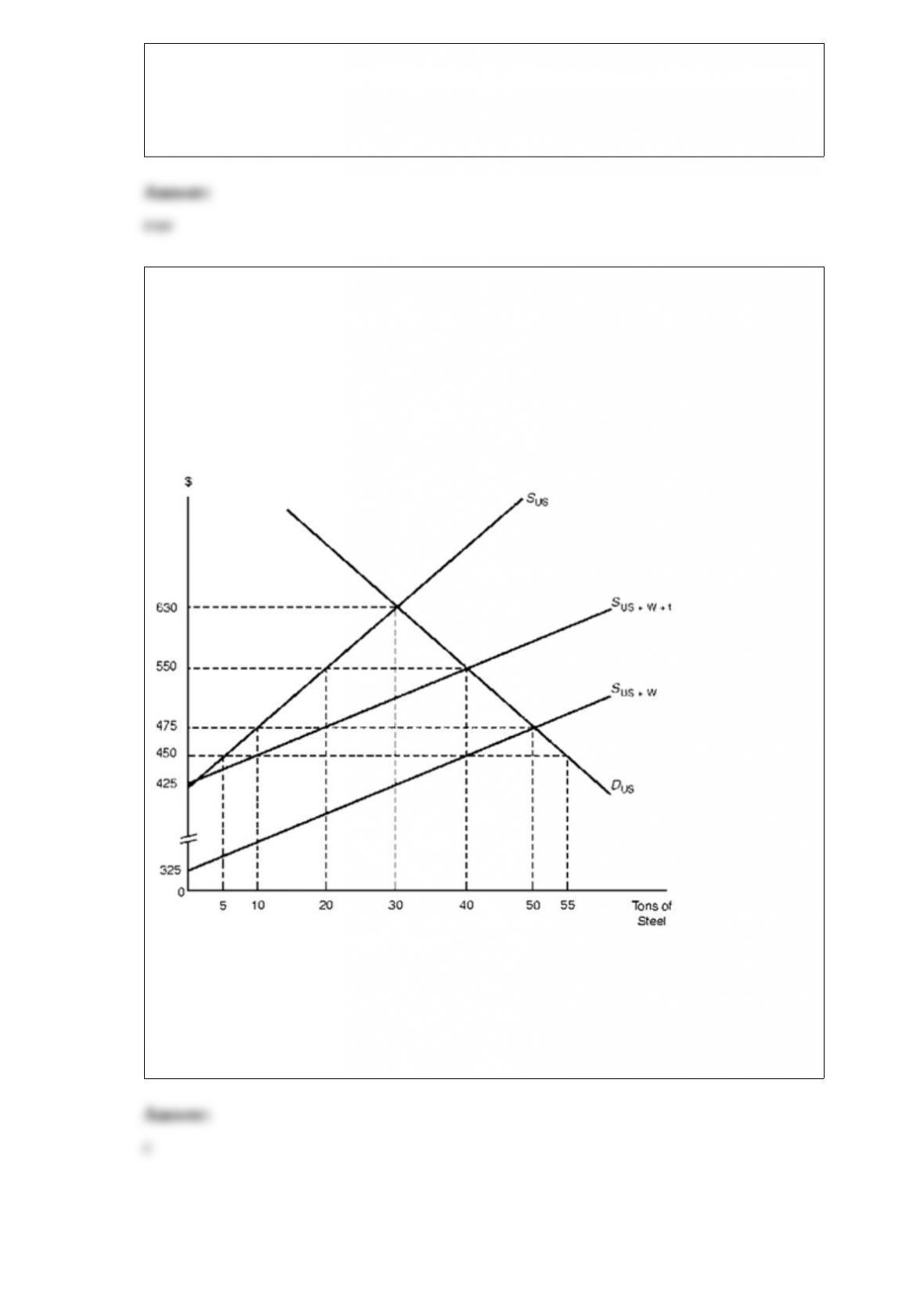
11) assume the united states is a large consumer of steel that is able to influence the
world price. its demand and supply schedules are respectively denoted by du.s. and su.s.
in figure 4.2. the overall (united states plus world) supply schedule of steel is denoted
by su.s.+w.
figure 4.2. import tariff levied by a “large” country
consider figure 4.2. of the $100 tariff, $____ is passed on to the u.s. consumer via a
higher price, while $____ is borne by the foreign exporter; the u.s. terms of trade:
a.$25, $75, improve
b.$25, $75, worsen
c.$75, $25, improve
d.$75, $25, worsen
12) according to the general agreement on tariffs and trade and its successor, the world
trade organization, only bilateral trade negotiations can take place between a country
and its trading partners.
a.true
b.false
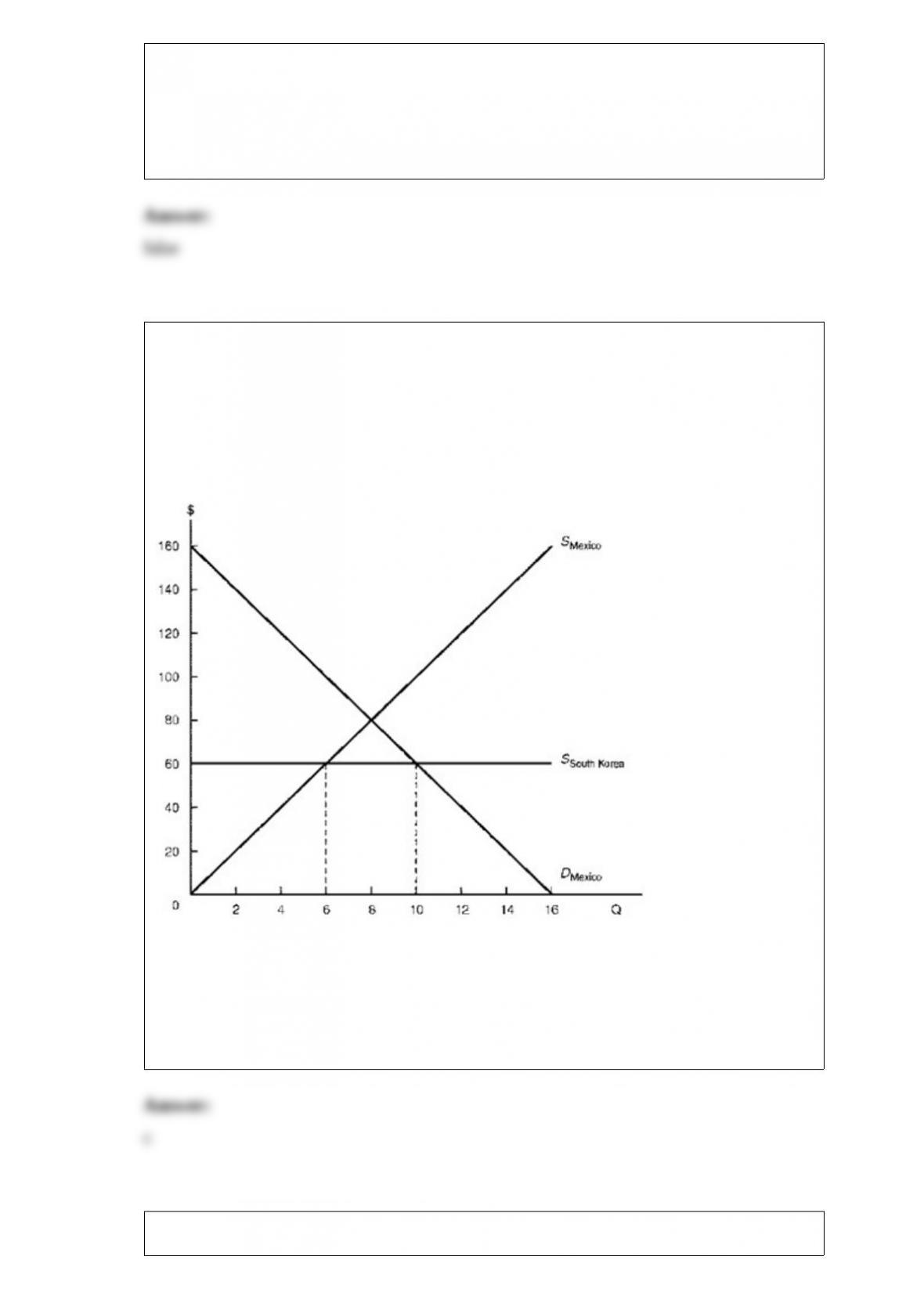
13) figure 6.2 illustrates the calculator market for mexico, assumed to be a small nation
that is unable influence the south korean (world) price. assume the south korean price to
be $60 per calculator.
figure 6.2. effects of an export subsidy
consider figure 6.2. with free trade, mexicans attain $____ of consumer surplus from
the availability of calculators, while mexican producer surplus equals $____.
a.$400, $200
b.$200, $400
c.$500, $180
d.$500, $240
14) labor migration tends to increase output and decrease wages in the country of
immigration while decreasing output and increasing wages in the country of emigration.
a.true
b.false
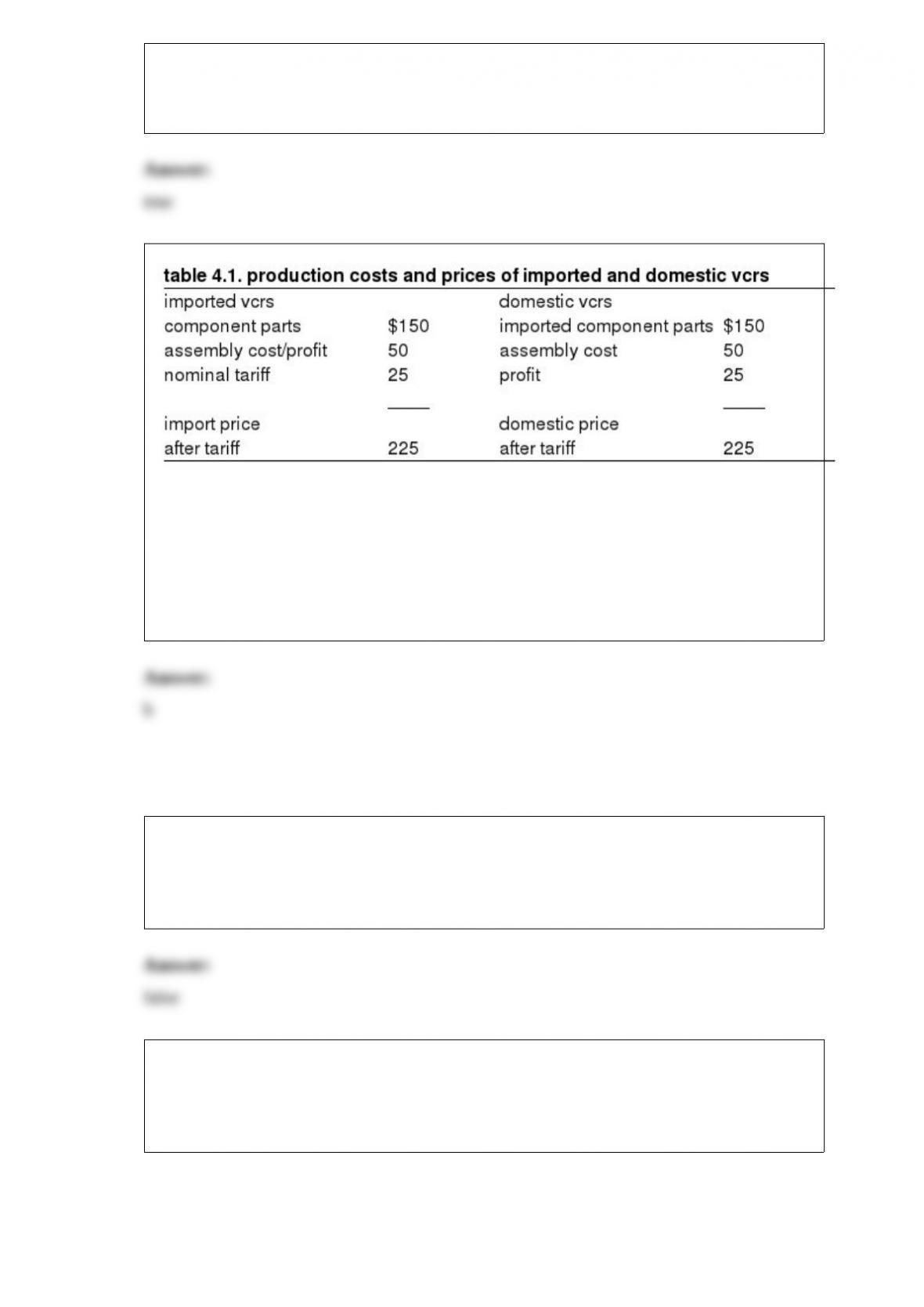
15) consider table 4.1. prior to the tariff, the total price of imported vcrs is:
a.$150
b.$200
c.$225
d.$235
16) the theory of reciprocal demand best applies when one country has a “large”
economy and the other country has a ‘small” economy.
a.true
b.false
17) figure 9.3 figure 9.3 represents the mexican labor market. assume that labor and
capital are the only factors of production. also assume the initial supply schedule of
labor is denoted by s0 and consists entirely of native mexican workers. the demand
schedule of labor is denoted by dmexico.
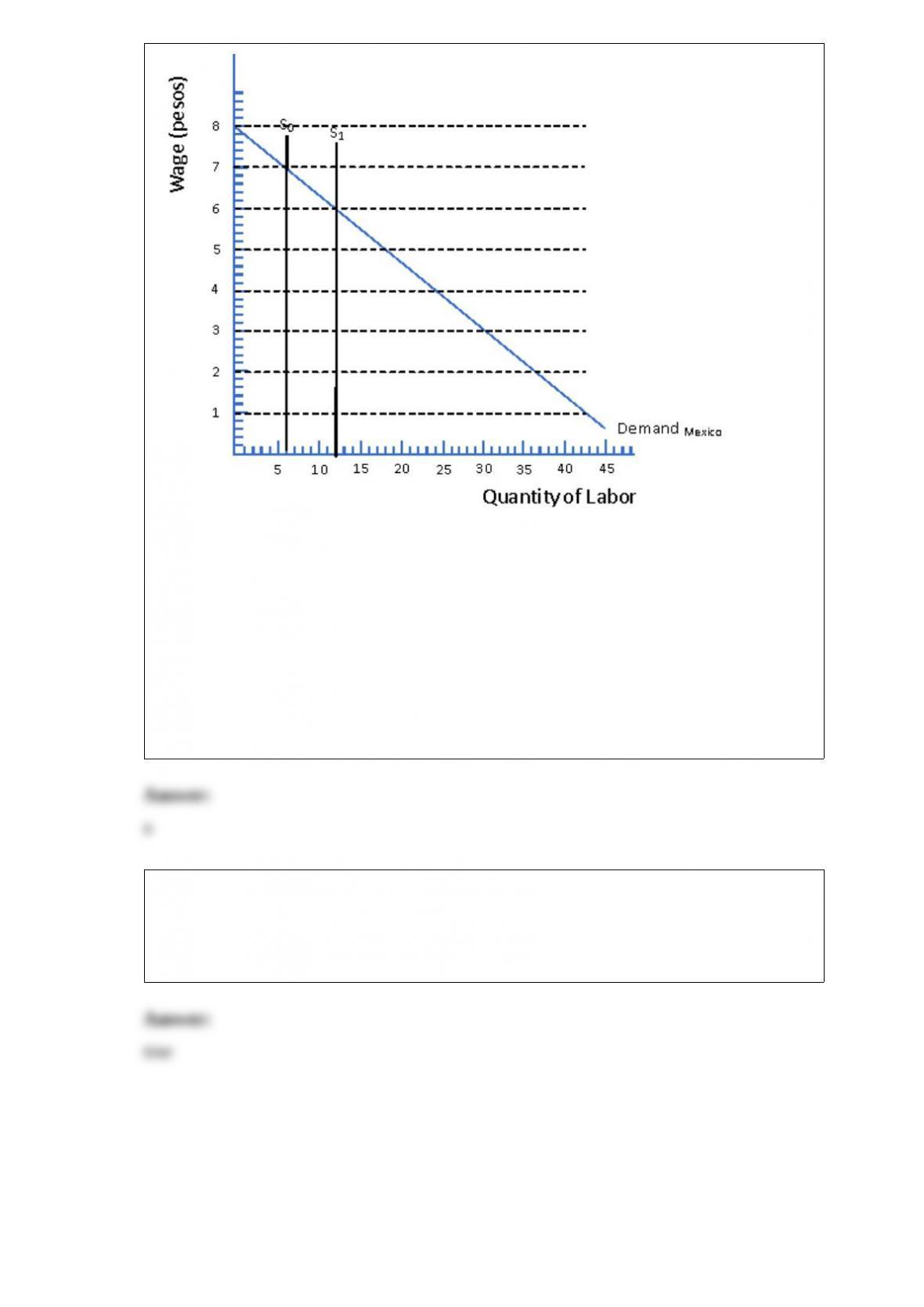
consider figure 9.3. if honduran migration to mexico results in the labor force
increasing to 12 workers, denoted by schedule s1, the:
a.wage rate for native mexican workers decreases and the payments to mexican capital
owners increases
b.wage rate for native mexican workers decreases and the payments to mexican capital
owners decreases
c.wage rate for native mexican workers increases and the payments to mexican capital
owners increases
d.wage rate for native mexican workers increases and the payments to mexican capital
owners decreases
18) decreasing cost conditions lead to complete specialization in the production of the
commodity of comparative advantage.
a.true
b.false