1) the marginal tax rate is:
a.less than the average tax rate when a tax is progressive.
b.calculated by dividing total taxes paid by one’s total taxable income.
c.the percentage of one’s total income that is paid in taxes.
d.the percentage of an increment of income that is paid in taxes.
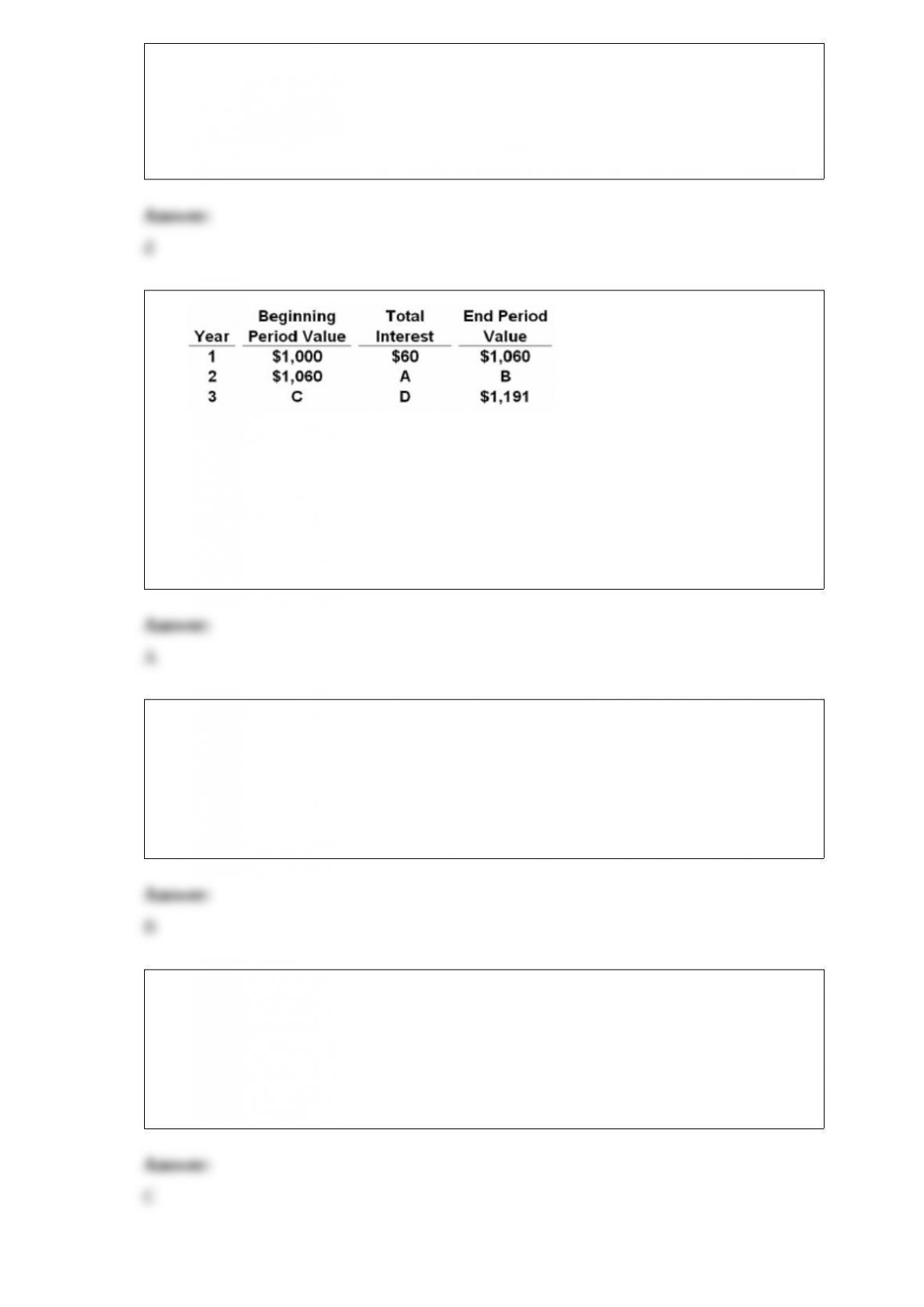
2)
Refer to the above table representing Darcy’s bank account. Assuming that $1000 was
deposited into her account at the beginning of year 1, and no further deposits or
withdrawals were made, what interest rate is being paid on Darcy’s account?
A.6 percent.
B.6.4 percent.
C.19.1 percent.
D.60 percent.
3) The demand curve for labor would shift leftward as the result of:
A.an increase in the price of the product labor is producing.
B.a decrease in the productivity of labor.
C.an increase in the price of labor.
D.a decrease in the price of capital, provided the output effect exceeds the substitution
effect.
4) If all workers are homogeneous, all jobs are equally attractive to workers, and labor
markets are perfectly competitive:
A.compensating differences would cause wage differentials.
B.noncompeting groups of workers would result in wage differentials.
C.all workers would receive the same wage rate.
D.worker mobility would occur such that wage differentials would widen.
5) the mr = mc rule applies:
a.to firms in all types of industries.
b.only when the firm is a “price taker.”
c.only to monopolies.
d.only to purely competitive firms.
6) In 1993 the Federal government boosted income tax rates. The change in tax revenue
that occurred in the seven years that followed:
A.supported the claims of supply-side economists and the Laffer Curve.
B.contradicted the claims of supply-side economists and the Laffer Curve.
C.caused productivity growth to slow.
D.significantly increased the size of the government’s budget deficit.
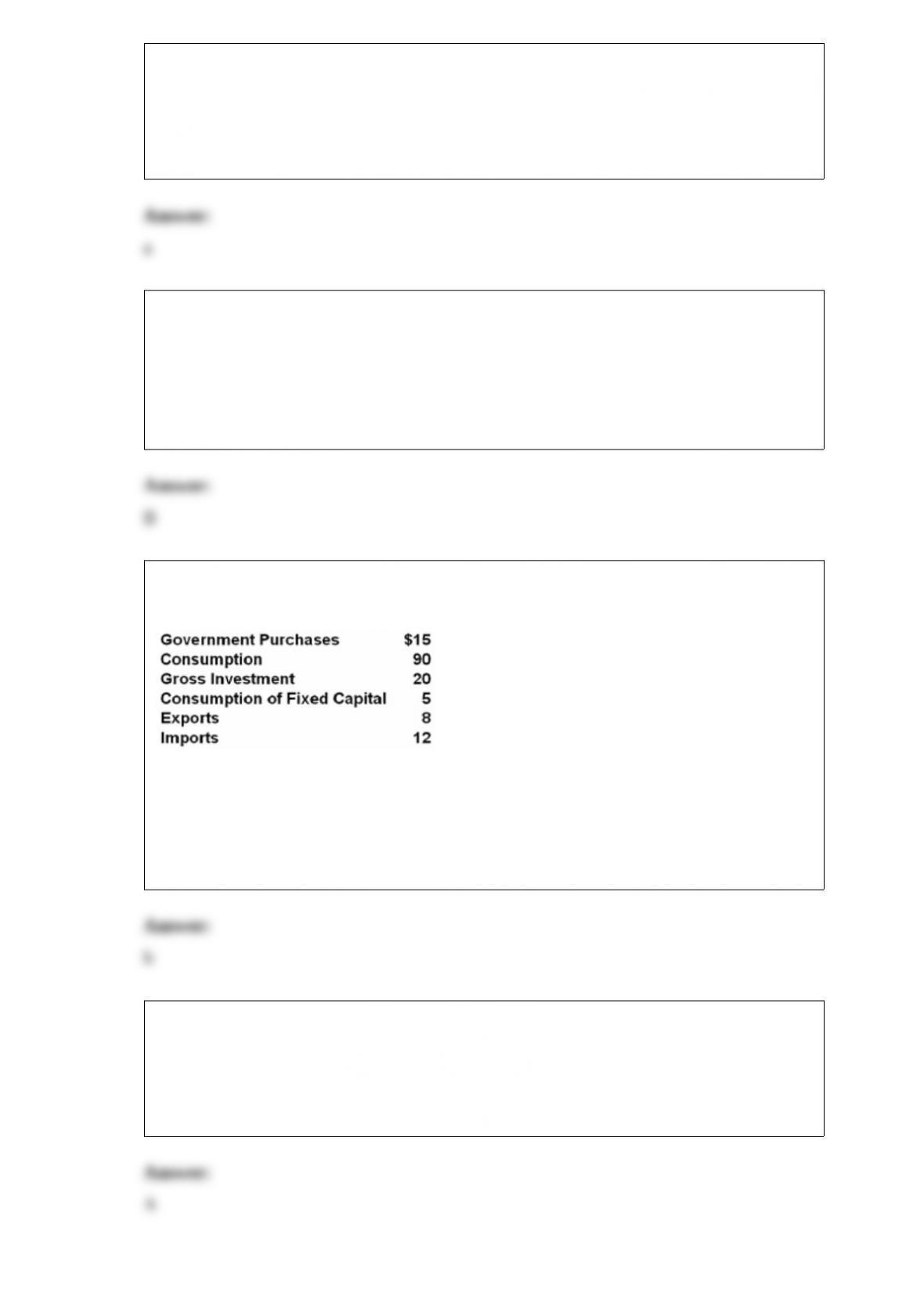
7) answer the next question(s) on the basis of the following data. all figures are in
billions of dollars:
refer to the above data. gdp is:
a.$116.
b.$121.
c.$125.
d.$150.
8) According to mainstream macroeconomists, U.S. macro instability has resulted from:
A.investment “booms” and “busts” and, occasionally, adverse aggregate supply shocks.
B.adherence by the Fed to a monetary rule.
C.government’s attempts to balance its budget.
D.wide fluctuations in net exports.
9) if a purely competitive firm is producing at some level less than the
profit-maximizing output, then:
a.price is necessarily greater than average total cost.
b.fixed costs are large relative to variable costs.
c.price exceeds marginal revenue.
d.marginal revenue exceeds marginal cost.
10) normative statements are concerned with:
a.facts and theories.
b.what ought to be.
c.what is.
d.rational choice involving costs and benefits.
11) Each of the following has contributed to growing income inequality in the United
States since 1970 except:
A.the decline in unionism.
B.greater demand for highly skilled workers.
C.stronger international competition from imports.
D.government transfers.
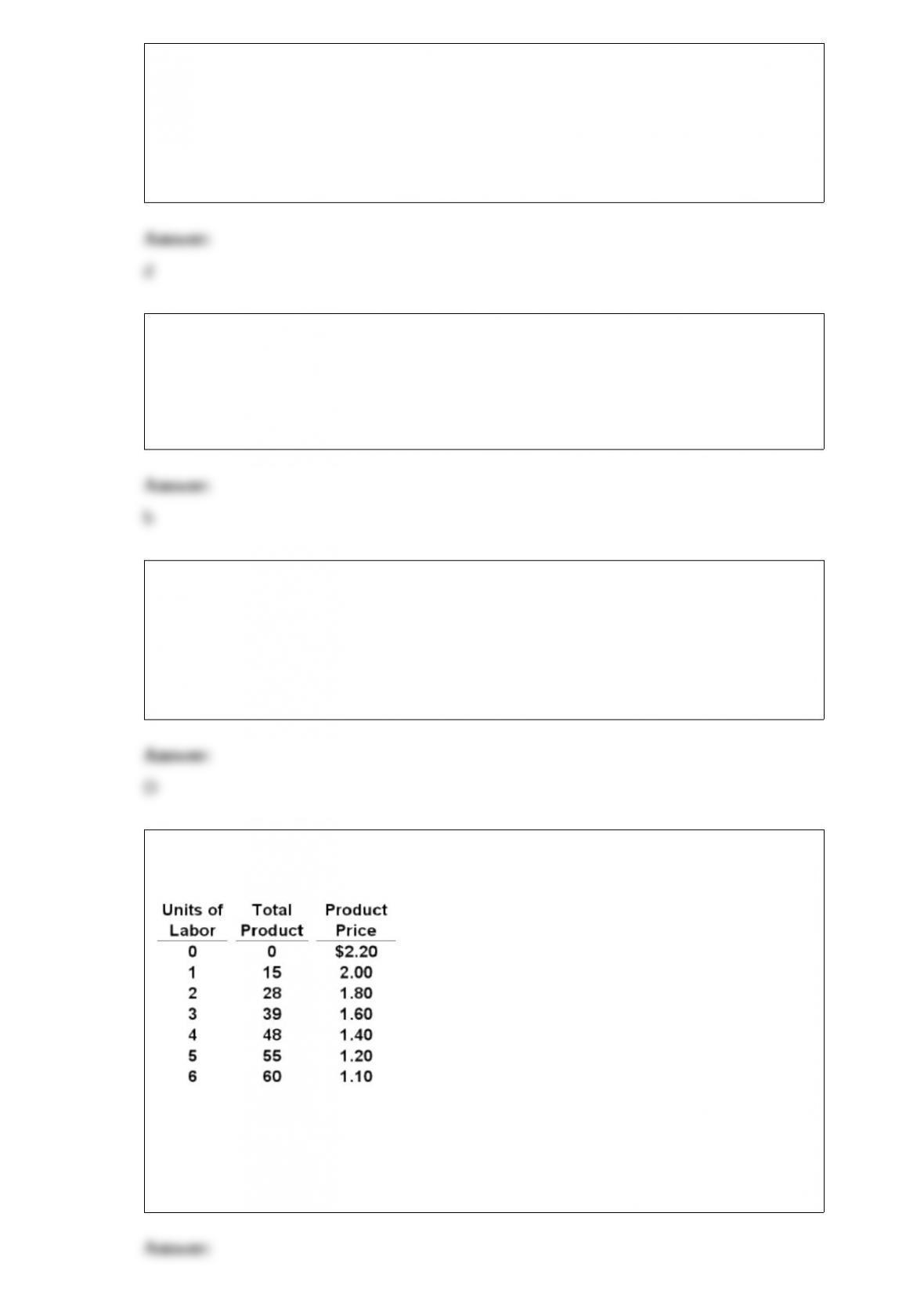
12) Assume that the firm is hiring labor in a purely competitive market.
The above data reveal that:
A.the firm is selling its product in a purely competitive market.
B.the firm is selling its product in an imperfectly competitive market.
C.there is no level of output at which this firm can operate at a profit.
D.the law of diminishing returns is not applicable to this firm.

13) Successful foreign aid programs:
A.enhance a DVCs resources and therefore shift its production possibilities curve to the
left.
B.enhance a DVCs resources and therefore shift its production possibilities curve to the
right.
C.move the DVC from a high investment-low consumption position to a low
investment-high consumption position on its stable production possibilities curve.
D.cause a DVCs exchange rate to depreciate.
14) the united states’ exports are about what percentage of u.s. gdp?
a.4 percent
b.25 percent
c.12 percent
d.30 percent
15) If the MPS in an economy is .4, government could shift the aggregate demand curve
leftward by $50 billion by:
A.reducing government expenditures by $125 billion.
B.reducing government expenditures by $20 billion.
C.increasing taxes by $50 billion.
D.increasing taxes by $250 billion.
16) Other things equal, an increase in the price level will:
A.shift the aggregate supply curve to the right.
B.shift the aggregate demand curve to the right.
C.cause a movement up along a short-run aggregate supply curve.
D.cause a movement down an aggregate demand curve.
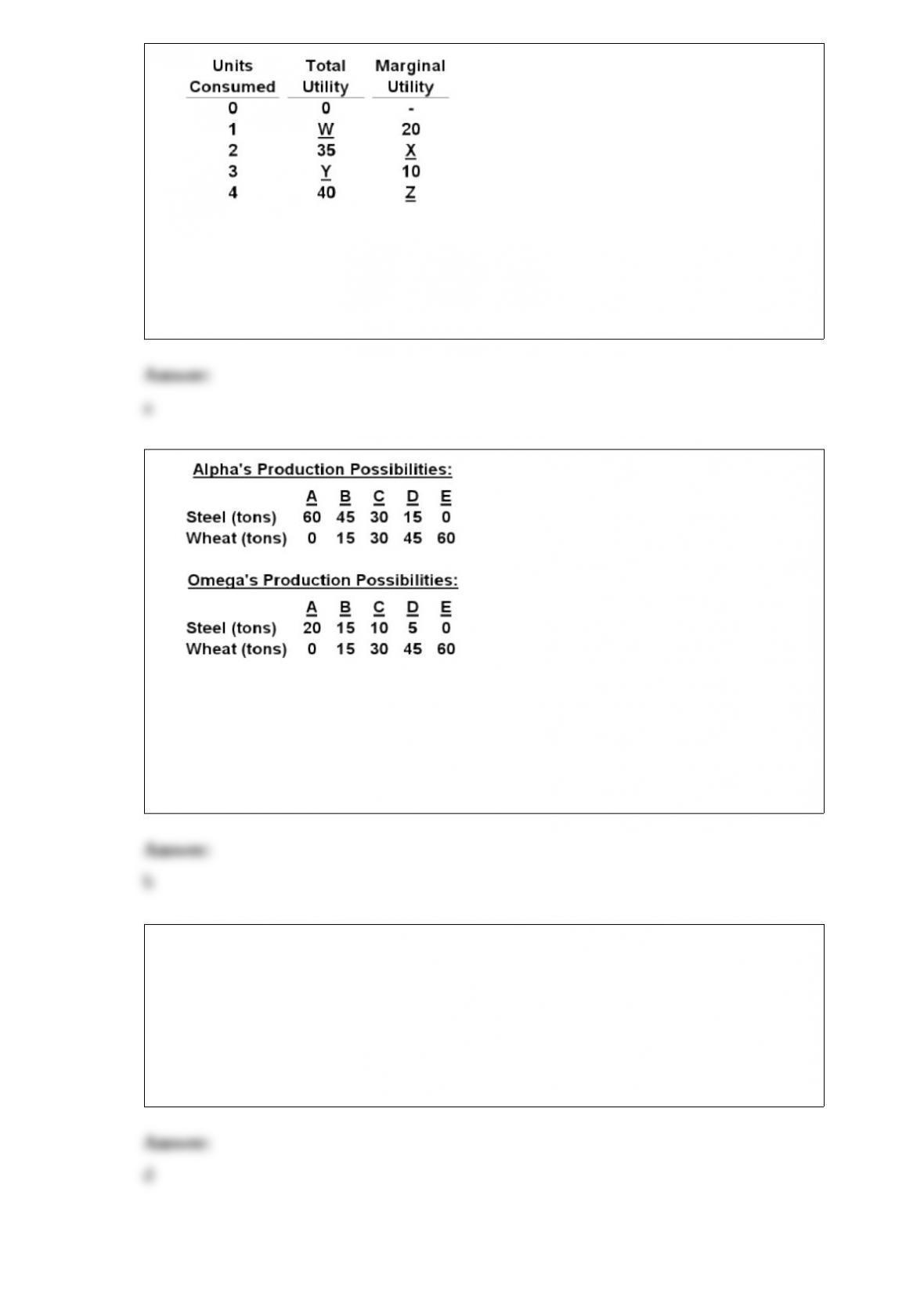
17)
refer to the above data. the value for x is:
a.15.
b.5.
c.55.
d.10.
18)
refer to the above data. the domestic opportunity cost of producing 1 ton of steel in
alpha is:
a. ton of wheat.
b.1 ton of wheat.
c.15 tons of wheat.
d.30 tons of wheat.
19) suppose that a business incurred implicit costs of $500,000 and explicit costs of $5
million in a specific year. if the firm sold 100,000 units of its output at $50 per unit, its
accounting:
a.profits were $100,000 and its economic profits were zero.
b.losses were $500,000 and its economic losses were zero.
c.profits were $500,000 and its economic profits were $1 million.
d.profits were zero and its economic losses were $500,000.