
The decline in the value of the yen after 2012 occurred as a result of the Japanese
central bank, the Bank of Japan, following an expansionary monetary policy. Investors
expected that the result would be lower
nominal Japanese interest rates and a higher inflation rate. In response, investors
________, causing the value of the yen to decline against the dollar.
A) sold Japanese financial assets and bought U.S. financial assets
B) sold Japanese financial assets and sold U.S. financial assets
C) bought Japanese financial assets and sold U.S. financial assets
D) bought Japanese financial assets and bought U.S. financial assets
A decrease in investment causes the price level to ________ in the short run and
________ in the long run.
A) increase; increase further
B) increase; decrease
C) decrease; decrease further
D) decrease; increase
An increase in the demand for Treasury bills will
A) increase the price of Treasury bills.

B) increase the interest rate on Treasury bills.
C) increase the opportunity cost of holding money vs. Treasury bills.
D) eventually cause households to hold less money.
People hold money as opposed to financial assets because money
A) earns interest.
B) is perfectly liquid.
C) earns no interest.
D) earns a higher return than other financial assets.
In the United States, each bank panic in the late nineteenth and early twentieth centuries
was accompanied by
A) inflation.
B) deflation.
C) a depression.
D) a recession.

Which of the following countries does not come close to the free market benchmark?
A) the United States
B) Japan
C) Cuba
D) France
Economists refer to the series of induced increases in consumption spending that result
from an initial increase in autonomous expenditures as the ________ effect.
A) multiplier
B) expenditure
C) consumption
D) aggregate demand
A financial security that represents a promise to repay a fixed amount of funds is a
A) share of stock.

B) coupon.
C) dividend.
D) bond.
Once an industry becomes established in a certain area firms that locate in that area gain
advantages over firms located elsewhere, leading to lower costs of production.
Economists refer to the lower costs that result from increases in the size of an industry
in a certain area as
A) external economies.
B) positive externalities.
C) strategic advantages.
D) technological change.
When aggregate expenditure is more than GDP, which of the following is true?
A) There was an unplanned decrease in inventories.
B) Firms spent less on capital goods than they planned.
C) Households bought fewer new homes than they planned.
D) All of the above must be true when aggregate expenditure is more than GDP.
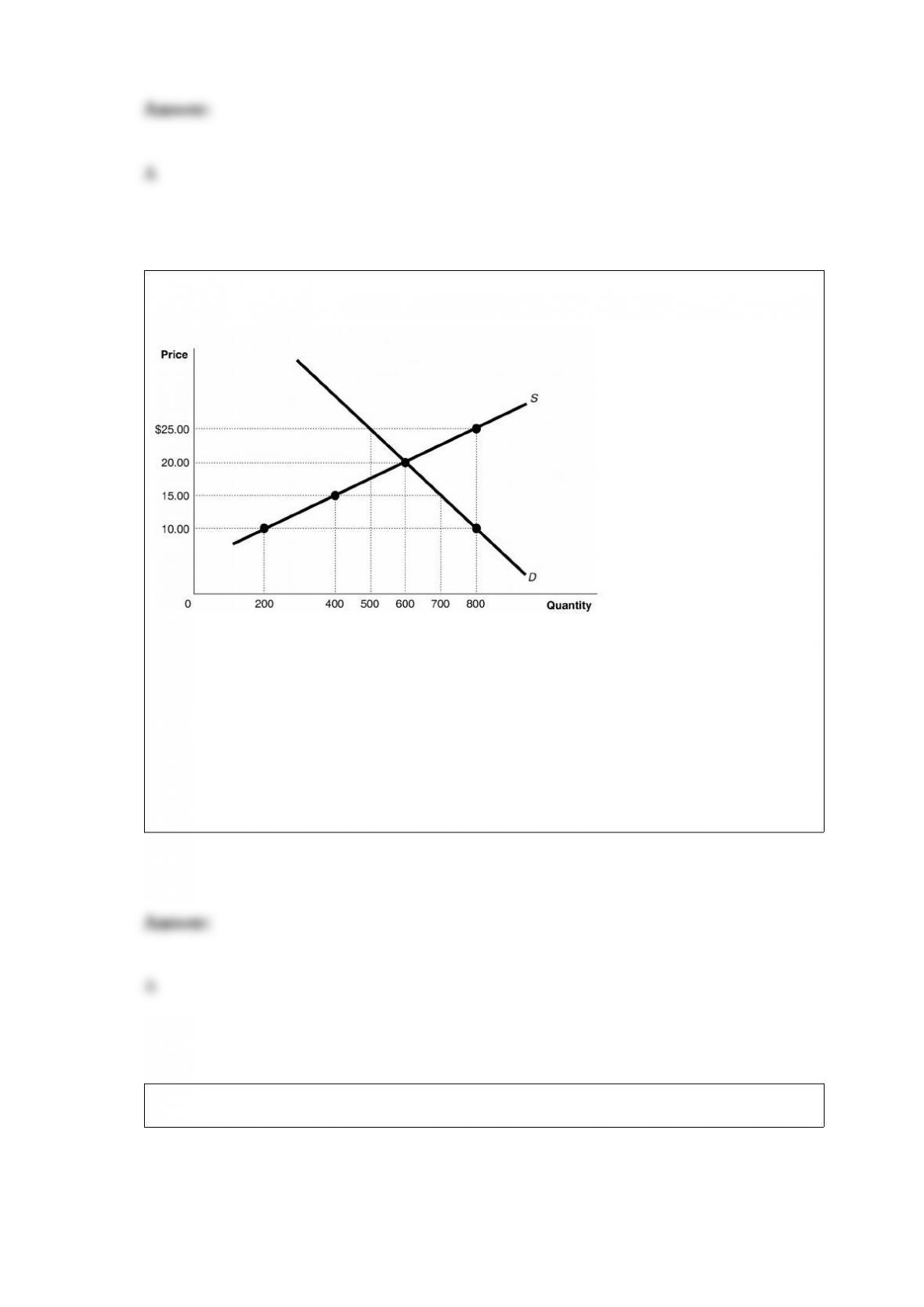
Figure 3-4
Refer to Figure 3-4. If the price is $25,
A) there would be a surplus of 300 units.
B) there would be a shortage of 300 units.
C) there would be a surplus of 200 units.
D) there would be a shortage of 200 units.
Figure 2-6
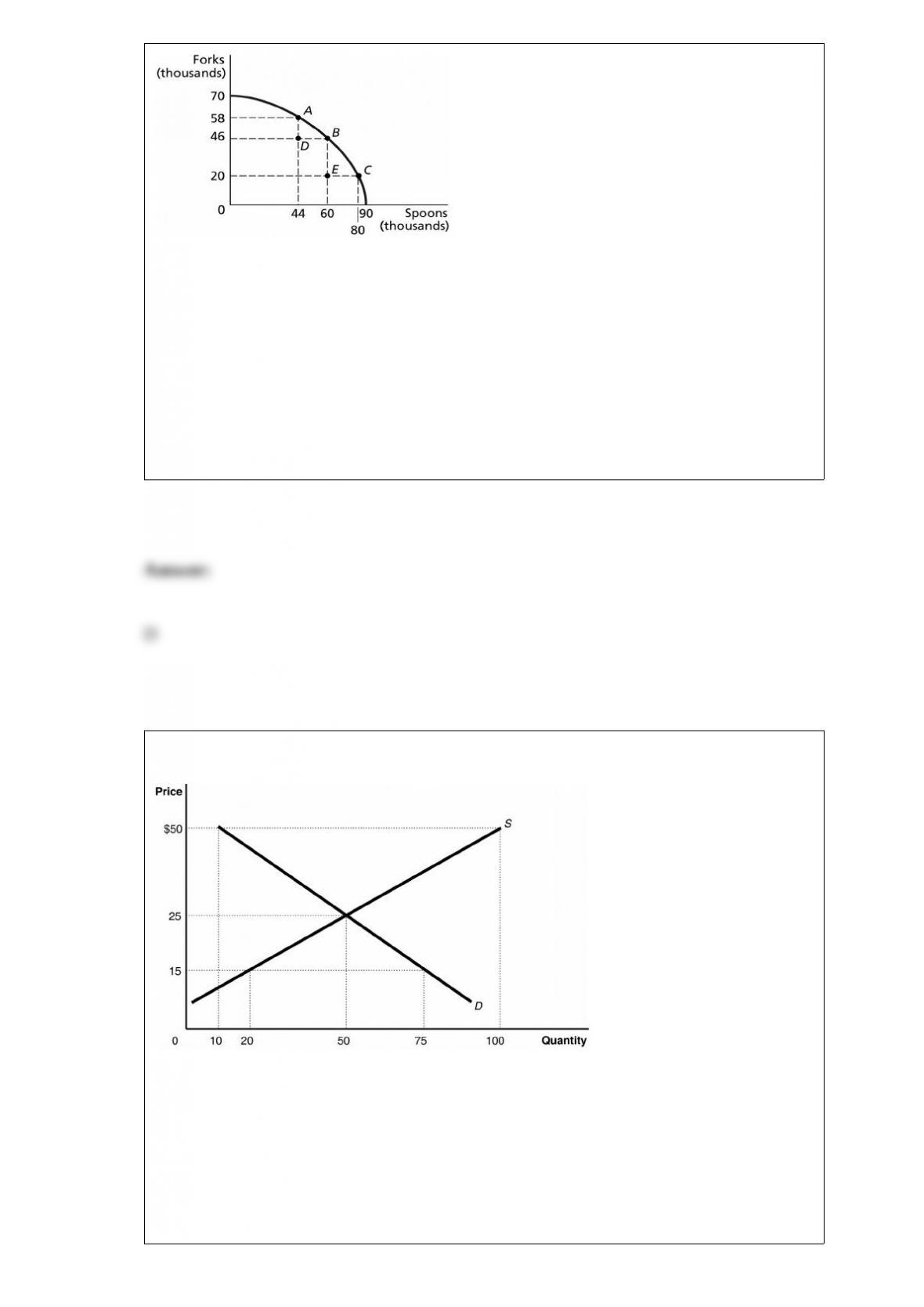
Refer to Figure 2-6. If the economy is currently producing at point E, what is the
opportunity cost of moving to point B?
A) 26 thousand forks
B) 20 thousand forks
C) 60 thousand spoons
D) 0 spoons
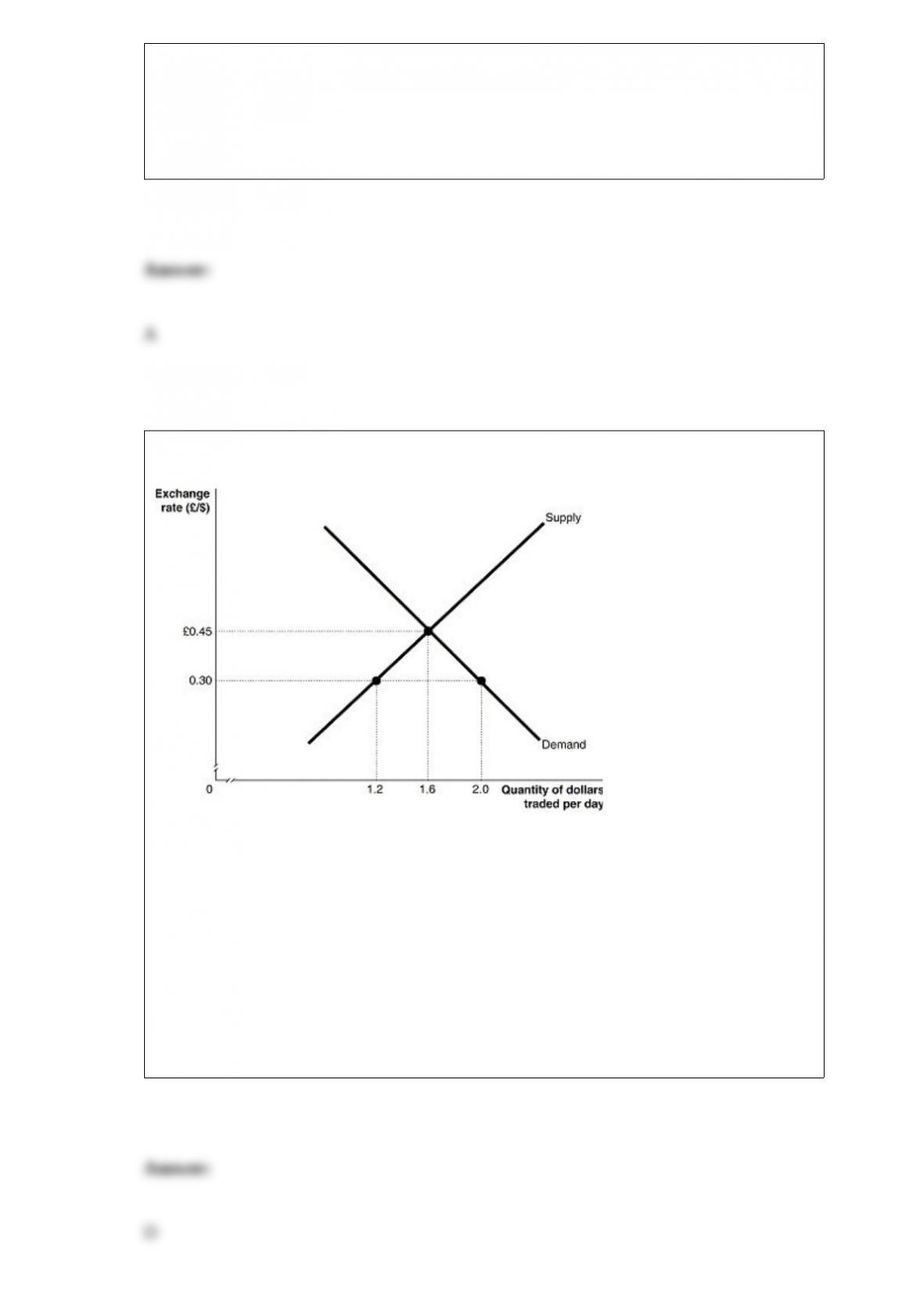
Figure 3-6
Refer to Figure 3-6. The figure above represents the market for coffee grinders.
Compare the conditions in the market when the price is $15 and when the price is $21.
Which of the following describes how the market differs at these prices?
A) At each price there is a shortage; the shortage is greater at $15 than at $21.
B) The difference between quantity supplied and quantity demanded is greater at $21
than at $15.
C) At each price there is a shortage; firms will raise the equilibrium price in order to
eliminate the shortage.
D) At each price the demand for coffee grinders exceeds the supply of coffee grinders.
Figure 19-12
Refer to Figure 19-12. The graph above depicts supply and demand for U.S. dollars
during a trading day, where the quantity is millions of dollars. In order to support a
fixed exchange rate of 0.30 pounds per dollar, the British central bank must
A) buy 0.4 million dollars per trading day.
B) sell 0.4 million dollars per trading day.
C) buy 0.8 million dollars per trading day.
D) sell 0.8 million dollars per trading day.

Some economists and policymakers who are in favor of government-provided health
care believe that providing health care will
A) generate additional moral hazard.
B) create negative externalities.
C) reduce asymmetric information.
D) generate more adverse selection.
Which of the following generates allocative efficiency in a market economy?
A) national government intervention
B) voluntary exchange between buyers and sellers
C) United Nations rules for competition
D) equity
Because the copyright on the L. Frank Baum book The Wonderful Wizard of Oz expired
many years ago, the actual written words from the book are in the public domain, which
means
A) any publisher can now can claim copyright of Baum’s words.

B) only the first publisher to reissue the book can claim copyright of Baum’s words.
C) no publisher can claim copyright of Baum’s words, but the book can be reissued by
any publisher.
D) no publisher can claim copyright of Baum’s words because the book can never be
reissued.