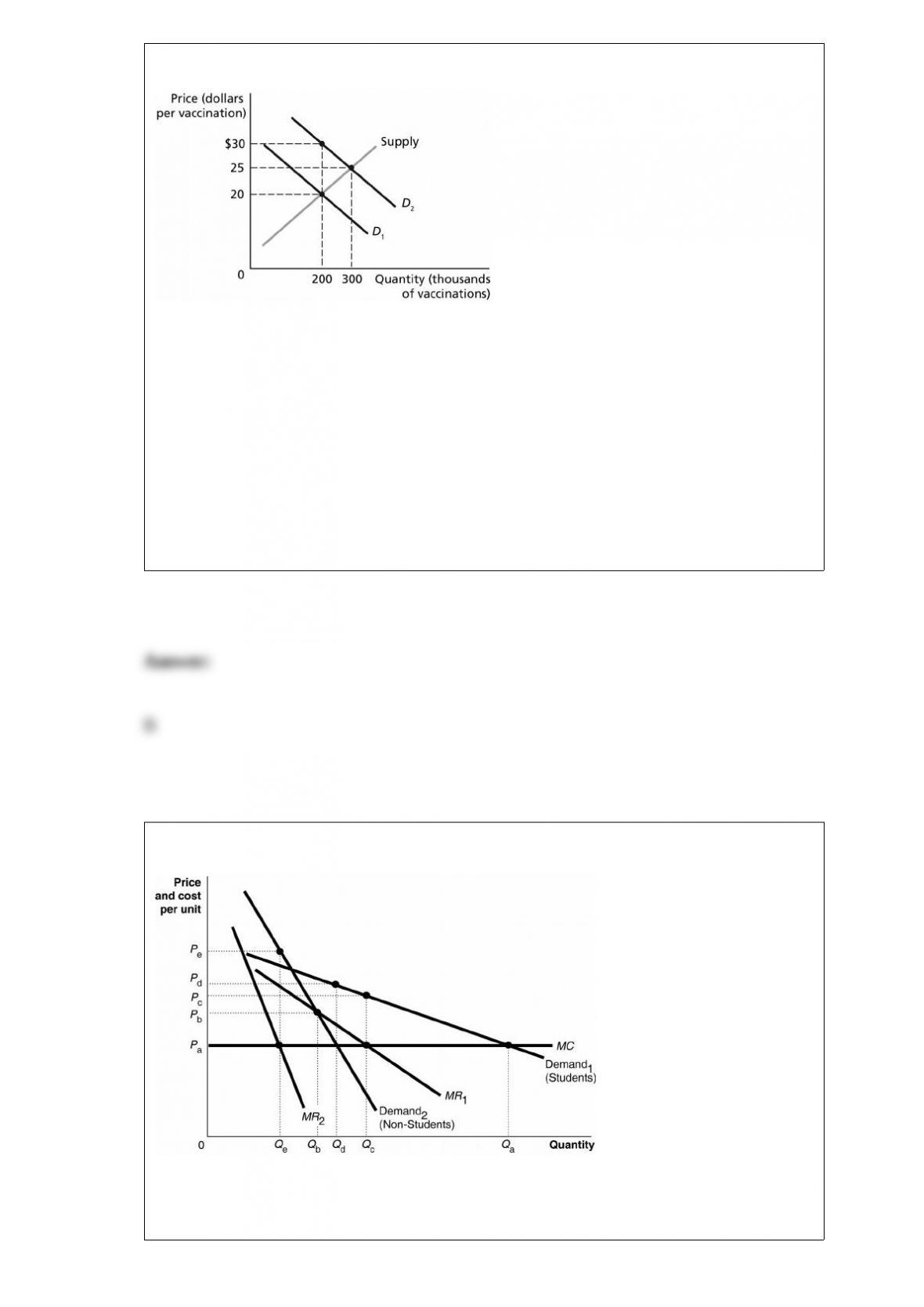
Figure 7-1
Figure 7-1 represents the market for
vaccinations. Vaccinations are considered a benefit to society, and the figure shows both
the marginal private benefit and the marginal social benefit from vaccinations. The
efficient equilibrium price is
A) $30.
B) $25.
C) $20.
D) <$20.
Figure 16-2
Plato Playhouse, a theatre
company in the university town of Wegg, caters to two groups of customers: students
and the non-student population. Figure 16-2 shows the demand curves for the two
groups of customers. Suppose Plato Playhouse price discriminates. Which of the

following statements is true?
A) By charging two different prices, the theatre company has redistributed some profits
from those who can pay higher prices to those who cannot, thereby increasing
economic efficiency.
B) By charging two different prices, the theatre company essentially allows those
willing to pay higher prices to subsidize those who are not.
C) By charging two different prices, the theatre company has redistributed some profits
from those who can pay higher prices to those who cannot, thereby improving equity.
D) Plato Playhouse will earn higher profits if it charges a single price € an average of
the two prices € instead of charging two different prices to the two different groups of
customers.
Soldiers in a World War II prisoner-of-war camp
A) used gold as a fiat money.
B) used cowrie shells as money.
C) used cigarettes as money.
D) used U.S. dollars as a commodity money.
If the demand for a steak is unit-elastic, then
A) the percentage change in quantity demanded is 1 percent greater than the percentage
change in price.

B) the percentage change in quantity demanded is equal to the percentage change in
price.
C) the percentage change in quantity demanded is 100 percent greater than the
percentage change in price (in absolute value).
D) quantity demanded does not respond to changes in price.
Firms in Thailand that had borrowed dollars while the baht was pegged to the dollar
faced interest payments that were ________ than they had planned while the Thai
government continued trying to defend the peg, because the baht had been pegged
________ the equilibrium exchange rate for the baht.
A) higher; above
B) higher; below
C) lower; above
D) lower; below
If the amount you owe on your house is less than the price of the house, you have
A) positive equity in your house.
B) an adjustable-rate mortgage on your house.
C) negative equity in your house.

D) a reverse mortgage on your house.
All of the following policies are ways for a country to promote long-run economic
growth except
A) increasing vaccinations against infectious diseases.
B) undergoing political reform to decrease corruption.
C) enacting stronger laws to protect property rights.
D) imposing stricter regulations to limit foreign direct investment.
An inward shift of a nation’s production possibilities frontier can occur due to
A) a reduction in unemployment.
B) a natural disaster like a hurricane or bad earthquake.
C) a change in the amounts of one good desired.
D) an increase in the labor force.

How might a U.S. federal budget surplus affect the balance of trade? (Assume exchange
rates are stated in terms of foreign currency per U.S. dollar.)
A) A federal budget surplus raises interest rates, which raises exchange rates, and
increases the balance of trade.
B) A federal budget surplus raises interest rates, which raises exchange rates, and
reduces the balance of trade.
C) A federal budget surplus reduces interest rates, which raises exchange rates, and
reduces the balance of trade.
D) A federal budget surplus reduces interest rates, which reduces exchange rates and
increases the balance of trade.
The United States has developed a comparative advantage in digital computers,
airliners and many prescription drugs. The source of its comparative advantage in these
products is
A) a favorable climate.
B) technology.
C) abundant supplies of natural resources.
D) a strong central government.

A rapid increase in the price of oil will tend to
A) shift short-run aggregate supply to the left.
B) shift long-run aggregate supply to the left.
C) shift long-run aggregate supply to the right.
D) shift aggregate demand to the right.
A supplier of an input is unlikely to have bargaining power if
A) the input supplied is specialized.
B) many firms can supply the input.
C) it is the sole supplier of the input.
D) it has a patent on the input.
Economic incentives are designed to make individual self-interest coincide with social
interest. According to economists, which of the following methods of pollution control
best uses economic incentives to reduce pollution?
A) Rewarding environmental groups for monitoring the activities of private firms that
produce products which generate pollution.
B) Imposing quantitative limits on the amount of pollution and imposing a penalty for
non-compliance with these limits.

C) Requiring the installation of specific pollution control devices.
D) Instituting a system of tradable emissions allowances.
The individual mandate provision of the ACA requires
A) every U.S. resident to have health insurance.
B) every U.S. company to provide health insurance to its employees.
C) every employed person to pay for his or her own health insurance.
D) every private insurance company to provide free health care to its current policy
holders.
Assume there is a surplus in the market for hybrid automobiles. Which of the following
statements correctly describes this situation?
A) The supply of hybrid automobiles is greater than the demand for hybrid automobiles.
B) Some consumers will be unable to obtain hybrid automobiles at the market price and
will have an incentive to offer to buy the product at a higher price.
C) The price of hybrid automobiles will fall in response to the surplus; as the price falls
the quantity demanded will increase and the quantity supplied will decrease.
D) the surplus will cause an increase in the equilibrium price of hybrid automobiles.

The aggregate expenditure model focuses on the relationship between ________ and
________ in the short run, assuming ________ is constant.
A) total production; total income; real GDP
B) total spending; real GDP; total income
C) total spending; real GDP; the price level
D) total income; real GDP; the price level
If national laws protecting the health and safety of workers completely eliminate any
and all risk, then
A) workers in risky occupations become better off.
B) compensating wage differentials disappear and workers in risky occupations may be
no better off.
C) compensating differentials would grow because workers could not be compensated
by being given lower risk jobs.
D) more people would be employed.