Fred runs a fishing lodge, and has a very profitable business during the summer. In the
fall, the number of guests at the lodge starts to decline. Fred should keep the lodge
open:
A. all year because his summer profits offset any losses he might have in the winter.
B. only during those months in which his total revenue exceeds his total cost.
C. only during those months in which his total revenue exceeds his fixed cost.
D. only during those months in which his total revenue exceeds his variable cost.
Consider the gamble inherent in looking for an apartment. If the expected value of
going to see another apartment is zero, then:
A. both risk-averse and risk-neutral people will consider seeing another apartment.
B. only risk-averse people will consider seeing another apartment.
C. risk-averse people will not consider seeing another apartment.
D. risk-neutral people will not consider seeing another apartment.

A village has five residents, each of whom has an accumulated savings of $50. Each
villager can use the money to buy a government bond that pays 10% interest per year or
to buy a year-old goat, send it onto the commons to graze, and sell it after one year. The
price of the goat that the villager will get at the end of the year depends on the amount
of weight it gains while grazing on the commons, which in turn depends on the number
of goats sent onto the commons, as shown in table below. Assume that if a villager is
indifferent between buying a bond and buying a goat, the villager will buy a goat.
What is the socially optimal number of goats to be sent out onto the commons?
A. 5
B. 4
C. 3
D. 2
Which of the following statements best expresses why economic efficiency should be
society’s first goal?
A. Efficiency gives the poor an incentive to improve their economic status.
B. Since the consensus on what is a fair distribution of goods is impossible, efficiency
is the next best goal.
C. People are not really concerned about the problems of the poor, so government must
address them instead.
D. Efficiency maximizes total economic surplus and thereby allows other goals to be
more easily achieved.
If a perfectly competitive firm produces an output level at which price is less than
marginal costs, then the firm should:
A. raise its price.
B. reduce output to earn greater profits or smaller losses.
C. expand output to earn greater profits or smaller losses.
D. leave its output level unchanged provided it is covering its variable cost.
Suppose Chris’s marginal utility from the first taco he eats is 15, and his marginal utility
from the second taco he eats is 12. One can infer that:
A. Chris’s total utility from eating two tacos is 27.
B. Chris should eat one taco.
C. Chris’s average utility from eating two tacos is 27.
D. Chris should eat two tacos.
Pure public goods:
A. should always be provided by government.
B. should always be provided by private firms.
C. are frequently provided by the government, and are sometimes provided by private
firms.
D. are, by definition, goods and services provided by the government.
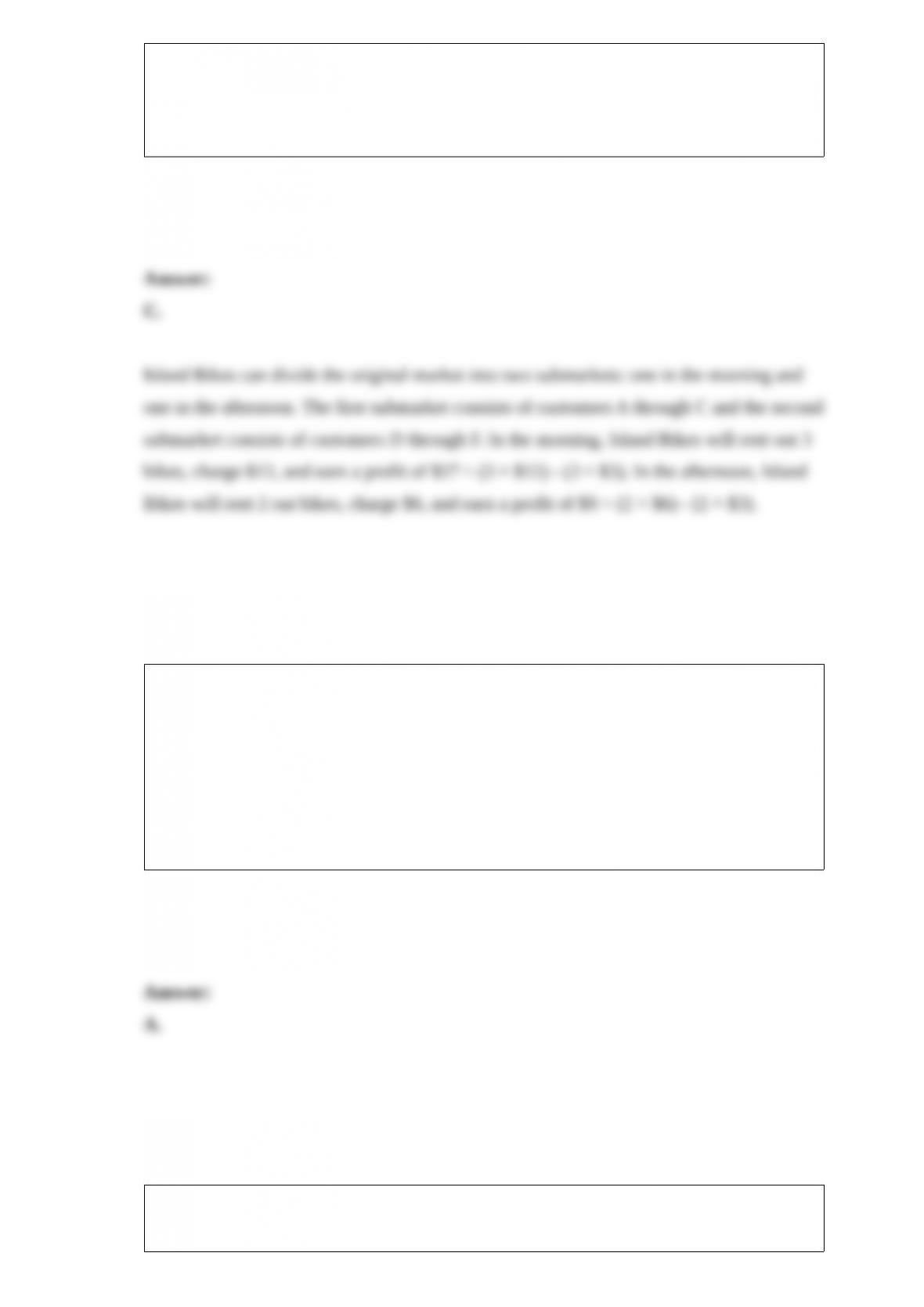
Suppose Island Bikes, a profit-maximizing firm, is the only bike rental company in a
small resort town. The marginal cost to Island Bikes of renting out a bike is $3, and
Island Bikes has no fixed costs. Each day Island Bikes has six potential customers,
whose reservations prices are listed below.
Suppose Island Bikes knows that customers whose reservation prices are at least $10
always rent bikes before noon, while those whose reservation prices are below $10
never do so. If Island bikes charges different price in the morning and in the afternoon,
then what will be its daily economic profit?
A. $27
B. $32
C. $33
D. $39
A measurement in terms of current dollar value is called a(n) ______ quantity.
A. nominal
B. real
C. deflated
D. indexed
Central banks that practice flexible inflation targeting are ____ than central banks that
practice strict inflation targeting.

A. more likely to adjust policy in response to output gaps
B. less likely to adjust policy in response to output gaps
C. more concerned with inside lags in macroeconomic policy
D. less concerned with inside lags macroeconomic policy
High rates of saving and investing in the private sector promote economic growth by:
A. increasing human capital.
B. improving the social and legal environment.
C. increasing physical capital.
D. improving technology.
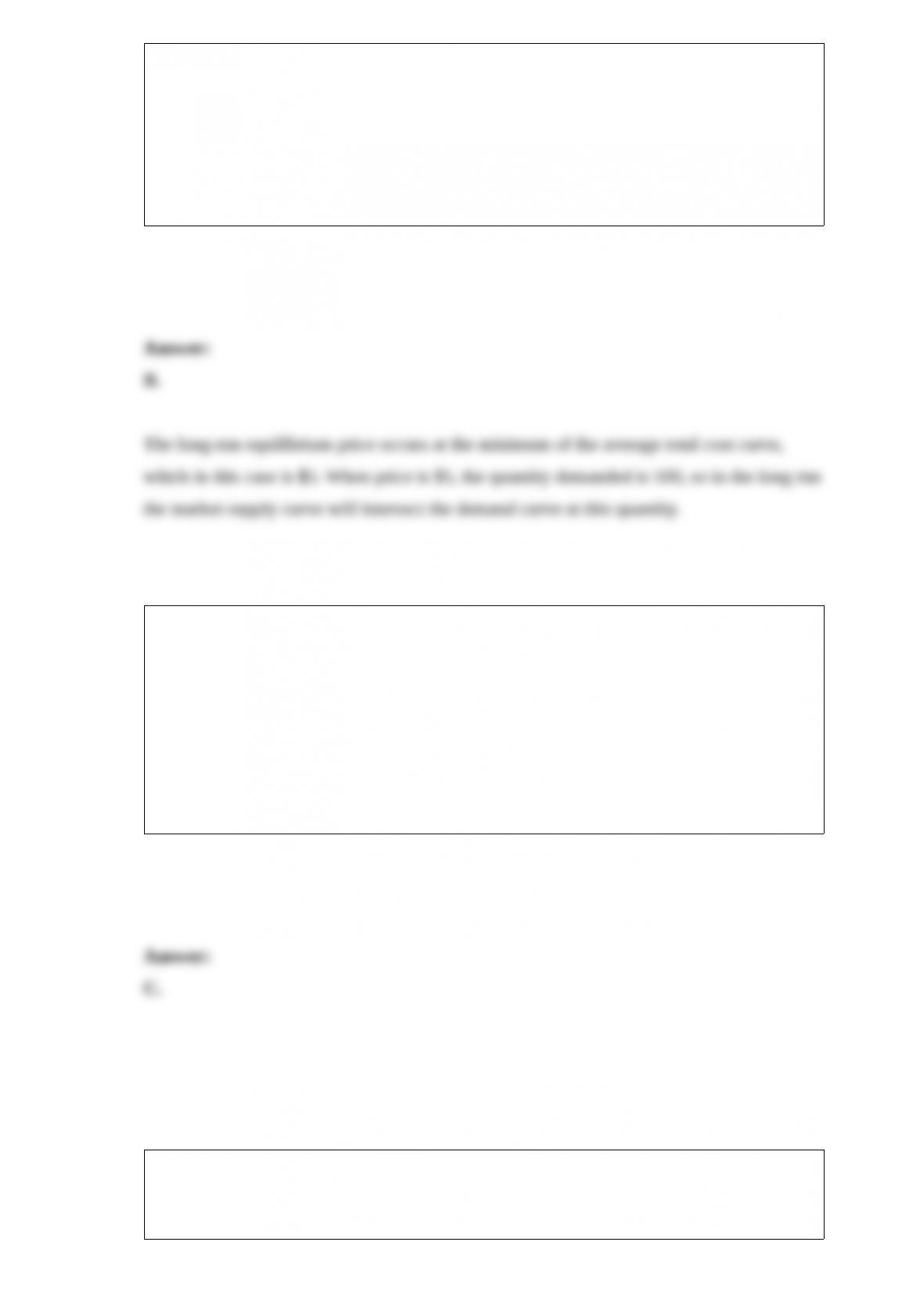
The figure below depicts the short-run market equilibrium in a perfectly competitive
market and the cost curves for a representative firm in that market. Assume that all
firms in this market have identical cost curves.
The long-run market equilibrium quantity in this industry is:
A. 300.
B. 500.
C. 700.
D. more than 700.
A change in the average price level is called _____, while a change in the price of a
specific good in comparison with other goods and services is called _______.
A. a quality adjustment; a substitution bias
B. a change in a relative price; inflation
C. inflation; a change in a relative price
D. a price level adjustment; a quality adjustment
Your scholarship depends on your maintaining a 3.5 cumulative GPA. Your GPA for last
semester was 3.6, which brought your cumulative GPA down. What must be true?
A. Last semester’s grades were higher than your overall GPA.
B. Last semester’s grades were lower than your overall GPA.
C. If this semester’s grades are the same as last semester’s, your overall GPA will stay
the same.
D. If this semester’s grades are the same as last semester’s, you might lose your
scholarship.
In the basic Keynesian model all of the following are true except:
A. planned consumption always equals actual consumption.
B. planned investment always equals actual investment.
C. planned government spending always equals actual government spending.
D. planned net exports always equal actual net exports.
Starting from long-run equilibrium, a large increase in government purchases will result
in a(n) ______gap in the short run and ____inflation and ____output in the long run.
A. expansionary; higher; potential
B. expansionary; lower; potential
C. expansionary; higher; higher
D. recessionary; higher; lower
Let MUc denote the marginal utility that Pablo receives from a cup of coffee, and let pc
denote the price of a cup of coffee. We typically expect that as Pablo buys more coffee:
A. MUc/pc will rise
B. MUc/pc will fall
C. MUc/pc will not change
D. MUc and pc will both fall

You own shares in a start-up internet company. If large swings in the stock market
increase financial investors’ concerns about market risk, then the price of your shares
will _____, holding other factors constant.
A. increase
B. decrease
C. not change
D. either increase or decrease
Using real GDP to compare the level of economic well-being in two countries may be
misleading because the value of ______ contributes to economic well-being, but is
excluded from real GDP.
A. capital goods
B. services
C. leisure
D. formal education
Assume an economy produces only footballs and baseballs and the base year is 2005.
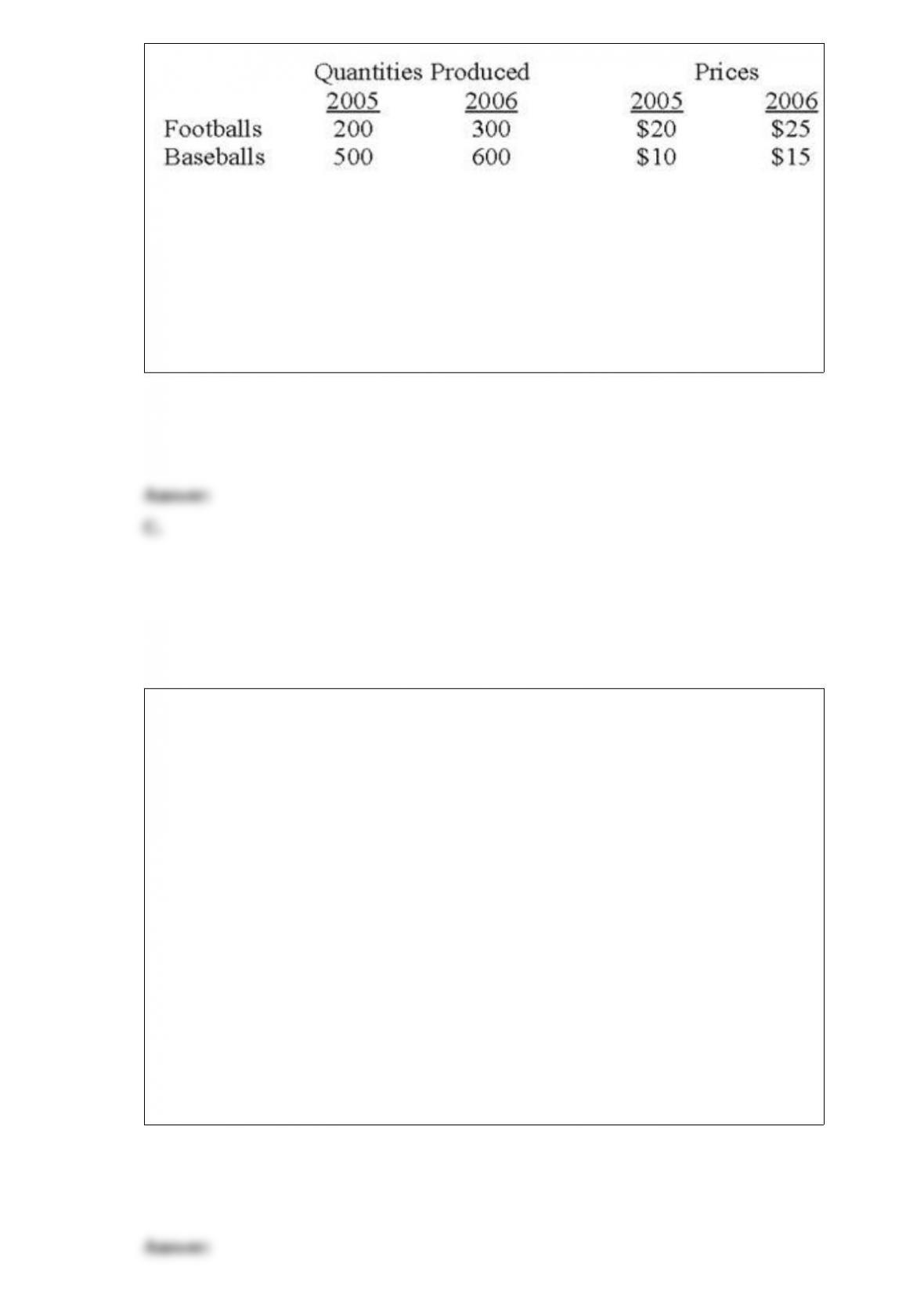
Given the data in the table above, what is the value of real GDP in 2006?
A. $ 9,000
B. $10,000
C. $12,000
D. $12,500
Suppose there are ten people playing cards in a room. One of them wants to smoke a
cigar; nine of them dislike the smell of cigar smoke. The smoker values the privilege of
smoking at $5, and each of the other nine people of the room would be willing to pay
fifty cents for clean air in the room. The rules governing use of the room state that
smoking is not allowed unless everyone agrees to allow smoking. If all ten people can
negotiate with each other at no cost, then which of the following outcomes is consistent
with the Coase theorem?
A. The cigar smoker will not be able to smoke because the majority of people in the
room dislike the smell of cigar smoke.
B. The cigar smoker will pay each of the other nine people fifty-five cents, and they
will agree to allow smoking.
C. The cigar smoker will smoke because the external cost of smoking does not need to
be taken into consideration.
D. The nine non-smokers will each pay the cigar smoker fifty cents and the cigar
smoker will not smoke.

The costs of unemployment are lowest (and perhaps even negative) for ______
unemployment.
A. frictional
B. cyclical
C. structural
D. cyclical and structural
If a firm shuts down in the short run, then its:
A. total revenue and total cost will fall to zero.
B. profit will equal zero.
C. economic loss will equal its fixed costs.
D. economic loss will equal its variable costs.
If there is excess demand in a market, then this suggests that:
A. there is no way to help some people without harming others.
B. there is an opportunity for mutually beneficial trades.
C. the market price is above the equilibrium price.
D. the market is in equilibrium.
As the rate of inflation increases, the increased cost to a consumer of more frequent
trips to the bank to make cash withdrawals represents an increase in the:
A. shoe leather costs of inflation.
B. erosion of the purchasing power of cash.
C. tax distortion generated by inflation.
D. “noise” in the price system.

Which of the following statements about inflation targeting is true?
A. Inflation targets have only been used in developed countries.
B. Inflation targets are always met.
C. Inflation targets have been used in both developed and developing countries.
D. Inflation targets increase uncertainty.
Someone who wants both the U.S. dollar to be ______ compared to other currencies
and the value of U.S. net exports to be ______ wants two things that may be
contradictory.
A. floating; large
B. weak; small
C. strong; small
D. strong; large
Two drawbacks in using fiscal policy as a stabilization tool are that fiscal policy can
affect ______ as well as aggregate demand and that fiscal policy is _______.
A. consumption; too flexible
B. potential output; not flexible enough
C. consumption; offset by automatic stabilizers
D. potential output; offset by automatic stabilizers
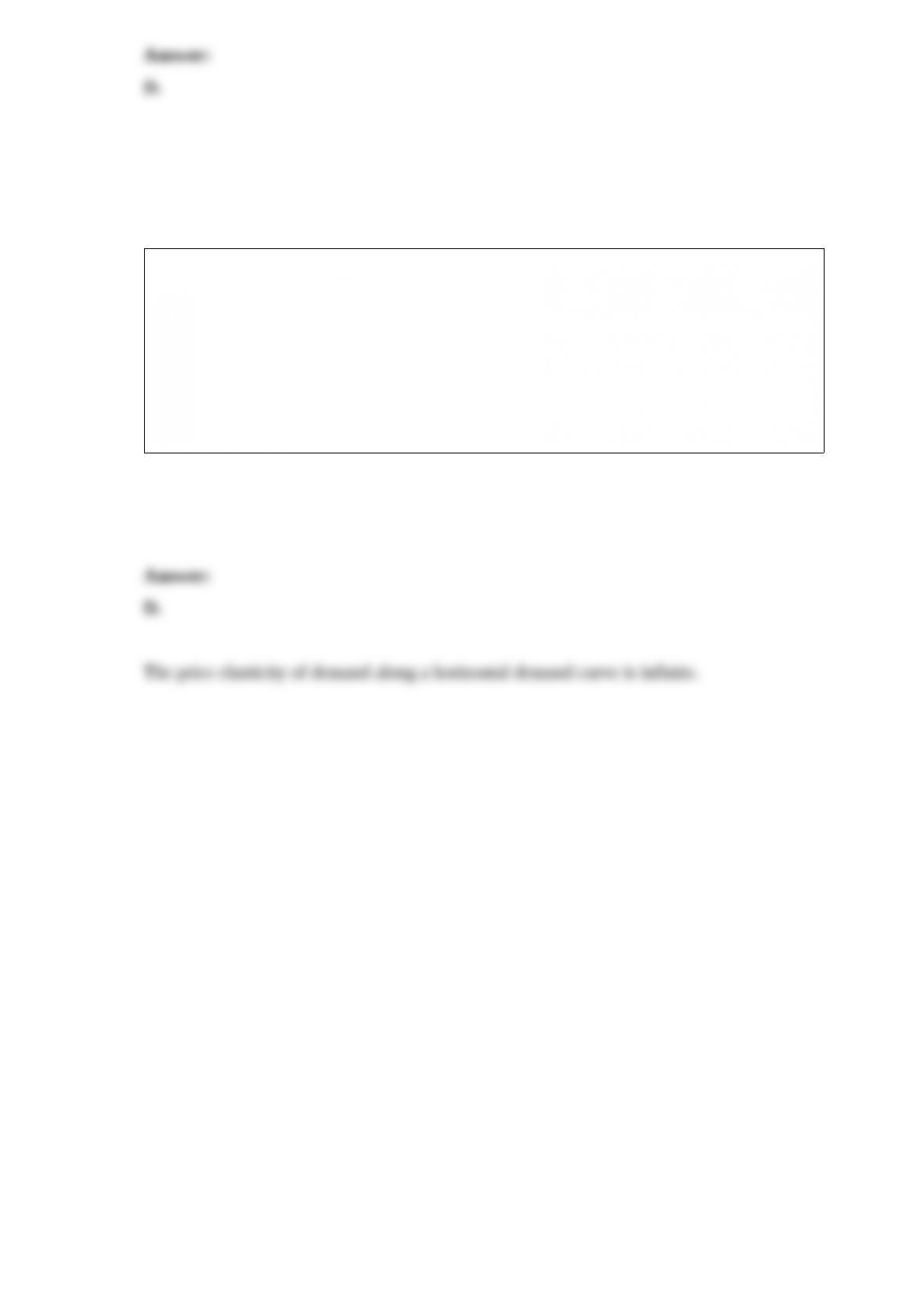
Refer to the figure below. The growth of access to the Internet will cause the marginal:
A. benefit curve to shift from MB2 to MB1.
B. benefit curve to shift from MB1 to MB2.
C. cost curve to shift from MC2 to MC1.
D. cost curve to shift from MC1 to MC2.
If a demand curve is horizontal at P = $5, then the price elasticity of demand is:
A. 5.
B. 0.2.
C. 0.
D. infinite.