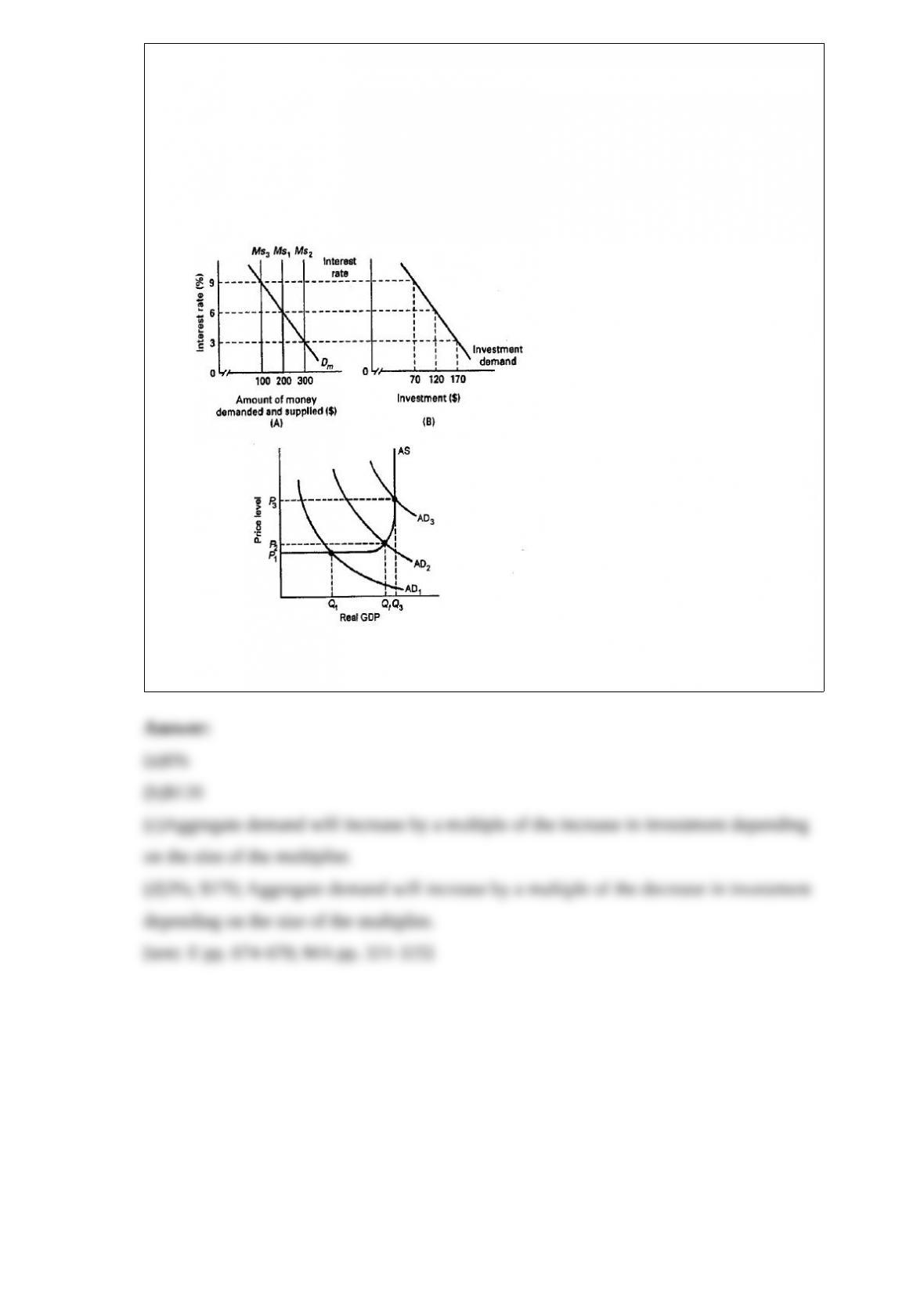
1) Use the below graphs to answer the following questions assuming the nominal GDP
in the economy is given.
(a)Look at graph A and suppose the supply of money increases from 100 to 200. What
will be the equilibrium rate of interest?
(b)Look at graph B which shows an investment-demand curve for this economy. Given
the answer to part (a) above, how much will investors plan to spend on capital goods?
(c)What will happen to
aggregate demand?
(d)Now trace what will happen in parts (a)(c) if the money supply increases to $300.
2)
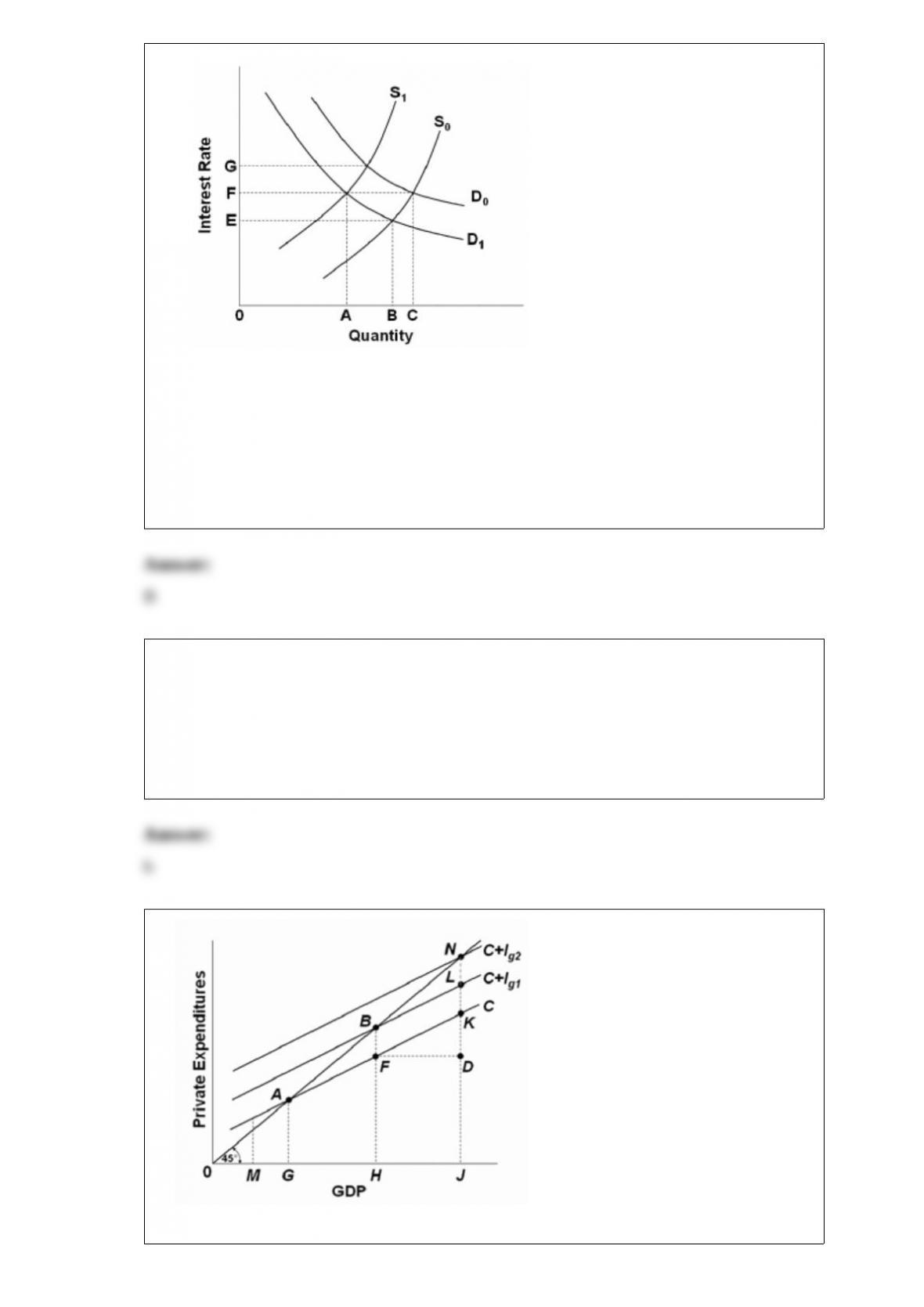
Refer to the above diagram. If the supply of loanable funds is S1 and the demand for
loanable funds is D1, the equilibrium interest rate and quantity of funds borrowed will
be:
A.G and A.
B.F and A.
C.F and C.
D.E and A.
3) (last word) which of the following is a source of data for the investment component
of u.s. gdp?
a.the census bureau’s retail trade survey
b.the census bureau’s housing starts survey and housing sales survey.
c.the conference board’s survey of consumer sentiment
d.the bureau of labor statistics consumer price index
4)
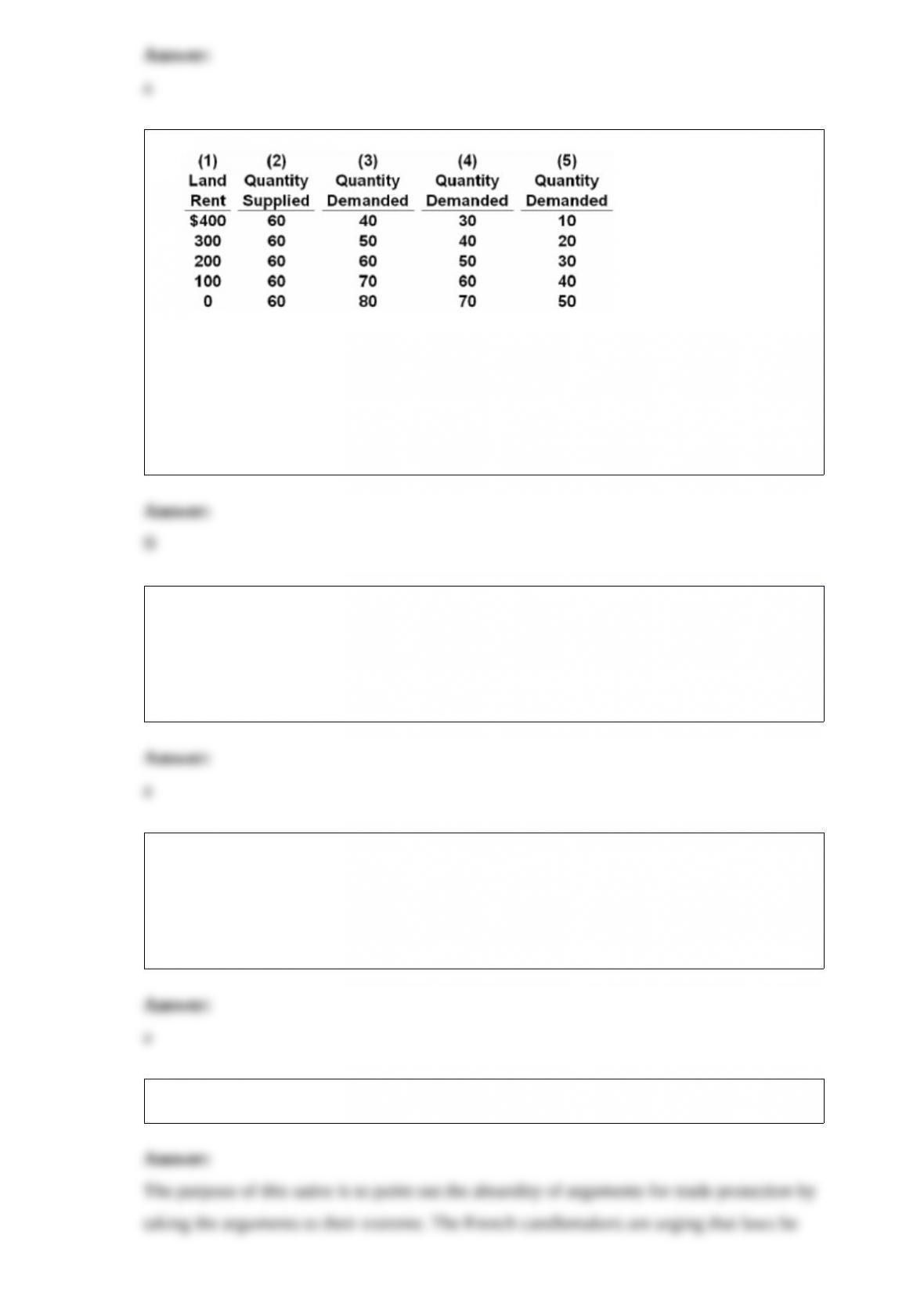
Refer to the above diagram that applies to a private closed economy. The slope of the

consumption schedule in this figure reveals that the:
A.MPS rises as income rises.
B.MPC is constant.
C.APC is constant.
D.APC increases as income increases.
5) Under a TAC system, fishing of a particular fishery is halted after:
A.a predetermined time period.
B.a predetermined amount of fish has been caught.
C.a predetermined number of fishing trips have been taken by each registered boat.
D.the market price of the fish falls below a predetermined trigger price.
6) Which of the following is a true statement?
A.The short-run Phillips Curve is horizontal.
B.The long-run Phillips Curve is horizontal.
C.There is a long-run tradeoff between inflation and unemployment.
D.The short-run Phillips Curve is downward sloping.
7) If you deposit a $50 bill in a commercial bank that has a 10 percent legal reserve
requirement the bank will:
A.have $45 of additional excess reserves.
B.be capable of lending an additional $500.
C.be capable of lending an additional $
D.have $50 of required reserves.
8) a competitive market system:
a.encourages growth by allowing producers to make profitable investment decisions
based on market signals.
b.encourages growth by ensuring that everyone in society will receive a decent standard
of living.
c.discourages growth because firms busy competing have no time to innovate or invest.
d.discourages growth unless government protects domestic firms from foreign
competition.
9)
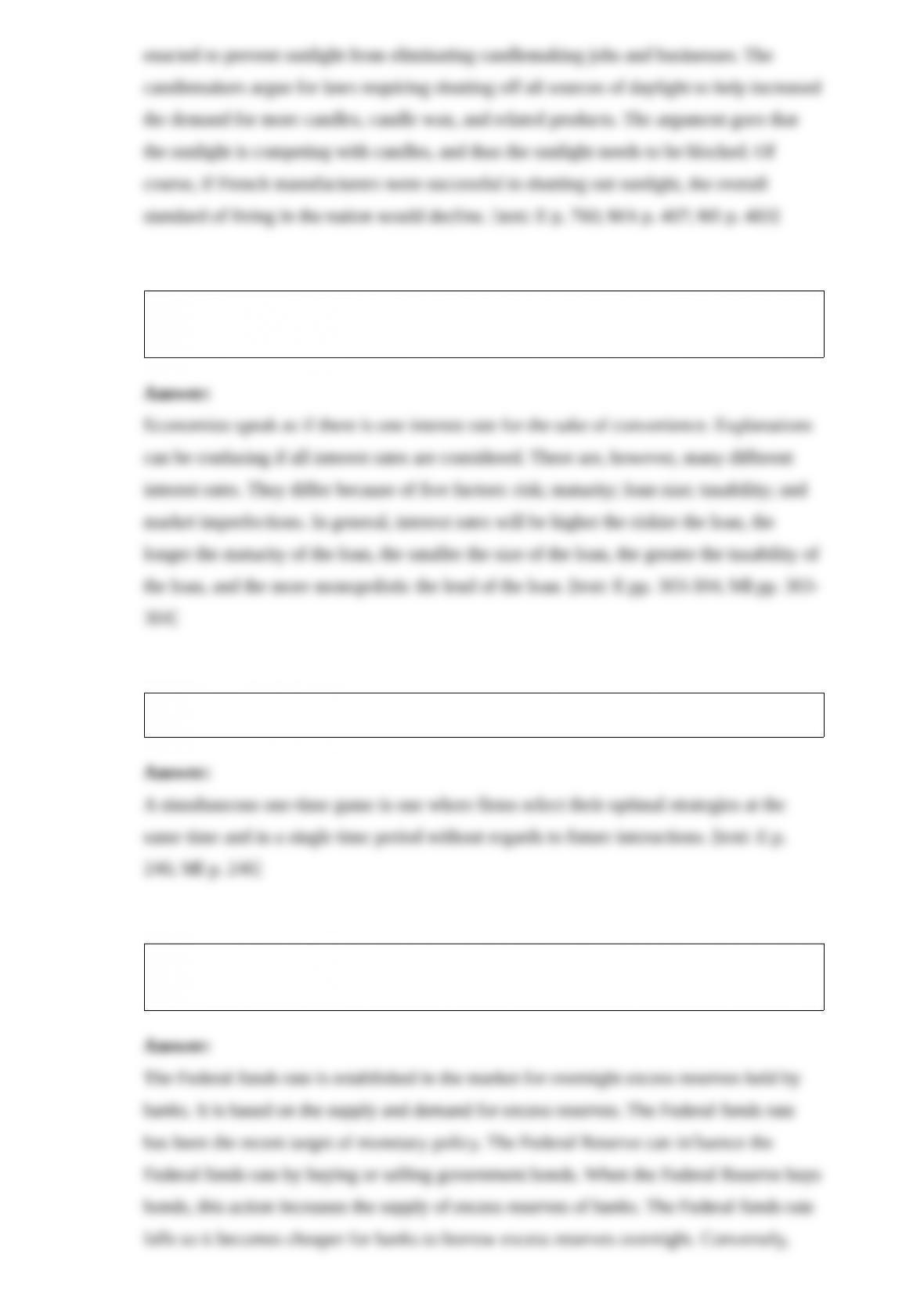
Refer to the above table, in which the values for columns (2) through (5) are in acres. If
the relevant columns are (1), (2), and (3), land rent will be:
A.$100 per acre.
B.$200 per acre.
C.$300 per acre.
D.$400 per acre.
10) in the united states real gdp:
a.has grown faster than real gdp per capita.
b.has grown faster in recent years than has nominal gdp.
c.per capita has grown faster than real gdp.
d.and real gdp per capita have grown at nearly identical rates.
11) human capital refers to:
a.the skills and knowledge that enable a worker to be productive.
b.machinery used by labor in production.
c.the accumulated financial wealth of households.
d.physical capital owned by households rather than businesses.
12) What is the point of the Petition of Candlemakers, 1845? How is the point made?
13) Economists often speak as if there is a single interest rate when in fact there are
many interest rates. What factors explain the differences in these interest rates?
14) Define a simultaneous one-time game.
15) How is the Federal funds rate established? What role does the Federal Reserve
play?
16) Why do DVCs experience different rates of growth? What are some obstacles to
growth?
17) Contrast planned and unplanned inventory changes. What effect do these changes
have on the investment demand curve?