Suppose the government wants to finance housing for low-income families by placing a
tax on the purchase of luxury homes. Assume the government defines a luxury home as
a home that is purchased for at least $1 million. This tax is consistent with the
A) benefits-received principle.
B) social equity principle.
C) ability-to-pay principle.
D) horizontal-equity principle.
Selling tickets to graduation ceremonies has long been a tradition among students at
institutions that limit the number of guests. Suppose your classmate, Heidi purchased
two tickets for $40 each. Is this transaction economically efficient?
A) No, people should never be allowed to sell items they received for free.
B) Yes, it was a voluntary exchange that benefited both parties.
C) No, Heidi paid too much for the tickets.
D) Yes, it is efficient only from the perspective of the seller and not from the
perspective of the buyer.
If the economy is slipping into a recession, which of the following would be an
appropriate fiscal policy?
A) an increase in the money supply and a decrease in interest rates

B) a decrease in government purchases
C) a decrease in taxes
D) a decrease in oil prices
To calculate the price elasticity of demand we divide
A) the percentage change in quantity demanded by the percentage change in price.
B) the percentage change in price by the percentage change in quantity demanded.
C) rise by the run.
D) the average price by the average quantity demanded.
Table 11-7
Table 11-7 shows cost data for Lotus Lanterns, a producer of whimsical night lights.

What is the marginal cost per unit of production when the firm produces 100 lanterns?
A) $420
B) $32
C) $11.10
D) $8.10
The study of the problems due to asymmetric information was begun when economists
analyzed which type of market?
A) the market for citrus fruit
B) the market for insurance
C) farmers’ markets
D) the market for automobiles
When members of Congress vote to pass new legislation, they will
A) always vote for the alternative favored by a majority of the voters.
B) fail to consistently represent the underlying preferences of voters.

C) always vote for the alternative favored by a plurality of the voters if there is no
majority position.
D) always fail to represent the underlying preferences of voters.
How will an interest rate increase in the United States affect equilibrium in the market
for dollars against foreign currencies? (Assume the exchange rate is stated in terms of
foreign currency per U.S. dollar.)
A) The equilibrium exchange rate will increase, and the equilibrium quantity of dollars
traded cannot be determined.
B) The equilibrium exchange rate will decrease, and the equilibrium quantity of dollars
traded cannot be determined.
C) The equilibrium exchange rate cannot be determined, and the equilibrium quantity of
dollars traded will increase.
D) The equilibrium exchange rate will increase, and the equilibrium quantity of dollars
traded will increase.
At macroeconomic equilibrium,
A) total investment equals total inventories.
B) total spending equals total production.
C) total consumption equals total production.
D) total taxes equal total transfers.
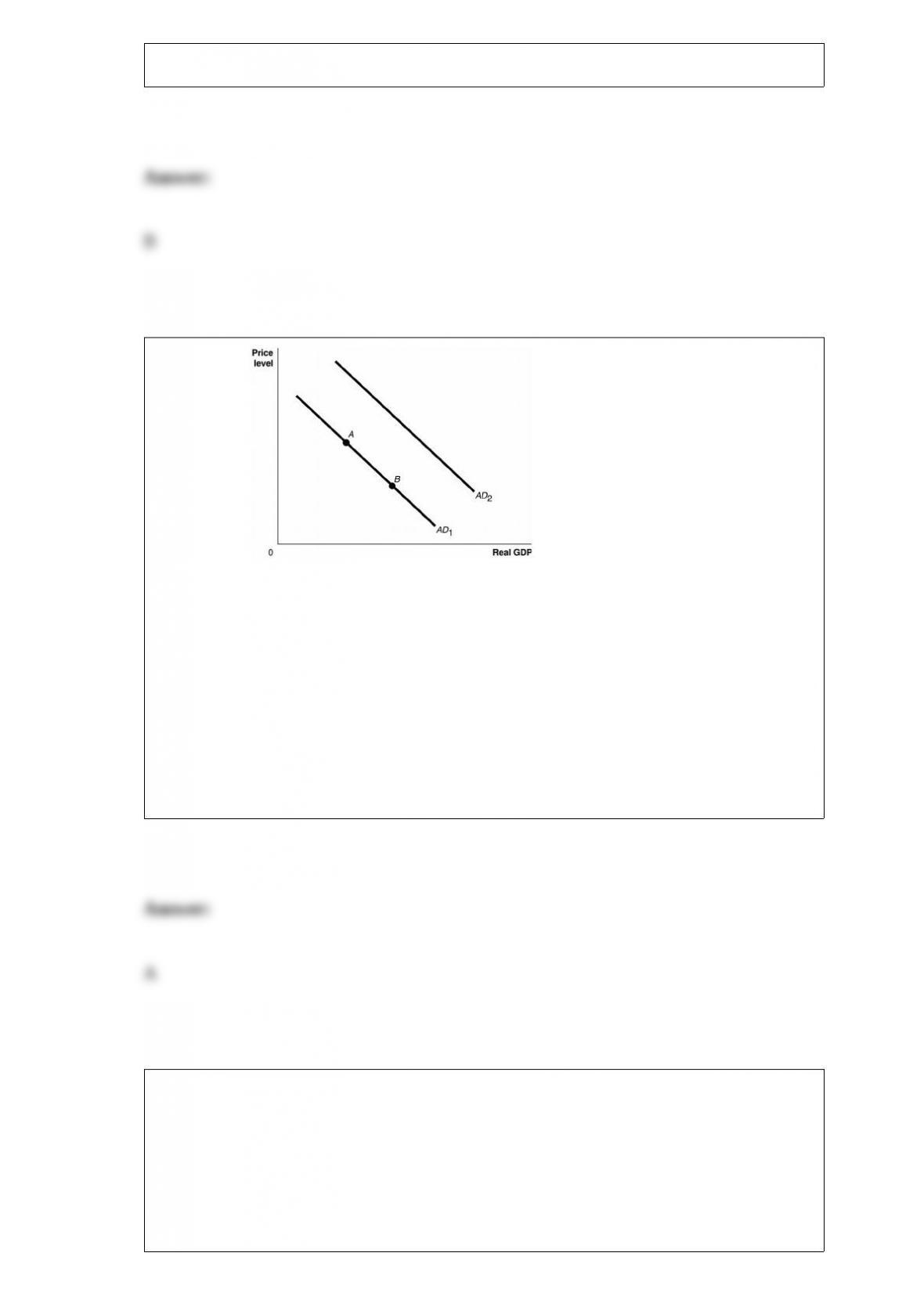
Figure 24-1
Ceteris paribus, an increase in government spending would be represented by a
movement from
A) AD1 to AD2.
B) AD2 to AD1.
C) point A to point B.
D) point B to point A.
If the consumption function is defined as C = 7,250 + 0.8Y, what is the value of the
multiplier?
A) 0.2
B) 0.8

C) 1.25
D) 5
Between 1980 and 2011, income inequality in the United States has increased in part
due to rapid technological change. How does technological change contribute to income
inequality?
A) Advancements in technology displace skilled and unskilled workers in certain fields,
leading to higher unemployment rates.
B) Technology complements the skills of the well-educated while rendering redundant
the labor services of unskilled and low-skilled workers. This causes a decline in the
wages of low and unskilled workers relative to other workers.
C) The opportunity cost of investing in technology is investments in human capital. The
resulting decrease in labor’s marginal productivity has lead to lower wages.
D) Technological change favors the owners of capital and since high income individuals
tend to own capital, income inequality is further exacerbated.
Table 2-11
Table 2-11 shows the number of labor hours required to produce a motorcycle and a
guitar in Ireland and Scotland.

Does either Ireland or Scotland have an absolute advantage and if so, in what product?
A) Scotland only has an absolute advantage in guitars.
B) Ireland only has an absolute advantage in guitars.
C) Scotland has an absolute advantage in both products.
D) Ireland only has an absolute advantage in motorcycles.
Which of the following statements is true?
A) As output increases, average fixed cost becomes smaller and smaller.
B) Average fixed cost does not change as output increases.
C) The marginal cost curve intersects the average fixed cost curve at its minimum point.
D) When marginal cost is greater than average fixed cost, average fixed cost increases.
Article Summary. In an attempt to discourage smoking, New York City Mayor
Michael Bloomberg proposed a bill which would set a $10.50 minimum price for a
pack of cigarettes. The bill would also prohibit retailers from offering any
discounts such as 2-for-1 offers or accepting discount coupons. New York City
already has the highest cigarette tax in the country, at $5.85 per pack, and the state
of New York is one of many which already require cigarettes be marked up by a
specified percentage. This bill is a companion to one which would require stores to
keep tobacco products hidden from sight. Although the bills are expected to be
challenged in court, a precedent has been set in Rhode Island, where a court

upheld a ruling allowing the city of Providence to forbid retailers from accepting
coupons and offering discounts on cigarettes. Source: Vivian Yee, “Bloomberg
Seeks End to Cheap Cigarettes,” New York Times, March 26, 2013.
The minimum price of $10.50 per pack of cigarettes being proposed by mayor
Bloomberg would have which of the following effects on the market for cigarettes?
A) Consumer surplus will decrease.
B) Some producer surplus will be transferred to consumers.
C) Deadweight loss will decrease.
D) Marginal benefit will be less than marginal cost.
Suppose in Vietnam a worker can produce either 16 units of cloth or 2 bicycles while in
China a worker can produce either 20 units of cloth or 5 bicycles.
a. Which country has an absolute advantage in cloth production? In bicycle production?
b. What is the opportunity cost of 1 unit of cloth in Vietnam? In China?
c. What is the opportunity cost of 1 bicycle in Vietnam? In China?
d. Which country has a comparative advantage in cloth production? In bicycle
production?
e. Suppose each country has 1,000 workers. Currently, each country devotes 40 percent
of its labor force to cloth production and 60 percent to bicycle production. What is the
output of cloth and bicycles for each country and what is the total output of cloth and
bicycles between the two countries?
f. Suppose each country specializes in the production of the good in which it has a
comparative advantage. What is the total output of cloth and bicycles in the two
countries?
g. Provide a numerical example to show how Vietnam and China can both gain from
trade. Assume that the terms of trade are established at 6 units of cloth for 1 bicycle.