
A tax leads to a(n) _____ in consumer surplus and a(n) _____ in producer surplus.
A) increase; increase
B) increase; decrease
C) decrease; increase
D) decrease; decrease
Public goods are NOT sold in efficient quantities in the marketplace because:
A) once supplied to a buyer, they can be made available at no cost to someone else.
B) the more one person has, the less another person has.
C) they are usually so costly that only the wealthy can afford them.
D) they are usually very poor quality goods.
Scenario: Choosing Insurance
The Ramirez family owns three cars and is considering buying insurance to cover the
cost of repairs. They face two possible states: in state 1 their cars need no repairs and
their income available for purchasing other goods and services is $50,000; in state 2

their cars need $10,000 worth of repairs and their income available for purchasing other
goods and services is reduced to $40,000. The probability of repairs is 10%, while the
probability of no repairs is 90%.
(Scenario: Choosing Insurance) Refer to the information in the scenario Choosing
Insurance. For $2,000 the Ramirez family can buy insurance that will cover the full cost
of repairs. If family members are risk-averse and want to maximize their expected
utility:
A) they will buy the insurance.
B) they will be indifferent between buying and not buying the insurance, since their
expected income for purchasing other goods and services is $48,000 regardless of what
they do.
C) they will buy the insurance as long as the utility of having a certain income of
$48,000 to buy goods and services other than car repairs is higher than the utility
associated with their expected income without insurance.
D) they will self-insure.
When a monopolist practices price discrimination, compared to a single-price
monopolist, producer surplus will:
A) remain the same.
B) increase.
C) decrease.
D) increase initially, and then return to its original level.
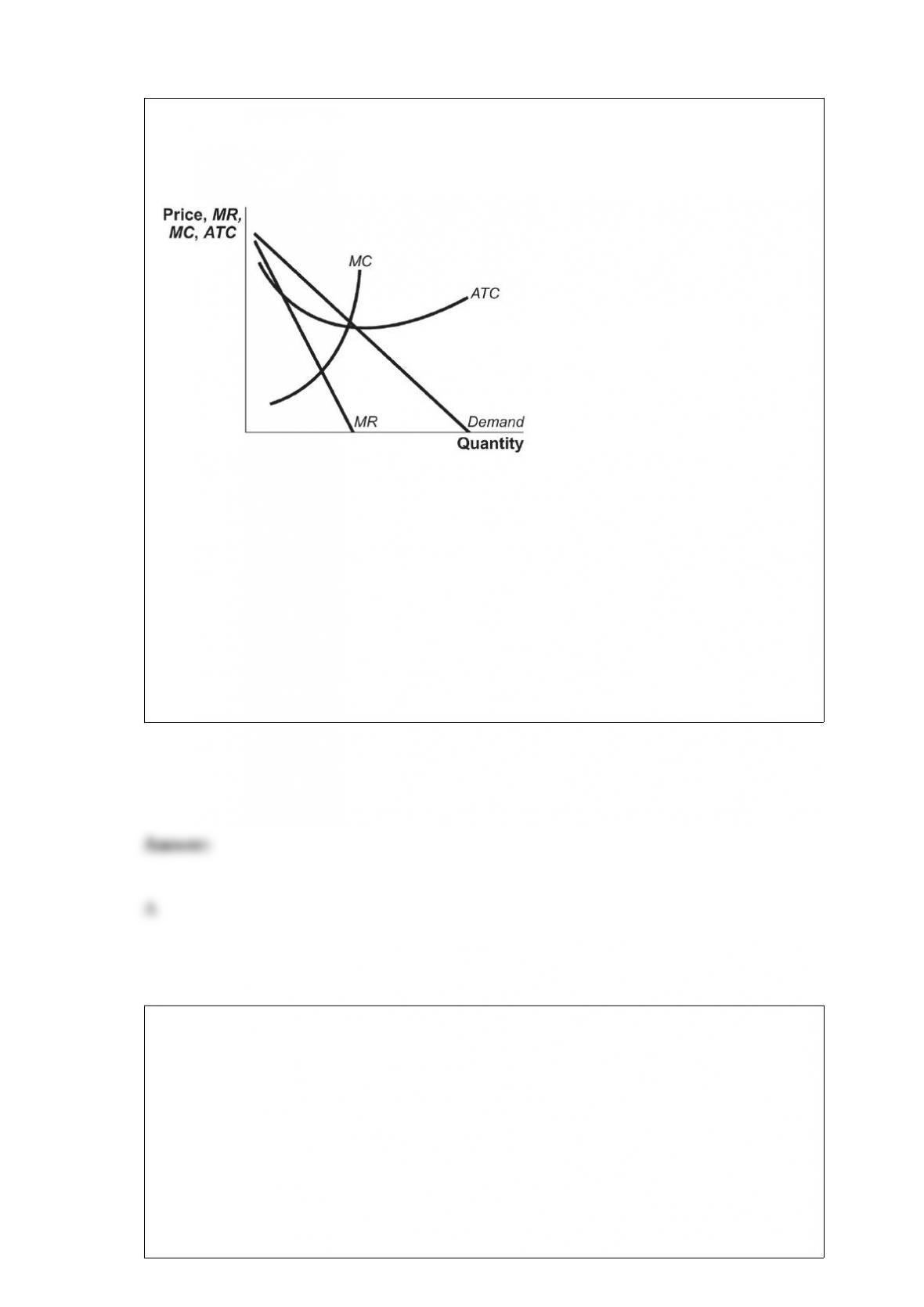
Figure: Monopolistic Competitor
(Figure: Monopolistic Competitor) If the firm shown in the figure Monopolistic
Competitor maximizes its returns, it will:
A) earn a positive economic profit.
B) break even.
C) incur a loss.
D) incur a loss equal to its MR.
If a firm operating in monopolistic competition is producing a quantity at which _____,
then the marginal decision rule tells us that profit _____.
A) MC > MR; can be increased by increasing production
B) MC < MR; can be increased by decreasing production
C) MC < MR; can be increased by increasing production
D) MC > MR; is maximized
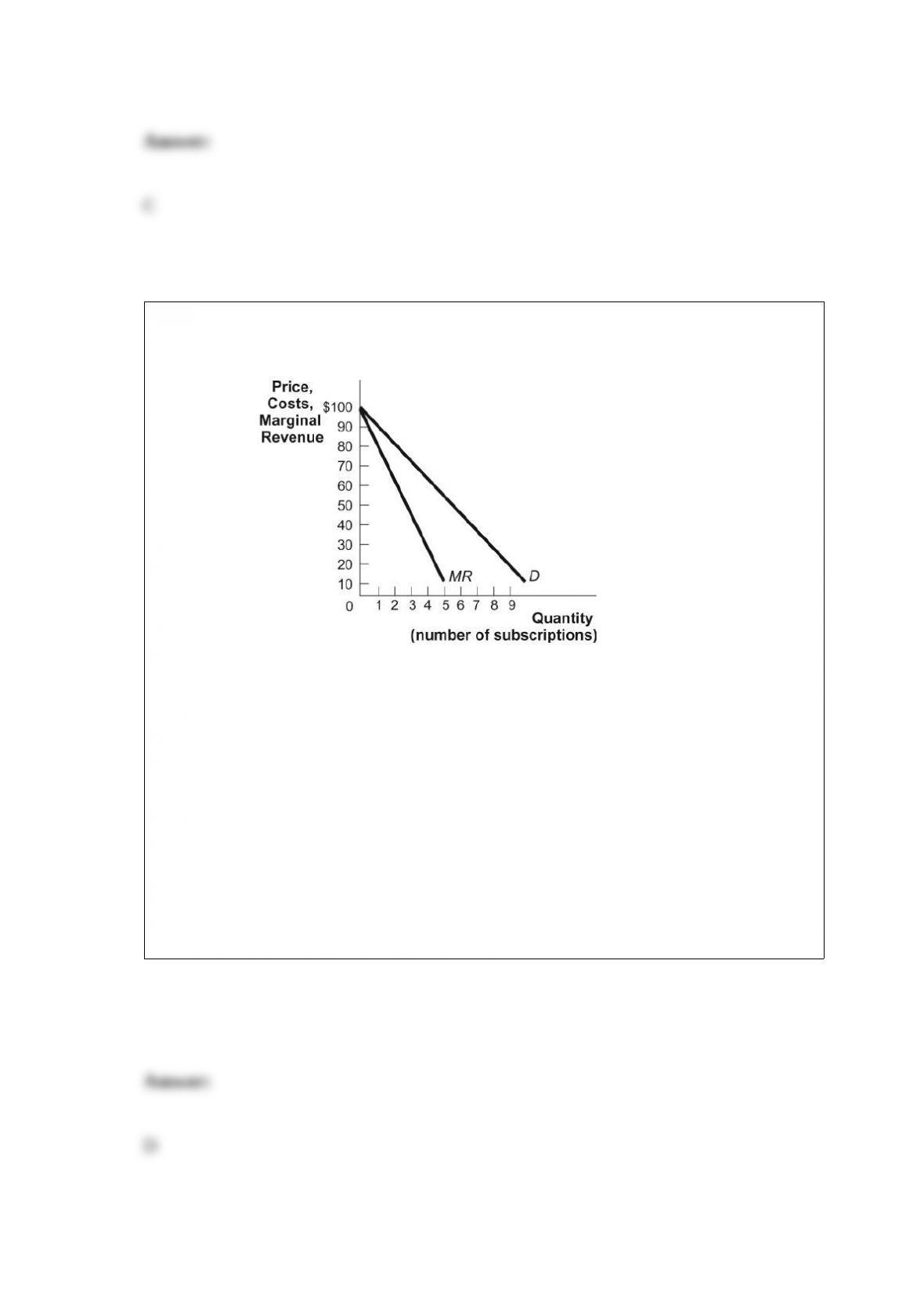
Figure: PPV
(Figure: PPV) Look at the figure PPV, which shows the demand and marginal revenue
for a pay-per-view football game on cable TV. Assume that the marginal cost and
average cost are a constant $40. If the cable company practices perfect price
discrimination, consumer surplus will be:
A) $180.
B) $100.
C) $40.
D) $0.

Figure: The Demand for Bricklayers
(Figure: The Demand for Bricklayers) Look at the figure The Demand for Bricklayers.
The equilibrium market wage for bricklayers is $100 a day, but a minimum wage of
$130 a day for bricklayers is set by the government. As a result:
A) six workers will now be hired by the firm.
B) three workers who otherwise would have been employed are now unemployed.
C) all bricklayers are better off.
D) construction firms will shut down.
An industry with a single producer that sells a single product with no substitutes is a:
A) perfectly competitive industry.
B) monopoly.
C) oligopoly.
D) monopolistically competitive industry.

The GoSports Company is a profit-maximizing firm with a monopoly in the production
of school team pennants. The firm sells its pennants for $10 each. We can conclude that
GoSports is producing a level of output at which:
A) average total cost equals $10.
B) average total cost is greater than $10.
C) marginal revenue equals $10.
D) marginal cost equals marginal revenue.
Assume that Stan just received a promotion and raise. In terms of labor supply, the
substitution effect of a higher wage will lead him to:
A) supply fewer hours of labor.
B) supply more hours of labor.
C) substitute leisure for work.
D) reduce work time to zero.
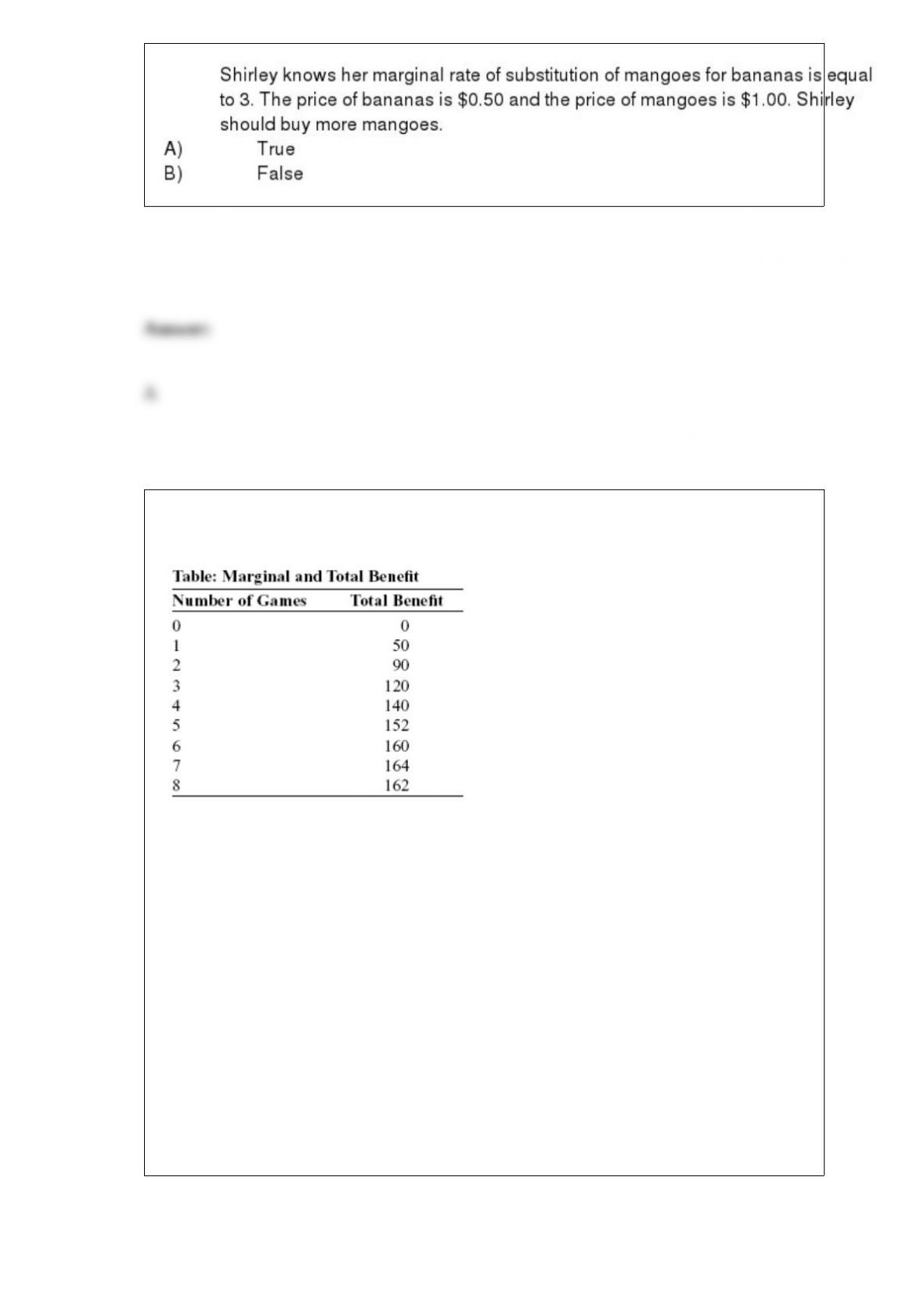
(Table: Marginal and Total Benefit) Look at the table Marginal and Total Benefit.
Rodger is deciding how many football games he wants to attend this year. Suppose
football tickets cost $10, but suppose too that the star player just got injured and will be
out for the season. As a result of the injury, Rodger’s total benefit of attending any game
is now only 10% of the value shown in the table. In this case, how many games should
he attend?
A) 0
B) 1
C) 2
D) 6

There are six households in a rural community. Each household earns $40,000 per year.
Suppose that a new resident builds a mansion in the community and that the income in
the new household is $4 million per year. After the new resident arrives, the median
household income has _____ and the mean household income has _____.
A) increased; increased
B) not changed; increased
C) increased; not changed
D) not changed; not changed
All of the following are possible reasons for market failure EXCEPT:
A) monopoly firms.
B) buyers and sellers not having access to the same information regarding a good or
service.
C) public goods.
D) extremely high prices for medical care.

Which of the following is an “either”or” decision?
A) Allen must decide how many courses to take this semester.
B) Sally must decide how many hours to spend studying for each of the four courses
that she is taking this semester.
C) Chris must decide how many hours to work each week at his part-time job.
D) Dylan must decide whether to major in economics or finance.
An increase in the demand for autoworkers may come about because of:
A) a decrease in the price of cars.

B) a decrease in the productivity of autoworkers.
C) a decrease in the supply of other factors that autoworkers use in production.
D) an increase in the price of cars.
Which is NOT an inefficiency caused by binding price ceilings?
A) inefficient allocation to consumers
B) wasted resources
C) illegal activity
D) inefficient allocation of sales among sellers
In most wealthy countries excluding the United States, the government pays _____ of
medical costs.
A) 100%
B) 70% to 80%
C) 30% to 40%
D) less than 20%
In the long run, monopolistic competitors will:
A) earn zero economic profits.
B) produce at the minimum of their ATC curves.
C) set price where MC = MR.
D) collude with other firms.
Consider a perfectly competitive firm in the short run. Assume that it is sustaining
economic losses but continues to produce at the profit-maximizing (loss-minimizing)
output. Which statement is FALSE?
A) Marginal cost is less than average total cost.
B) Marginal cost is equal to marginal revenue.
C) Price is equal to marginal cost.
D) Marginal cost is less than average variable cost.
In terms of labor supply, the substitution effect of a higher wage causes a(n):
A) increase in leisure time.
B) increase in the quantity of labor supplied.
C) substitution of leisure for work.
D) reduction of work time to zero.
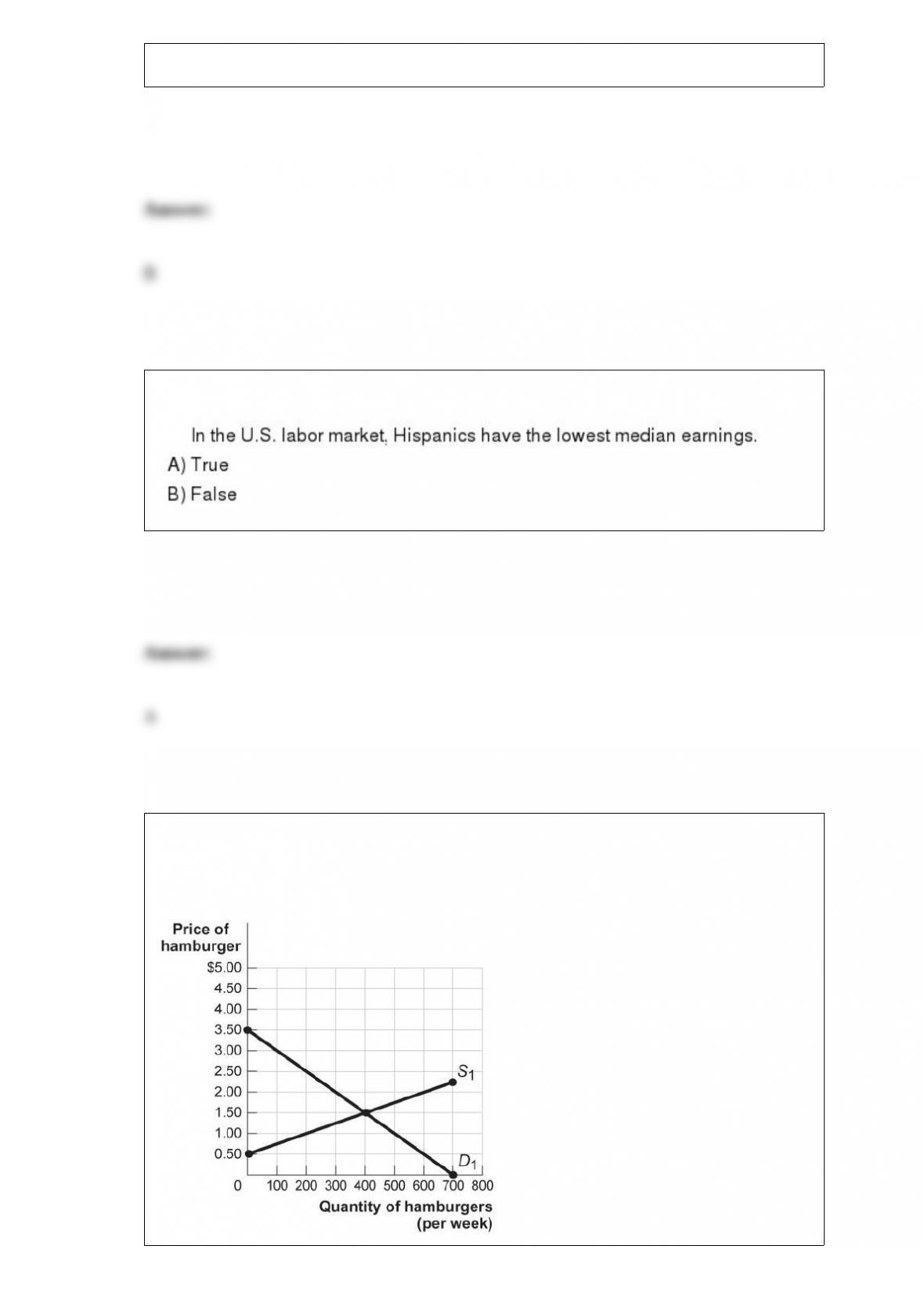
Figure: The Market for Hamburgers

(Figure: The Market for Hamburgers) The figure The Market for Hamburgers shows the
weekly market for hamburgers in Tuscaloosa. If the price of a hamburger falls from
$2.00 to $1.50, the gain in consumer surplus to consumers who are persuaded to buy at
the lower price (and who were not buying when the price was $2.00) is equal to:
A) $100.
B) $75.
C) $50.
D) $25.
For most goods, indifference curves:
A) may intersect.
B) slope upward.
C) are concave from the origin.
D) slope downward.
The minimum wage, which sets a lower limit on the wages that workers can earn, is
often above the equilibrium price. The minimum wage is an example of:
A) a price floor.
B) a price ceiling.
C) a quota.
D) an equilibrium price.
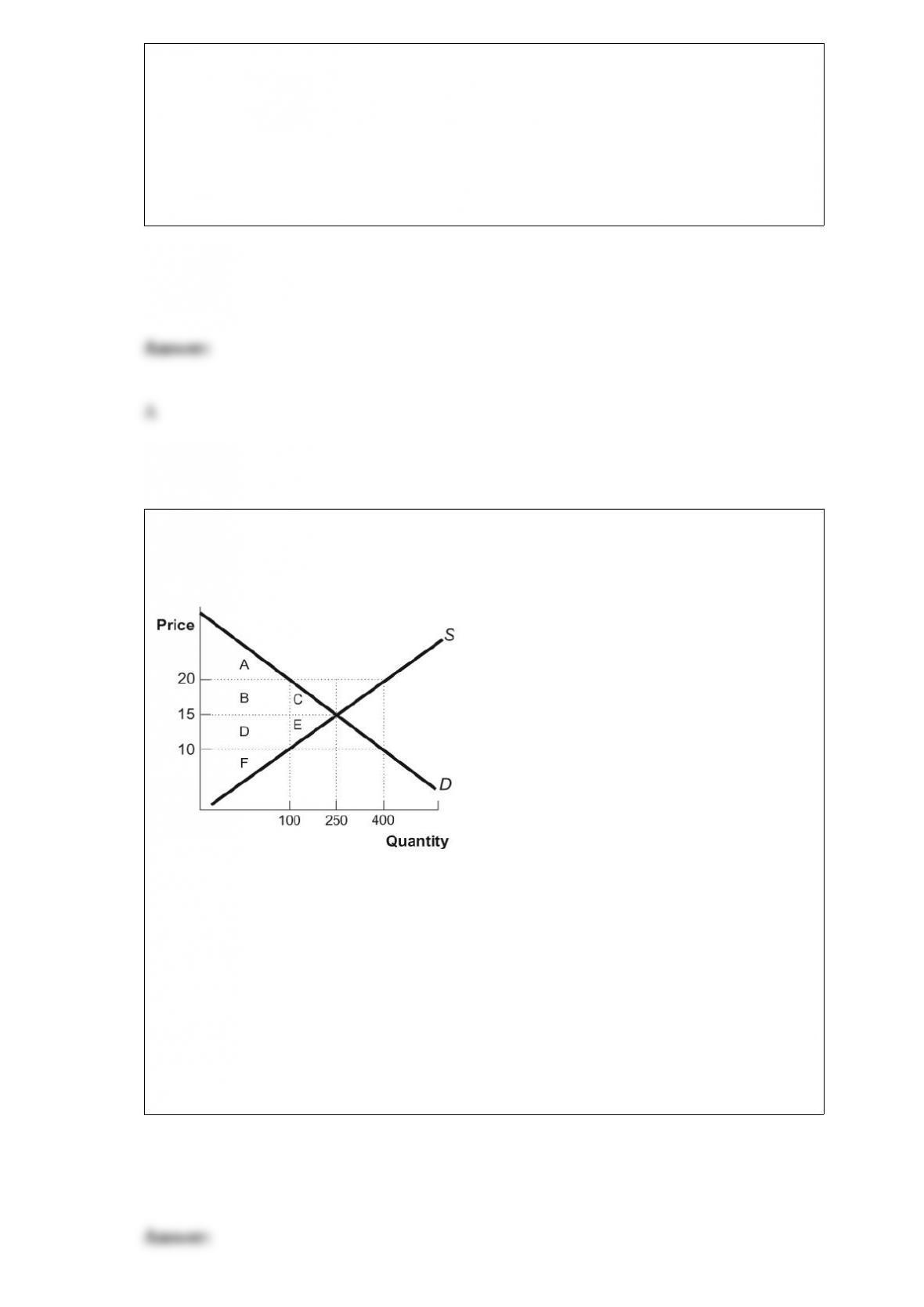
Figure: Quantity Controls
(Figure: Quantity Controls) Look at the figure Quantity Controls. If the government
decides to restrict the quantity sold to 100, which of the following is FALSE?
A) Total surplus will fall by areas C and E.
B) The market is not at equilibrium.
C) Consumer surplus is maximized.
D) Mutually beneficial transactions have been missed.
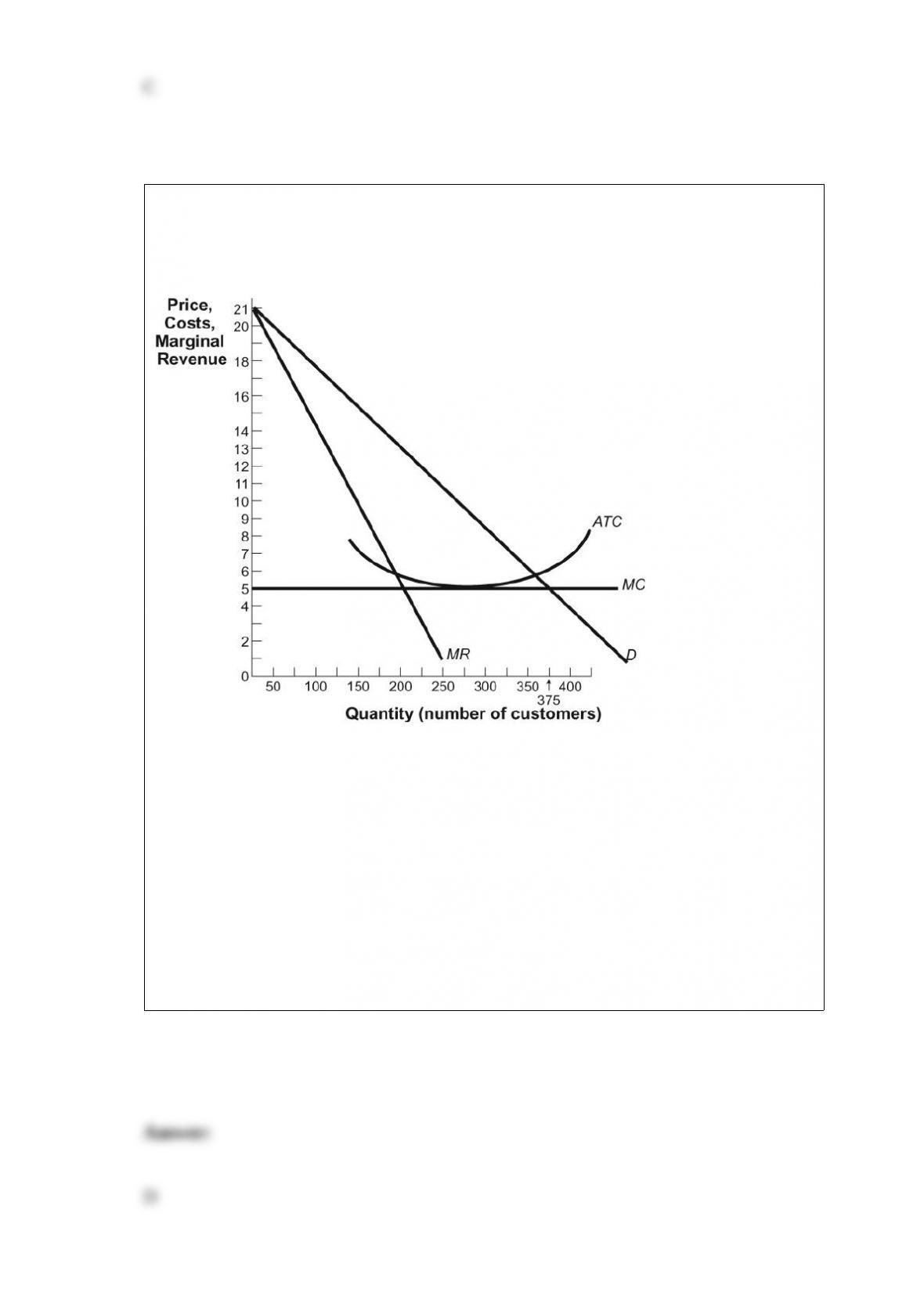
Figure: Water Works
(Figure: Water Works) Look at the figure Water Works, which describes a small town’s
water works, a natural monopoly. If regulators require the water works to charge the
price that eliminates deadweight loss, the water works will:
A) earn profits.
B) break even.
C) incur losses.
D) have a large producer surplus.
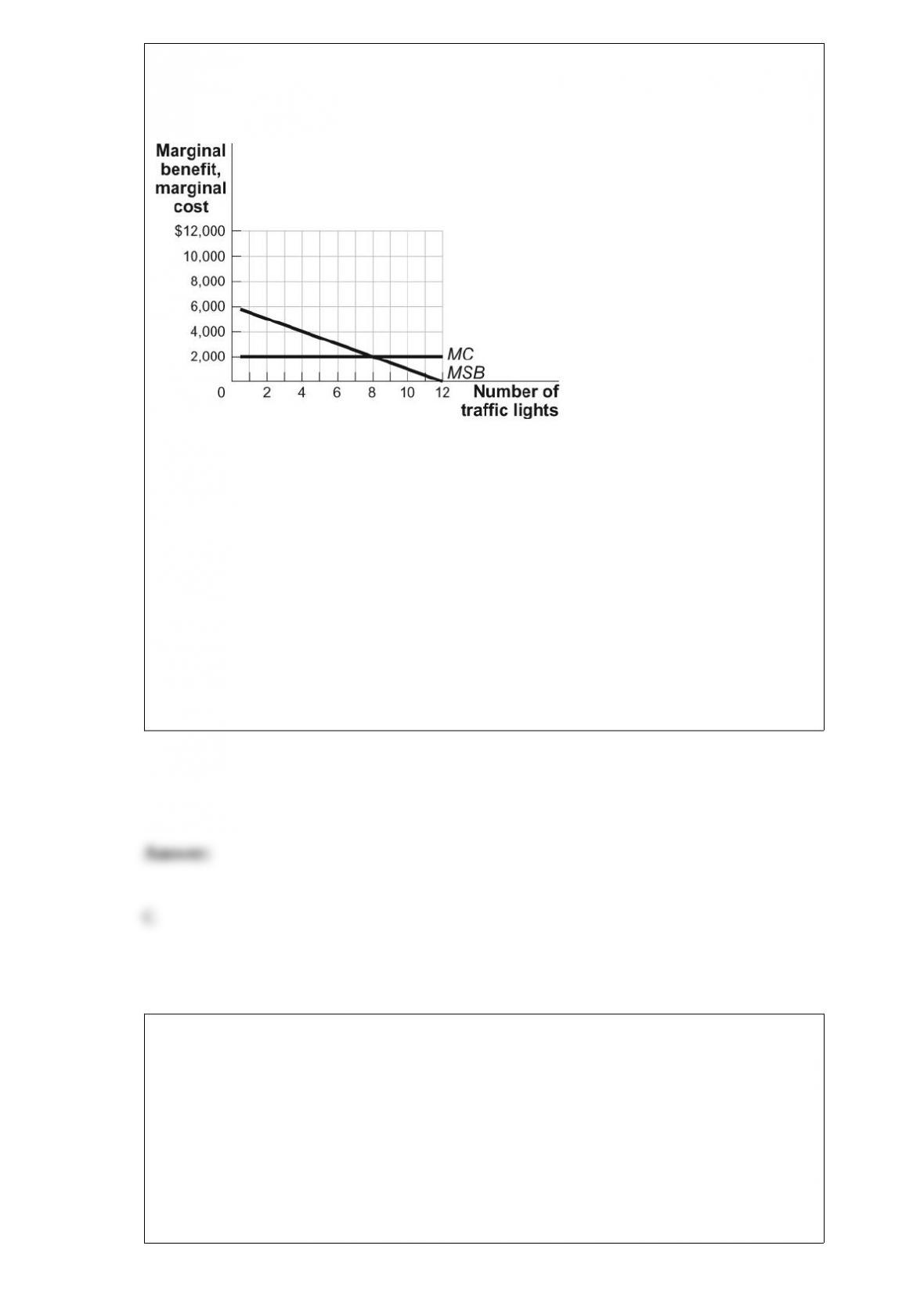
Figure: Traffic Lights in Plymouth
(Figure: Traffic Lights in Plymouth) Look at the figure Traffic Lights in Plymouth.
Plymouth has 1,000 residents. Each of the residents has the same individual marginal
benefit per traffic light. If the government provides traffic lights, the socially efficient
quantity is:
A) 0.
B) 4.
C) 8.
D) 12.
Consumption bundles that Mei CANNOT afford because the bundles cost more than
her income are _____ the budget line.
A) within
B) beyond
C) on
D) at the corner of
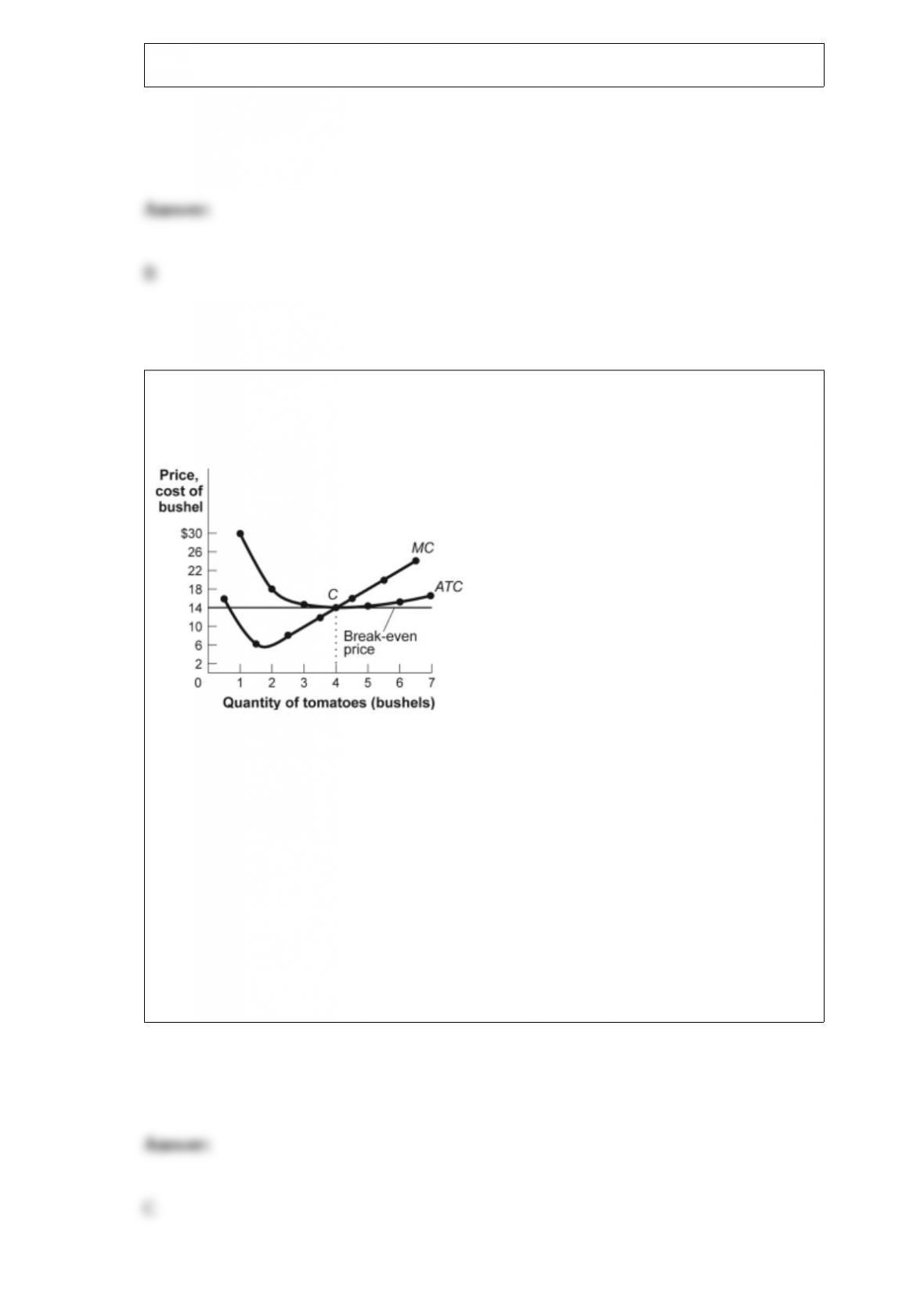
Figure: Total Cost for Tomato Producers
(Figure: Total Cost for Tomato Producers) Look at the figure Total Cost for Tomato
Producers. The market for tomatoes is perfectly competitive. The market price of a
bushel of tomatoes is $14. The farmer’s total cost at the profit-maximizing number of
bushels is:
A) $3.50.
B) $14.00.
C) $56.00.
D) $72.00.

A tax that takes a higher percentage of income as income rises is:
A) proportional.
B) an ability tax.
C) progressive.
D) regressive.
What are the fundamental differences between the Medicare and Medicaid programs?
John and Deanna are married, with two children. Both adults have college degrees, but
Deanna has chosen not to enter the labor force, while John has worked continuously for
10 years. Suppose Deanna gets a job with John’s employer. She is offered a salary that
is $15,000 below John’s. Is Deanna being discriminated against because she is a
woman? Support your answer.
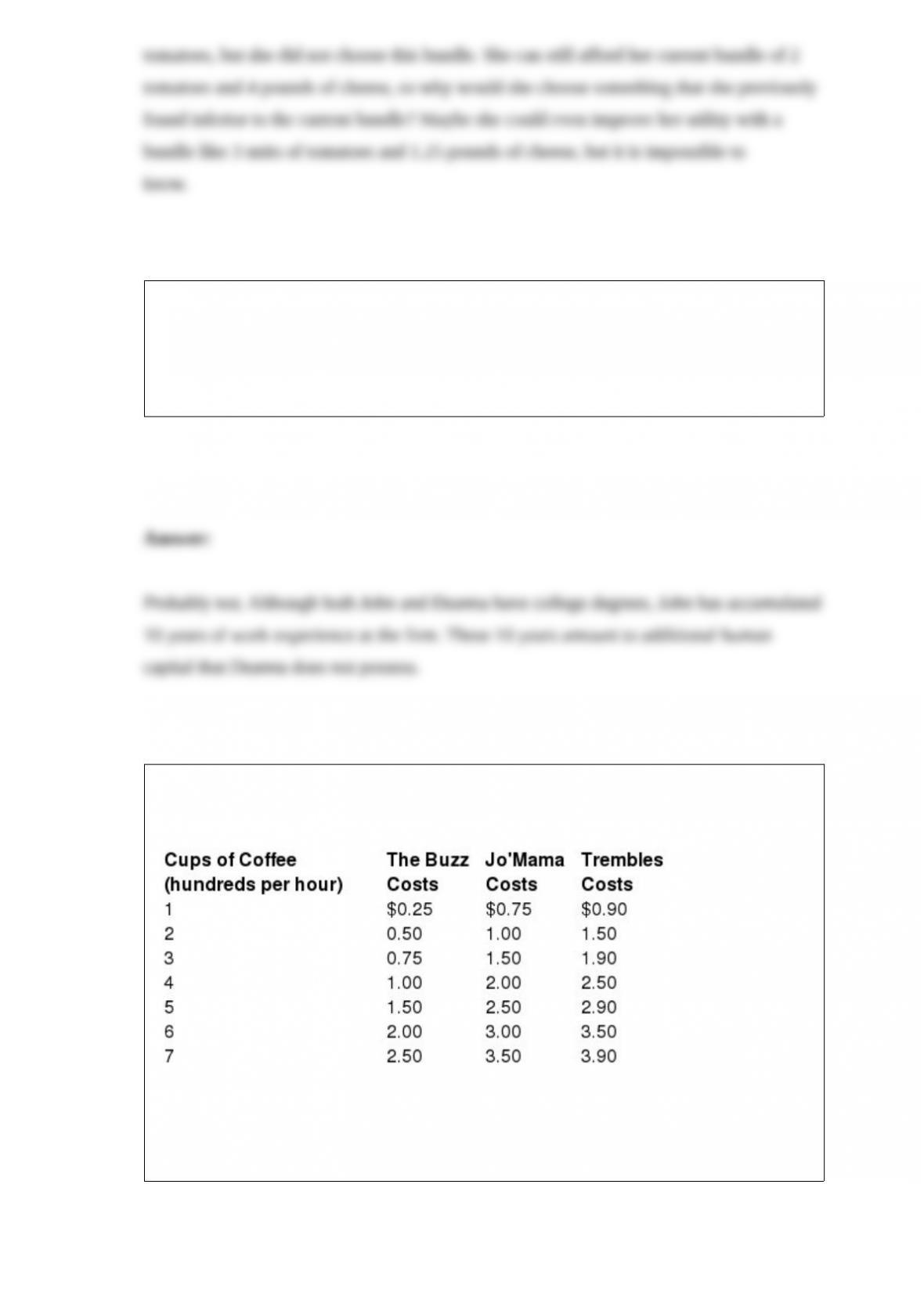
Table: Coffee Shops
(Table: Coffee Shops) Look at the table Coffee Shops. If the price of coffee is $1.75,
how many cups will be supplied and how much producer surplus will be earned by
coffee shops in the town?
A university bookstore decreased the price of a sweatshirt from $20 to $18 and
discovered that sweatshirt sales increased from 100 per week to 120 per week. Use the
midpoint formula to compute the price elasticity of demand for sweatshirts.
Why do economists generally regard median income as a better measure of a typical
American’s well-being than mean income?
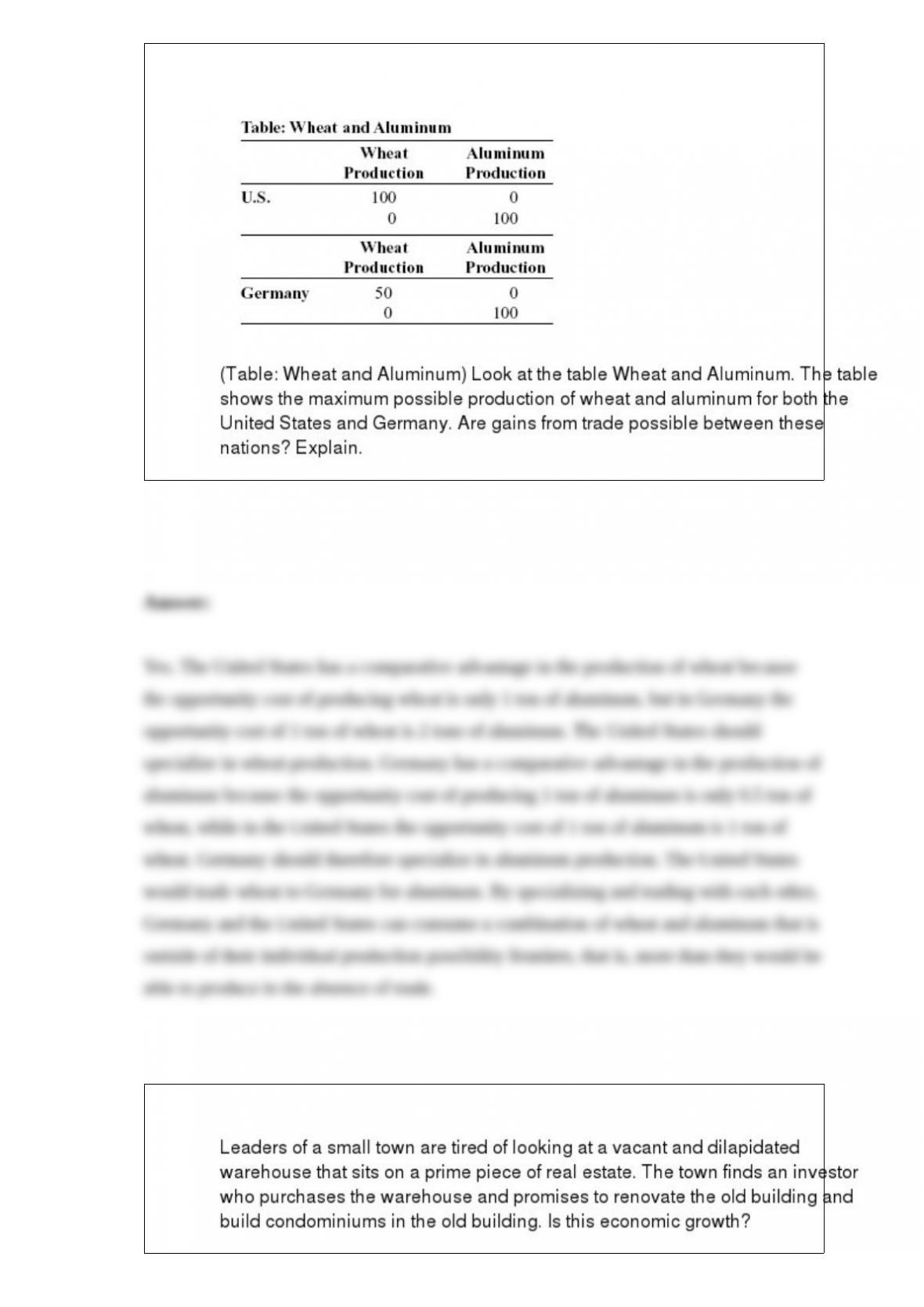

How do poverty programs differ from social insurance programs?
How would each of the following events affect the supply of compact cars? I. The price
of steel rises. II. The production technology for car manufacturing improves. III. The
price of sport utility vehicles falls.