
1) the optimal or allocatively efficient point on a production possibilities curve is
achieved where:
a.the smallest physical amounts of inputs are used to produce each good.
b.each good is produced at a level where marginal benefits equal marginal costs.
c.large amounts of capital goods are produced relative to consumer goods.
d.large amounts of consumer goods are produced relative to capital goods.
2) (Consider This) The idea that the price level readily moves upward but not
downward is called the:
A.elevator effect.
B.escalator effect.
C.ratchet effect.
D.stair-step effect.
3) Suppose that a large tree on Betty’s property is blocking Chuck’s view of the lake
below. Betty accepts Chuck’s offer to pay Betty $100 for the right to cut down the tree.
This situation describes:
A.the Coase theorem.
B.the adverse selection problem.
C.tragedy of the commons.
D.a market for externality rights.
4) one of the main differences between ppos and hmos is that:
a.hmo physicians charge on a traditional fee-for-service basis, while ppo physicians do
not.
b.hmos are usually for-profit organizations, whereas ppos are not.
c.ppos employ their own doctors, whereas hmos do not.
d.ppo physicians charge on a traditional fee-for service basis, while hmos do not.
5) the diamond-water paradox arises because:
a.essential goods may be cheap while nonessential goods may be expensive.
b.the marginal utility of certain products increases, rather than diminishes.
c.essential goods are always higher priced than nonessential goods.

d.we sometimes fail to use money as a standard of value.
6) The securities held as assets by the Federal Reserve Banks consist mainly of:
A.corporate bonds.
B.Treasury bills and Treasury bonds.
C.common stock.
D.certificates of deposit.
7) which of the following is an implication of the circular flow model?
a.negative events in one part of the economy are isolated in their effect.
b.adverse effects in one market can spill over into other markets, magnifying the effect
on the economy.
c.prices of goods and services will tend to remain stable over time.
d.the shares of total resource income going to wages, rent, interest, and profit will tend
to equalize.
8) The modern view of technological advance is that it:
A.is rooted in the independent advance of science, an element largely external to the
market system.
B.it is rarely carried out by oligopolists or pure monopolists.
C.is an internal element of capitalism, occurring in responses to profit incentives.
D.necessarily destroys existing monopoly power.
9) Twenty-two states currently (2007) have:
A.prohibitions against unionization by state employees.
B.compulsory union membership in the public sector.
C.laws outlawing lockouts in labor disputes.
D.right-to-work laws.
10) A rightward shift in the aggregate supply curve is best explained by an increase in:
A.business taxes.
B.productivity.
C.nominal wages.
D.the price of imported resources.
11) Labor unions are restrained in their wage demands because:
A.legislation limits annual increases in nominal wages to 6 percent.
B.the labor demand curve is downsloping.
C.marginal wage cost curves lie above labor supply curves in most labor markets.
D.most unions deal with monopsonists who have superior bargaining power.
12) a purely competitive seller should produce (rather than shut down) in the short run:
a.only if total revenue exceeds total cost.
b.only if total cost exceeds total revenue.
c.if total revenue exceeds total cost or if total cost exceeds total revenue by some
amount less than total fixed cost.
d.if total cost exceeds total revenue by some amount greater than total fixed cost.
13)
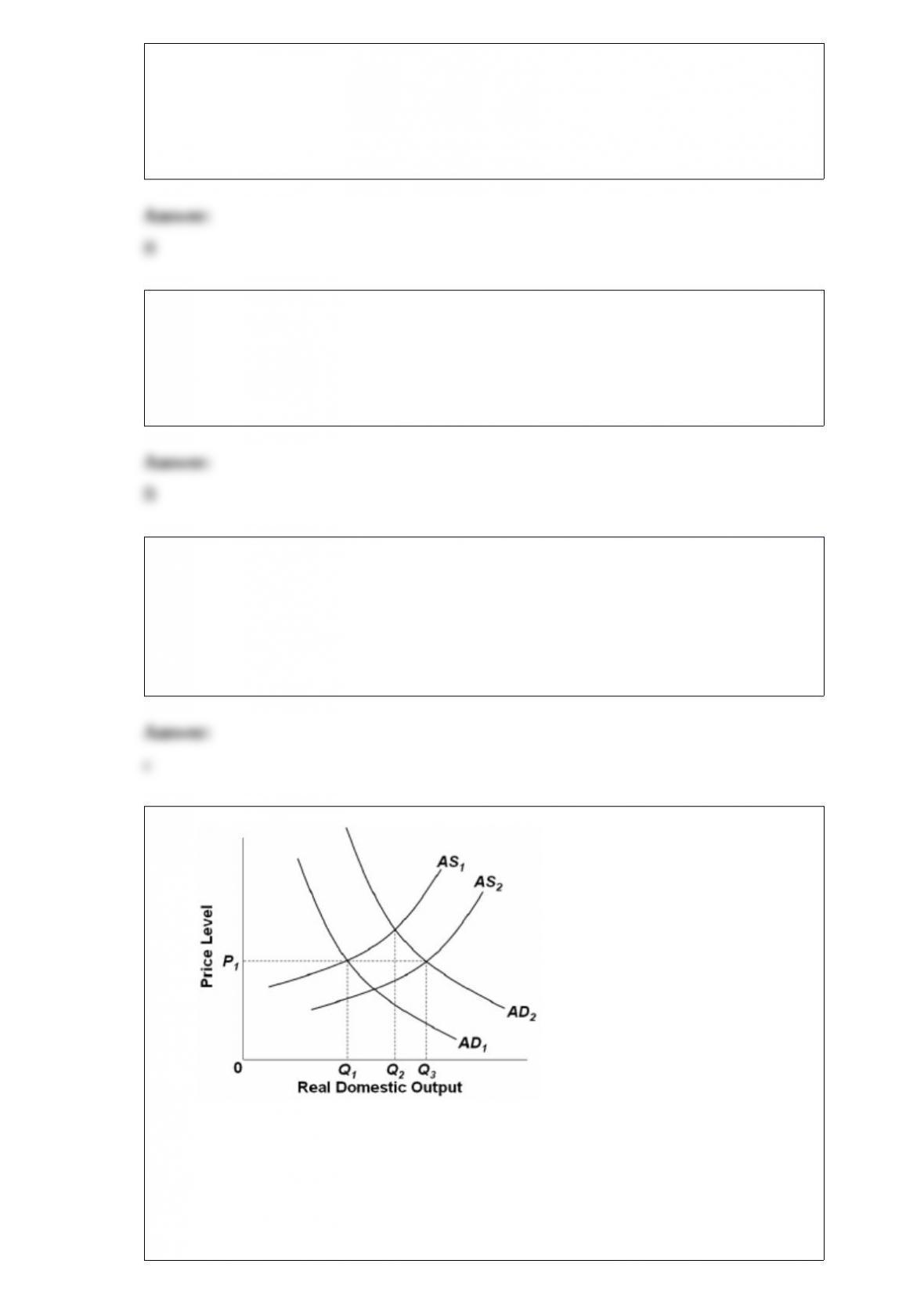
In the above figure AD1 and AS1 represent the original aggregate supply and demand
curves and AD2 and AS2 show the new aggregate demand and supply curves. The
change in aggregate supply from AS1 to AS2 could be caused by:
A.a reduction in the price level.
B.the increased availability of entrepreneurial talent.
C.an increase in business taxes.

D.the real-balances, interest-rate, and foreign purchases effects.