1) To fully understand how taxes affect economic well-being, we must
a.assume that economic well-being is not affected if all tax revenue is spent on goods
and services for the people who are being taxed.
b.compare the taxes raised in the United States with those raised in other countries,
especially France.
c.compare the reduced welfare of buyers and sellers to the amount of revenue the
government raises.
d.take into account the fact that almost all taxes reduce the welfare of buyers, increase
the welfare of sellers, and raise revenue for the government.
2) In which of the following markets is economic profit driven to zero in the long run?
a.oligopoly
b.monopoly
c.monopolistic competition
d.cartels
3) To determine whether a good is considered normal or inferior, one could examine the
value of the
a.income elasticity of demand for that good.
b. for that good.
c.price elasticity of supply for that good.
d. for that good.
4) When a society cannot produce all the goods and services people wish to have, it is
said that the economy is experiencing
a.scarcity.
b.surpluses.
c.inefficiencies.
d.inequalities.
5) Scenario 14-4
The information below applies to a competitive firm that sells its output for $40 per
unit.
– When the firm produces and sells 150 units of output, its average total cost is $24.50.
– When the firm produces and sells 151 units of output, its average total cost is $24.55.
When the firm increases its output from 150 units to 151 units, its profit
a.decreases by $5.75.
b.decreases by $7.20.
c.increases by $4.15.
d.increases by $7.95.
6) If buyers today become more willing and able than before to purchase larger
quantities of stand up paddle boards (SUPs) at each price of SUPs, then
a.we will observe a movement downward and to the right along the demand curve for
SUPs.
b.we will observe a movement upward and to the left along the demand curve for SUPs.
c.the demand curve for SUPs will shift to the right.
d.the demand curve for SUPs will shift to the left.
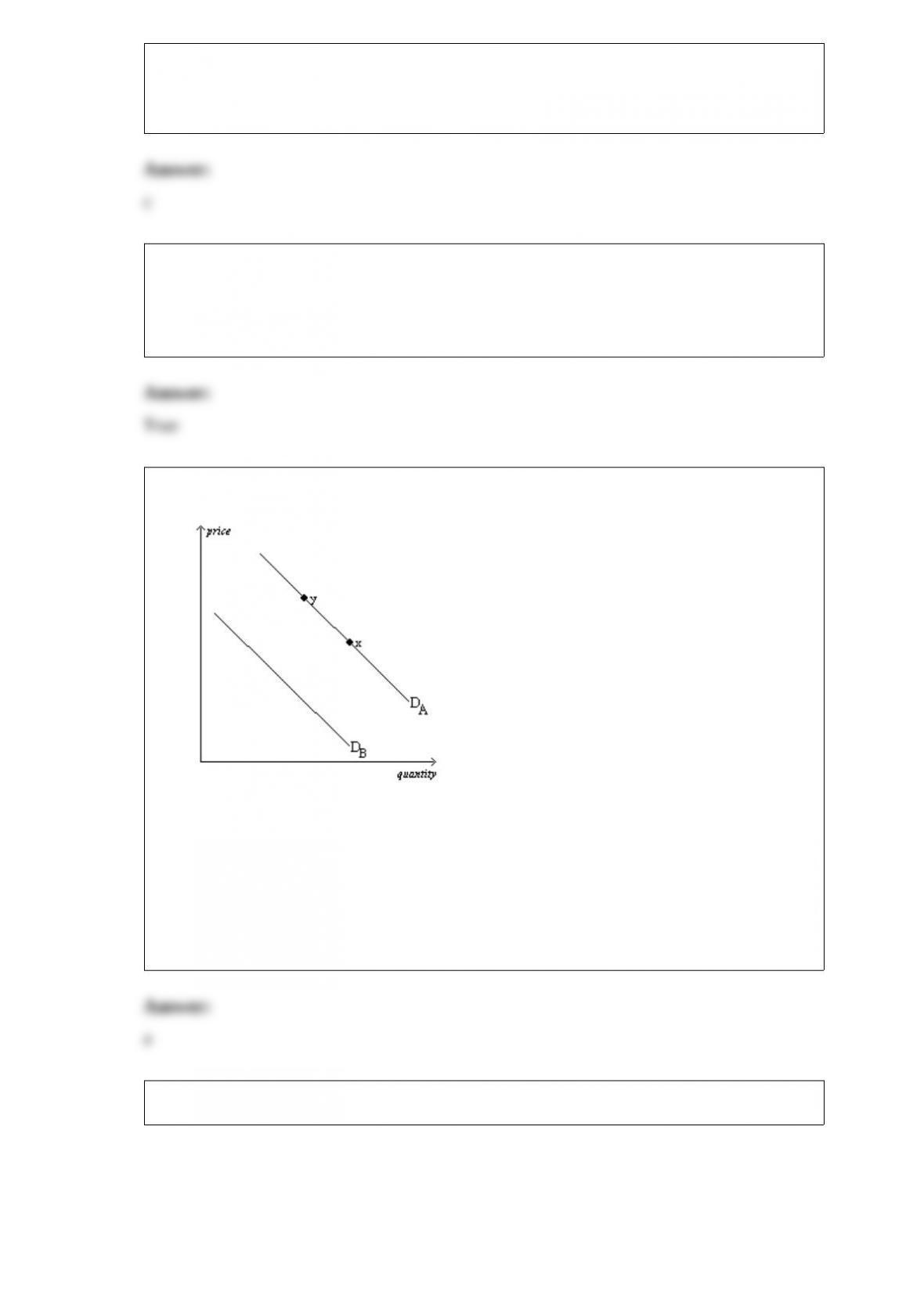
7) Figure 20-4
Refer to Figure 20-4. The ratio of female-to-male earnings has increased steadily from
about 1980 to 2008 because the earnings of men
a.increased steadily but by approximately half of the increase in the earnings of women.
b.decreased while the earnings of women increased.
c.stayed relatively constant while the earnings of women increased.
d.decreased by substantially more than the decrease in the earnings of women.
8) Cocoa and marshmallows are complements, so a decrease in the price of cocoa will
cause an increase in the demand for marshmallows.
a.True
b.False
9) The diagram below pertains to the demand for turkey in the United States.
All else equal, a large number of people becoming vegetarians would cause a move
from
a.DA to DB.
b.DB to DA.
c.x to y.
d.y to x.
10) Figure 7-19
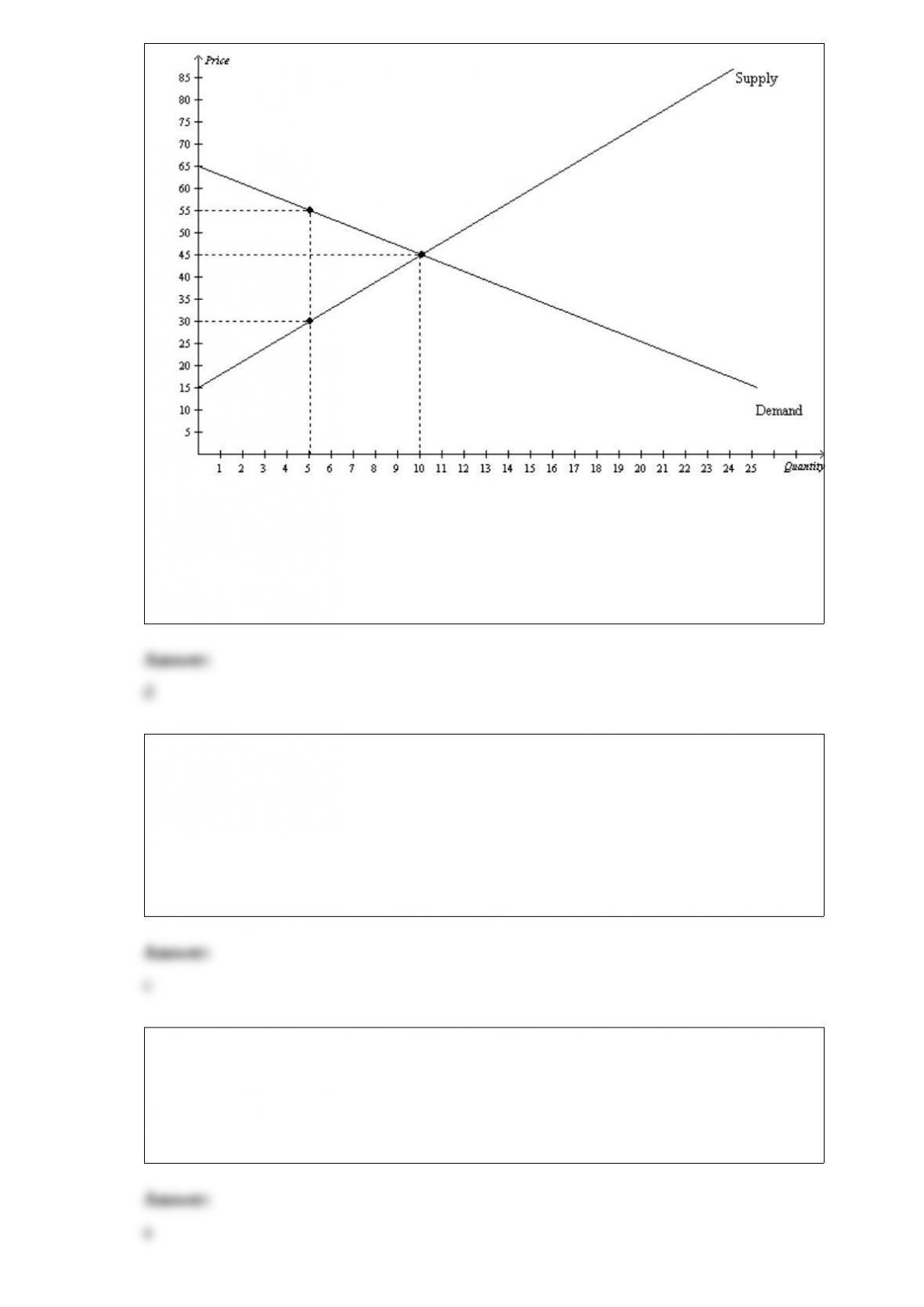
the government imposes a price floor of $55 in this market, then total surplus will be
a.$100.00 higher than it would be without the price floor.
b.$50.00 lower than it would be without the price floor.
c.$125.00 lower than it would be without the price floor.
d.$62.50 lower than it would be without the price floor.
11) Which of the following might cause the supply curve for an inferior good to shift to
the right?
a.an increase in input prices
b.a decrease in consumer income
c.an improvement in production technology that makes production of the good more
profitable
d.a decrease in the number of sellers in the market
12) The short-run market supply curve in a perfectly competitive industry
a.shows the total quantity supplied by all firms at each possible price.
b.is perfectly inelastic at the market price.
c.is perfectly elastic at the market price.
d.shows the variety of prices that different firms will charge for a given quantity.

13) Consider a consumer who purchases two goods, X and Y. If the price of good Y
falls, then the substitution effect by itself will
a.cause the consumer to buy more of good Y and less of good X.
b.cause the consumer to buy more of good X and less of good Y.
c.not affect the amount of goods X and Y that the consumer buys.
d.result in an upward-sloping demand for good Y if the substitution effect is positive.
14) In the parable of the leaky bucket, a fundamental problem with government
redistribution programs is identified. As long as the government only has “leaky
buckets” at its disposal,
a.the costs of welfare programs will exceed the benefits.
b.it should not try to reach complete equality in income.
c.income equality will be the best policy option.
d.equality of economic opportunity will reduce society’s utility.
15) Suppose a firm in a competitive market produces and sells 150 units of output and
earns $1,800 in total revenue from the sales. If the firm increases its output to 200 units,
the average revenue of the 200th unit will be
a.less than $12.
b.more than $12.
c.$12.
d. Any of the above may be correct depending on the price elasticity of demand for the
product.
16) A study of the market for optometrists’ services in the 1960s showed that
a.all states in the United States prohibited advertising by optometrists.
b.almost all professional optometrists opposed legal restrictions on their rights to
advertise.
c.the average price of eyeglasses would decrease if the legal restrictions on advertising
by optometrists were removed.
d.advertising on eyeglasses limited competition among optometrists.
17) Figure 16-4
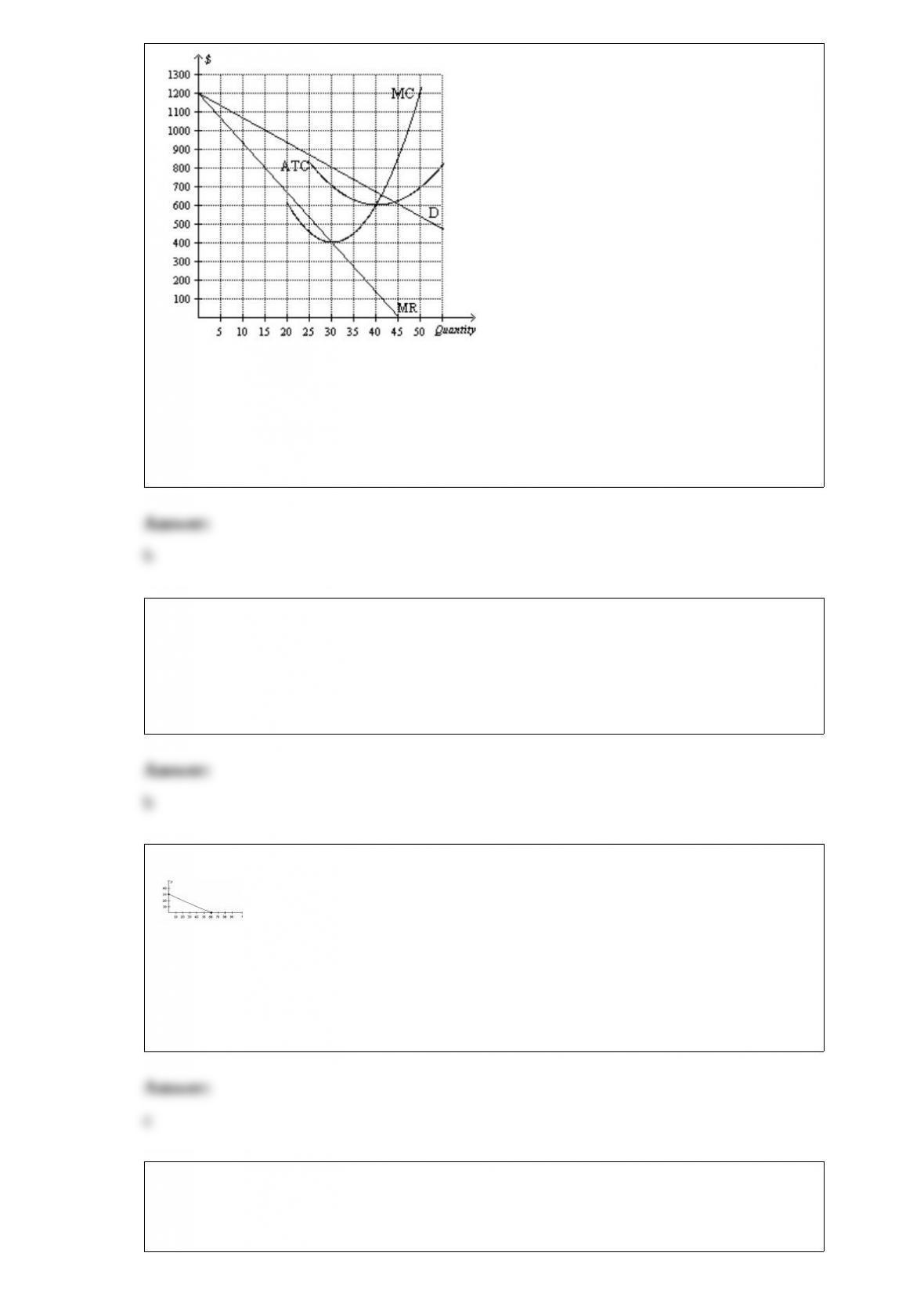
The firm in this figure is monopolistically competitive. This firm
a.is operating in the long run.
b.is earning a short-run economic profit.
c.is incurring a short-run loss.
d.The answer cannot be determined from the information given.
18) The prisoners’ dilemma game
a.provides insight into why cooperation is individually rational.
b.provides insight into why cooperation is difficult.
c.is a game in which neither player has a dominant strategy.
d.is a game in which exactly one of the two players has a dominant strategy.
19) The following diagram shows a budget constraint for a particular consumer.
If the price of X is $12, then what is the price of Y?
a.$9
b.$16
c.$24
d.$30
20) Table 12-21
The dollar amounts in the last three columns are the taxes owed under the three
different tax systems.
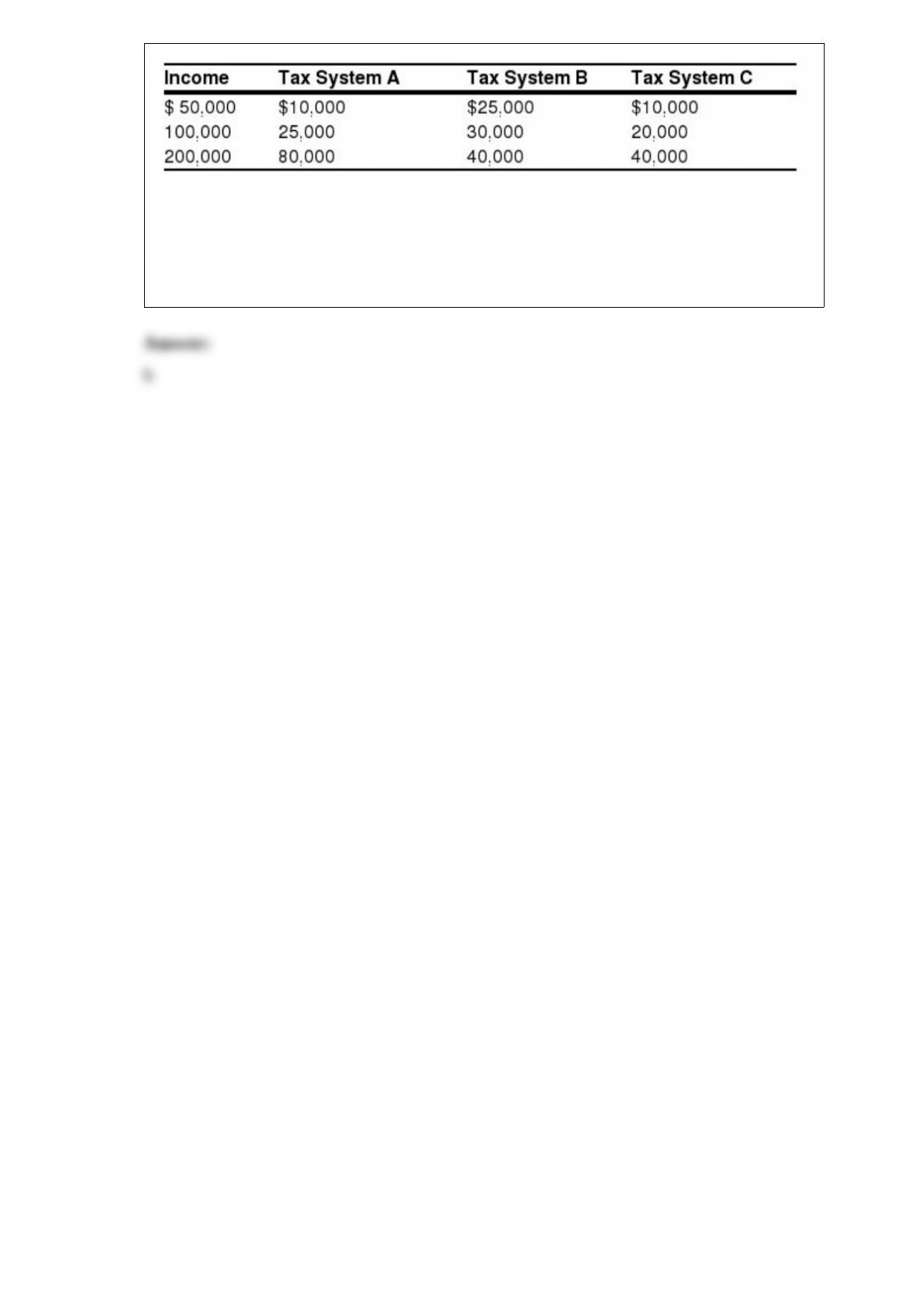
Which of the three tax systems is regressive?
a.Tax System A
b.Tax System B
c.Tax System C
d.None of the systems are regressive.