
Two types of existing houses are for sale: ones with a cracked foundation and ones
without. In all other respects, they are identical. Houses without cracked foundations
are worth $200,000 while those with cracked foundations are worth $200,000 minus the
$20,000 to fix the crack or $180,000. The frequency of solid foundations is 80%.
Sellers know which type of house they have but buyers cannot detect a crack. No seller
“must” sell his house in order to move and thus no one accepts anything less than its
value.
Suppose some of the owners with solid foundations remove their homes from the
market because they can’t sell for a price that is as high as the value of their homes.
Then
A. the buyers’ reservation price rises.
B. the owners of cracked slabs also begin to remove their homes from the market.
C. the proportion of homes for sale with a cracked slab rises.
D. the buyers become more willing to believe the owners’ claim of a solid foundation.
If taxpayers pay a smaller fraction of their income in taxes as their incomes rise, the tax
is _______ and if taxpayers pay a larger fraction of their income in taxes as their
income rise, the tax is ______
A. regressive; progressive
B. progressive; regressive
C. proportional; progressive
D. regressive; proportional
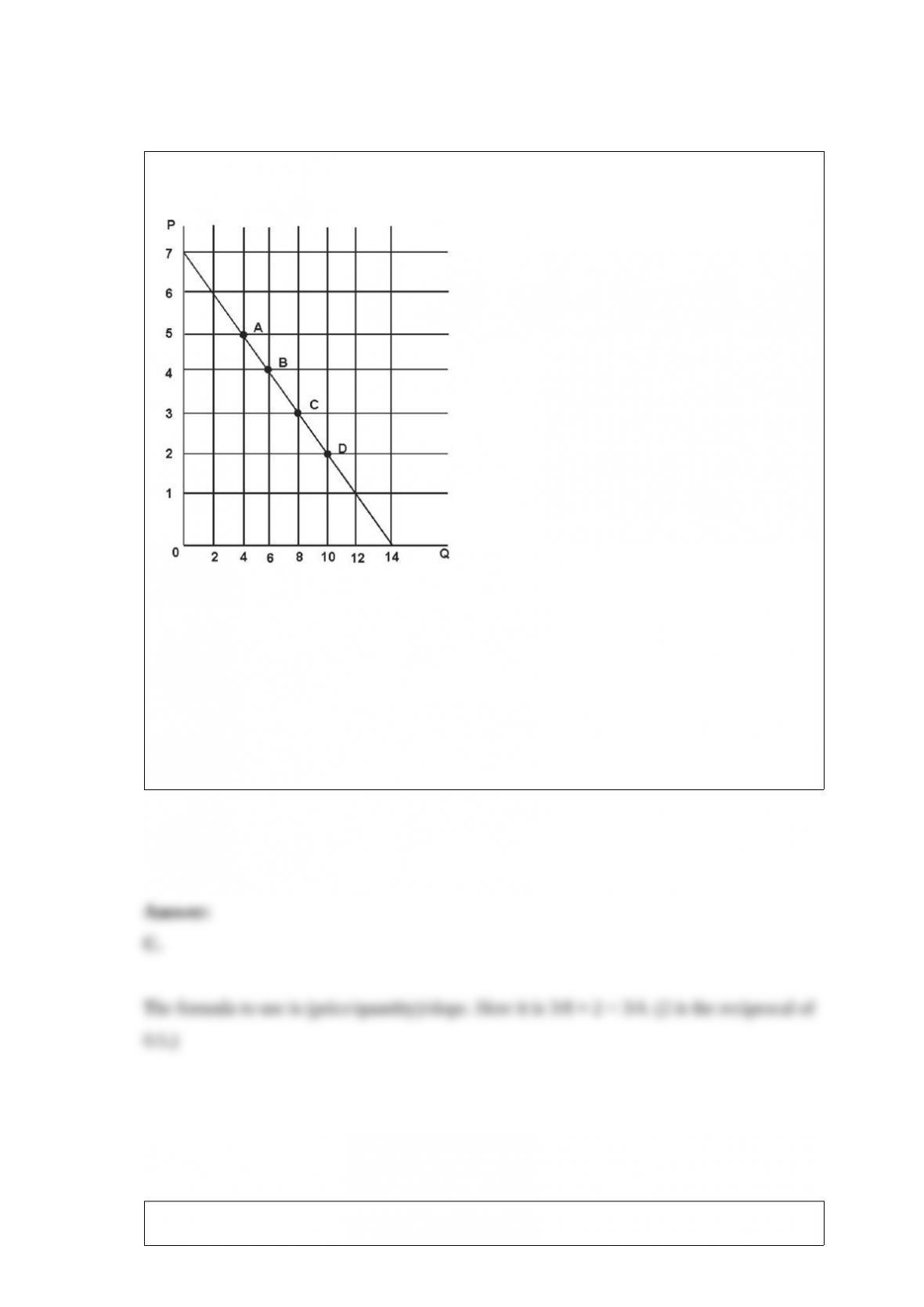
The following graph depicts demand.
Refer to the figure above. The price elasticity of demand at point C is:
A. 3/16.
B. 16/3.
C. 3/4.
D. 3/8.
If the marginal utility per dollar is not the same for each good, the consumer could

_____ her utility by spending ______ on goods for which the marginal utility per dollar
is higher.
A. decrease, more
B. increase, more
C. maximize, less
D. increase, less
If domestic saving is less than domestic investment, then a country will have a ______
and positive net capital ______.
A. trade deficit; outflows
B. trade deficit; inflows
C. trade balance; inflows
D. trade surplus; outflows
Which of the following is NOT a characteristic of governmental rent controls?
A. Equitable distribution of apartments.
B. Excess demand for apartments.
C. Fewer newly built apartment buildings.
D. Very low vacancy rates.
Refer to the table above. The marginal revenue of the fifth unit of output is:
A. $0.
B. $2.
C. $6.
D. -$2.
Microeconomics is distinguished from macroeconomics in that microeconomics
focuses on:

A. the performance of the national economy.
B. the overall price level.
C. choices made by individuals or groups in the context of individual markets.
D. how to improve the performance of the national economy.
In the long run, total spending only influences:
A. actual output.
B. potential output.
C. productive capacity.
D. inflation.
Which of the following would cause supply to shift to the left?
A. Wages rise.
B. Demand for the good falls.
C. The price of the good falls.
D. Expectations about future demand improve.
Price elasticity of demand is often expressed as a positive number because:
A. using the formula yields a positive number.
B. demand has a positive slope.
C. it’s convenient to use absolute values even though the formula yields non-positive
numbers.
D. both the numerator and the denominator in the formula are negative.
Shelter for homeless people is an example of
A. a want

B. a need
C. something they can live without
D. something hard to find
If a firm is earning zero profits
A. its revenues are sufficient to pay explicit costs, but not implicit costs.
B. the owner will not be able to pay himself or herself a salary.
C. it will shut down in the long run, but will continue to operate in the short run.
D. the owners are earning a return on their time and investment that is equal to the
opportunity costs of that time and investment.
Which of the following would not be included in the calculation of accounting profits?
A. Wages of workers.
B. The salary the owner could have earned working elsewhere.

C. Rent.
D. Medical insurance coverage for workers.
The __________ the difference between domestic opportunity costs and international
opportunity costs, the __________ the potential benefits of trading with other countries.
A. smaller; greater
B. greater; greater
C. greater; smaller
D. larger; more insignificant
Suppose that this graph describes the current labor market for high school teachers:

Given the wage equal to W*, immediately following a shift of the supply curve to the
left
A. there will be a shortage of certified teachers.
B. there will be an excess supply of certified teachers.
C. the reservation wage of each remaining teacher will fall.
D. the market will be in equilibrium.
The last time you went on a road trip, you noticed that there were several fast food
outlets clustered near some freeway exits, but none at the others. Now that you are
familiar with Hotelling’s model, you know that the reason for this is:
A. zoning laws.
B. firms vying for a favorable location.
C. failure by the firms to correctly distribute themselves.
D. the existence of fast food cartels.
Each of the following statements describes how the political and legal environment
encourages productivity EXCEPT:
A. Well-defined property rights encourage production and saving.

B. Political stability promotes economic growth.
C. Price changes in markets provide suppliers incentives to supply goods to markets.
D. Pay rates determined by a governmental planning agency provide workers with the
incentive to work hard.
A measure of GDP in which quantities produced are valued at the prices of a fixed base
year is called:
A. real GDP.
B. nominal GDP.
C. base GDP.
D. current GDP.
The time between when the fed funds rate is cut and investment spending increases is
an example of:
A. Okun’s law.
B. the outside lag in macroeconomic policy.

C. anchoringinflationary expectations.
D. the inside lag in macroeconomic policy.
A currency appreciation is a(n):
A. increase in the value of a currency relative to other currencies.
B. decrease in the value of a currency relative to other currencies.
C. reduction in the official value of a currency in a fixed-exchange-rate system.
D. increase in the official value of a currency in a fixed-exchange-rate system.
Long-lived, produced goods used for producing other goods and services are called:
A. consumption goods.
B. non-market goods.
C. value-added goods.
D. capital goods.

When statisticians fail to allow for the possibility that consumers switch from products
with rising prices to those whose prices are stable or falling, the CPI will tend to
______ the rate of inflation.
A. understate
B. precisely measure
C. be unrelated to
D. overstate
As the price of computers falls, the quantity demanded of computers increases. This is
an application of
A. the law of supply
B. production possibility expansion
C. the law of demand
D. needs versus wants

Unplanned inventory investment equals zero when
A. planned investment is greater than actual investment.
B. planned investment is less than actual investment.
C. planned investment equals actual investment.
D. expected sales are greater than actual sales.
For perfectly competitive firms price _____ marginal revenue; for monopolists price
____ marginal revenue.
A. equals; equals
B. equals; is less than
C. is less than; equals
D. equals; is greater than

The nominal interest rate is the:
A. annual percentage increase in the dollar value of a financial asset.
B. annual percentage increase in the purchasing power of a financial asset.
C. real rate of return on an asset.
D. the real interest rate minus the inflation rate.
All else equal, if U.S. stocks are perceived to have become riskier compared to financial
investments in other countries, then the market equilibrium value of the exchange rate
for the U.S. dollar will:
A. rise.
B. fall.
C. become fixed.
D. be equal to the value chosen by the Federal Reserve.
Research confirms that government provision of infrastructure:
A. hinders economic growth.
B. promotes economic growth.

C. increases human capital.
D. leads to reduced spending on research and development.
The Board of Governors consists of ______ governors appointed for staggered ___-year
terms.
A. 5; 12
B. 5; 14
C. 7; 12
D. 7; 14