
A positive externality is internalized when
a. demand shifts to the right until the socially optimum level of output is obtained.
b. demand shifts to the left until the socially optimum level of production is obtained.
c. supply shifts to the left until the socially optimum level of production is obtained.
d. b and c
e. none of the above
We would expect the total utility of diamonds to be __________ than the total utility of
water and the marginal utility of diamonds to be __________ than the marginal utility
of water.
a. higher; higher
b. lower; lower
c. higher; lower
d. lower; higher
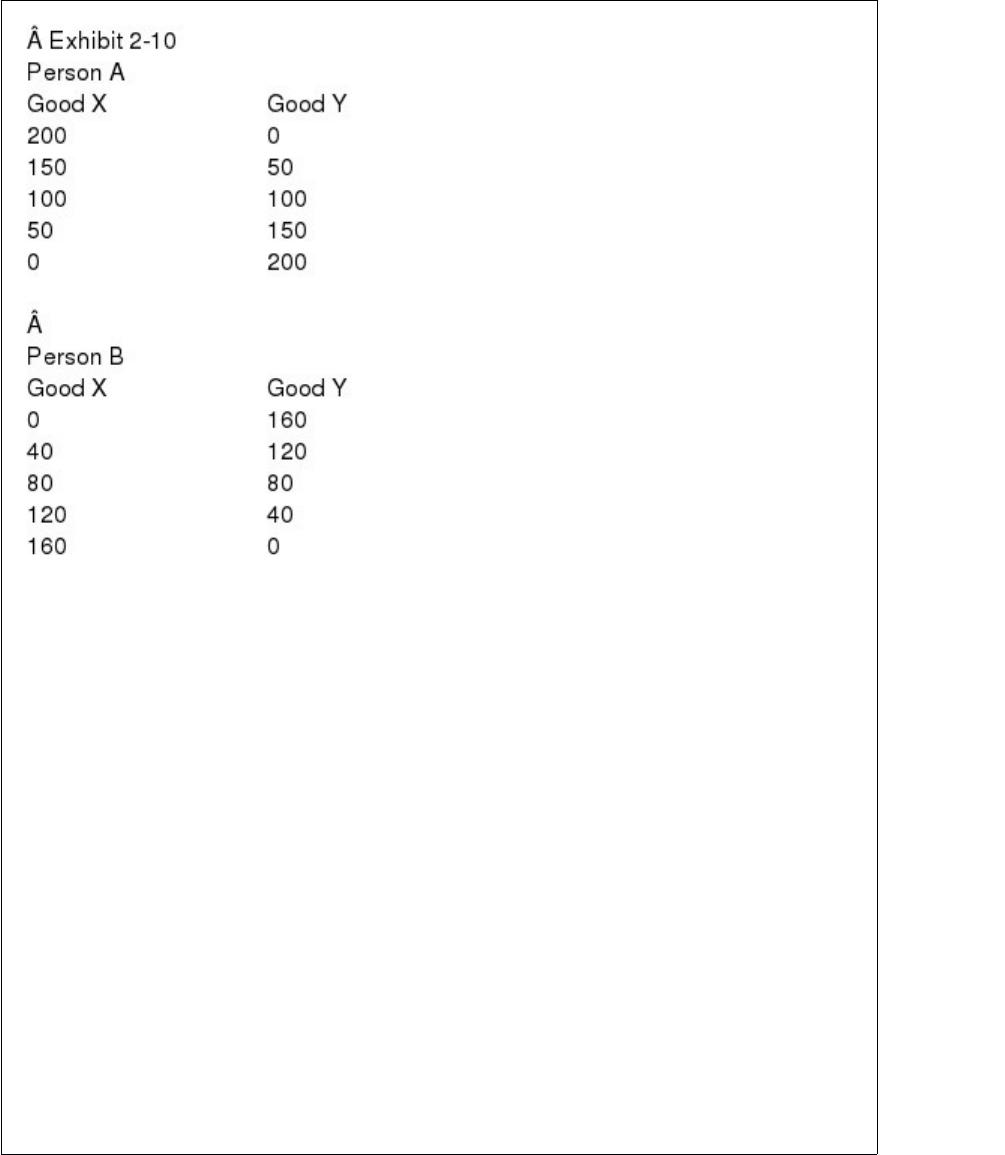
Which of the following statements is true?
a. There would be no gains from trade between person A and person B because they
have the opportunity cost of producing one unit of good X (or one unit of good Y) is the
same for both persons.
b. Both person A and person B will benefit from specialization and trade as long as
person A specializes in the production of good X and person B specializes in the
production of good Y.
c. Both person A and person B will benefit from specialization and trade as long as
person A specializes in the production of good Y and person B specializes in the
production of good X.
d. Both person A and person B will benefit from trade as long as person A produces
both good X and good Y, and person B produces neither good.
e. Both person A and person B will benefit from trade as long as person B produces
both good X and good Y, and person A produces neither good.

An indifference curve shows all the combinations of bundles of two goods a person can
purchase given a fixed amount of income.
a. True
b. False
The market in which the currencies of different countries are exchanged is called the
a. money market.
b. capital market.
c. foreign exchange market.
d. loanable funds market.
The coordinates of point A are 20 units of X and 36 units of Y. The coordinates of point
B are 22 units of X and 30 units of Y. With X on the horizontal axis and Y on the
vertical axis, the slope of the line between points A and B is
a. + 3.00
b. + .20
c. + 0.33
d. – 0.33

e. – 3.00
To an economist, wage discrimination exists when
a. individuals of equal marginal revenue products are paid different wage rates.
b. people of different ethnic backgrounds are treated differently by employers.
c. women are paid different wage rates than men.
d. African-Americans are paid different wage rates than whites.
e. b, c, and d
If the price of good X is $100 and the price of good Y is $40, it follows that the relative
price of one unit of good Y is ___________ unit(s) of good X.
a. 0.40
b. 0.20
c. 2.50
d. 4.00
e. There is not enough information to answer the question.

If I have the only telephone in town, it is essentially worthless. Then other people in
town get telephones and I can call them. The value of my telephone rises as more and
more of the town installs phones. This makes the telephone a(n) __________ good.
a. Internet
b. intermediary
c. network
d. connectivity
A constant-cost industry has a long-run (industry) supply curve that is
a. upward sloping.
b. downward sloping.
c. horizontal.
d. U-shaped.
Which of the following statements is false?
a. The Treasury bond information published under the column heading €Yield€ is based
on the ask price of the bond.
b. The Treasury bond information published under the column heading €Yield€ is based
on the assumption that the bond is held to maturity.
c. The Treasury bond information published under the column heading €Bid€ indicates
the price a buyer will pay if he buys the bond.
d. The Treasury bond information published under the column heading €Bid€ is the
price a buyer will receive if she sells the bond.

Labor unions obtain higher wages for their members by reducing the profits of the
business owners in the short run and in the long run.
a. True
b. False
The capture theory of regulation implicitly holds that
a. the members of a regulated industry have a stronger incentive to attend regulatory
meetings than taxpayers and consumers.
b. regulators will always do what they think is in the public’s best interest.
c. regulatory lag is often longer than most people think.
d. b and c
e. a, b, and c