1)
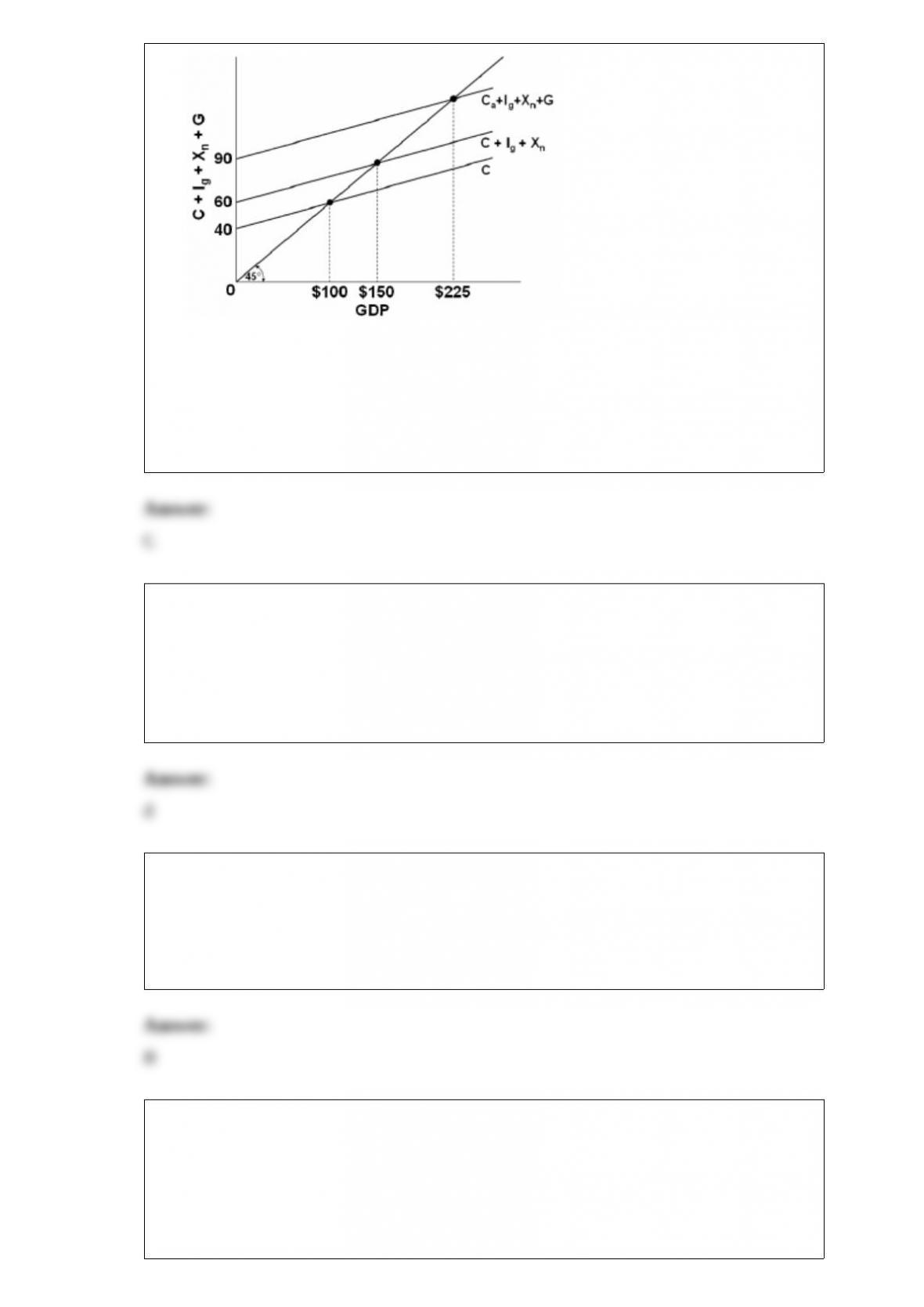
Refer to the above diagram. The sizes of the multipliers associated with changes in
investment and government spending in this economy are:
A.2.5 and 1.5 respectively.
B.3 and 2 respectively.
C.both 2.5.
D.2 and 3 respectively.
2) the price elasticity of demand for widgets is 0.80. assuming no change in the demand
curve for widgets, a 16 percent increase in sales implies a:
a.1 percent reduction in price.
b.12 percent reduction in price.
c.40 percent reduction in price.
d.20 percent reduction in price.
3) Which of the following is considered a legitimate concern of a large public debt?
A.Bankruptcy of the Federal government
B.Crowding-out of private investment
C.Burdening future generations
D.Collapse of the financial system
4) An important problem in evaluating public projects through the use of cost-benefit
analysis is that:
A.real costs cannot be stated in monetary terms.
B.one must decide whether to compare total costs and total benefits or marginal costs
and marginal benefits.
C.positive and negative externalities associated with such projects may be difficult to
measure.
D.the funding of such projects is inherently inflationary.
5) Statistical discrimination:
A.is malicious.
B.is profitable, but not malicious.
C.cannot persist because of competition.
D.explains all occupational discrimination.
6) the following demand schedule:
refer to the above data. the price elasticity of demand is relatively elastic:
a.in the $6-$4 price range.
b.over the entire $6-$1 price range.
c.in the $3-$1 price range.
d.in the $6-$5 price range only.
7) growth is advantageous to a nation because it:
a.promotes faster population growth.
b.lessens the burden of scarcity.
c.eliminates the economizing problem.
d.slows the growth of wants.
8) which of the following is not considered to be a growth-promoting institutional
structure?

a.well-established and enforced property rights.
b.strong government restrictions on international trade.
c.financial institutions that effectively link savers to investors.
d.a competitive market system.
9) Which of the following is not a DVC policy that might increase DVC economic
growth?
A.encouraging direct foreign investment
B.opening economics to world trade
C.establishing independent central banks
D.encouraging emigration of highly skilled workers
10) a production possibilities curve shows:
a.that resources are unlimited.
b.that people prefer one of the goods more than the other.
c.the maximum amounts of two goods that can be produced assuming the full use of
available resources.
d.combinations of capital and labor necessary to produce specific levels of output.
11) (Advanced analysis) Answer the next question(s) on the basis of the following
information for a private closed economy, where Ig is gross investment, S is saving, and
Y is gross domestic product (GDP).
Refer to the above information. In equilibrium saving will be:
A.$40.
B.$120.
C.$60.
D.$80.
12) If each taxpayer paid the same lump-sum amount regardless of income level, the tax
system would be:
A.disproportionate.
B.progressive.
C.proportional.
D.regressive.
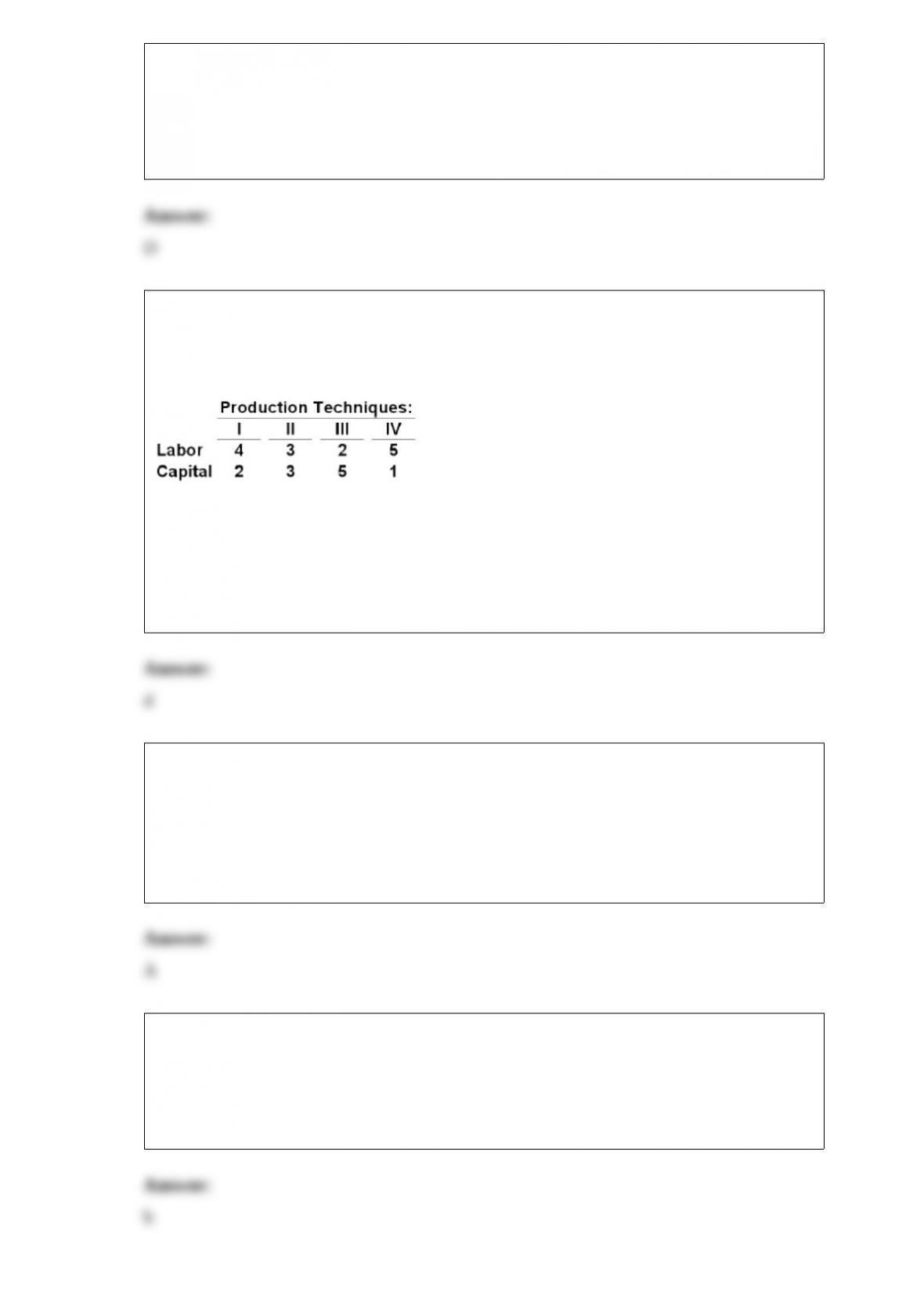
13) suppose 30 units of product a can be produced by employing just labor and capital
in the four ways shown below. assume the prices of labor and capital are $2 and $3
respectively.
refer to the above information. which technique is economically most efficient in
producing a?
a.i
b.ii
c.iii
d.iv
14) The right to buy and sell emission rights for sulfur-dioxide pollution was granted in
the:
A.Clean Air Act of 1990
B.Superfund Law of 1980
C.Market for Externalities Act of 1970
D.Acid-Rain Act of 1995
15) at the equilibrium price:
a.quantity supplied may exceed quantity demanded or vice versa.
b.there are no pressures on price to either rise or fall.
c.there are forces that cause price to rise.
d.there are forces that cause price to fall.
16)
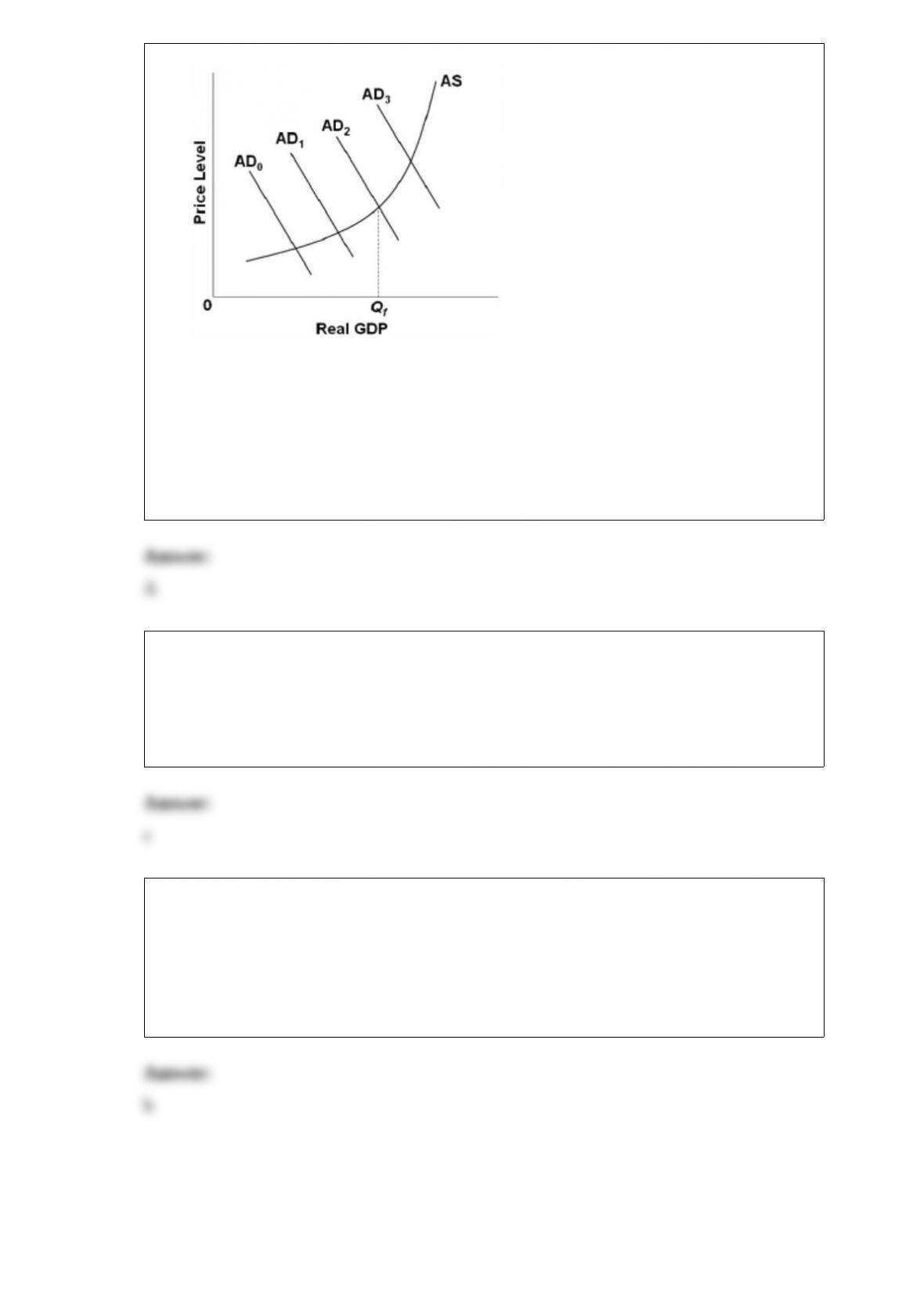
Refer to the above diagram, in which Qf is the full-employment output. An
expansionary fiscal policy would be most appropriate if the economy’s present
aggregate demand curve were at:
A.AD0.
B.AD2.
C.AD3.
D.None of the above.
17) economists argue that in treating patients:
a.physicians should use any test or procedures that might help the patient.
b.health care should not be rationed by physicians because it is an entitlement or right.
c.both benefits and costs should be taken into account by physicians.
d.physicians should use any test or procedure whose marginal benefit is positive.
18) which of the following will enable a nation to obtain a combination of consumer
goods and capital goods outside its production possibilities curve?
a.full employment.
b.international specialization and trade.
c.full production.
d.productive efficiency.