
Duopolists A and B face the following demand curves: QA = 120 ” 2PA + PB and QB =
120 ” 2PB + PA. If both firms have zero marginal cost and they form a cartel, what is
the profit-maximizing price and quantity?
a. P = 30, Q = 180.
b. P = 40, Q = 160.
c. P = 60, Q = 120.
d. P = 80, Q = 80.
e. P = 75, Q = 90.
A consumer buys 12 units of entertainment, measured on the horizontal axis, and 84
units of “all other things.” The consumer’s income elasticity of demand is equal to 1 for
both goods. If income increases by 10%, then the consumer’s marginal rate of
substitution at the utility-maximizing market bundle will:
a. increase.
b. decrease.
c. be equal to 1.
d. remain constant.
e. There is insufficient information to answer the question.

If a payoff is equally likely to be $1, $2, $3, $4, or $5, the square of the standard
deviation is:
a. 0
b. 2
c. 4
d. 10
e. 100
Hedge Fun is a landscaping firm that specializes in topiary. It contracts with the owners
of 125 local homes and provides its service at an annual fee of $1,300. Its average
variable cost is $800, and its annual fixed cost is $28,000. What is the degree of
operating leverage?
a. 2.7.
b. 2.1.
c. 1.8.
d. 1.3.
e. None of the above.

Suppose the Ajax Insurance Company provides insurance for skydivers whose wealth
before diving is $400. An accident will leave divers with a wealth of $100. The
company divides the divers into two classes: safe (probability of an accident = 0.2) and
unsafe (probability of an accident = 0.5). The utility of wealth for all divers is given by
the function: U(w) = w0.5. The utility of no insurance for the safe diver is:
a. 15
b. 17.3
c. 18
d. 18.3
e. none of the above.
Oligopoly is a market structure that necessarily has:
a. cartels.
b. a large number of firms with homogeneous products.
c. a large number of firms with slightly different products.
d. a small number of firms but more than one.
e. only one firm.

Consumer surplus is important to firms because:
a. it represents value consumers receive that they do not pay for.
b. market prices must incorporate consumer surplus.
c. they must pay taxes based on the level of consumer surplus.
d. if firms can capture it, they can increase their profitability.
e. a and d
If elasticity of demand is “2, marginal cost is $4, and average cost is $6, a
profit-maximizing markup price is:
a. $4.
b. $6.
c. $8.
d. $10.
e. $12.
Most states require car owners to provide evidence that they have auto insurance when
they register their cars and obtain license plates. For the sellers of insurance policies,

this may help to limit the severity of the:
a. information asymmetry.
b. moral hazard problem.
c. signaling problem.
d. adverse selection problem.
e. Akerlof problem.
The demand curve’s usual slope implies that consumers:
a. buy more as the price of a good is increased.
b. buy more as a good is advertised more.
c. buy more at higher average incomes.
d. buy less as the price of a good is increased.
e. have tastes that sometimes change.
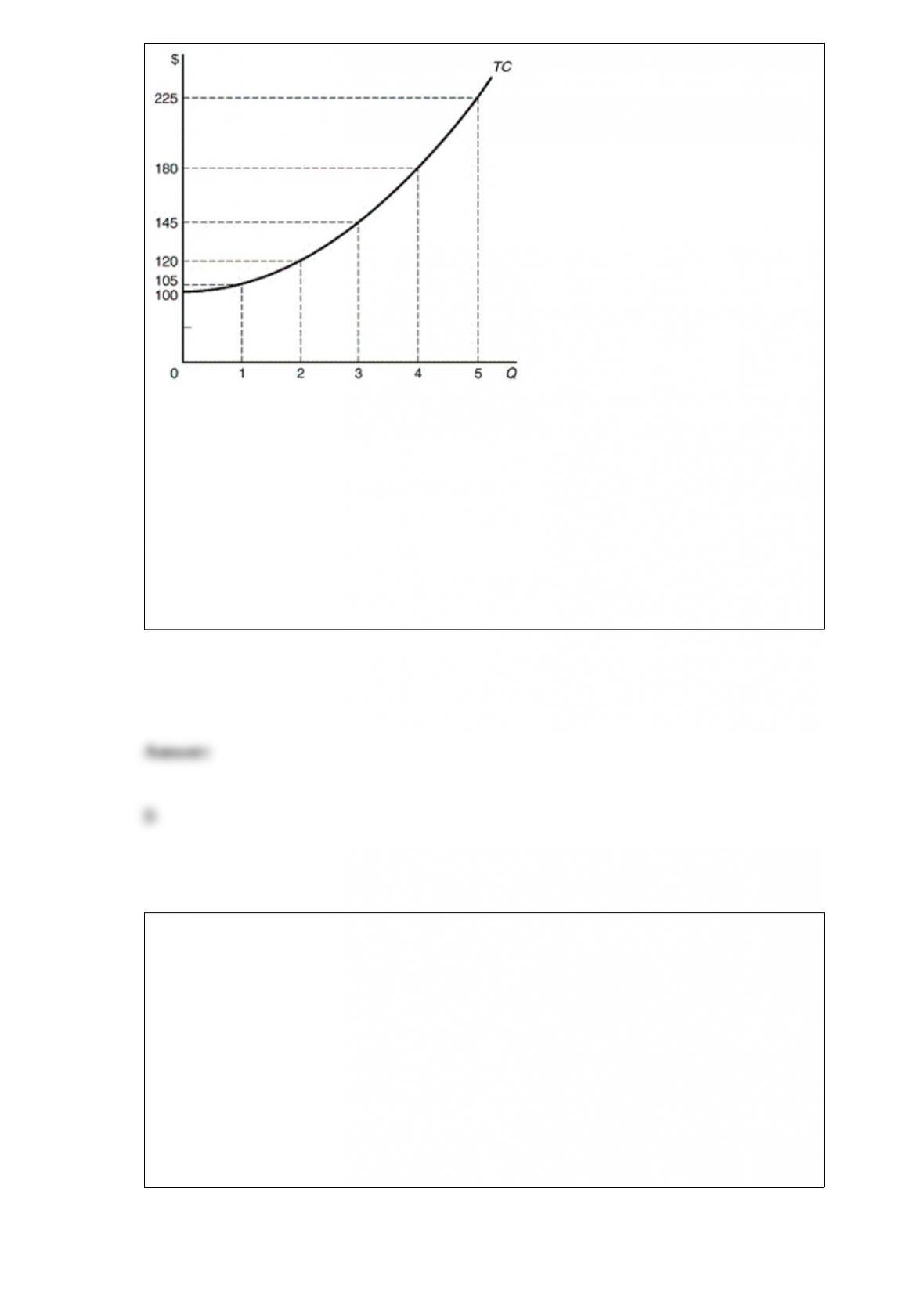
The following figure represents the short-run total cost function for the Fidget
Company, which produces widgets. The equation for the marginal cost function is:
a. MC = 100.
b. MC = 10Q.
c. MC = 10Q2.
d. MC = 100Q.
e. MC = 100 + 5Q2.
Managers make decisions that contribute to the profitability of a firm by:
a. exploiting market efficiencies.
b. taking on risks.
c. engaging in illegal behavior.
d. maximizing sales.
e. manipulating the share price of the firm’s stock.
In the model of perfect competition, there are:
a. high barriers to entry and no nonprice competition.
b. low barriers to entry and some advertising and product differentiation.
c. very high barriers to entry and some advertising and product differentiation.
d. high barriers to entry and some advertising and product differentiation.
e. low barriers to entry and no nonprice competition.
When an economist says an oligopoly has a ‘small” number of firms, the economist
means:
a. exactly 1.
b. exactly 2, 3, or 4.
c. few enough to allow for interdependence.
d. few enough to allow for perfectly inelastic demand curves.
e. few enough to allow for four stages of industry development.
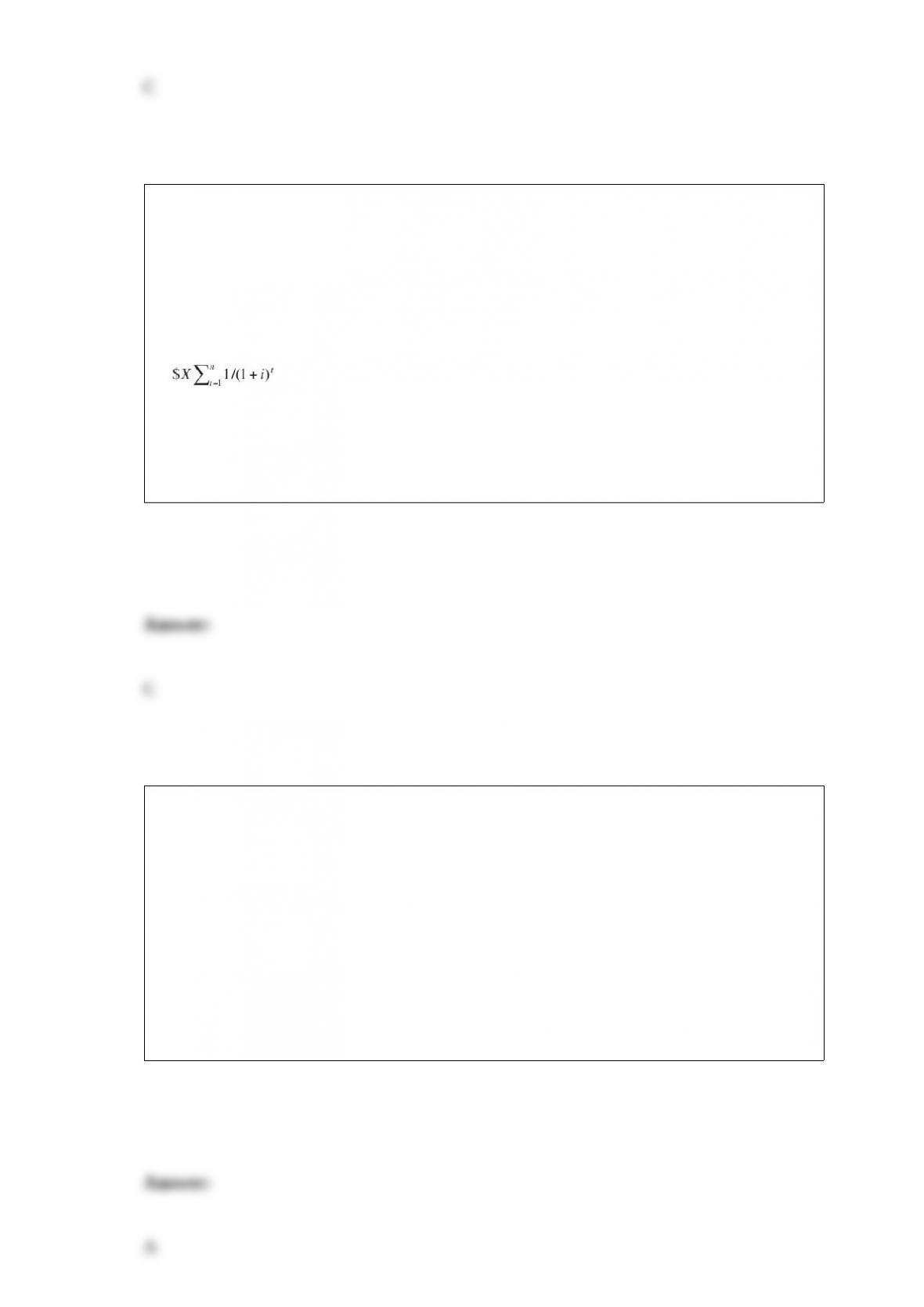
If the annual interest rate is i, the present value of $X to be received at the end of each
of the next n years is:
a. $X/i.
b. $X/(1 + i)n.
c.
d. $X[(1 + i)n] / [ i(1 + i)n ” 1].
e. $X / [i(1 + i)n ” 1].
Transferable emissions permits establish property rights to:
a. generate a certain amount of pollution.
b. generate more business for the Chicago Board of Trade.
c. reduce the regulatory burden of the FTC.
d. allocate the costs of pollution control equitably.
e. generate unlimited amounts of specified pollutions.

The chain rule of differentiation is:
a. Y = U(W(X)) dY/dX = dY/dX dW/dX.
b. Y = U(W(X)) dY/dX = dU/dW dW/dX.
c. Y = U(W(X)) dY/dX = dU/dX dW/dX.
d. Y = U(W(X)) dY/dX = dW/dU dU/dX.
e. Y = U(W(X)) dY/dX = dU/dU dU/dX.
If marginal revenue exceeds marginal costs, to increase profits a firm should:
a. reduce output.
b. increase output.
c. hold output constant.
d. increase marginal revenue.
e. reduce marginal cost.
Kenny’s Cartage hauls crushed stone for $15 a ton and has total costs given by TC =
100 + 5X + X2. The profit-maximizing level of output is:
a. 5 tons.
b. 2.1 tons.
c. 10 tons.
d. 20 tons.
e. 0 tons.
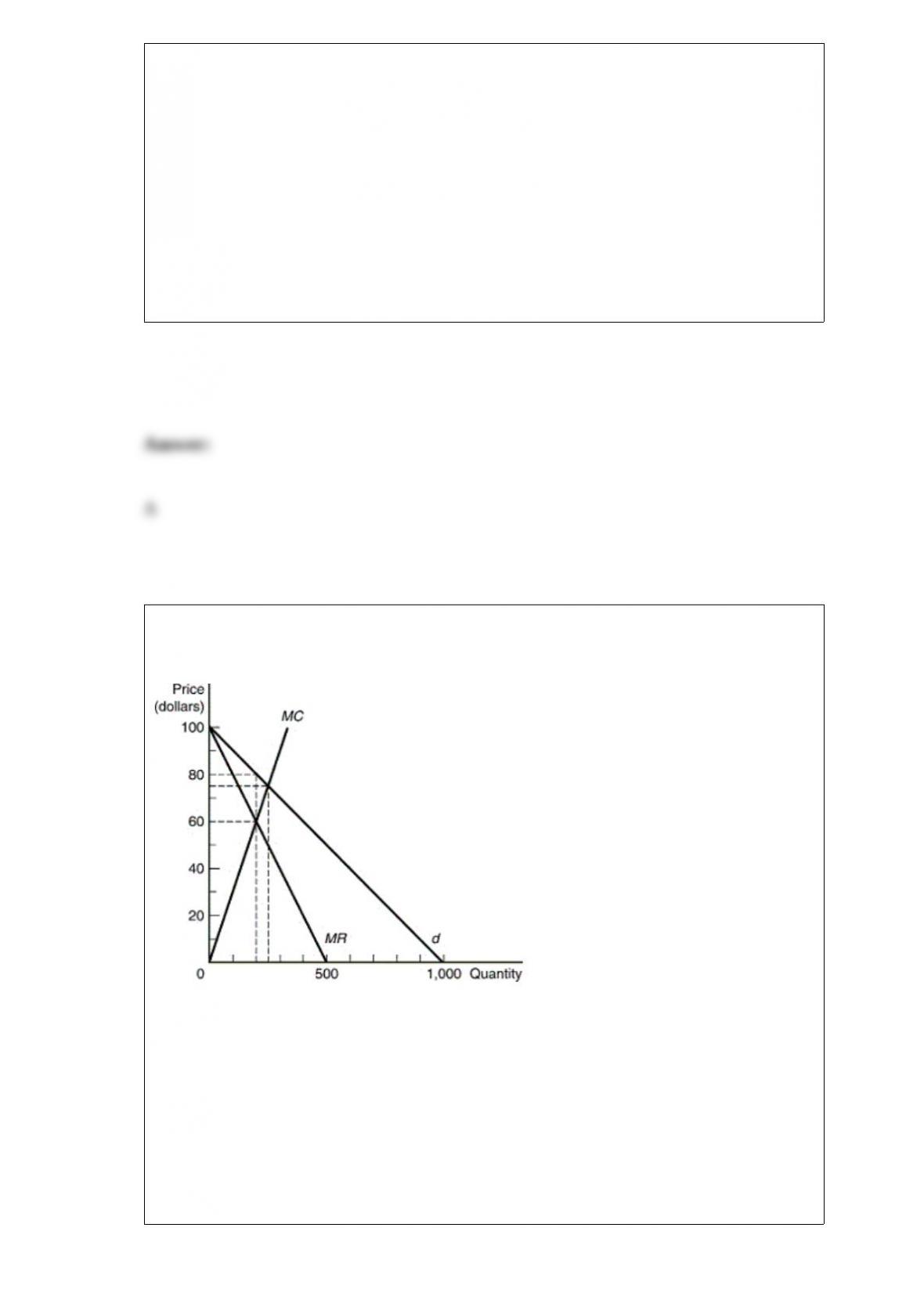
If the cartel described by the accompanying diagram is broken up and forced into a
perfectly competitive market situation, the optimal output and price will be:
a. Q = 200 and P = $80.
b. Q = 260 and P = $60.
c. Q = 250 and P = $80.
d. Q = 250 and P = $75.
e. Q = 500 and P = $60.
Maximum profit occurs wherever:
a. the slope of the total revenue function equals marginal revenue.
b. the slope of the total revenue function equals marginal cost.
c. the slope of the total revenue function is maximized.
d. the total revenue is maximized.
e. none of the above.
Whenever average variable cost is declining with increases in output:
a. marginal cost is always declining as average total cost declines.
b. average total cost at first decreases and then increases with output.
c. marginal cost is always declining as average total cost increases.
d. marginal cost at first decreases and then increases with output.
e. marginal cost at first increases and then decreases with output.
Donald Trumpet is indifferent between rates of return satisfying R = 0.10 + 0.01s (s is
the standard deviation). Donald is:
a. risk-averse and profit maximizing.
b. risk-averse and not profit maximizing.
c. risk loving and profit maximizing.
d. risk loving and not profit maximizing.
e. risk-neutral.
Points along a budget constraint describe:
a. market baskets that cost the same amount of money.
b. market baskets that bring the consumer equal utility.
c. quantities of a good that the consumer is willing and able to buy at alternative market
prices.
d. alternative prices that a producer might charge for a good.
e. alternative levels of utility that a consumer might get from consuming a given market
basket.
If there is only one variable input, average variable cost can be defined as the:
a. output’s price divided by the input’s average product.
b. output’s price divided by the input’s marginal product.
c. price of the variable input divided by its average product.
d. price of the variable input divided by its marginal product.
e. price of the variable input multiplied by its marginal product.
In the United States most cartels were declared illegal by the:
a. Sherman Antitrust Act.
b. Interstate Commerce Commission.
c. Supreme Court.
d. Constitution.
e. Declaration of Independence.
The slope coefficient estimate b from a regression of profits on sales of a number of
firms in the coal industry is 0.075. How should you interpret this coefficient?
a. Average profit in the coal industry is 7.5%.
b. If a firm in the coal industry were to increase its sales by $1, its profits would rise on
average by $0.075.
c. If a firm has 1 more dollar in sales than another firm in the coal industry, it will have
7.5 more cents in profit on average.
d. Average profit in the coal industry is .75%.
e. If a firm in the coal industry were to increase its sales by $1, its profits would rise on
average by $0.0075.
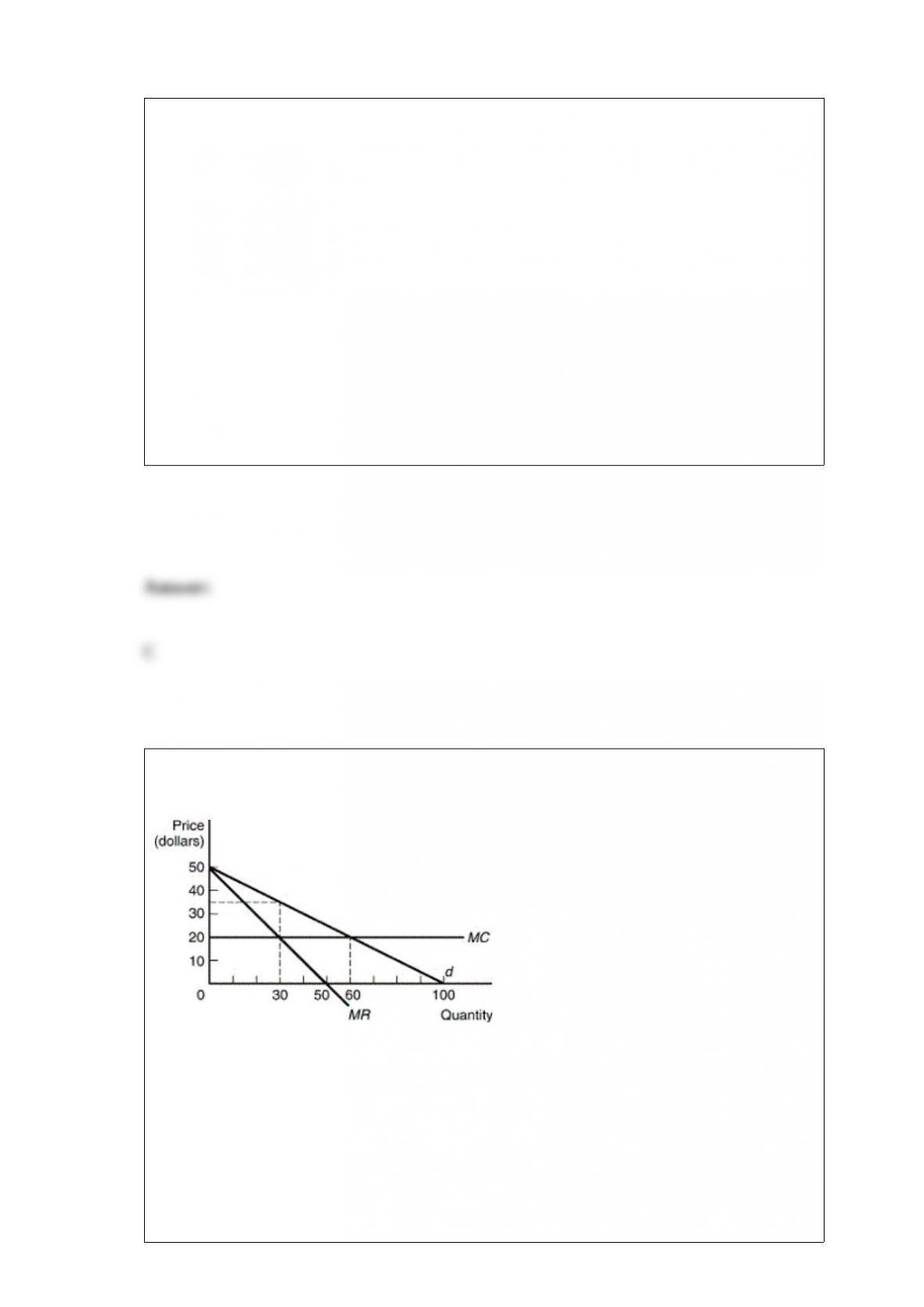
If the monopolist shown in the following figure could practice first-degree price
discrimination, the consumer surplus would be:
a. $0.
b. $225.
c. $450.
d. $900.

e. $1,200.
The cost of pollution originating in the chemical industry is Cp = 4P + 2P2, where P is
the quantity of pollutants emitted. The cost of pollution control for this industry is Cc =
120 ” 12P. What is the optimal level of pollution?
a. 0 units.
b. 1 unit.
c. 2 units.
d. 3 units.
e. 4 units.
In an English auction:
a. buyers bid against each other with a succession of increasingly higher prices until
only one remains.
b. a bid is announced, and if no buyer accepts the bid in a given period of time, a new,
slightly lower, bid is announced; this procedure continues until a bidder accepts the
announced price.
c. each bidder submits a price that is known only to that bidder; bids are opened and the
highest (lowest) bid is accepted.
d. each bidder submits a price that is known only to that bidder; bids are opened and the
highest (lowest) bidder wins, but the transaction occurs at the second highest (lowest)
price.
e. none of the above.