
If the price level in the United States is 110, the price level is 135 in Mexico, and the
nominal exchange rate is 12.5 pesos per dollar, what is the real exchange rate from the
U.S. perspective?
A) 8.8
B) 10.2
C) 10.8
D) 11.4
If a corporation goes bankrupt, bondholders have ________ on the firm’s assets.
A) no claim
B) third claim, after the IRS and stockholders,
C) second claim, after stockholders,
D) first claim
Economists assume that individuals
A) behave in unpredictable ways.
B) will never take actions to help others.
C) prefer to live in a society that values fairness above all else.
D) are rational and respond to incentives.
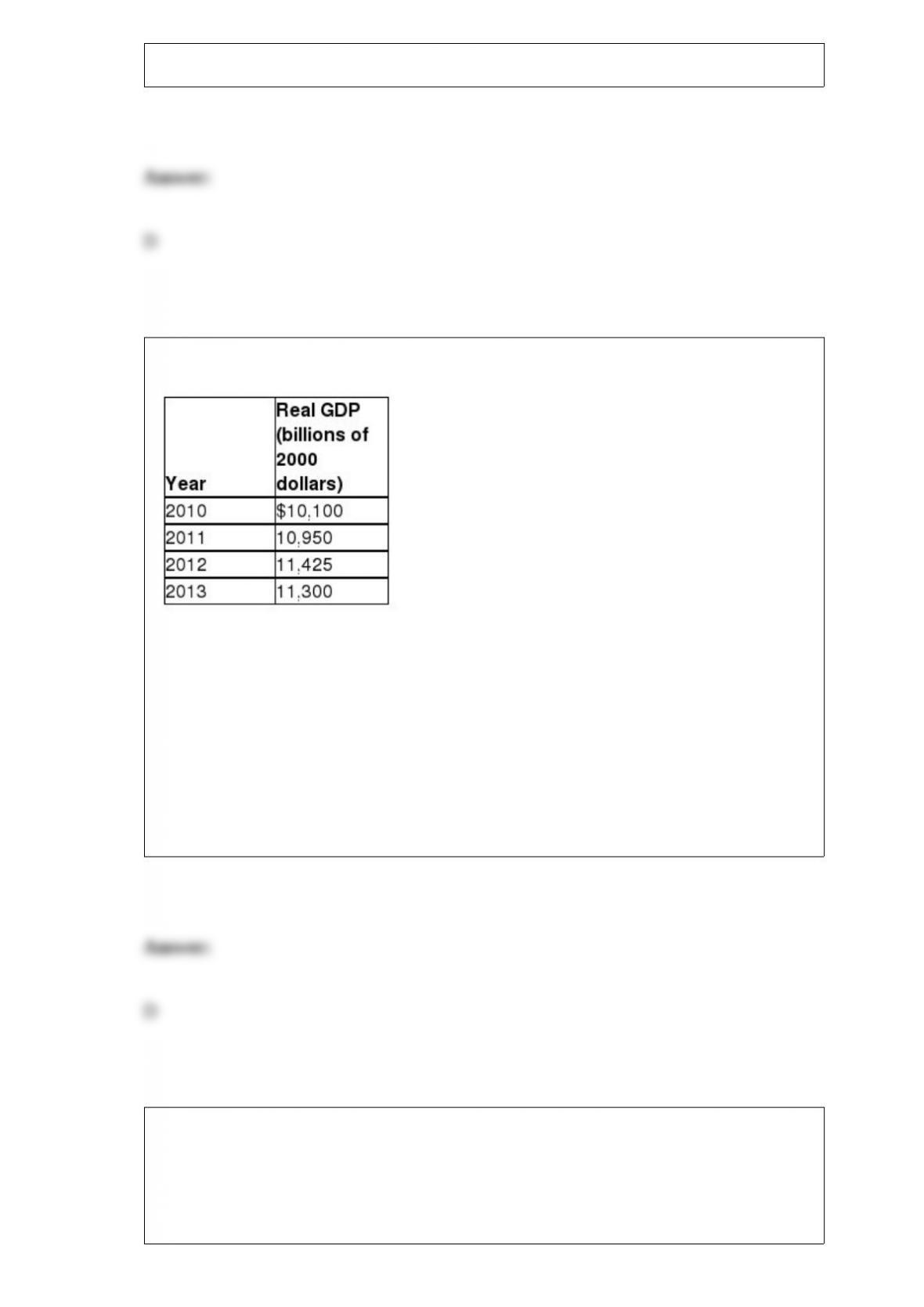
Table 10-2
Using the table above, what is the approximate growth rate of real GDP from 2011 to
2012?
A) 1%
B) 2%
C) 3%
D) 4%
Tomas increased his consumption of potato chips when the price of pistachios
increased. For Tomas, potato chips and pistachios are
A) substitutes in consumption.

B) both inferior goods.
C) complements in consumption.
D) both luxury goods.
The costs in time and other resources that parties incur in the process of agreeing to and
carrying out an exchange of goods or services are called
A) exchange costs.
B) implicit costs.
C) transactions costs.
D) selling costs.
In the dynamic aggregated demand and aggregate supply model, inflation occurs if
A) AD shifts faster than SRAS.
B) AD shifts slower than SRAS.
C) SRAS shifts faster than AD.
D) LRAS shifts faster than AD.

Which of the following is not an assumption made by the dynamic model of aggregate
demand and aggregate supply?
A) Potential real GDP increases continuously.
B) The aggregate demand curve shifts to the right during most periods.
C) The short-run aggregate supply curve shifts to the right except during periods when
workers and firms expect higher wages.
D) Aggregate demand and potential real GDP decrease continuously.
Carolyn spends her income on popular magazines and music CDs. If the price of a CD
is four times the price of a magazine and if Carolyn is maximizing her utility, she buys
A) both goods until the marginal utility of the last CD purchased is four times the
marginal utility of the last magazine purchased.
B) both goods until the marginal utility of the last magazine purchased is four times the
marginal utility of the last CD purchased.
C) four times as much magazines as CDs.
D) four times as much CDs as magazines.

According to the “Rule of 70,” how many years will it take for real GDP per capita to
double when the growth rate of real GDP per capita is 5%?
A) less than 1 year
B) 5 years
C) 14 years
D) 35 years
Suppose a bank has $100 million in checking account deposits with no excess reserves
and the required reserve ratio is 10 percent. If the Federal Reserve reduces the required
reserve ratio to 4 percent, then the bank can make a maximum loan of
A) $0.
B) $4 million.
C) $6 million.
D) $10 million.
Which of the following statements about the economic decisions consumers, firms, and
the government have to make is false?
A) Governments face the problem of scarcity in making economic decisions.
B) Only individuals face scarcity; firms and the government do not.

C) Both firms and individuals face scarcity.
D) Each faces the problem of scarcity which necessitates trade-offs in making economic
decisions.
You borrow $10,000 from a bank for one year at a nominal interest rate of 5%. If
inflation over the year is 2%, what is the real interest rate you are paying?
A) 2%
B) 2.5%
C) 3%
D) 5%
When production in an economy grows more quickly than the population in that
economy, which of the following must be occurring?
A) Real GDP is falling.
B) Incomes are growing at a slower rate than the population.
C) Real GDP per capita is rising.
D) Living standards are falling.

The expenses you encounter when you buy in one market and sell in a distant market
are known as
A) production costs.
B) fixed costs.
C) transactions costs.
D) sunk costs.
The sale of Treasury securities by the Federal Reserve will, in general,
A) not change the money supply.
B) not change the quantity of reserves held by banks.
C) increase the quantity of reserves held by banks.
D) decrease the quantity of reserves held by banks.