
Actions taken by investors who sell a country’s currency in anticipation of buying it
back later at a lower price is known as
A) purchasing power parity.
B) currency arbitrage.
C) destabilizing speculation.
D) exchange rate manipulation.
If aggregate expenditure is greater than GDP, how will the economy reach
macroeconomic equilibrium?
A) Inventories will decline, and GDP and employment will decline.
B) Inventories will rise, and GDP and employment will decline.
C) Inventories will decline, and GDP and employment will rise.
D) Inventories will rise, and GDP and employment will rise.
Article Summary. Concerned about slow economic growth, the Fed announced in
September 2013 that it would postpone winding down its $85 billion a month bond
purchasing program which has been a key component of its monetary stimulus
package. Fed Chairman Ben Bernanke would not commit to a timeline for
reducing the bond purchases, stating that the program was “not on a preset
course.” The Fed’s forecasts of economic growth have been lowered for 2013 and
2014, and the Fed does not expect to raise interest rates until 2015. Since late 2008,
the Fed has held its benchmark interest rate near zero, while its balance sheet has

tripled to more than $3.6 trillion. The Fed also stated that so long as inflation did
not become a threat, it would not raise interest rates until the unemployment rate
dropped to 6.5 percent. At the time of the announcement, the unemployment rate
was 7.3 percent. Source: Pedro da Costa and Alister Bull, “Fed Surprises, sticks to
stimulus as it cuts growth outlook,” Reuters, September 18, 2013.
When the Fed announced it did not expect to raise its benchmark interest rate until
2015, it was referring to the
A) prime rate.
B) federal funds rate.
C) long-term real rate of interest.
D) required reserve rate.
Of the following high-income countries, which has the highest number of CT scanners
per 1 million population?
A) Canada
B) Japan
C) the United Kingdom
D) the United States
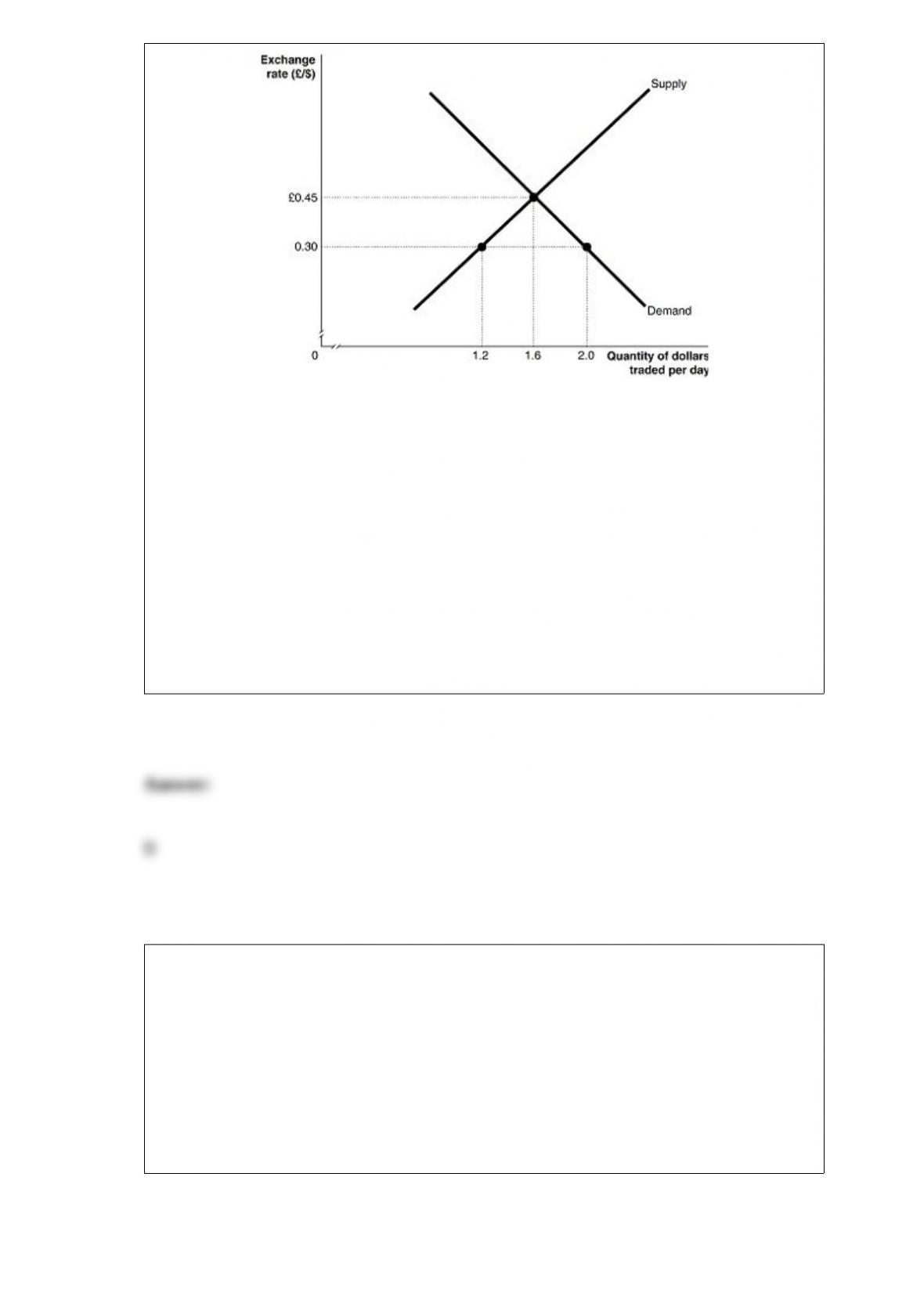
Figure 19-12
The graph above, depicts supply and demand for U.S. dollars during a trading day. At a
fixed exchange rate of 0.30 pounds per dollar, the dollar is ________ versus the pound.
A ________ of the dollar would correct the fundamental disequilibrium that exists in
this market.
A) undervalued; devaluation
B) undervalued; revaluation
C) overvalued; revaluation
D) overvalued; devaluation
An increase in the interest rate causes
A) a movement up along the money demand curve.
B) a movement down along the money demand curve.
C) the money demand curve to shift to the left.
D) the money demand curve to shift to the right.
Consider the following items:
a. the novel “The DaVinci Code” by Dan Brown
b. the “The Spirited Shipper,” an innovative wine shipping box
c. a Swiss chef’s award-winning recipe
d. an original fabric design, for example, the fabric used for “Coach” bags and luggage
Which of the items listed is an example of intellectual property?
A) a and b only
B) a, b, and c
C) a and d only
D) all of the items listed
Figure 5-8 Consider a
chemical plant that discharges toxic fumes over a nearby community. To reduce the
emissions of toxic fumes the firm can install pollution abatement devices. Figure 5-8
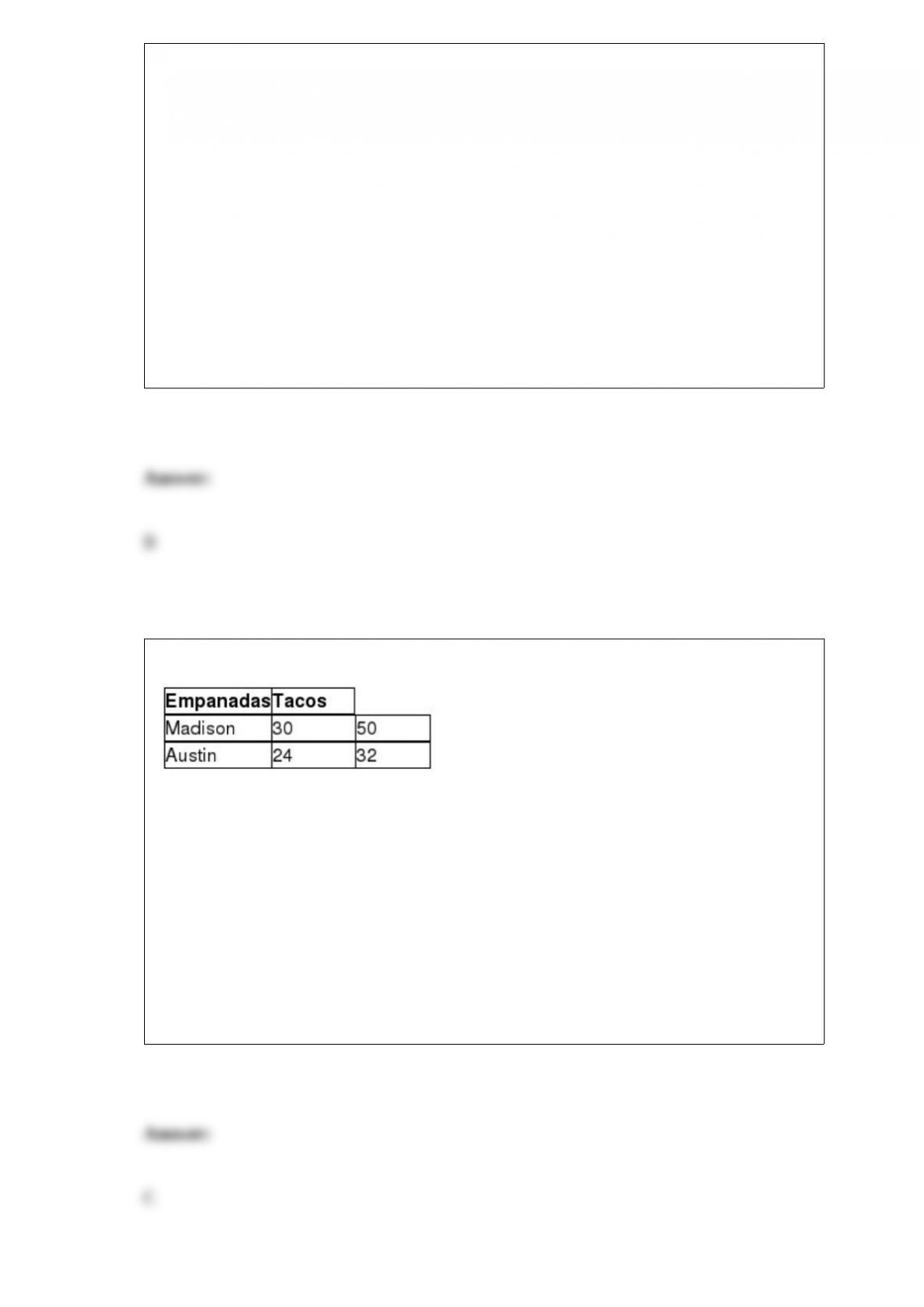
shows the marginal benefit and the marginal cost from reducing the toxic fumes
emissions.
Suppose the emissions reduction target is currently established at 8 million tons. Should
society undertake to reduce an additional 1 million tons so that the total reduction is 9
million tons?
A) No, because there is a net cost represented by the area B + C.
B) Yes, because the marginal benefit exceeds the marginal costs.
C) Yes, because toxic fumes are dangerous and must be eliminated at any cost.
D) No, because the firms will pass the additional cost on to consumers.
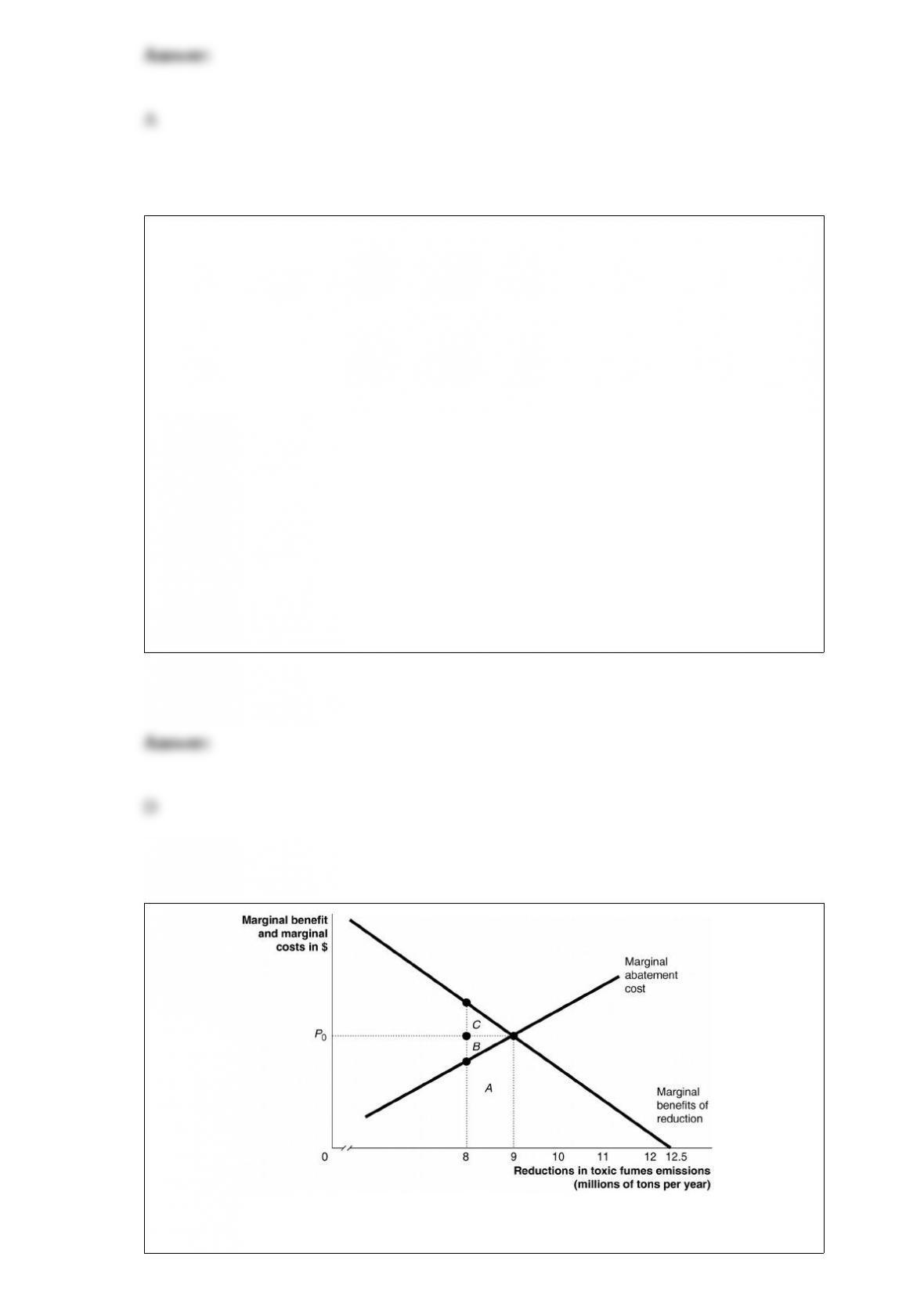
Table 9-5
Madison and Austin own Cafe Ole’. Table 9-5 lists the number of empanadas and tacos
Madison and Austin can each make in one hour. Select the statement that accurately
interprets the data in the table.
A) Madison has a comparative advantage in making empanadas.
B) Austin has an absolute advantage in making tacos.
C) Austin has a comparative advantage in making empanadas.
D) Austin has a comparative advantage in making empanadas and making tacos.

In the United States
A) the income tax system has little or no impact on the distribution of income.
B) the after-tax income distribution of income is more equal than the before-tax
distribution.
C) once a person is in poverty, it is very difficult for a person to get out of poverty.
D) the degree of income mobility is relatively low.
Ted’s Pancake Kitchen suffers a short-run loss. When should Ted decide to shut down
rather than continue to produce?
A) if his Kitchen’s revenue is less than its variable costs
B) if his Kitchen’s revenue is less than its fixed costs
C) if his Kitchen’s revenue is less than its explicit costs
D) if his Kitchen’s revenue is less than its total costs
The Federal Reserve was established in 1913 to
A) prevent inflation by decreasing the money supply.
B) stimulate the economy by increasing bank reserves.
C) stop bank panics by acting as a lender of last resort.

D) prevent bad loans by requiring banks to hold reserves.
Jenna runs a small boutique in Capitola. She tells one of her suppliers that she is willing
to pay $6 for a pair of wool hand warmers and not a dime more. On the basis of this
information, what can you conclude about her price elasticity of demand for wool hand
warmers?
A) It is elastic.
B) It is perfectly elastic.
C) It is perfectly inelastic.
D) The price elasticity coefficient is 0.
The purchase by an individual or firm of stock or bonds issued in another country is
called
A) foreign exchange arbitrage.
B) foreign direct investment.
C) foreign portfolio investment.
D) global stock exchange.
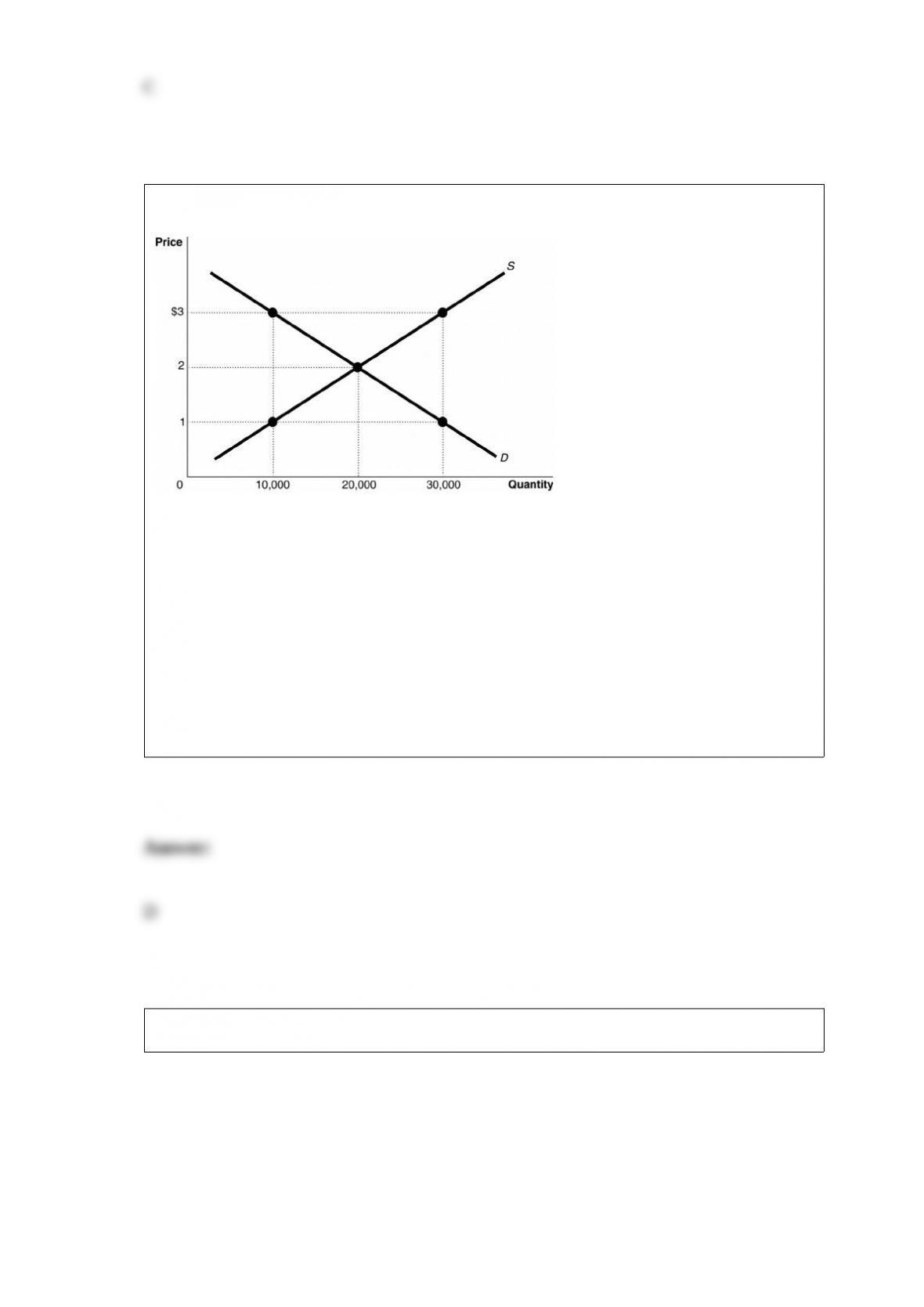
Figure 4-4
The figure above represents the market for iced tea. Assume that this is a competitive
market. If 20,000 units of iced tea are sold
A) the deadweight loss is equal to economic surplus.
B) producer surplus equals consumer surplus.
C) the marginal benefit of each of the 20,000 units of iced tea equals $3.
D) marginal benefit is equal to marginal cost.
Table 4-4
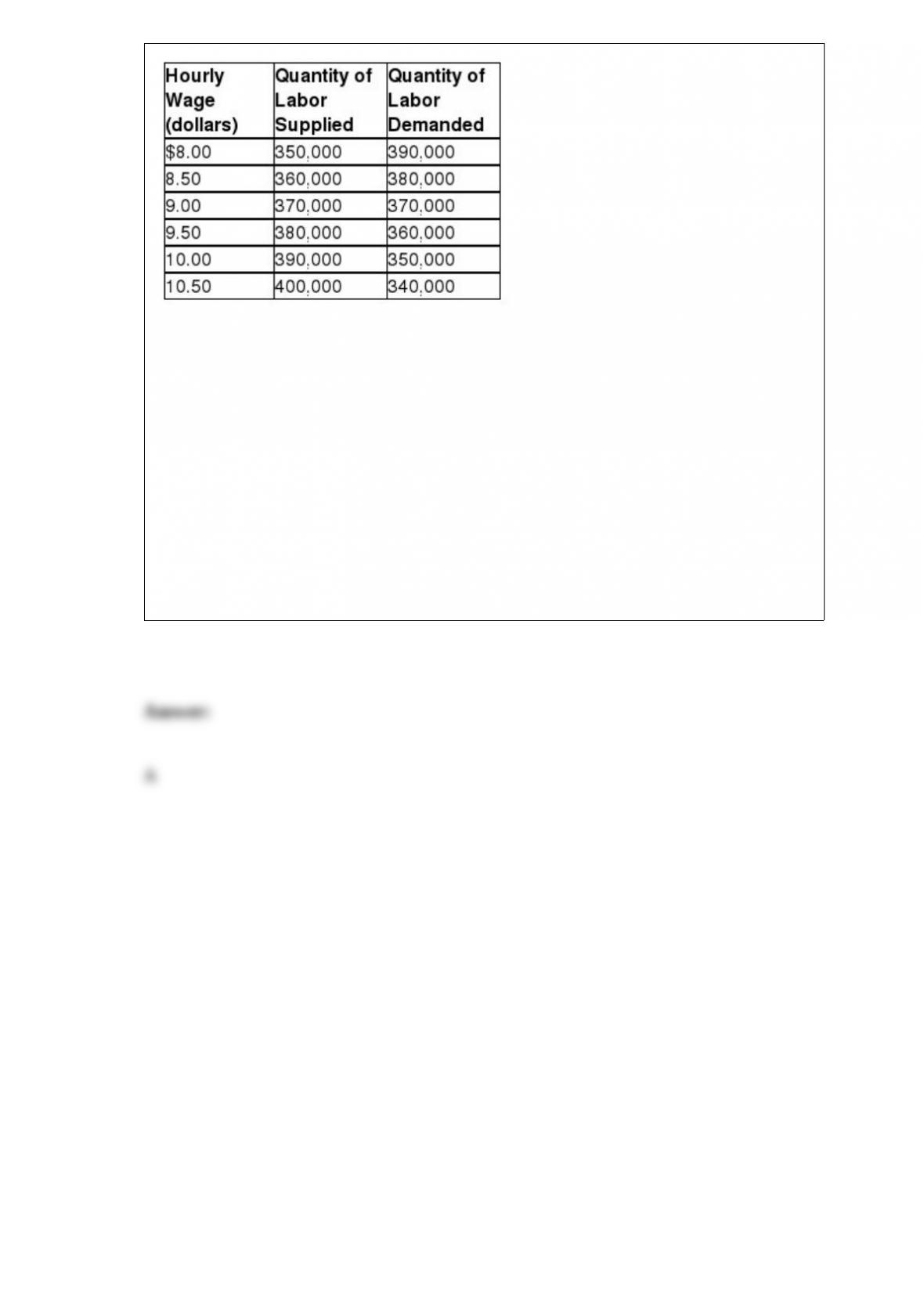
Table 4-4 shows the demand and supply schedules for the low-skilled labor market in
the city of Westover.
If a minimum wage of $10.00 an hour is mandated, what is the quantity of labor
supplied?
A) 390,000
B) 370,000
C) 350,000
D) 40,000