
Suppose the development of new drought-resistant hybrid seed corn leads to a
50-percent increase in the average yield per acre without increasing the cost to the
farmers who use the new technology. If the conditions in the corn production industry
are approximated by the price-taker model, which of the following is most likely to
occur?
a. The price of corn will increase.
b. The price of soybeans (a substitute for corn) will increase.
c. The profits of corn farmers who quickly adopt the new technology will increase.
d. The profits of corn farmers who do not adopt the new technology will increase.
If a movie theater is going to gain by charging students a dollar less than other
customers,
a. the demand of students must be more elastic than that of other customers.
b. the demand of students must be less elastic than that of other customers.
c. students must have higher incomes than other customers.
d. other customers must enjoy movies more than students.
The Keynesian analysis of fiscal policy implies that
a. fiscal policy should generally be expansionary except during periods of economic
recession.

b. fiscal policy should generally be restrictive except during inflationary booms.
c. the federal budget should be balanced annually except during war.
d. the federal budget should be used to maintain aggregate demand at a level consistent
with full employment.
If the Federal Reserve is engaging in open market operations designed to expand the
money supply, it is probably
a. selling government securities to banks.
b. selling government securities to the public.
c. buying government securities from the public.
d. encouraging banks to exchange their Fed deposits for currency.
When is the definition and enforcement of property rights especially difficult?
a. when many polluters harm a large group of people by emitting the same pollutant
b. when a single polluter is harming a single person or entity
c. when land is owned by a corporation
d. when the benefits of prosecution are clear

The demand for union labor is usually determined by
a. the number of union members.
b. the strength of the union.
c. the total value of the union labor in the production process.
d. market conditions outside the union’s direct control.
If the price of tuna fish increases from 50 cents to 60 cents per can and the quantity
demanded decreases from 100 cans to 50 cans, then the tuna fish producer could
increase its total revenue by
a. lowering price.
b. decreasing quantity supplied.
c. leaving price the same.
d. raising price.
e. decreasing supply.

The sound economic institutions and policies needed for economic growth and
prosperity
a. emerge from the political process, if they emerge at all.
b. are unaffected by political decision-making and constitutional rules.
c. are virtually guaranteed to emerge, if democracy becomes the form of government in
a nation.
d. can only emerge from a democracy
If Apple Computer Corporation constitutes a sizeable share of your current stock
holdings, the purchase of which of the following stocks would provide you with the
greatest reduction in risk?
a. Hewlett-Packard
b. IBM
c. Dell Computer Corporation
d. Wal-Mart
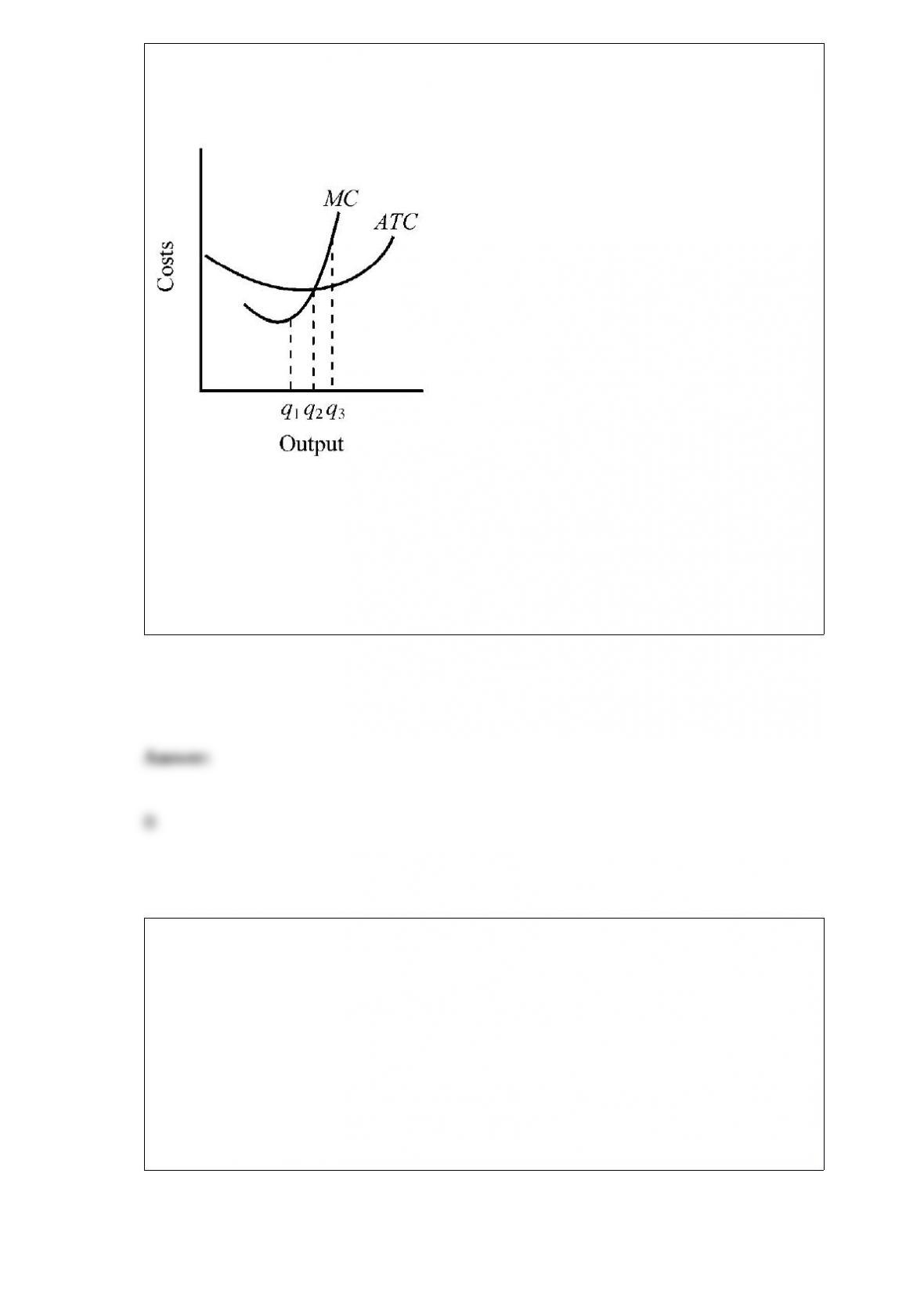
Use the figure to answer the following question(s).
Figure 8-6
At what output does the firm depicted in Figure 8-6 minimize its per-unit cost of
production?
a. q1
b. q2
c. q3
d. an output beyond q3
Which of the following about inventory changes and GDP is true?
a. Inventory investment adds to GDP because it represents goods produced during the
current period.
b. Inventory investment is subtracted from GDP because the goods were not sold during
the period.
c. Inventory investment does not affect GDP because the goods were not sold during the
period.
d. Inventory investment does not affect GDP because it does not represent goods
produced during the period.

If the United Auto Workers union can obtain a substantial wage increase for auto
workers, there will be
a. a decrease in the supply of automobiles, which is a shift to the right of the supply
curve.
b. a decrease in the supply of automobiles, which is a shift to the left of the supply
curve.
c. an increase in the supply of automobiles, which is a shift to the right of the supply
curve.
d. an increase in the supply of automobiles, which is a shift to the left of the supply
curve.
Consider the market for grapes. An increase in the wage paid to grape pickers will
cause the
a. demand curve for grapes to shift to the right, resulting in a higher equilibrium price
for grapes and a reduction in the quantity consumed.
b. demand curve for grapes to shift to the left, resulting in a lower equilibrium price for
grapes and an increase in the quantity consumed.
c. supply curve for grapes to shift to the left, resulting in a lower equilibrium price for
grapes and a decrease in the quantity consumed.
d. supply curve for grapes to shift to the left, resulting in a higher equilibrium price for
grapes and a decrease in the quantity consumed.
Economists refer to expenditures on training, education, and skill development
designed to increase the productivity of an individual as
a. overhead expenditures.
b. investments in human capital.
c. non-exhaustive expenditures.
d. social capital.
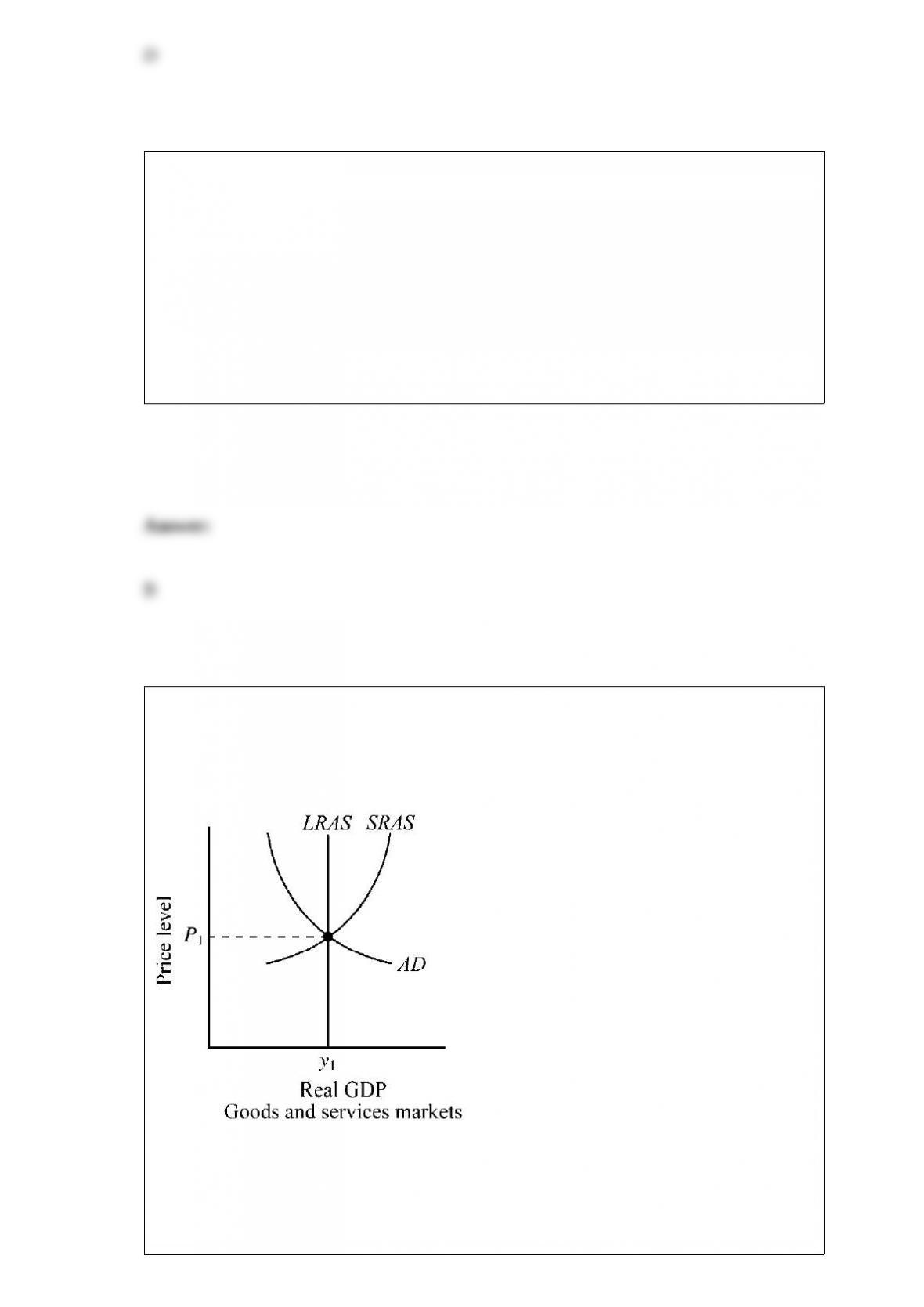
Use the figure below to answer the following question(s).
Figure 9-2
Figure 9-2 indicates that the output of the economy, y1, is
a. greater than the economy’s long-run capacity.
b. equal to the economy’s long-run capacity.
c. less than the economy’s long-run capacity.
d. not consistent will full employment of the economy’s resources.

A decrease in the required reserve ratio would be
a. a restrictive policy because it lowers the amount of total reserves in the banking
system.
b. a restrictive policy because it lowers the amount of excess reserves in the banking
system.
c. an expansionary policy because it raises the amount of required reserves in the
banking system.
d. an expansionary policy because it raises the amount of total reserves in the banking
system
e. an expansionary policy because it raises the amount of excess reserves in the banking
system.
Which one of the following transactions would be included in GDP?
a. Ava pays $50 for a used picture frame at a neighborhood garage sale.
b. Ethan donates $500 to his town’s junior college scholarship fund.
c. Emily pays $500 to fix the front end of her car damaged in a recent accident.
d. Mia pays $5,000 to purchase 100 shares of Microsoft stock.

A decrease in the money supply
a. lowers the interest rate, causing a decrease in investment and a decrease in GDP.
b. lowers the interest rate, causing a decrease in investment and an increase in GDP.
c. raises the interest rate, causing an increase in investment and a decrease in GDP.
d. raises the interest rate, causing an increase in investment and an increase in GDP.
e. raises the interest rate, causing a decrease in investment and a decrease in GDP.
Gross domestic product during a period is measured by adding
a. incomes received by households minus the sale of factor services supplied
domestically.
b. factor payments made by domestic firms minus retained earnings and indirect
business taxes.
c. expenditures on new final goods and services produced domestically.
d. the market value of all goods and services produced domestically and then
subtracting net exports from that figure.
When the price of a good is legally set below the equilibrium level, a shortage often
results. This shortage
a. is a temporary failure of the market mechanism.
b. is the result of a shift in demand.
c. is the result of a shift in supply.
d. occurs because the price ceiling prevents the market mechanism from establishing an

equilibrium price.
Which of the following countries began economic liberalization in the 1970s and have
achieved an impressive record of economic growth since that time?
a. Venezuela and Zimbabwe
b. China and Chile
c. Mexico and Canada
d. United States and Norway
A downward-sloping portion of a long-run average total cost curve is the result of
a. economies of scale.
b. diseconomies of scale.
c. diminishing returns.
d. the existence of fixed resources.

If a market is contestable, the market will be characterized by
a. minimum-cost production methods and a competitive (normal) profit rate.
b. high barriers to entry and a small number of suppliers.
c. prices in excess of production costs and mergers leading to monopoly.
d. a large number of suppliers offering a homogeneous product.
Under the adaptive expectations hypothesis, which of the following is the most likely
short-run effect of a move to a more expansionary monetary policy?
a. higher prices and no change in real output
b. higher prices and expansion in real output
c. no change in prices but an expansion in real output
d. no change in either prices or real output
The Earned Income Tax Credit provides a tax credit or rebate to
a. businesses that undertake investment expenditures.

b. taxpayers with incomes greater than $100,000.
c. persons with low incomes who are working.
d. single parent families when the parent stays home to take care of the children.
Which of the following would generate a dollar demand for the euro?
a. American exports to Europe.
b. European demand for U.S. government bonds.
c. American demand for European real estate.
d. All of the above are correct.
The Social Security system of the United States is based on the pay-as-you-go
principle. This indicates that funding of the benefits paid to current retirees comes
primarily from
a. the income generated by the system’s ownership of stock.
b. the tax payments of current workers.
c. the funds that current retirees paid into their personal savings accounts during their
working years.
d. money created by the Federal Reserve system.

Which of the following most clearly indicates that fiscal policy is becoming more
expansionary?
a. An increase in the budget deficit relative to GDP
b. A reduction in the budget deficit relative to GDP
c. An increase in the budget surplus relative to GDP
d. An increase in the nominal (dollar) size of the budget deficit
When individuals shift funds from money market mutual funds to no-load stock and
bond mutual funds,
a. the growth rate of M1 will decline but the growth of M2 will be unaffected.
b. the growth rate of M2 will decline but the growth of M1 will be unaffected.
c. the growth rate of both M1 and M2 will decline.
d. the growth rate of both M1 and M2 will increase.
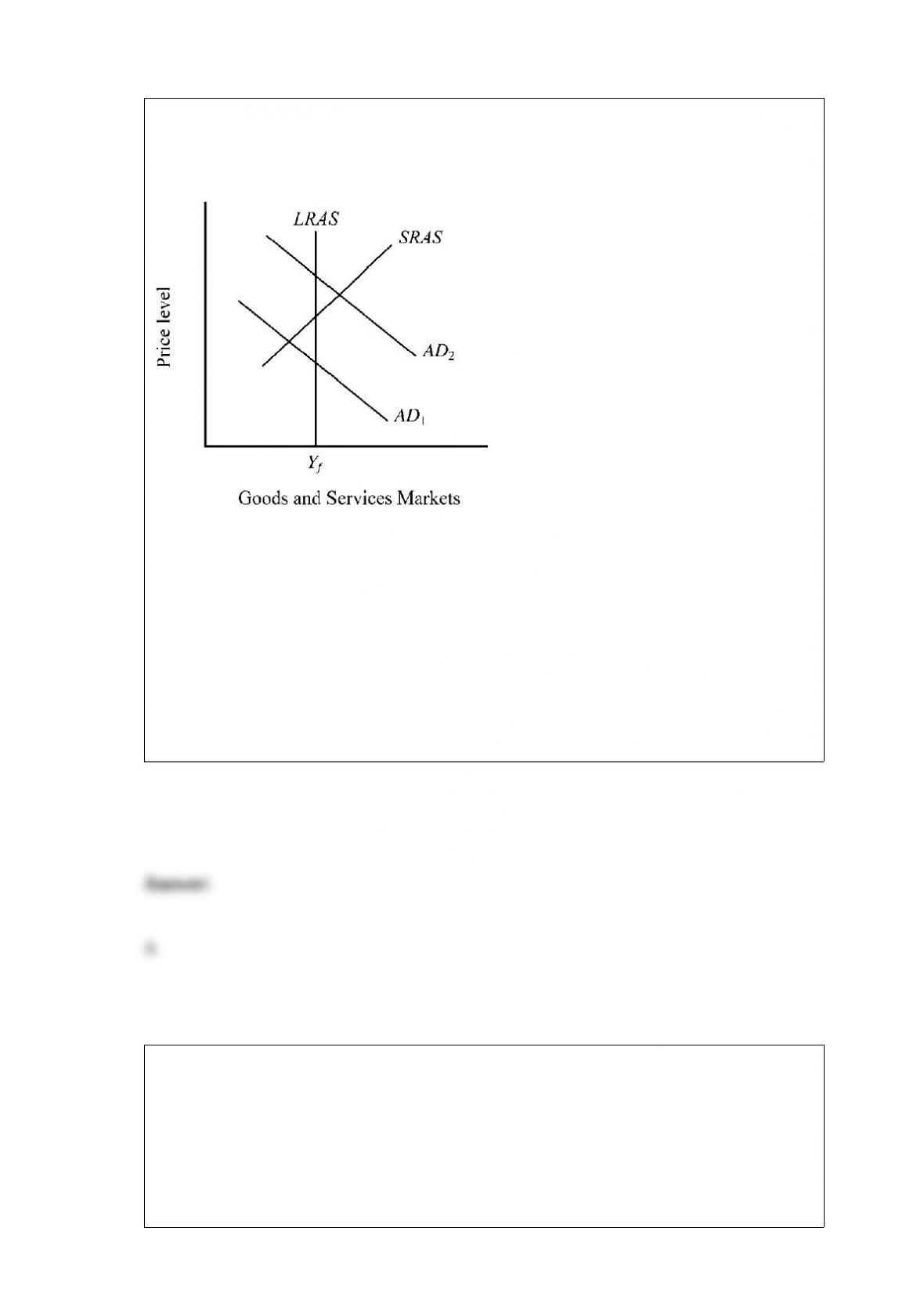
Figure 14-3
Suppose the economy was currently operating at SRASand AD2in Figure 14-3. To
combat inflation, the Fed institutes restrictive monetary policy. Suppose that by the time
the policy impacts the economy, ADhas already moved to AD1. Which of the following
would be true?
a. The policy would cause the economy to fall further into a recession than it would
have if the Fed had not undertaken the policy.
b. The policy will help by preventing the recession from becoming worse.
c. The policy would cause the economy to go into an economic boom.
d. This is a trick question; the impact of monetary policy is felt immediately by the
economy.
If a small percentage increase in the price of a good results in a rather large percentage
increase in the quantity supplied of the good, supply is said to be
a. vertical.
b. relatively inelastic.
c. relatively elastic.
d. robust.