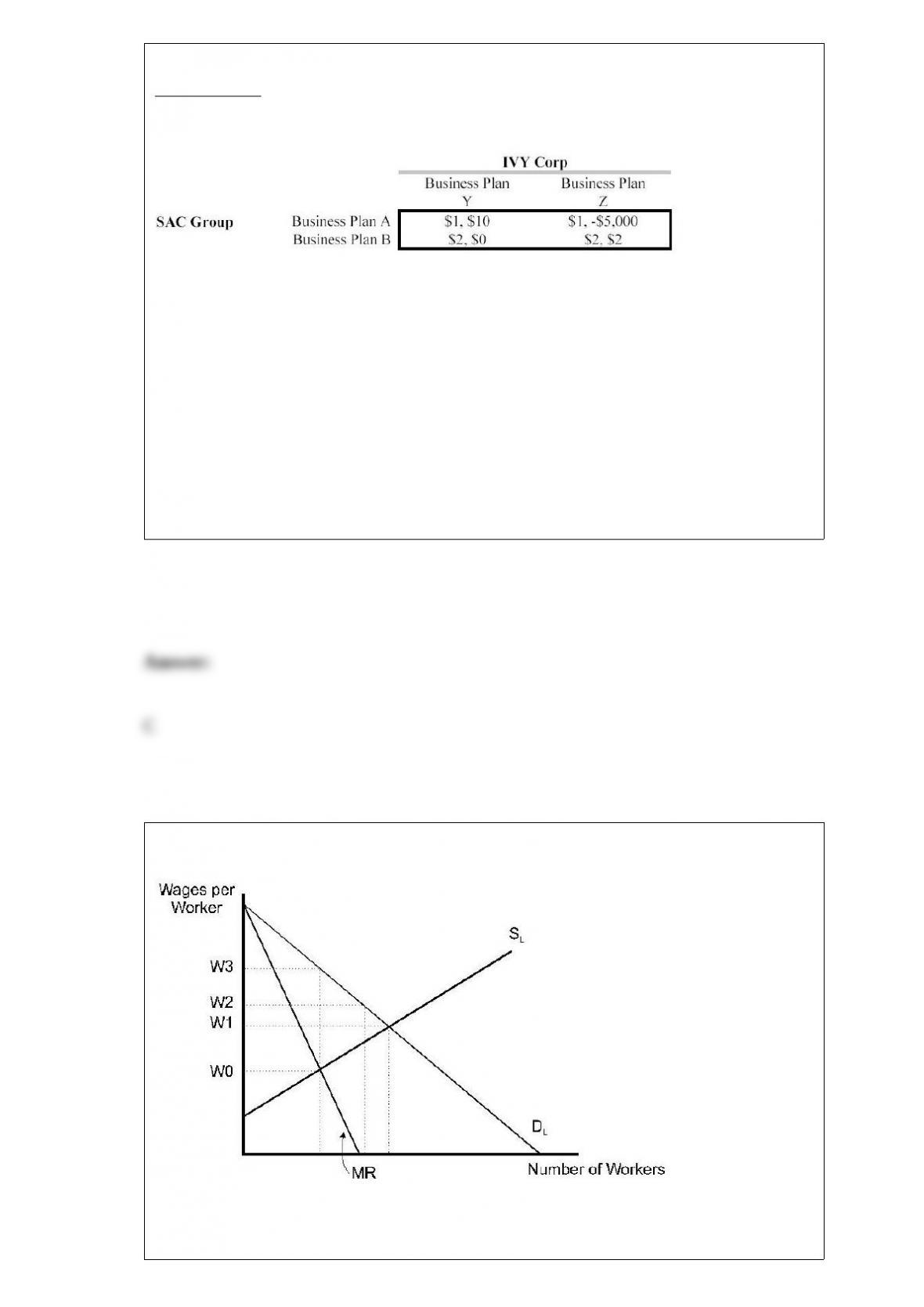
Scenario 13.8
Consider the following game:
In game in Scenario 13.8, what will occur if IVY Corp. plays a maximin strategy?
A) $1, $10
B) $1, -$5000
C) $2, $0
D) $2, $2
E) There is a .25 chance of each outcome in that case.
Figure 14.3
A labor union is exercising monopoly power in the labor market.

Refer to Figure 14.3. To maximize the number of workers hired, the labor union will
agree to wage rate:
A) W0.
B) W1.
C) W2.
D) W3.
E) none of the above
John Brown’s utility of income function is U = log(I+1), where I represents income.
From this information you can say that
A) John Brown is risk neutral.
B) John Brown is risk loving.
C) John Brown is risk averse.
D) We need more information before we can determine John Brown’s preference for
risk.

Moral hazard may arise in lending when small firms borrow funds from banks for one
project (e.g., buy new machinery for a factory) and actually use the funds in other ways
(e.g., buy the manager a new corporate jet). What is the source of the asymmetric
information problem in this case?
A) The bank has more information about the true cost of the corporate jet than the firm.
B) The bank has more information about the opportunity cost of the loaned funds.
C) The firm has more information about the actual use of the funds than the bank.
D) The firm has more information about the interest rate on the loan than the bank.
The correlation between an asset’s real rate of return and its risk (as measured by its
standard deviation) is usually
A) positive.
B) strictly linear.
C) flat.
D) negative.
E) chaotic.
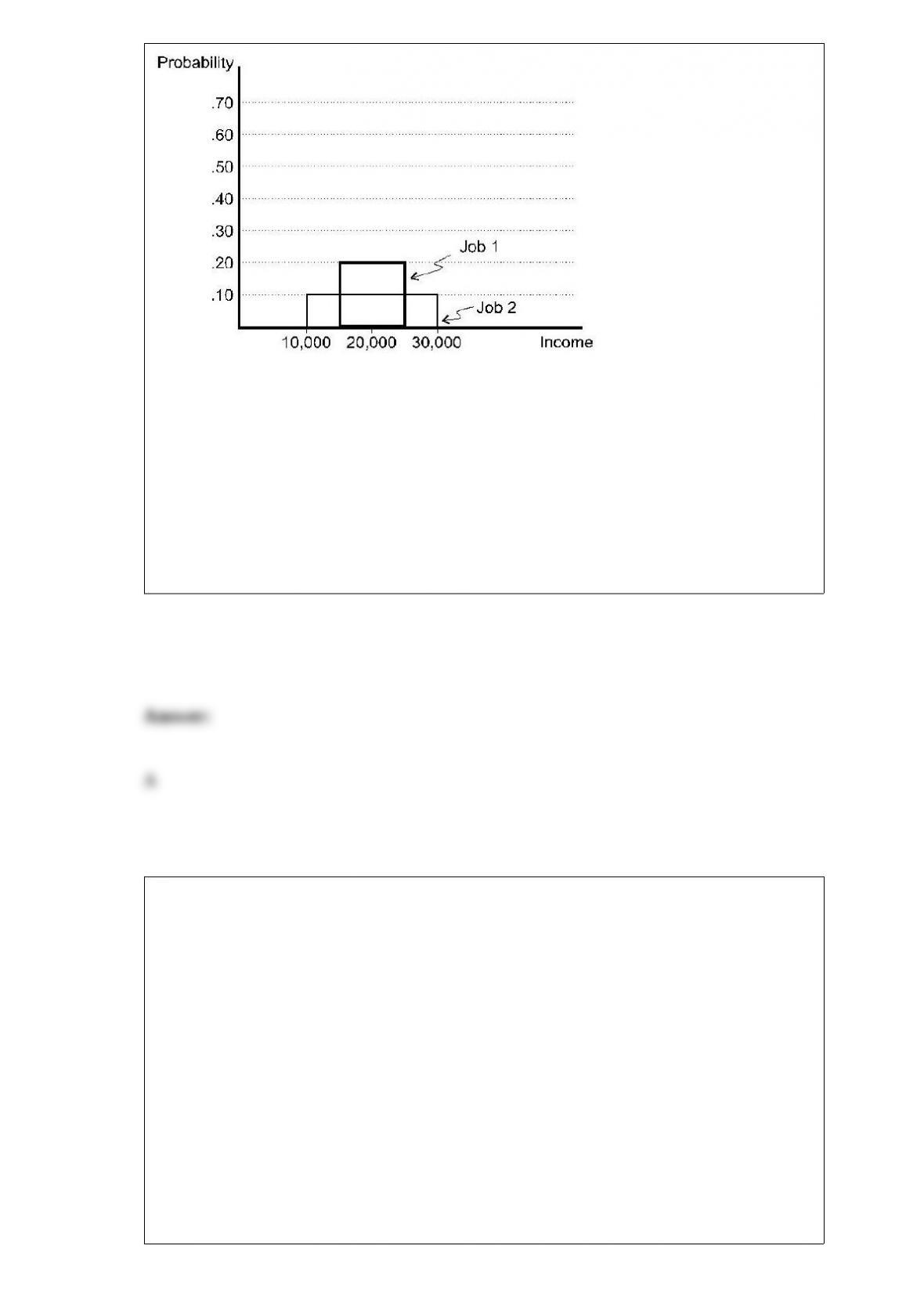
In the figure below, what is true about the two jobs?
A) Job 1 has a lower standard deviation than Job 2.
B) All outcomes in both jobs have the same probability of occurrence.
C) A risk-averse person would prefer Job 2.
D) A risk-neutral person would prefer Job 1.
E) Job 1 has a higher expected income than Job 2.
The difference between the utility of expected income and expected utility from income
is
A) zero because income generates utility.
B) positive because if utility from income is uncertain, it is worth less.
C) negative because if income is uncertain, it is worth less.
D) that expected utility from income is calculated by summing the utilities of possible
incomes, weighted by their probability of occurring, and the utility of expected income
is calculated by summing the possible incomes, weighted by their probability of
occurring, and finding the utility of that figure.
E) that the utility of expected income is calculated by summing the utilities of possible

incomes, weighted by their probability of occurring, and the expected utility of income
is calculated by summing the possible incomes, weighted by their probability of
occurring, and finding the utility of that figure.
Which of the following equations based on capital (K) and labor (L) inputs does not
represent a plausible production function?
A) F(K,L) = 3KL
B) F(K,L) = 3K
C) F(K,L) = K + L – 1
D) F(K,L) = 10(KL)0.5
Scenario 10.7:
The marginal revenue of green ink pads is given as follows:
MR = 2500 – 5Q
The marginal cost of green ink pads is 5Q.
Refer to Scenario 10.7. Suppose that the firm chooses to produce 200 ink pads. At this
level of output the demand for ink pads is
A) inelastic.
B) unit elastic.
C) elastic.
D) unit elastic.
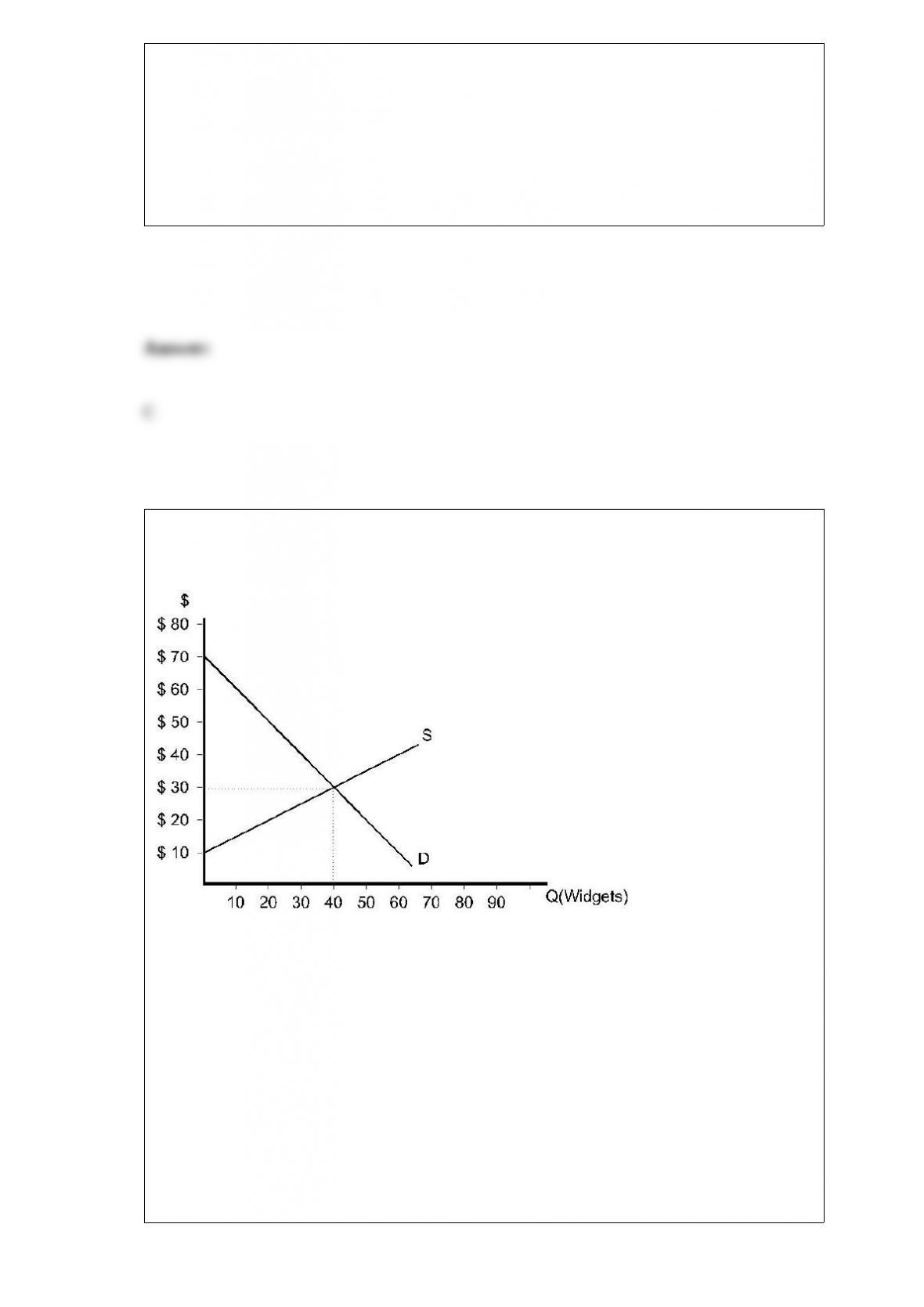
Figure 9.1
Refer to Figure 9.1. If the market is in equilibrium, total consumer surplus is
A) $30.
B) $70.
C) $400.
D) $800.
E) $1200.

Which of the following move the handling of a common property resource closest to
efficiency?
A) ensuring that the sellers of the resource are perfectly competitive
B) ensuring that the seller of the resource is a monopolist
C) banning the sale of the resource
D) banning the use of the resource
E) assigning a usage fee for access to the resource
Managers’ pursuit of which of the following objectives would NOT lead to a
principal-agent problem in a corporation?
A) The corporation’s growth
B) Increased market share for the corporation
C) The maximum possible profit for the corporation
D) A great “golden parachute” or retirement package
E) Increased current salary and fringe benefits

Which oligopoly model(s) have the same results as the competitive model?
A) Cournot
B) Bertrand
C) Stackelberg
D) Both Cournot and Stackelberg
In the insurance market, “moral hazard” refers to the problem that
A) insurers can’t tell high-risk customers from low-risk customers.
B) high-risk customers have an incentive to give false signals to make themselves look
like low-risk customers.
C) companies may unfairly lump individuals together by race, sex, age or other
characteristics in an attempt to use demographic data to pinpoint high-risk populations.
D) individuals are willing and able to pay different amounts for insurance, but must all
be charged the same amount.
E) individuals may change their behavior after the insurance is bought, so that they
behave in a more high-risk manner than they did before.

In a certain textile firm, labor is the only short term variable input. The manager notices
that the marginal product of labor is the same for each unit of labor, which implies that
A) the average product of labor is always greater that the marginal product of labor
B) the average product of labor is always equal to the marginal product of labor
C) the average product of labor is always less than the marginal product of labor
D) as more labor is used, the average product of labor falls
E) there is no unambiguous relationship between labor’s marginal and average products.
Scenario 5.10:
Hillary can invest her family savings in two assets: riskless Treasury bills or a risky
vacation home real estate project on an Arkansas river. The expected return on Treasury
bills is 4 percent with a standard deviation of zero. The expected return on the real
estate project is 30 percent with a standard deviation of 40 percent.
Refer to Scenario 5.10. Hillary’s indifference curves showing her preferences toward
risk and return can be shown in a diagram. Expected return is plotted on the vertical
axis and standard deviation of return on the horizontal axis. Although her indifference
curves are upward sloping and bowed downward, their slope is very gradual (they are
almost horizontal). With these indifference curves Hillary will invest:
A) most of her savings in Treasury bills, and a small percentage in the real estate
project.
B) all of her savings in Treasury bills.
C) half of her savings in Treasury bills and half in the real estate project.

D) most of her savings in the real estate project, and a small percentage in Treasury
bills.
The Prisoners’ Dilemma is a particular type of game in which negotiation and
enforcement of binding contracts is not possible, and such games are known as:
A) cooperative games.
B) noncooperative games.
C) collusive games.
D) Cournot games.
For net present value calculations, the rate of return that one could earn by investing in
another project with similar risk is known as the:
A) real interest rate.
B) nominal interest rate.
C) prime interest rate.
D) opportunity cost of capital.

Which of the following statements is true about a consumer’s optimal decision when
indifference curves are concave?
A) Both goods are consumed.
B) No goods are consumed.
C) Only one of the goods is consumed.
D) It occurs at the point of tangency with the budget line.
Which of the following situations is likely to generate noncooperative behavior in
repeated games?
A) The game is repeated a finite number of times.
B) There are many players in the game.
C) The payoffs can change rapidly from one game period to the next.
D) All of these situations can generate noncooperative behavior.
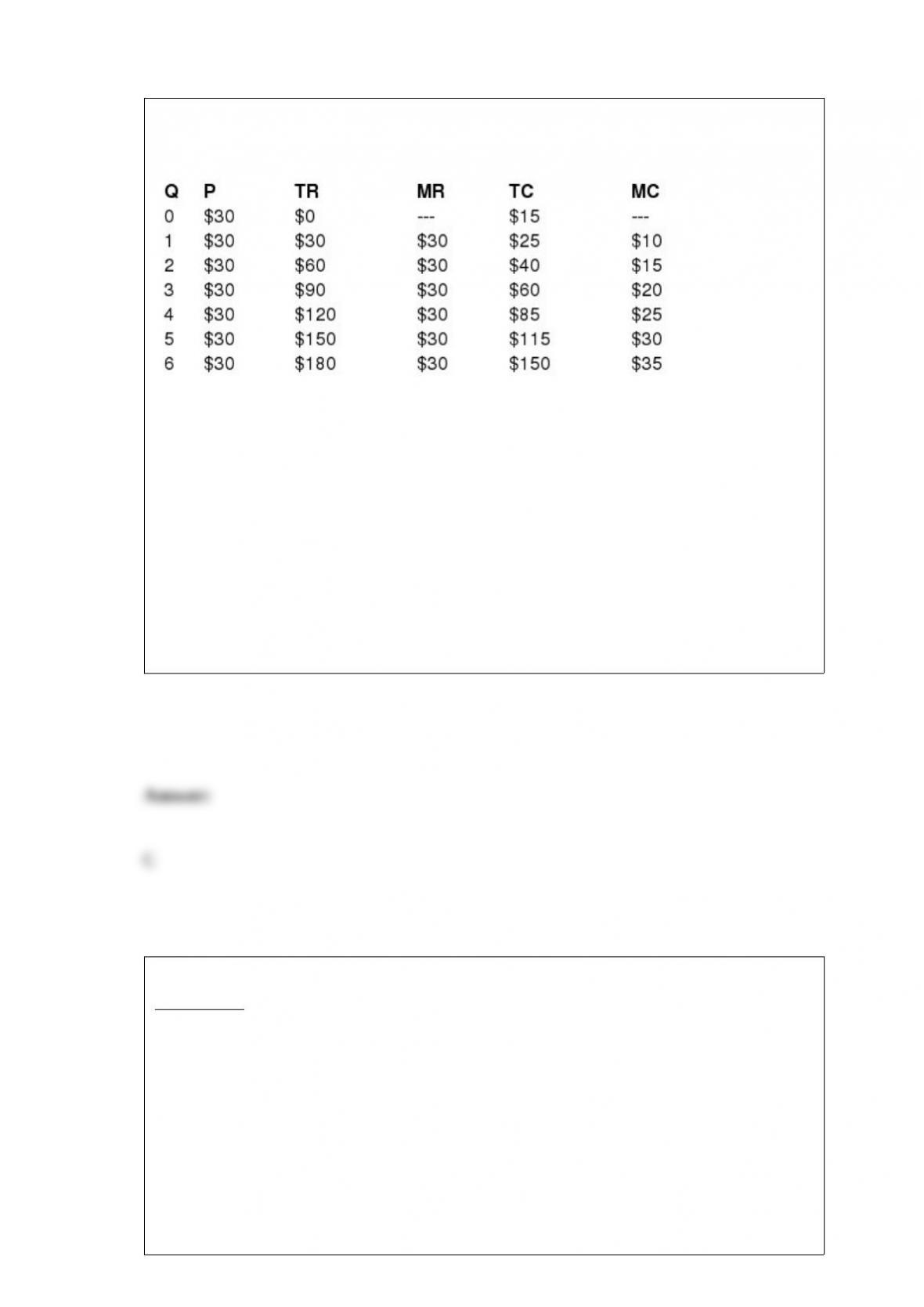
TABLE 8.1
The maximum profit available to the firm is
A) $20.
B) $30.
C) $35.
D) $155.
E) $180.
Scenario 3:
Sam and Sally are the only consumers in an economy where tee shirts and candy are the
only commodities that are consumed. The marginal utility schedule for each appears
below.
Sam tee shirts MU(tee shirts) Candy MU(Candy)
1 10 1 6
2 9 2 5

3 8 3 4
4 7 4 5
5 6 5 4
Sally tee shirts MU(tee shirts) Candy MU(Candy)
1 24 1 12
2 19 2 9
3 18 3 8
4 14 4 7
5 10 5 3
There are 7 candies and 7 tee shirts total in the economy.
Consider the case when the goods are redistributed such that Sam has 4 tee shirts and 4
candies. Sally has 3 tee shirts and 3 candies.
What is Sam’s marginal rate of substitution of tee shirts for candy at the current
distribution?
A)2
B) 7/5.
C) 5/7.
D) It is impossible to determine without the prices of each commodity.
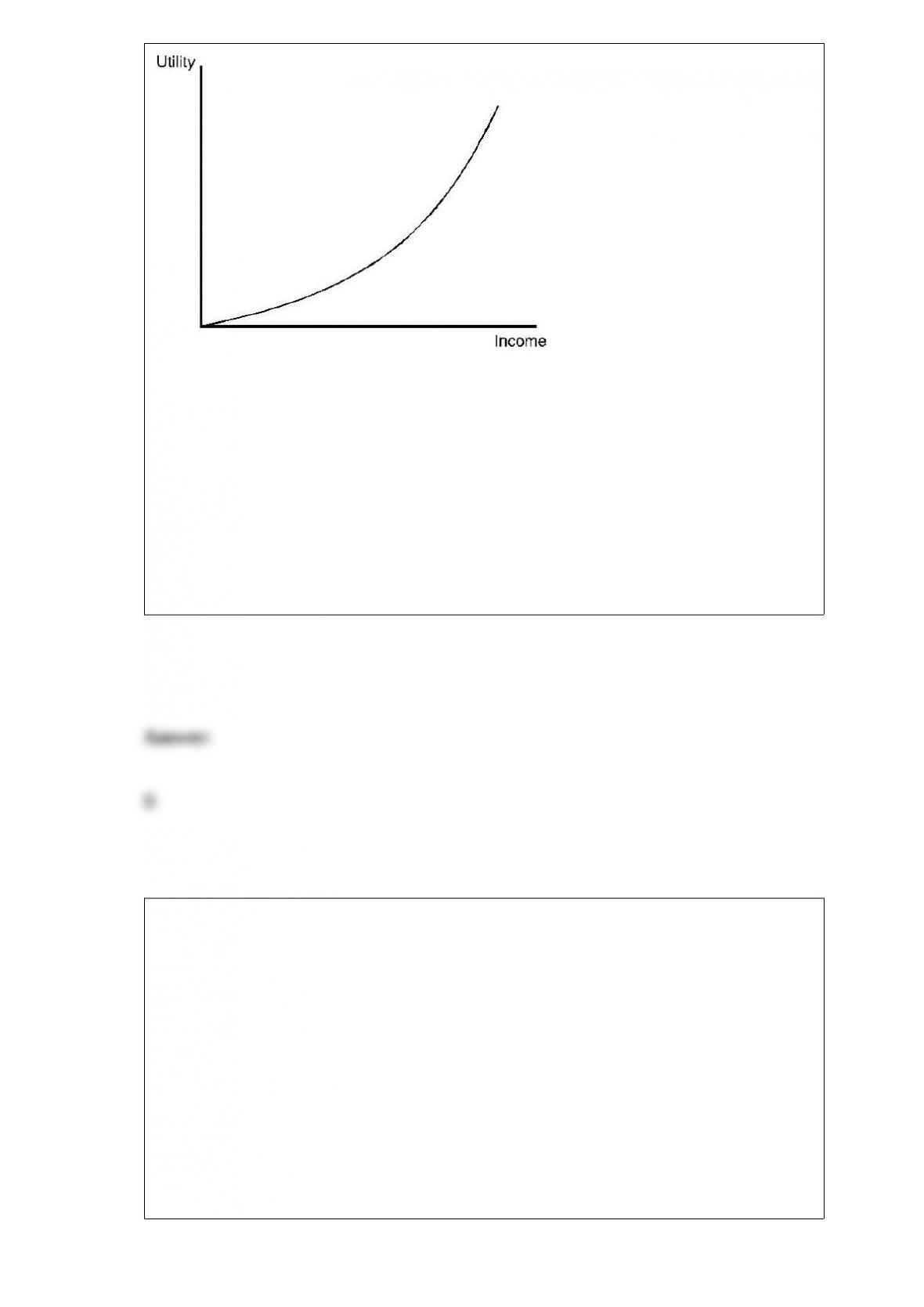
Figure 5.1
An individual whose attitude toward risk is illustrated in Figure 5.1 is
A) risk averse.
B) risk loving.
C) risk neutral.
D) None of the above is necessarily correct.
The budget line in portfolio analysis shows that
A) the expected return on a portfolio increases as the standard deviation of that return
increases.
B) the expected return on a portfolio increases as the standard deviation of that return
decreases.
C) the expected return on a portfolio is constant.
D) the standard deviation of a portfolio is constant.
E) a riskless portfolio will earn a zero return.

Which is NOT a weakness of the policy of mandatory separation of recyclables?
A) It actually pays people to use more recyclable material, and thus more material in
total.
B) It is costly for households in terms of time spent.
C) It is costly for the government to monitor.
D) Individuals may shift away from recyclable to non-recyclable materials just so they
don’t have to bother to separate them.
E) Implementation is difficult and consumes household space.
Season ticket holders for the St. Louis Rams received a surprise when they read the
applications forms to renew their season tickets. In order to get their season ticket to the
Rams’ home games, they also had to buy tickets to the preseason games. Many season
ticket holders grumbled about this practice as an underhanded way for the St. Louis
Rams to get more money from its season ticket holders. This practice is an example of:
A) peak-load pricing.
B) intertemporal price discrimination.
C) two-part tariff.
D) bundling.

E) Both A and B are correct.
Suppose that a firm can produce its output at either of two plants. If profits are
maximized, which of the following statements is true?
A) The marginal cost at the first plant must equal marginal revenue.
B) The marginal cost at the second plant must equal marginal revenue.
C) The marginal cost at the two plants must be equal.
D) all of the above
E) none of the above
Use the following statements to answer this question:
I. The inflation rate (the rate of change in the general price level) calculated from a
price index like CPI is the same regardless of the base year we use to form the price
index.
II. Although the CPI may indicate the general price level increased by 5% last year,
there are some consumer products that may have experienced more or less inflation in
the past year.
A) I and II are true.

B) I is true and II is false.
C) I is false and II is true.
D) I and II are false.
The endpoints (horizontal and vertical intercepts) of the budget line:
A) measure its slope.
B) measure the rate at which one good can be substituted for another.
C) measure the rate at which a consumer is willing to trade one good for another.
D) represent the quantity of each good that could be purchased if all of the budget were
allocated to that good.
E) indicate the highest level of satisfaction the consumer can achieve.
Second-degree price discrimination is the practice of charging
A) the reservation price to each customer.
B) different prices for different quantity blocks of the same good or service.
C) different groups of customers different prices for the same products.

D) each customer the maximum price that he or she is willing to pay.
Eliminating price supports for all US agricultural producers will hurt the farmers who
cultivate products that have
A) a high own price elasticity of demand and a high price elasticity of market supply.
B) a high own price elasticity of demand and a low price elasticity of market supply.
C) a low own price elasticity of demand and a high price elasticity of market supply.
D) a low own price elasticity of demand and a low price elasticity of market supply.