1) the consumer price index was 177.1 in 2001 and 179.9 in 2002. therefore, the rate of
inflation in 2002 was about:
a.6.7 percent.
b.3.4 percent.
c.1.6 percent.
d.4.1 percent.
2) In which of the following pairs of antitrust cases did the firms prevail against the
antitrust charges leveled against them?
A.the Alcoa case and the Microsoft case
B.the U.S. Steel case and the Alcoa case
C.the DuPont cellophane case and the U.S. Steel Case
D.the U.S. Steel case and the Microsoft Case
3)
refer to the above information. total cost is:
a.the change in marginal cost.
b.
c.
d.
4)
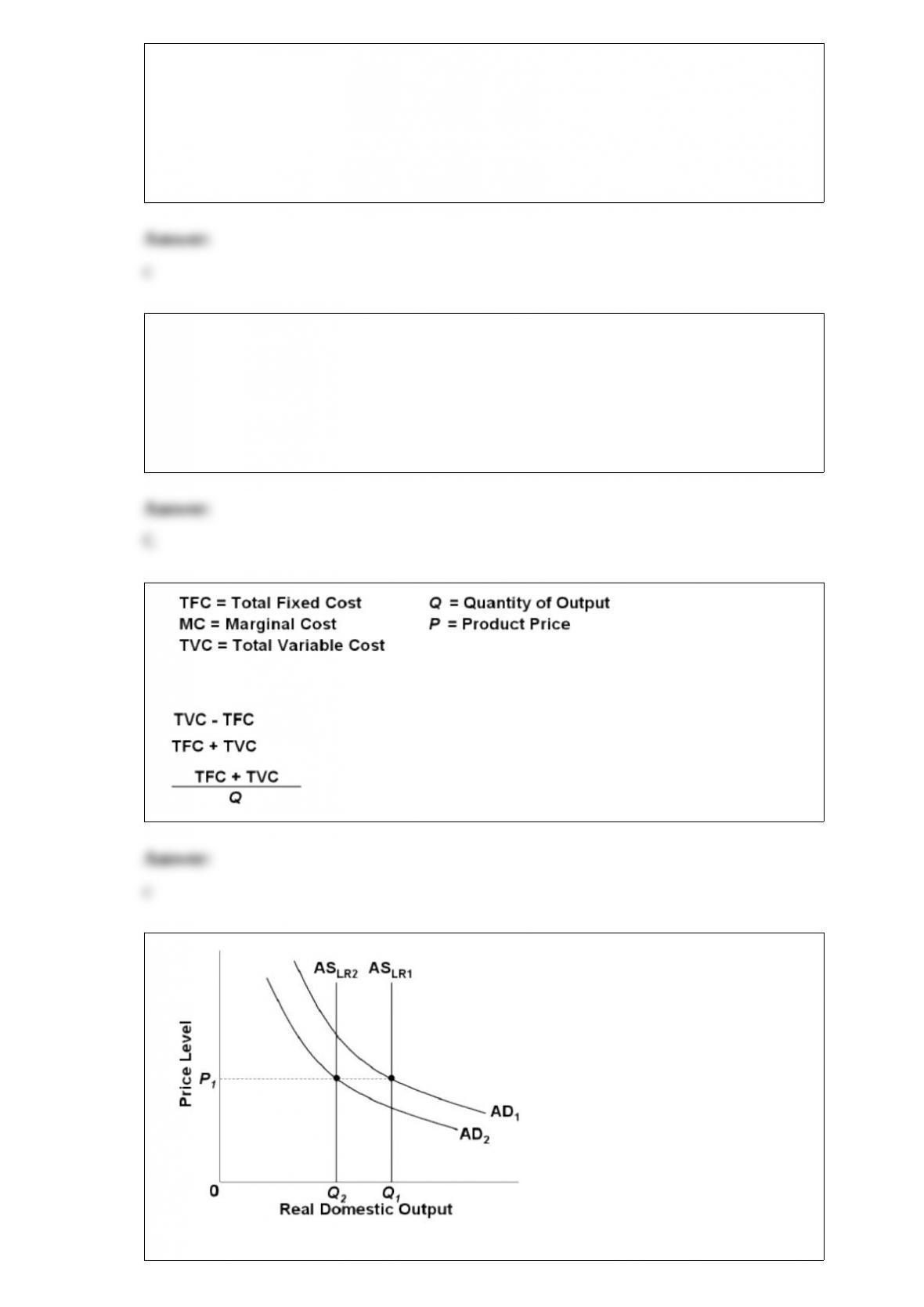
Refer to the above diagram. A decline of aggregate supply from ASLR1 to ASLR2,

followed by a decline of aggregate demand from AD1 to AD2, would best describe the:
A.direct relationship between aggregate supply and aggregate demand.
B.real-business-cycle view of recession.
C.monetarist view of recession.
D.mainstream, Keynesian-based, view of recession.
5) if the rate of inflation is 12 percent per year, the price level will double in about:
a.4 years.
b.6 years.
c.10 years.
d.12 years.
6) street entertainers generally have a difficult time making large incomes from their
performances because they:
a.are not sufficiently talented.
b.provide public goods and therefore face free-rider problems.
c.fail to attract audiences.
d.tend to lack marketing skills.
7) Which of the following combinations is plausible, as it relates to a nation’s balance of
payments?
A.current account = $+40 billion; capital account = $-10 billion; financial account =
$-50 billion.
B.current account = $+50 billion; capital account = $-20 billion; financial account = $
+30 billion.
C.current account = $+10 billion; capital account = $+40 billion; financial account = $
+50 billion.
D.current account = $+30 billion; capital account = $-20 billion; financial account =
$-10 billion.
8) one can say with certainty that equilibrium price will decline when supply:
a.and demand both decrease.
b.increases and demand decreases.
c.decreases and demand increases.
d.and demand both increase.
9)
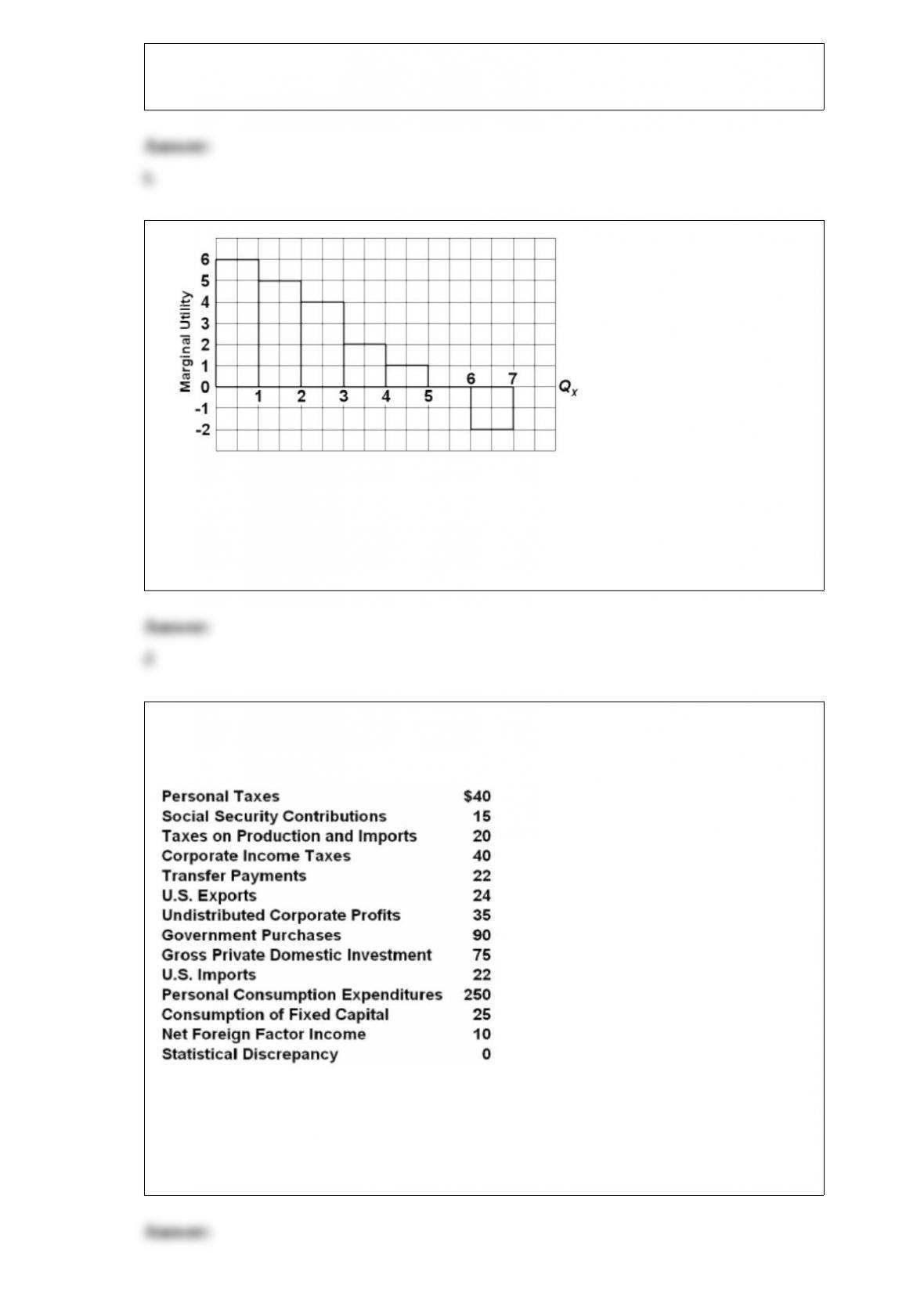
refer to the above diagram. total utility is at a maximum at _____ units of x.
a.2
b.3
c.4
d.6
10) answer the next question(s) on the basis of the following data. all figures are in
billions of dollars.
refer to the above data. pi is:
a.$314.
b.$346.
c.$408.
d.$437.

11) determine, other things equal, the effects of a given change in a determinant of
demand or supply for product x upon (1) the demand (d) for, or supply (s) of, x, (2) the
equilibrium price (p) of x and (3) the equilibrium quantity (q) of x.
refer to the above. an increase in income, if x is a normal good, will:
a.increase d, increase p, and increase q.
b.increase d, increase p, and decrease q.
c.increase s, increase p, and increase q.
d.decrease d, increase p, and increase q.
12) To reduce the Federal funds rate, the Fed would:
A.increase the discount rate.
B.increase the reserve requirement.
C.sell government securities.
D.buy government securities.
13) the corporate form of business enterprise has promoted the development of
large-scale business operations because:
a.the corporate form of enterprise is in a highly advantageous position to protect itself
from the effects of long-run inflation.
b.corporations have been able to marshal large amounts of financial capital through the
sale of stocks and bonds.
c.corporations have been more successful than unincorporated businesses in keeping
labor unions out of their plants.
d.this legal form of enterprise has been subject to fewer government controls than have
proprietorships and partnerships.