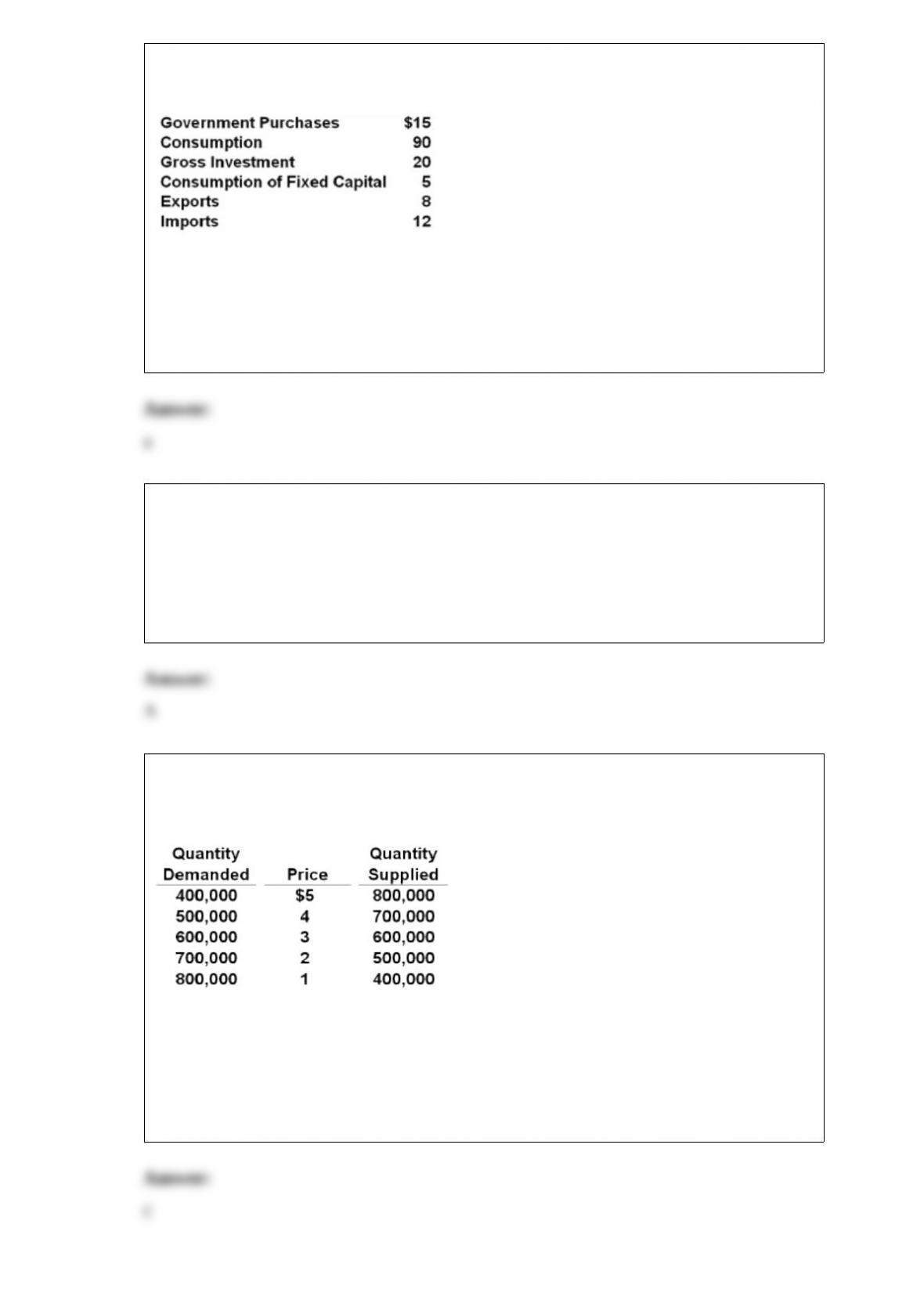
1) answer the next question(s) on the basis of the following data. all figures are in
billions of dollars:
refer to the above data. ndp is:
a.$116.
b.$121.
c.$125.
d.$150.
2) Because government price supports cause surplus production, government policies
have been designed to:
A.increase demand and decrease supply of farm products.
B.decrease demand and increase supply of farm products.
C.increase demand and increase supply of farm products.
D.decrease demand and decrease supply of farm products.
3) the following table applies to a purely competitive industry composed of 100
identical firms.
refer to the above table. at the equilibrium price, each of the 100 firms in this industry
will produce:
a.600,000 units of output.
b.60,000 units of output.
c.6,000 units of output.
d.600 units of output.

4) An international agreement reached in 1994 by the world’s trading nations provides
for:
A.an increase in export subsidies on agricultural products.
B.an increase in agricultural price supports.
C.a reduction of tariffs on agricultural products.
D.an international research organization designed to discover nonfood uses of
agricultural output.
5) the demand for commodity x is represented by the equation p = 10 – 0.2q and supply
by the equation p = 2 + 0.2q.
refer to the above information. the equilibrium price for x is:
a.$2.
b.$4.
c.$6.
d.$7.
6) other things equal, if the fixed costs of a firm were to increase by $100,000 per year,
which of the following would happen?
a.marginal costs and average variable costs would both rise.
b.average fixed costs and average variable costs would rise.
c.average fixed costs and average total costs would rise.
d.average fixed costs would rise, but marginal costs would fall.
7) The demand for most agricultural products:
A.is such that as price falls total revenue will increase.
B.is price inelastic.
C.declines as population increases.
D.is increasing faster in the United States than the supply of these products.
8) in the short run it is impossible for an expansion of output to increase:
a.average total cost.
b.average fixed cost.
c.marginal cost.
d.average variable cost.
9) Consider the following investment situations.
(a)A local bookseller is considering expanding store space to increase his capacity for
books. The rent for the additional space would cost $3000 per year. The bookseller
predicts that the added space will pull in an additional profit of $4000 per year. The
current interest rate is 12%. Should the bookseller invest in the extra space?
(b)A baker is considering expanding her business by adding an additional oven to her
kitchen. The new oven would cost $700. The baker expects the new oven to bring in
additional profits of $800. The baker can borrow at a nominal interest rate of 15% and
the current inflation rate is 4%. Should she make the investment?
(c)A mechanic is considering expanding his garage. After a strong year last year, the
mechanic is able to finance the expansion from last years profits. The expansion itself is
expected to cost $11,000. The mechanic estimates that the additional garage will bring
in revenue totaling $12,000. The mechanic is currently receiving an interest rate of 8%
on his saved profits. Should he make the investment?
10) a firm comprised of plants or units operating in different industries, say, beer and
theme parks, best illustrates a:
a.vertically integrated firm.
b.multinational corporation.
c.multiplant firm.
d.conglomerate.
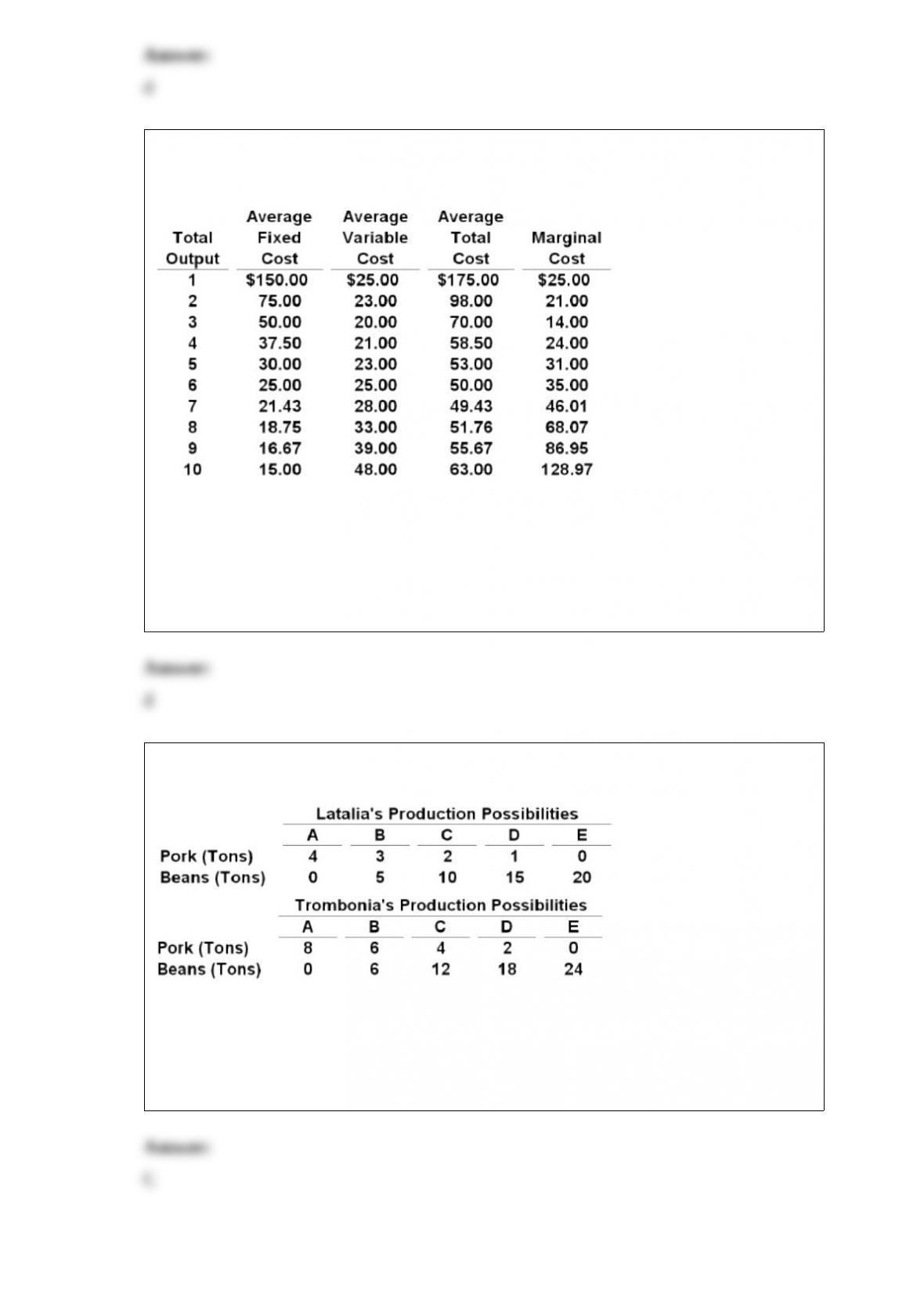
11) the following cost data for a firm that is selling in a purely competitive market.
refer to the above data. at 6 units of output, total fixed cost is ____ and total cost is
____
a.$25; $50.
b.$50; $300.
c.$100; $200.
d.$150; $300.
12) The following production possibilities tables for two countries, Latalia and
Trombonia:
Refer to the above tables. In Latalia the domestic real cost of 1 ton of pork:
A.is 3 tons of beans.
B.diminishes with the level of pork production.
C.is 5 tons of beans.
D.is 1/5 of a ton of beans.

13) The demand for land is:
A.perfectly elastic.
B.perfectly inelastic.
C.upsloping.
D.downsloping.
14) The amount to which some current amount of money will grow as interest
compounds over time is known as:
A.the future value of that sum of money.
B.the present value of that sum of money.
C.compound interest.
D.the time-value of money.
15) which of the following is not characteristic of the demand for a commodity that is
elastic?
a.the relative change in quantity demanded is greater than the relative change in price.
b.buyers are relatively sensitive to price changes.
c.total revenue declines if price is increased.
d.the elasticity coefficient is less than one.
16) studies of the minimum wage suggest that the price elasticity of demand for teenage
workers is relatively inelastic. this means that:
a.an increase in the minimum wage would increase the total incomes of teenage
workers as a group.
b.an increase in the minimum wage would decrease the total incomes of teenage
workers as a group.
c.the unemployment effect of an increase in the minimum wage would be relatively
large.
d.the cross elasticity of demand between teenage and adult workers is positive and very
large.
17) cost-push inflation may be caused by:
a.a decline in per unit production costs.

b.a decrease in wage rates.
c.a negative supply shock.
d.an increase in resource availability.