
In the long run, an increase in the growth rate of the money supply causes the inflation
rate to ________, which then causes the nominal interest rate to ________.
A) increase; increase
B) increase; decrease
C) decrease; increase
D) decrease; decrease
The federal government debt as a percentage of GDP fell during
A) 2002-2007.
B) 1980-1992.
C) 1998-2001.
D) World War II.
All else equal, as the labor supply increases, the marginal product of labor will
A) increase at an increasing rate.
B) increase at a decreasing rate.

C) decrease at an increasing rate.
D) decrease at a decreasing rate.
During a typical recession in the United States,
A) investment expenditures usually decrease at the same rate as consumption
expenditures.
B) investment expenditures usually decrease, while consumption expenditures usually
increase.
C) investment expenditures usually decrease much more than consumption
expenditures.
D) investment expenditures usually decrease less than consumption expenditures.
If the MPC is 0.75 and the tax rate is 10%, the expenditure multiplier will equal
A) 0.48
B) 1.48
C) 3.08
D) 3.6
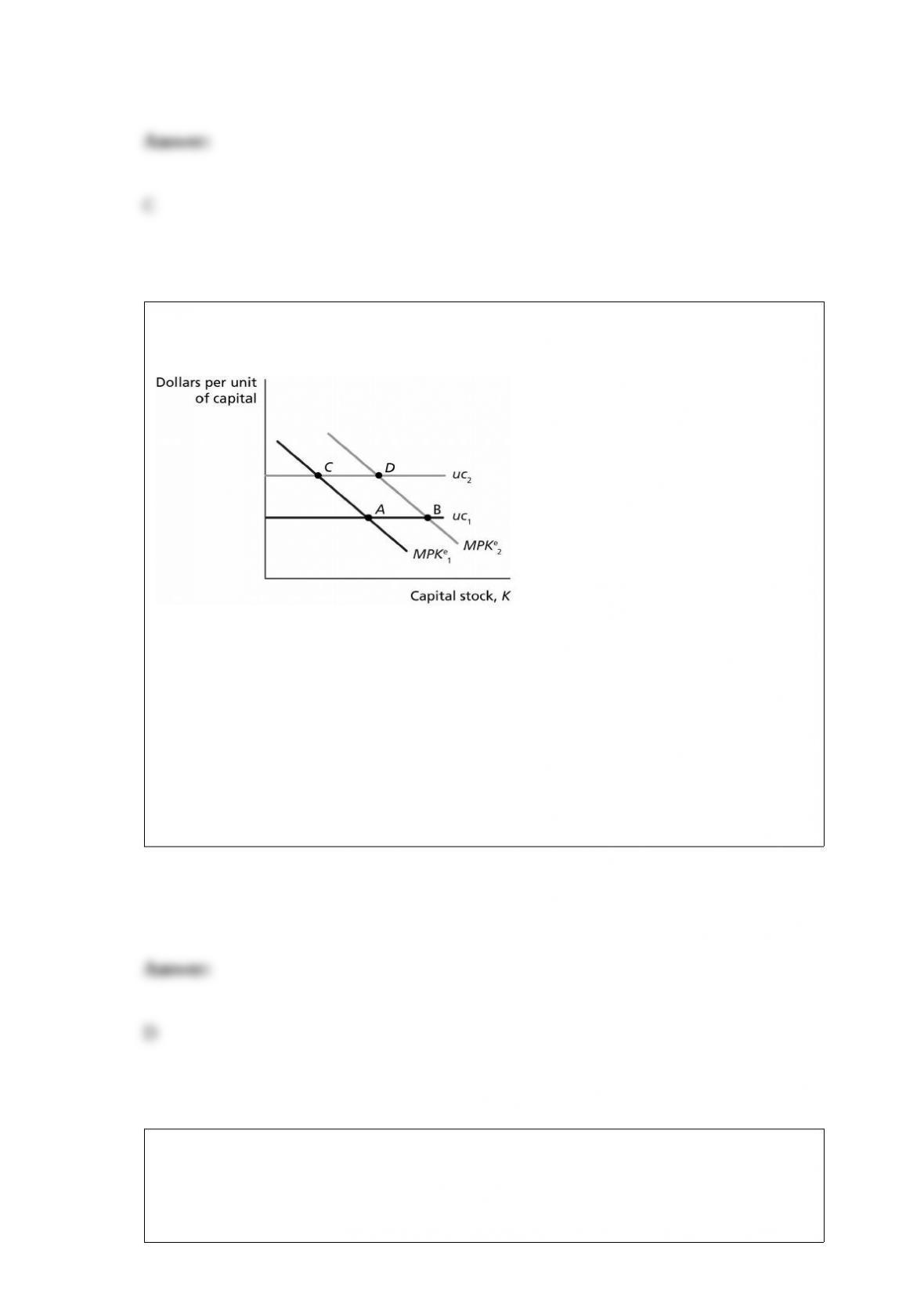
Figure 16.1
Refer to Figure 16.1. A decrease in the real price of capital goods is best represented by
a movement from
A) point A to point B.
B) point B to point A.
C) point A to point C.
D) point C to point A.
An increase in the real interest rate outside of the United States will ________ the
demand for the dollar and ________ the demand for foreign financial assets.
A) increase; increase

B) increase; decrease
C) decrease; increase
D) decrease; decrease
If the MPC = 0.75, a decrease in government spending from $875 billion to $840 billion
will decrease real GDP by
A) $26.25 billion.
B) $35 billion.
C) $46.67 billion.
D) $140 billion.
Figure 14.2
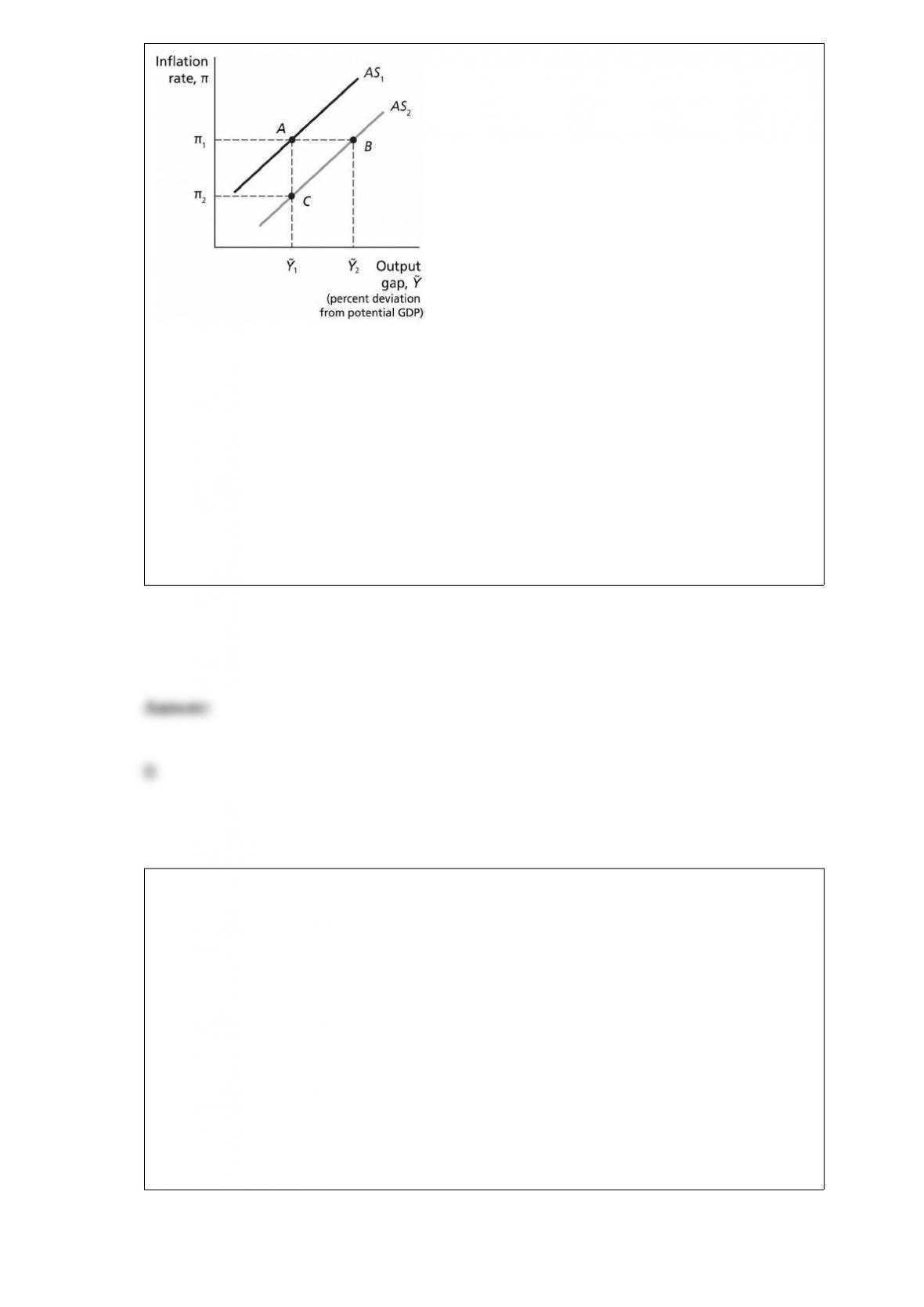
Refer to Figure 14.2. Hurricane Katrina was responsible for destroying a large portion
of oil and natural gas refining capacity on the Gulf coast in 2005. Other things equal,
this would best be represented by a movement from
A) point A to point B.
B) point B to point A.
C) point B to point C.
D) point A to point C.
When the housing bubble began to burst in 2006, investors became
A) more likely to purchase mortgage-backed securities since mortgage values had
declined significantly, making the securities a better value.
B) less likely to purchase mortgage-backed securities since the default rate on
mortgages began to rise.
C) more likely to purchase mortgage-backed securities since the higher rate of return
made these investments much more profitable.
D) less likely to purchase mortgage-backed securities since the government virtually
took over the mortgage market.

Other things equal, a decrease in the price level will
A) shift the AS curve to the left.
B) shift the AS curve to the right.
C) cause a movement up the AS curve.
D) cause a movement down the AS curve.
If the inflation rate in 2013 was 2.5 percent, and because of that people expect the
inflation rate in 2014 will also be 2.5%, these people are said to have
A) rational expectations.
B) expectations of stagflation.
C) adaptive expectations.
D) expectations of supply shocks.

If households save $0.20 of each additional dollar of increased income and spend the
rest, the expenditure multiplier will be
A) 1.25
B) 2
C) 5
D) 8
Suppose the annual growth rate of real GDP for the nation of Vicuna is 8%, the growth
rate of velocity is 0%, and the growth rate of the money supply is 12%.
a. What is the current rate of inflation?
b. What will happen to the inflation rate if the growth of the money supply increases to
16%?
c. What will happen to the inflation rate if the growth of the money supply increases to
16%, and at the same time, the growth rate of velocity increases to 4%?
From the classical perspective, a decrease in output during a recession is a result of

A) firms voluntarily supplying fewer goods and services in the marketplace.
B) a greater quantity of goods and services supplied than is the quantity demanded for
these goods and services.
C) the decrease in the overall level of production due to those firms which were forced
to shut down.
D) the decline in availability of factors of production which naturally occurs at the
onset of a recession.
If the money supply grows at 5% and real GDP grows at 6%, the quantity theory
predicts the inflation rate will be
A) -1%.
B) 1%.
C) 1.2%.
D) 11%.
Suppose the majority of the shares of Yahoo stock were sold to an Italian firm. Other
things equal, this will
A) increase the balance of the U.S. current account.

B) increase the balance of the U.S. financial account.
C) create a capital outflow in the United States.
D) decrease net portfolio investment in the United States.
If a person completely smooths consumption over his lifetime, then consumption is best
represented by which of the following?
A) wealth / the number of years the person expects to live
B) lifetime income / the number of years the person expects to work
C) (wealth + lifetime income) / the number of years the person expects to live
D) (wealth + lifetime income) / the number of years the person expects to work
Changes in the real interest rate affect all of the following components of aggregate
expenditure except
A) consumption.
B) investment.
C) government purchases.
D) net exports.
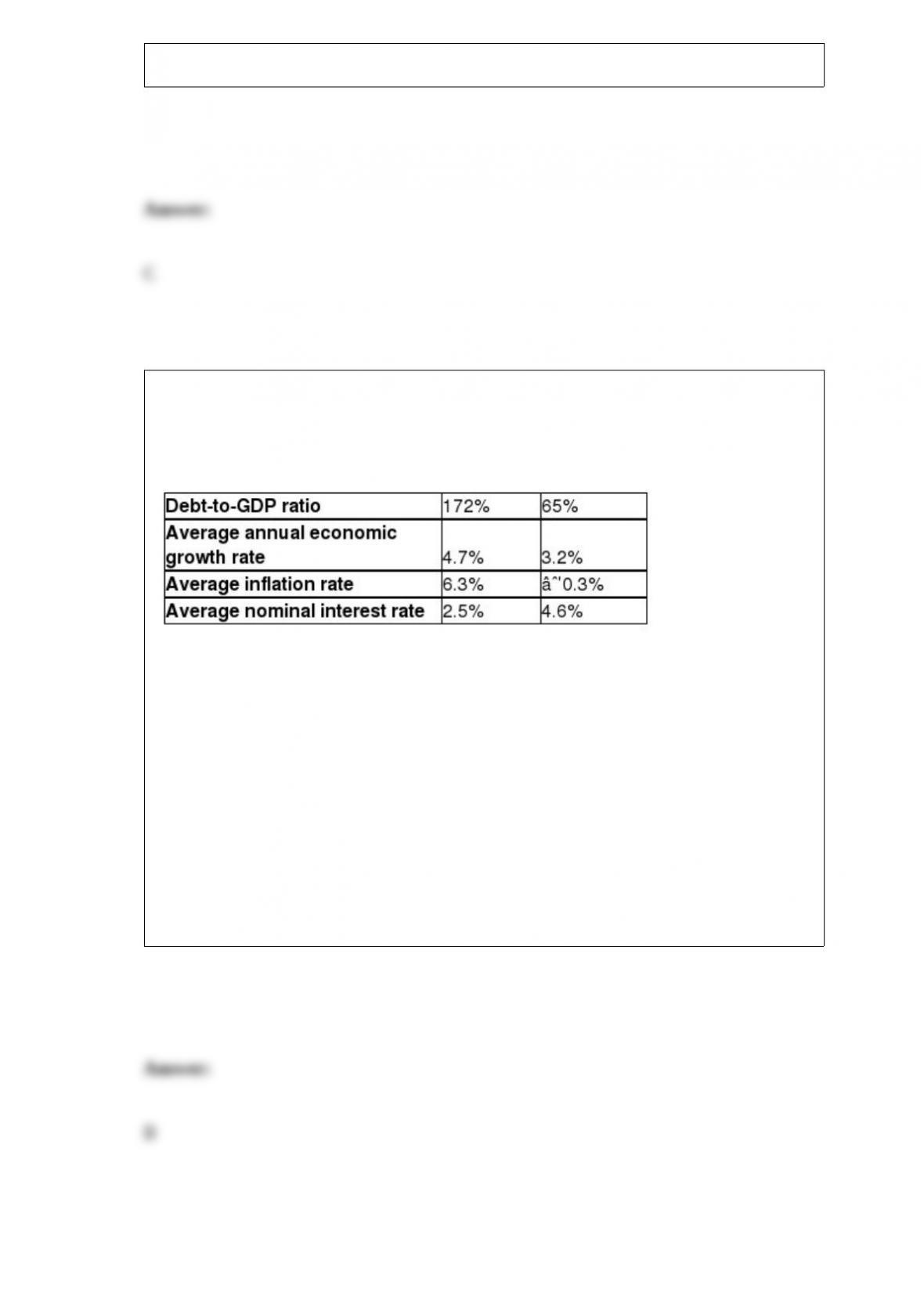
Table 3
Cordelia Saldinia
The above table contains data for the nations of Cordelia and Saldinia for 2012. Assume
seigniorage is zero.
Refer to Table 15.3. Based on the data in the table, fiscal policy in Cordelia is
________ and fiscal policy in Saldinia is ________.
A) sustainable; sustainable
B) sustainable; unsustainable
C) unsustainable; sustainable
D) unsustainable; unsustainable

The Phillips curve will shift down with ________ or ________.
A) a positive supply shock; an increase in expected inflation
B) a positive supply shock; a decrease in expected inflation
C) a negative supply shock; an increase in expected inflation
D) a negative supply shock; a decrease in expected inflation
In the Solow growth model, the steady state occurs when
A) investment = depreciation.
B) depreciation = 0.
C) the capital-labor ratio = 1.
D) saving = investment.
Figure 11.2
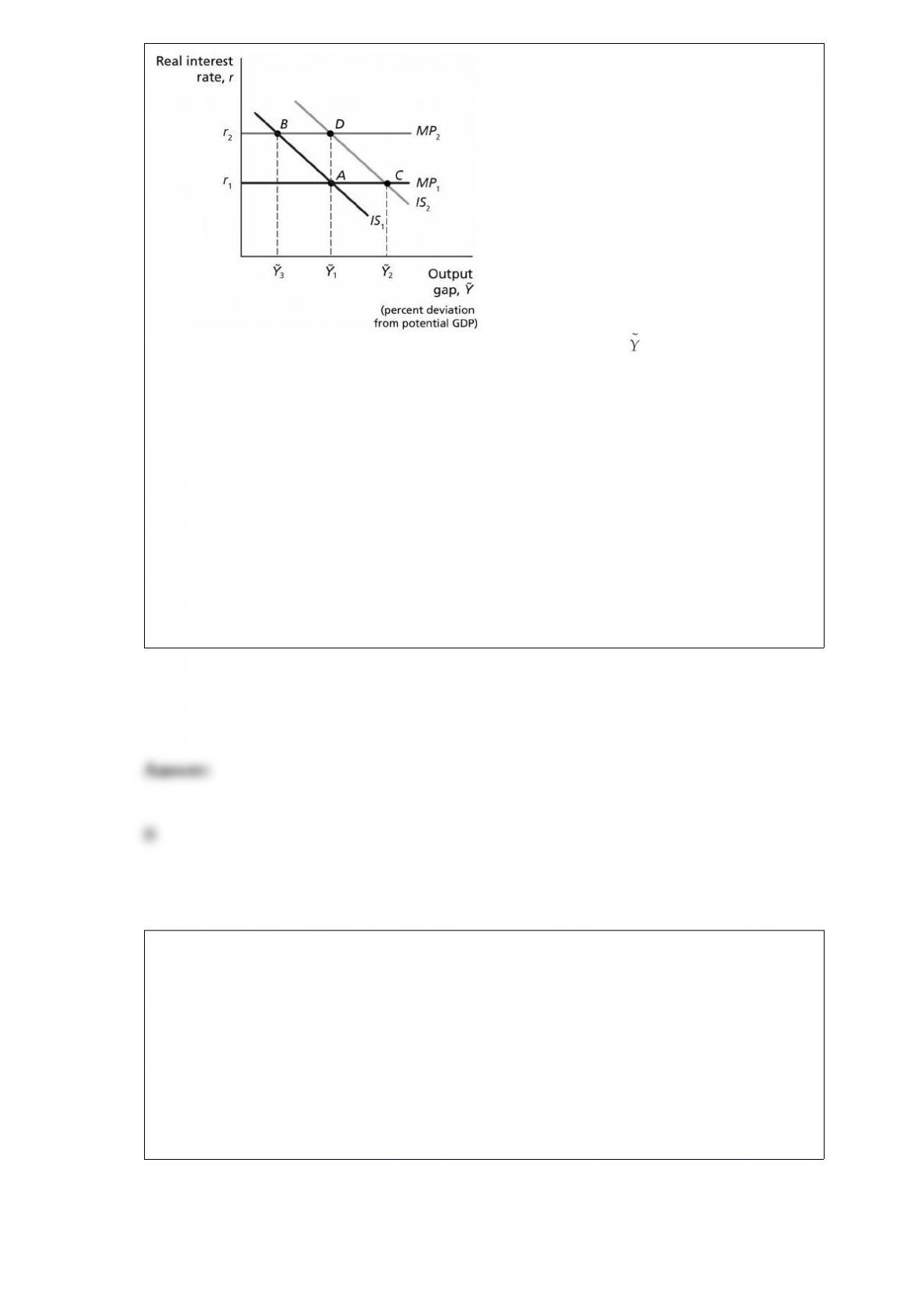
Refer to Figure 11.2. Assume the economy is in equilibrium at 1, where real GDP
equals potential GDP. The economy experiences a positive demand shock, and the Fed
responds by increasing real interest rates to bring real GDP and inflation back to their
original levels. Other things equal, the Fed’s response to the positive demand shock is
best represented by a movement from
A) point B to point D.
B) point C to point D.
C) point B to point A.
D) point C to point A.
Which of the following best describes real GDP?
A) Real GDP = Potential GDP – Nominal GDP
B) Real GDP = Potential GDP + Deviation from potential GDP
C) Real GDP = Deviation from potential GDP / Potential GDP
D) Real GDP = Nominal GDP / Potential GDP
From 2002 to 2011, the average unemployment rate in the United States
A) was higher than the average unemployment rates in most high-income European
countries.
B) and the average unemployment rates in other high-income countries varied
significantly.
C) was roughly the same as the average unemployment rates in other high-income
countries.
D) was the lowest of all high-income countries.
Table 4.2
Suppose that you intend to invest $10,000 in one-year government bonds. You are
looking for the highest return on your investment and do not care whether you
invest in the United States or Japan, but as U.S. resident, you want your
investment return to be in U.S. dollars. The Table lists 4 scenarios, each showing
the current interest rate for one-year government bonds in the United States and
Japan, the current exchange rate between the dollar and the yen, and the expected
exchange rate in one year. Other than the interest rates, you assume the bonds
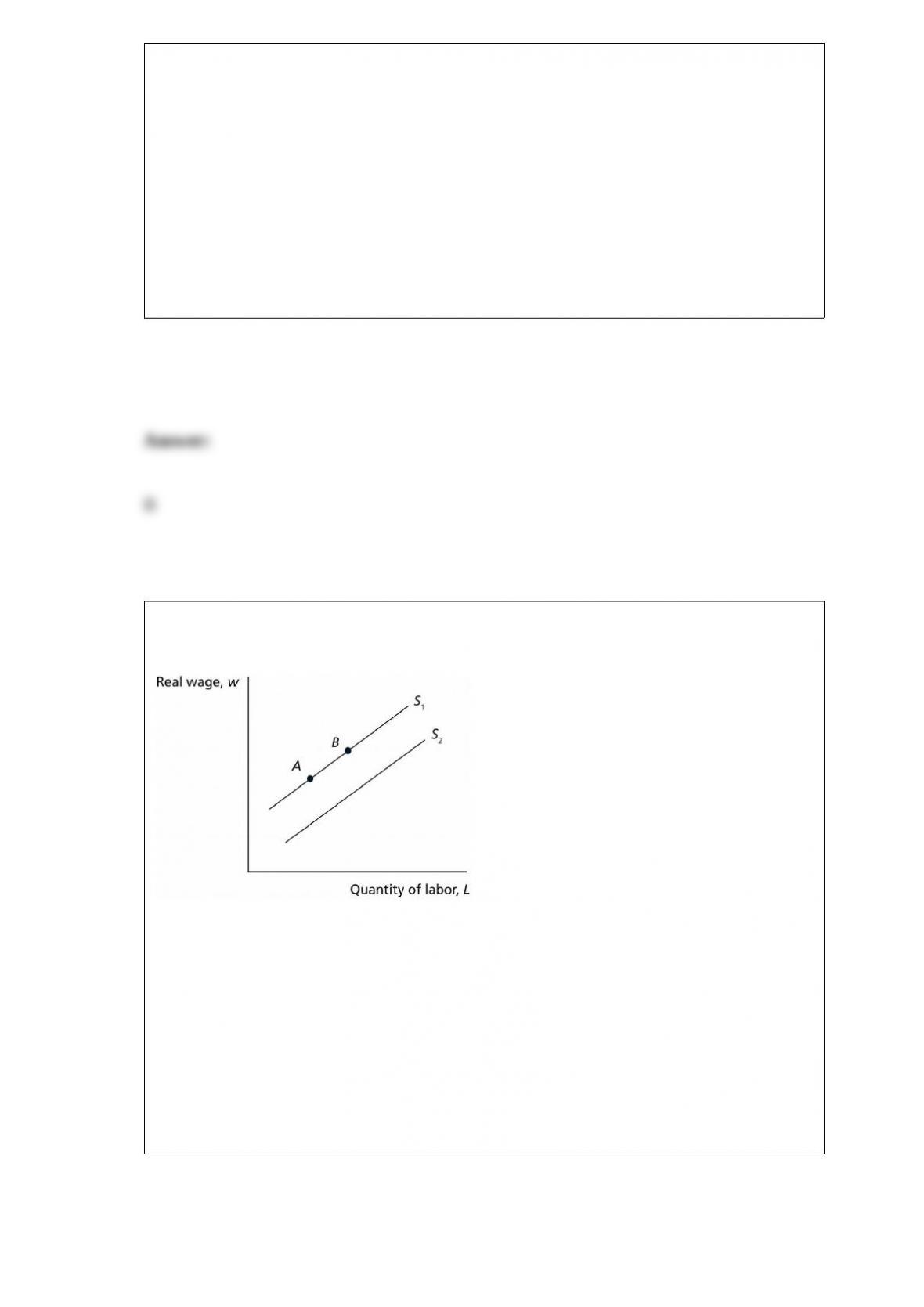
from each country to be identical.
Refer to Table 4.2. If you choose to invest in Japanese bonds, your investment return
from Scenario B will be
A) 3%.
B) 4%.
C) 6%.
D) 8%.
Figure 8.2
Refer to Figure 8.2. Holding other variables constant, an increase in income taxes will
result in a
A) movement from point A to point B.
B) movement from point B to point A.
C) shift from curve S1 to curve S2.
D) shift from curve S2 to curve S1.
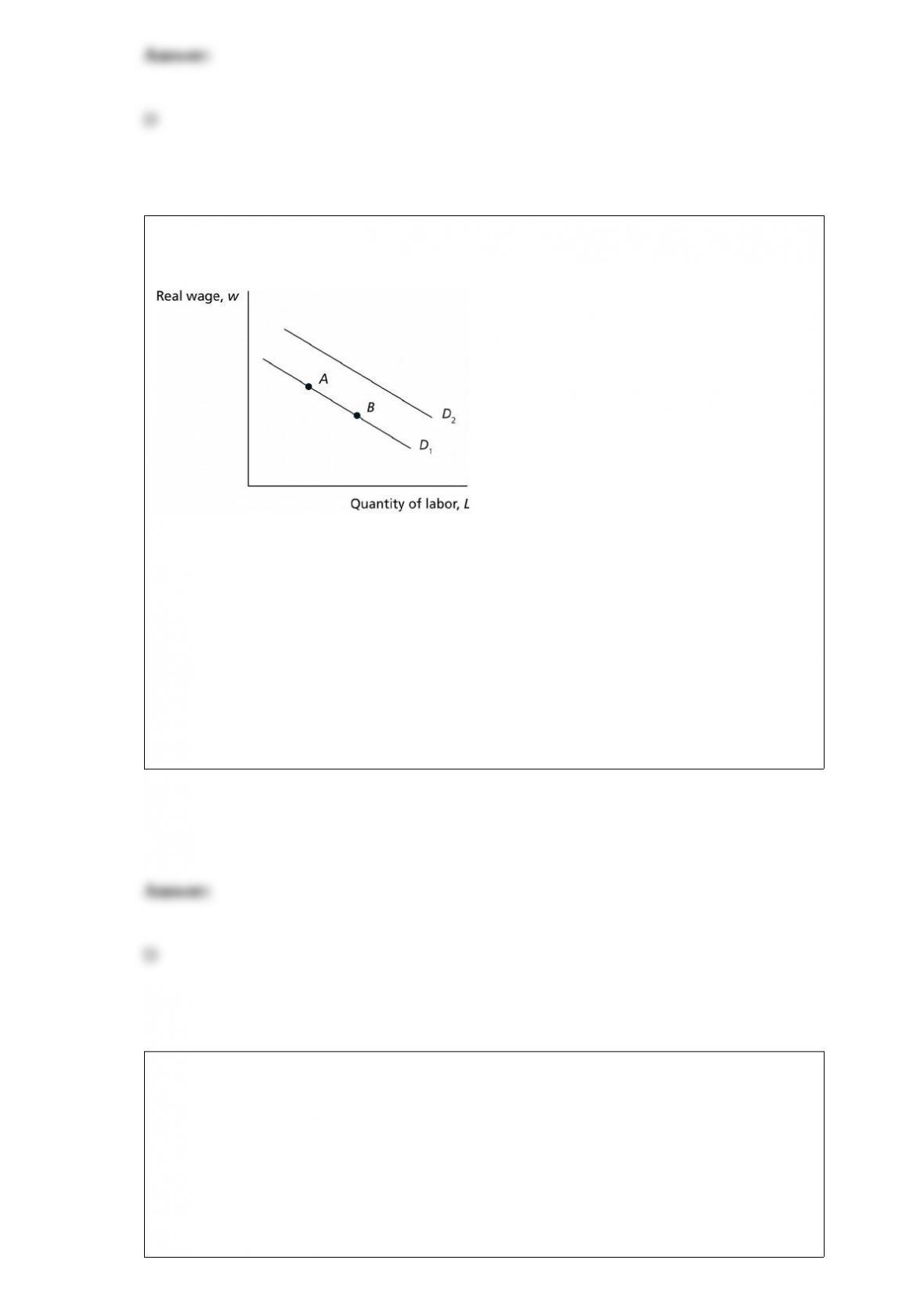
Figure 8.1
Refer to Figure 8.1. Holding other variables constant, an increase in the real wage rate
will result in a
A) shift from curve D1 to curve D2.
B) shift from curve D2 to curve D1.
C) movement from point A to point B.
D) movement from point B to point A.
If the exchange rate changes from $1.52 = £1.00 to $1.65 = £1.00, then relative to each
other,
A) both the dollar and the British pound have appreciated.
B) both the dollar and the British pound have depreciated.
C) the dollar has appreciated and the British pound has depreciated.

D) the dollar has depreciated and the British pound has appreciated.
If the government issues new government bonds to finance a budget deficit, the supply
of loanable funds will ________ and the equilibrium amount of investment will
________.
A) increase; increase
B) increase; decrease
C) decrease; increase
D) decrease; decrease
Which of the following would be the least likely to increase total factor productivity?
A) private investment in research and development
B) increases in human capital
C) the establishment of strong property rights
D) increases in the population growth rate

One advantage of a fixed exchange rate system compared to a floating or managed float
exchange rate system is
A) it is easier for central banks to control inflation.
B) there is no need for government intervention.
C) it allows the exchange rate to reflect demand and supply in the market.
D) it eliminates the possibility of depreciation during a recession.
Suppose you borrow $8,000 for one year and at the end of the year you repay the
$8,000 plus $600 of interest. The expected inflation rate was 3.5% at the time you took
out the loan, but the actual inflation rate turned out to be 2.5%. What was the expected
real interest rate at the time of the loan? What was the actual real interest rate you paid?
Who gained and who lost from the XOAXOAerence in the expected and actual
inflation rates?
Explain why some shifts to the aggregate demand curve are temporary and why some
are permanent.
Discuss how successful the American Recovery and Reinvestment Act was at
increasing real GDP and employment.

What is the difference between positive analysis and normative analysis?
Explain the typical relationship between the interest rates paid on bonds and loans and
the riskiness, liquidity, and term to maturity of the bonds and loans.
Explain how the circular flow diagram illustrates that the total value of spending on
goods and services in an economy is equal to the total value of income in that economy.
Explain why the Fed does not consider zero unemployment as a desirable goal.
What are the effects of an expansionary fiscal policy on interest rates and output in an
open economy with floating exchange rates?
Most economists believe there are four reasons the CPI overstates the true inflation rate.
List and briefly explain these four reasons.
Explain how the CPI underestimates inflation with respect to college tuition.

Table 2.5
2012 2013
Quantity Price Quantity Price
Refer to Table 2.5. Calculate nominal and real GDP for 2012 and Assume 2012 is the
base year. What is the value of the GDP deflator for 2012 and for 2013?
Suppose that for the nation of Calliope, the debt-to-GDP ratio is 325%, the average
annual growth rate is 1.1%, the average inflation rate is 0.5%, and the average nominal
interest rate is 2.2%. Based on this information, determine if fiscal policy is sustainable
in Calliope, and if not, what the primary budget deficit would have to be to make fiscal
policy sustainable.
Explain the difference between the Fed following discretionary policy and the Fed
following a rules strategy.

Explain the difference between correlation and causation.
Explain how a decrease in housing prices may reduce the wealth of some while
increasing the wealth of others. What effect would this have on aggregate consumption?
The text lists 5 key provisions of the Dodd-Frank Act. What are those 5 key provisions?

Explain the XOAXOAerence between GDP and GDI.
Assuming that total factor productivity is constant, describe the effect of an increase in
the capital-labor ratio on the per worker production function. What happens to the
marginal product of labor, the marginal product of capital, and real GDP per capita?