
How would the elimination of a sales tax affect the market for a product that had been
subject to the tax?
A) The demand for the product would rise and the equilibrium price would fall by the
amount of the tax.
B) The equilibrium price for the product would fall by less than the amount of the tax.
C) The reduction in government revenue from the tax would be made up by an increase
in property taxes.
D) The supply of the product would become more elastic.
Adverse selection will occur in a market as a result of
A) asymmetric information.
B) moral hazard.
C) the sale of “lemons.”
D) rational ignorance.
If the marginal tax rate is equal to the average tax rate as taxable income increases, the
tax structure is
A) regressive.
B) proportional.

C) progressive.
D) unfair.
What effect does a depreciation of the dollar have on real GDP in the United States in
the short run?
A) Real GDP will fall.
B) Real GDP will rise.
C) Real GDP will be unaffected by the depreciation of the dollar.
D) Real GDP will be unchanged, but nominal GDP will rise.
When the government makes a firm the exclusive legal provider of a good or service, it
grants the firm
A) a copyright.
B) a network externality.
C) a quota.
D) a public franchise.
All else equal, the decrease in consumer preference predicted by Apple for its iPhone 5
would be represented by a
A) shift the supply curve for iPhones to the right.
B) shift the supply curve for iPhones to the left.
C) shift the demand curve for iPhones to the right.
D) shift the demand curve for iPhones to the left.
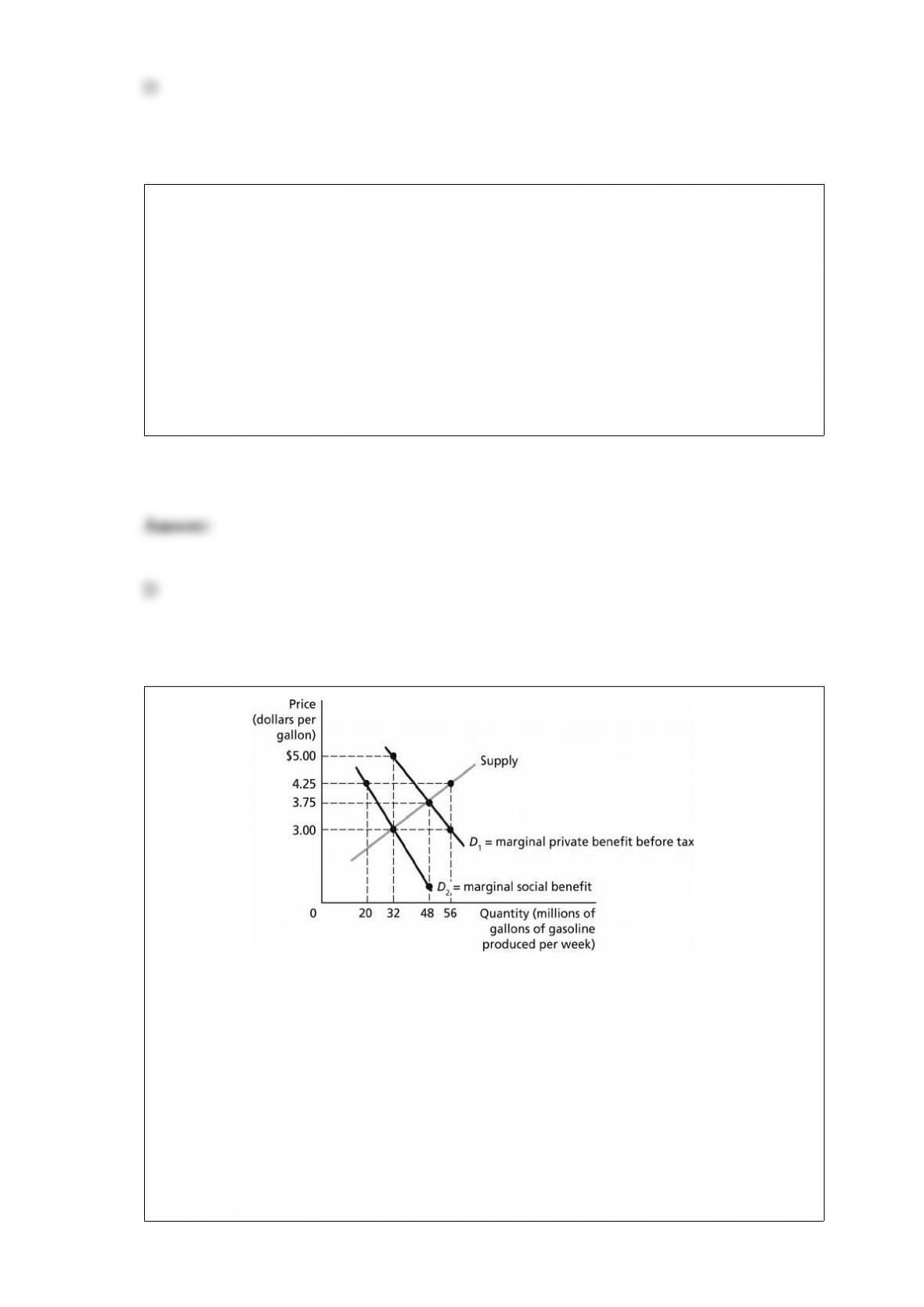
Figure 5-13 Figure 5-13
illustrates the market for gasoline before and after the government imposes a tax to
bring about the efficient level of gasoline production. The market equilibrium quantity
of gasoline is ________ million gallons per month.
A) 20
B) 32
C) 48
D) 56

Which of the following is not a characteristic of long-run equilibrium in a
monopolistically competitive market?
A) Selling price equals average total cost.
B) Production is at minimum average total cost.
C) Marginal revenue equals marginal cost.
D) Selling price is greater than marginal cost.
What is the primary difference between a sole proprietorship and a partnership?
A) Proprietorships have unlimited liability while partnerships have limited liability.
B) Partnerships can issue stocks and bonds while proprietorships cannot.
C) Partnerships have more owners than do proprietorships.
D) There is no real difference between the two types of firms.
Imagine that you borrow $5,000 for one year and at the end of the year you repay the
$5,000 plus $600 of interest. If the inflation rate was 4%, what was the real interest rate
you paid?
A) 16 percent
B) 12 percent
C) 8 percent
D) 6 percent
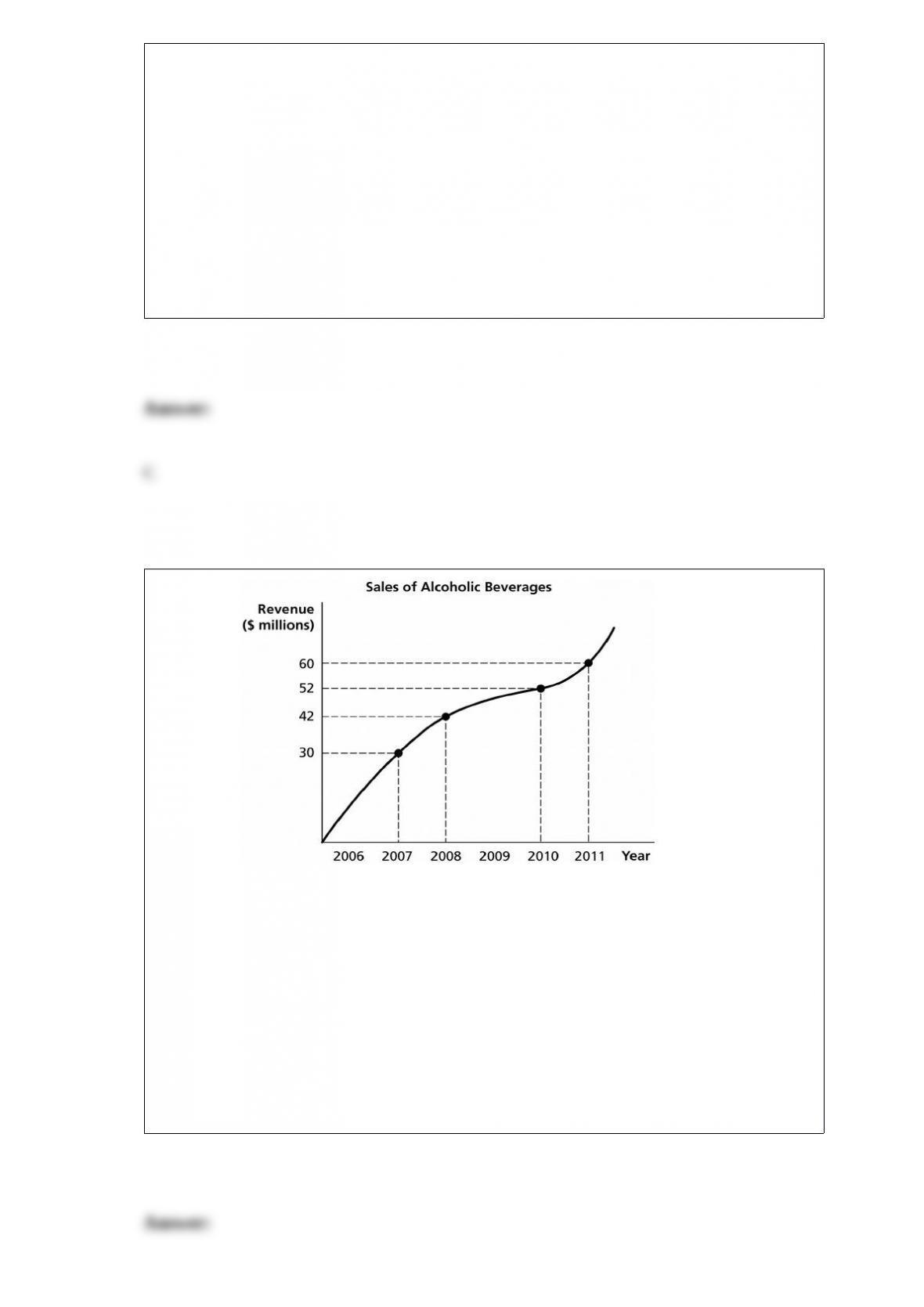
Figure 1-1
Using the information in the figure above, calculate the percentage change in sales of
alcoholic beverages between 2007 and 2011.
A) 30%
B) 50%
C) 66.7%
D) 100%

When there are few close substitutes available for a good, demand tends to be
A) perfectly inelastic.
B) perfectly elastic.
C) relatively inelastic.
D) relatively elastic.
If expected inflation rises, the long-run Phillips curve will
A) shift to the right.
B) not be affected.
C) shift to the left.
D) become negatively sloped.
Which of the following is a factor of production that generally is fixed in the short run?
A) raw materials

B) labor
C) a factory building
D) water
An increase in aggregate demand results in a(n) ________ in the ________.
A) recession; long run
B) expansion; long run
C) expansion; short run
D) recession; short run
Suppose a competitive firm pays a wage of $12 an hour and sells its product at $3 per
unit. Assume that labor is the only input. If hiring another worker would increase output
by five units per hour, then to maximize profits the firm should
A) not change the number of workers it currently hires.
B) lay off some of its workers.
C) hire the additional worker.
D) There is not enough information to answer the question.

The demand for capital is similar to the demand for labor in that
A) the marginal product of labor is derived from the marginal product of capital.
B) the marginal revenue product curve for labor is the same as the marginal revenue
product curve for capital.
C) both are derived demands.
D) both are inelastic at high prices and elastic at low prices.