Tax incidence is the actual division of the
A) burden of the tax between buyers and sellers in a market.
B) tax revenues between government agencies.
C) tax revenues between the federal government and state governments.
D) population into different tax brackets.
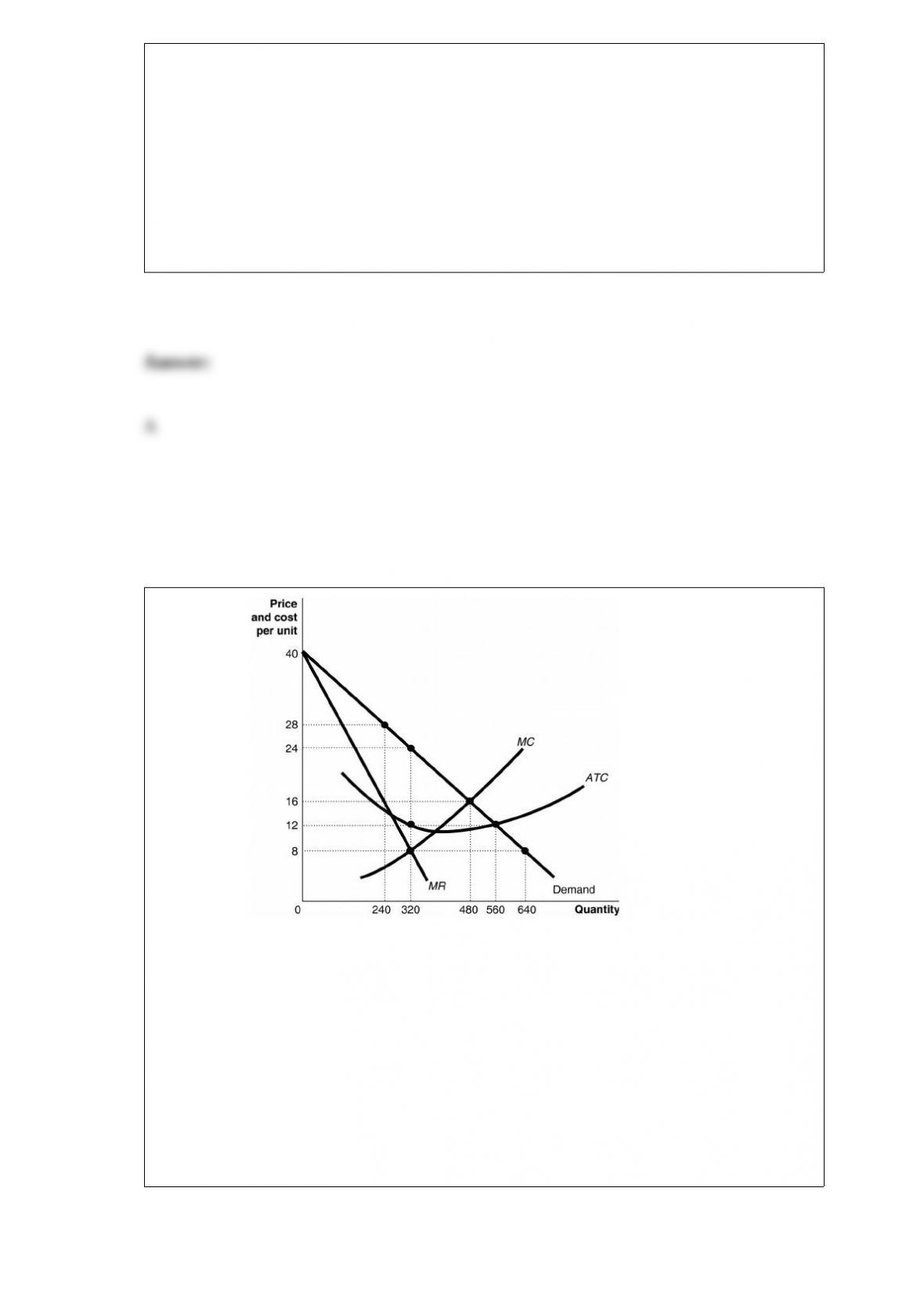
Figure 16-5
Suppose the firm represented in the diagram decides to practice perfect price
discrimination. What is the profit-maximizing quantity?
A) 320 units
B) 480 units
C) 560 units
D) 640 units

The volatility of a stock’s market price is indicated by
A) the highest stock price and the lowest stock price over the previous year.
B) the price of newly issued shares compared to the price of previously issued shares.
C) the difference between the stock’s selling price and its asking price.
D) the stock’s price-earnings ratio.
An article on how prices in South Bend, Indiana rise during Notre Dame home football
games noted: “For the Sept. 16 game against the University of Michigan, the South
Bend Marriott is charging $649 a night for a double room. …… The Marriott’s regular
weekend price is $149 a night.”
Source: Ilan Brat, “Notre Dame Football Introduces Its Fans To Inflationary
Spiral,” Wall Street Journal, September 7, 2006, p. A1. Which of the following
statements is true?
A) The Marriott is practicing first-degree price discrimination by charging what the
market will bear.
B) This is evidence of third-degree price discrimination because hotel accommodation
on a particular day is not a product that can be resold later.
C) There is no evidence of price discrimination; the Marriott is responding to increased
demand for hotel rooms in the face of constant supply.
D) The Marriott has adopted this pricing strategy to capitalize on arbitrage profits.

A monopoly firm’s demand curve
A) is the same as the market demand curve.
B) is perfectly inelastic.
C) is more inelastic than the demand curve for the product.
D) is inelastic at high prices and elastic at lower prices.
From 1991 until 2001, the United States was in a period of
A) expansion.
B) recession.
C) business cycle troughs.
D) business cycle peaks.
Economists use the concept of ________ to measure how one economic variable, such
as quantity, responds to a change in another economic variable, such as price.
A) slope

B) efficiency
C) relativity
D) elasticity
You have a bond that pays $60 per year in coupon payments. Which of the following
would result in an increase in the price of your bond?
A) Coupon payments on newly-issued bonds rise to $80 per year.
B) The likelihood that the firm issuing your bond will default on debt increases.
C) The price of a share of stock in the company falls.
D) Coupon payments on newly-issued bonds fall to $50 per year.
Figure 4-7

The figure above represents the market for iced tea. Assume that this is a competitive
market. If 10,000 units of iced tea are sold,
A) the deadweight loss is equal to economic surplus.
B) producer surplus equals consumer surplus.
C) the marginal benefit of each of the 10,000 units of iced tea equals $3.
D) marginal benefit is less than marginal cost.
Which of the following is an example of a product that is nonexcludable and rival?
A) free concert (with limited seating) in a park
B) national defense
C) automobiles
D) flu vaccinations
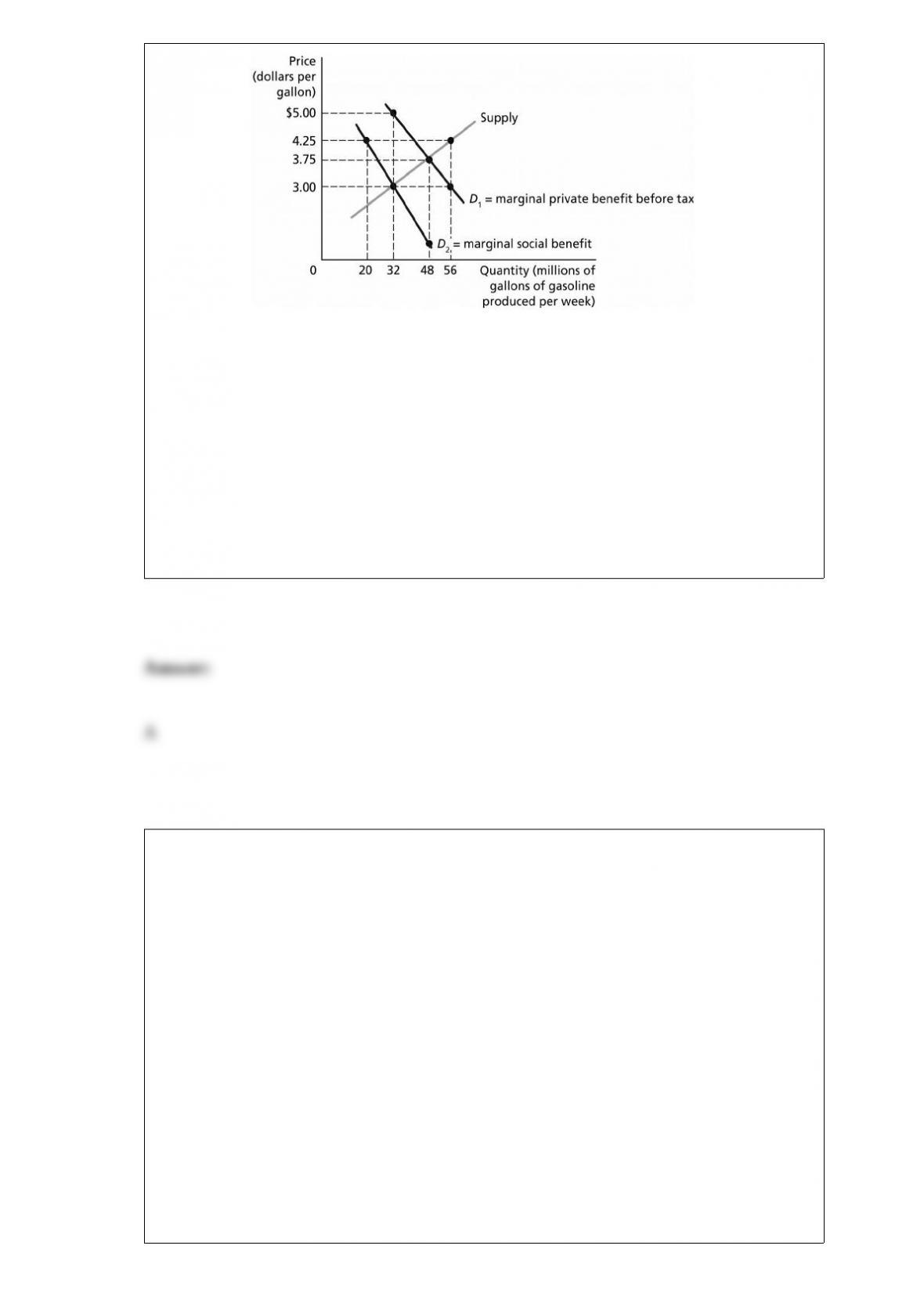
Figure 5-13 Figure 5-13
illustrates the market for gasoline before and after the government imposes a tax to
bring about the efficient level of gasoline production. The efficient equilibrium price of
gasoline is ________ per gallon.
A) $3.00
B) $3.75
C) $4.25
D) $5.00
Which of the following describes a difference between the marginal product of labor
and the marginal revenue product of labor?
A) The marginal product of labor declines as each additional worker is hired because of
the law of diminishing returns. The marginal revenue product of labor declines as each
additional worker is hired because of diseconomies of scale.
B) The marginal product of labor declines as each additional worker is hired because of
the law of diminishing returns. The marginal revenue product increases as each
additional worker is hired because of increases in the productivity of labor.
C) The marginal product of labor is inelastic. The marginal revenue product of labor is
elastic.
D) The marginal product of labor measures the change in output as additional workers
are hired. The marginal revenue product measures the change in revenue as additional
workers are hired.

Suppose an economy’s exchange rate system is the gold standard and vast tracks of gold
are discovered, as is what happened in the United States in 1849. If the economy is at
full employment, what should this discovery do?
A) It should raise the money supply but have no impact on the price level.
B) It should raise the money supply and cause inflation.
C) It should raise the money supply and cause disinflation.
D) It should lower the money supply and cause deflation.
E) It should not change the money supply.
Why is price discrimination legal but not discrimination based on race or gender?
A) because price discrimination increases profits and therefore tax revenues for the
government, but discrimination based on race or gender reduces tax revenues
B) because price discrimination reduces deadweight loss, but discrimination based on
race or gender increases deadweight loss
C) because price discrimination involves charging people different prices based on their
willingness to pay rather than on the basis of arbitrary characteristics
D) because price discrimination enables firms to increase output and employment, but
race or gender based discrimination reduces employment

Two economists from Northwestern University estimated the benefit households
received from subscribing to broadband Internet service. They found that in the year
they analyzed, 47 million consumers paid an average of $36 per month to subscribe to a
broadband Internet service, and estimated the value of total consumer surplus for these
subscribers was equal to $890.5 million. Based on these numbers, what was the average
monthly consumer surplus per subscriber for broadband Internet service?
A) $0.05
B) $0.77
C) $13.06
D) $18.95
Which of the following is counted as “capital” in economics?
A) the money people have
B) the machines workers have to work with
C) the accumulated skills and training workers have
D) the wealth people have
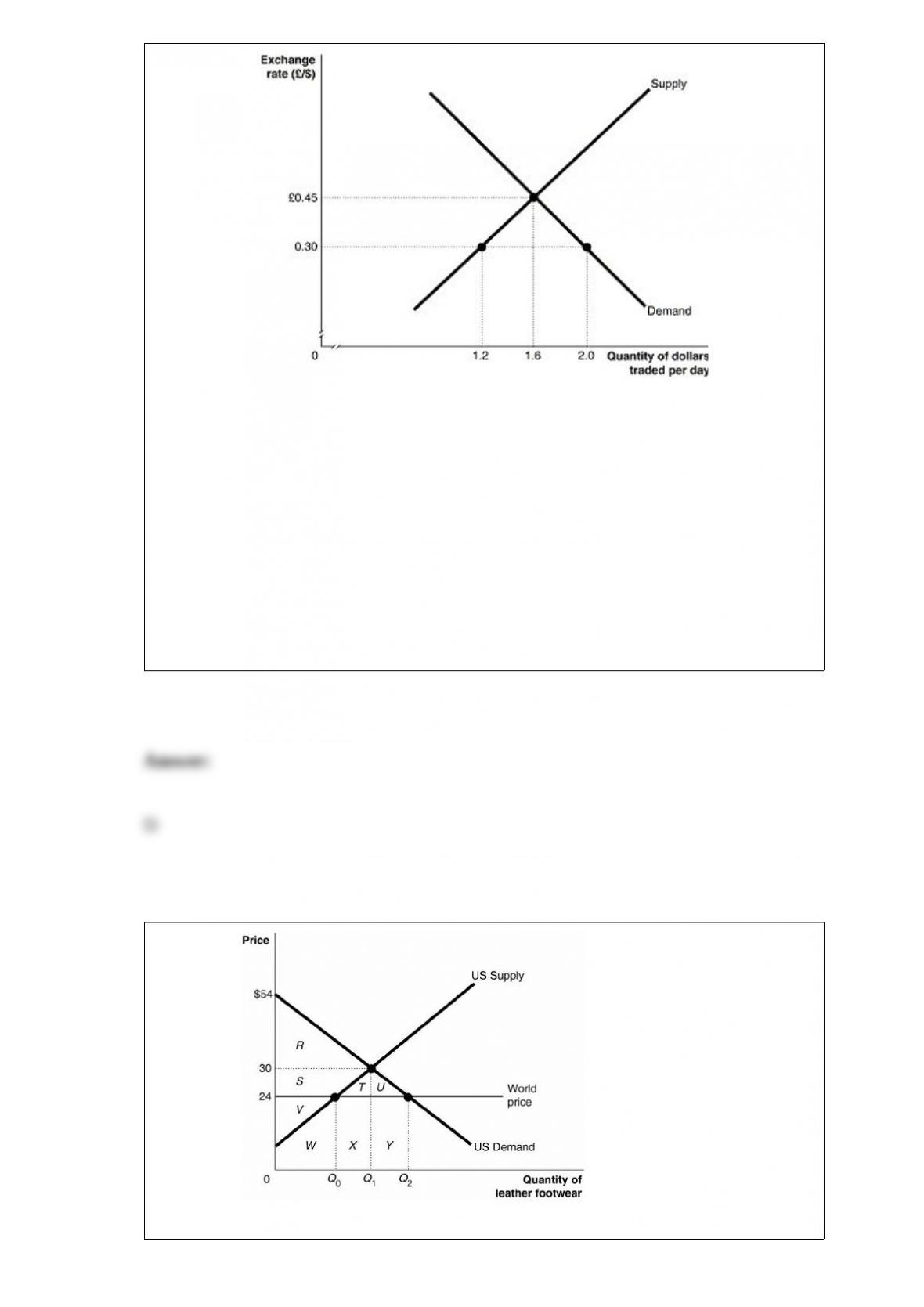
Figure 30-12
The graph above depicts supply and demand for U.S. dollars during a trading day,
where the quantity is millions of dollars. In order to support a fixed exchange rate of
0.30 pounds per dollar, the British central bank must
A) buy 0.4 million dollars per trading day.
B) sell 0.4 million dollars per trading day.
C) buy 0.8 million dollars per trading day.
D) sell 0.8 million dollars per trading day.
Figure 9-4 Figure 9-4 shows the U.S.
demand and supply for leather footwear.

Suppose the government allows imports of leather footwear into the United States.
What will be the quantity of imports?
A) Q0
B) Q1
C) Q2
D) Q2 – Q0