1) the misallocation of resources resulting from large positive externalities can best be
corrected by levying a specific tax on the production of that good or service.
2) Energy demand is relatively stable over the course of a day.
3) a government subsidy per unit of output increases supply.
4) with fixed money income, an increase in the price of one good and a decrease in the
price of the other will cause the new budget line to intersect the original budget line.
5) economic theory suggests that immigration should be allowed into a country until the
marginal benefit of the last immigrant is zero.
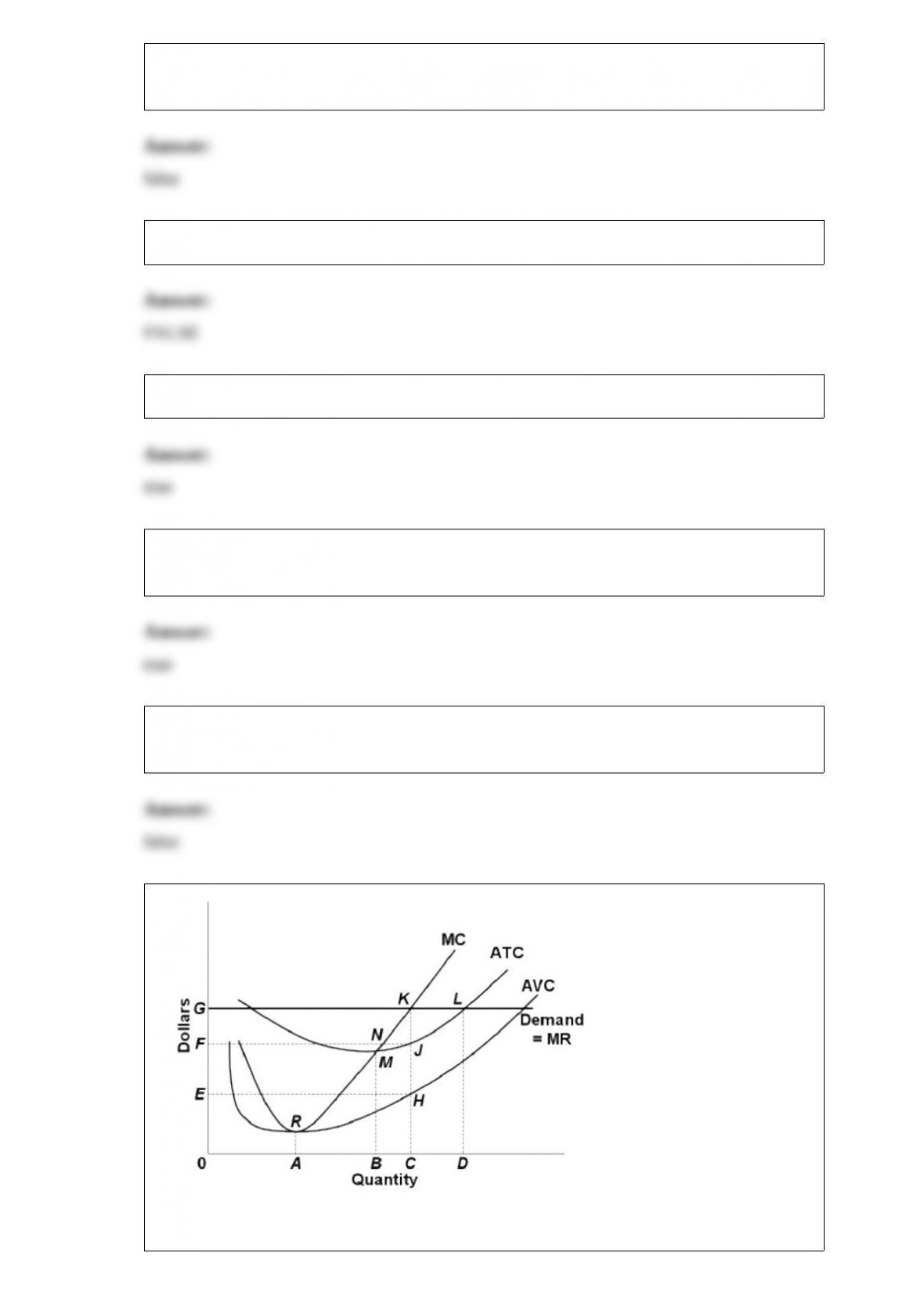
6)
refer to the above diagram. if this represents a typical firm in the industry and the firm
is producing at the profit-maximizing level of output in the short run, then in the long

run we would expect more firms to enter the market.
7) strong property rights inhibit economic growth by strictly regulating economic
behavior.
8) there were over 1 million legal immigrants into the united states in 2007.
9) a rational consumer will cease purchasing a product at that quantity where marginal
utility begins to diminish.
10) Shirking refers to the behavior of workers who provide less-than-expected effort on
the job.
11) International trade based on the principle of comparative advantage creates a more
efficient allocation of world economic resources.
12) assume a drought in the great plains reduces the supply of wheat. noting that wheat
is a basic ingredient in the production of bread and that potatoes are a consumer
substitute for bread, we would expect the price of wheat to:
a.rise, the supply of bread to increase, and the demand for potatoes to increase.
b.rise, the supply of bread to decrease, and the demand for potatoes to increase.
c.rise, the supply of bread to decrease, and the demand for potatoes to decrease.
d.fall, the supply of bread to increase, and the demand for potatoes to increase.
13)
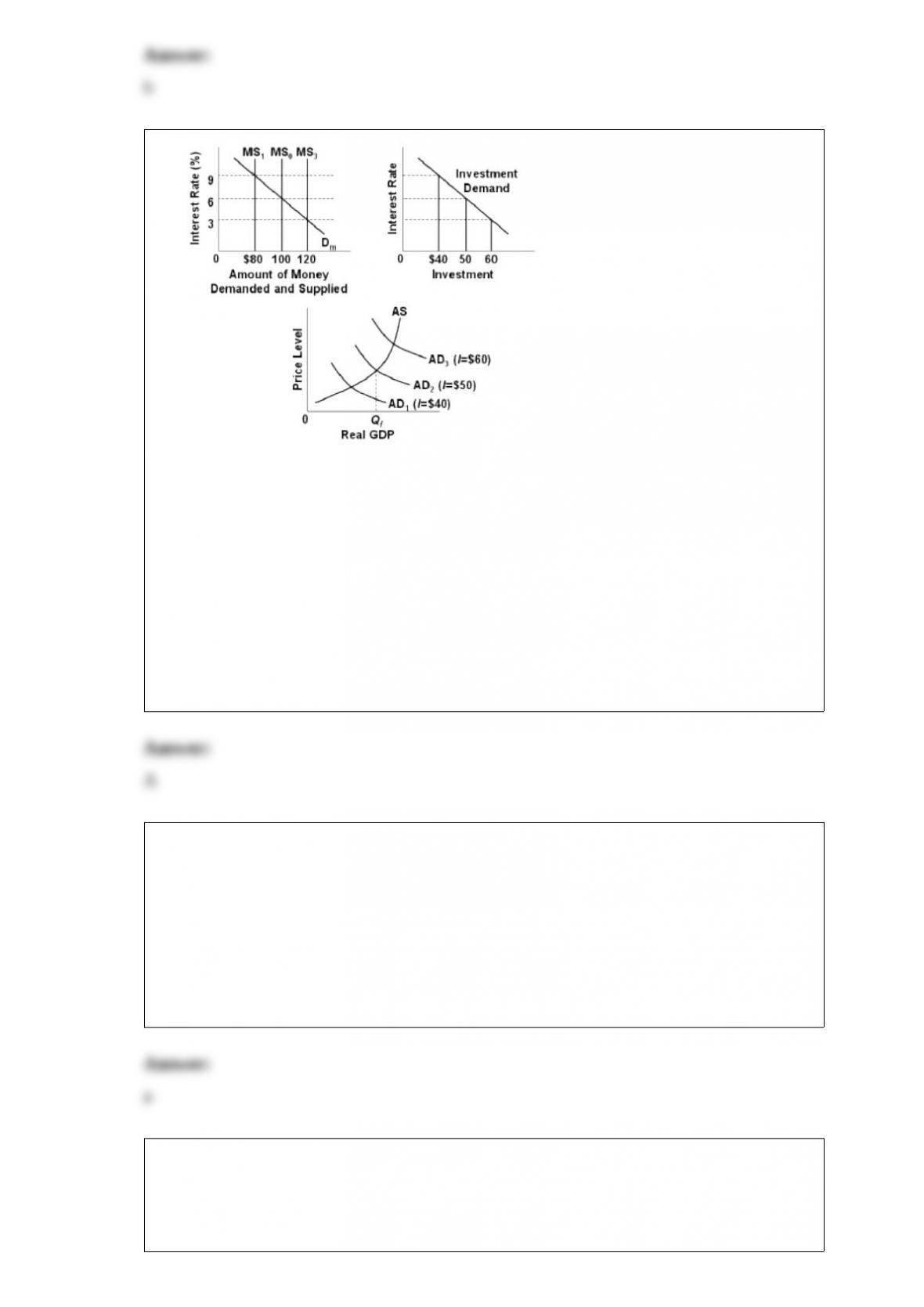
Refer to the above diagrams. The numbers in parentheses after the AD1, AD2, and AD3
labels indicate the levels of investment spending associated with each curve. All figures
are in billions. If the MPC for the economy described by the figures is .8:
A.an increase in the money supply from $80 to $100 will shift the aggregate demand
curve rightward by $50 billion at each price level.
B.an increase in the money supply from $80 to $100 will shift the aggregate demand
curve leftward by $40 billion at each price level.
C.a decrease in the interest rate from 9 percent to 6 percent will shift the aggregate
demand curve leftward by $100 billion at each price level.
D.a decrease in the interest rate from 6 percent to 3 percent will shift the aggregate
demand curve leftward by $50 billion at each price level.
14) (last word) the “after this, therefore because of this” fallacy states that:
a.because event a precedes event b, a is necessarily the cause of b.
b.the very attempt to accomplish a certain objective may create conditions that prohibit
the achievement of that goal.
c.events may drastically alter plans; one’s intentions and actual accomplishments may
differ considerably.
d.generalizations that are accurate at the level of microeconomics may be inaccurate at
the level of macroeconomics.
15) which of the following statements is true about causes of business cycle
fluctuations?
a.economists all agree that supply shocks are the cause of most business cycle
fluctuations.
b.economists all agree that productivity shocks are the cause of most business cycle
changes.
c.economists all agree that monetary changes are primarily responsible for business
cycle fluctuations.
d.there are a wide range of theories as to the underlying causes of business cycle
movements.
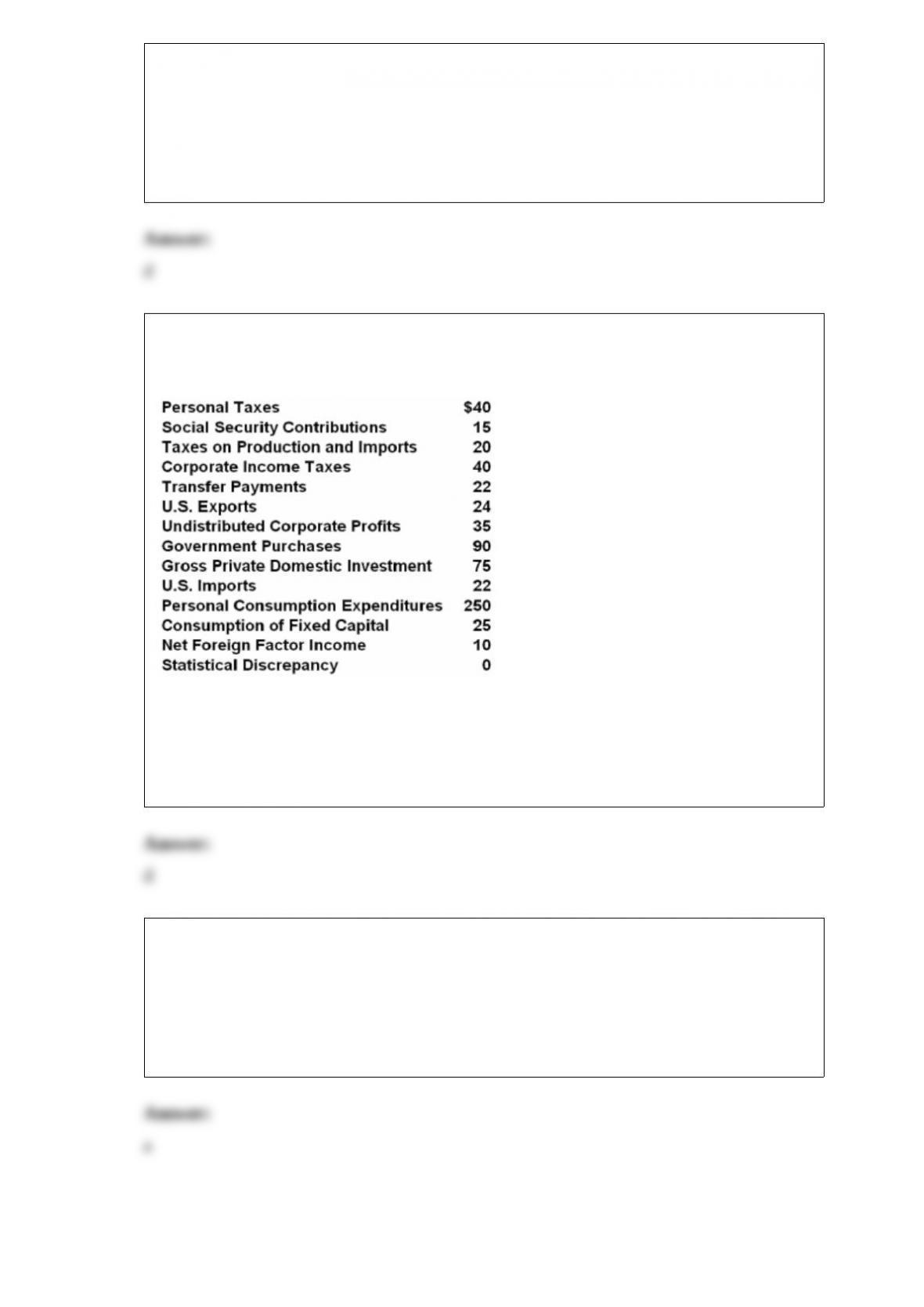
16) answer the next question(s) on the basis of the following data. all figures are in
billions of dollars.
refer to the above data. ni is:
a.$362.
b.$372.
c.$447.
d.$402.
17) of the following countries, the one that best exhibits the characteristics of a market
economy is:
a.canada.
b.cuba.
c.north korea.
d.china.
18)
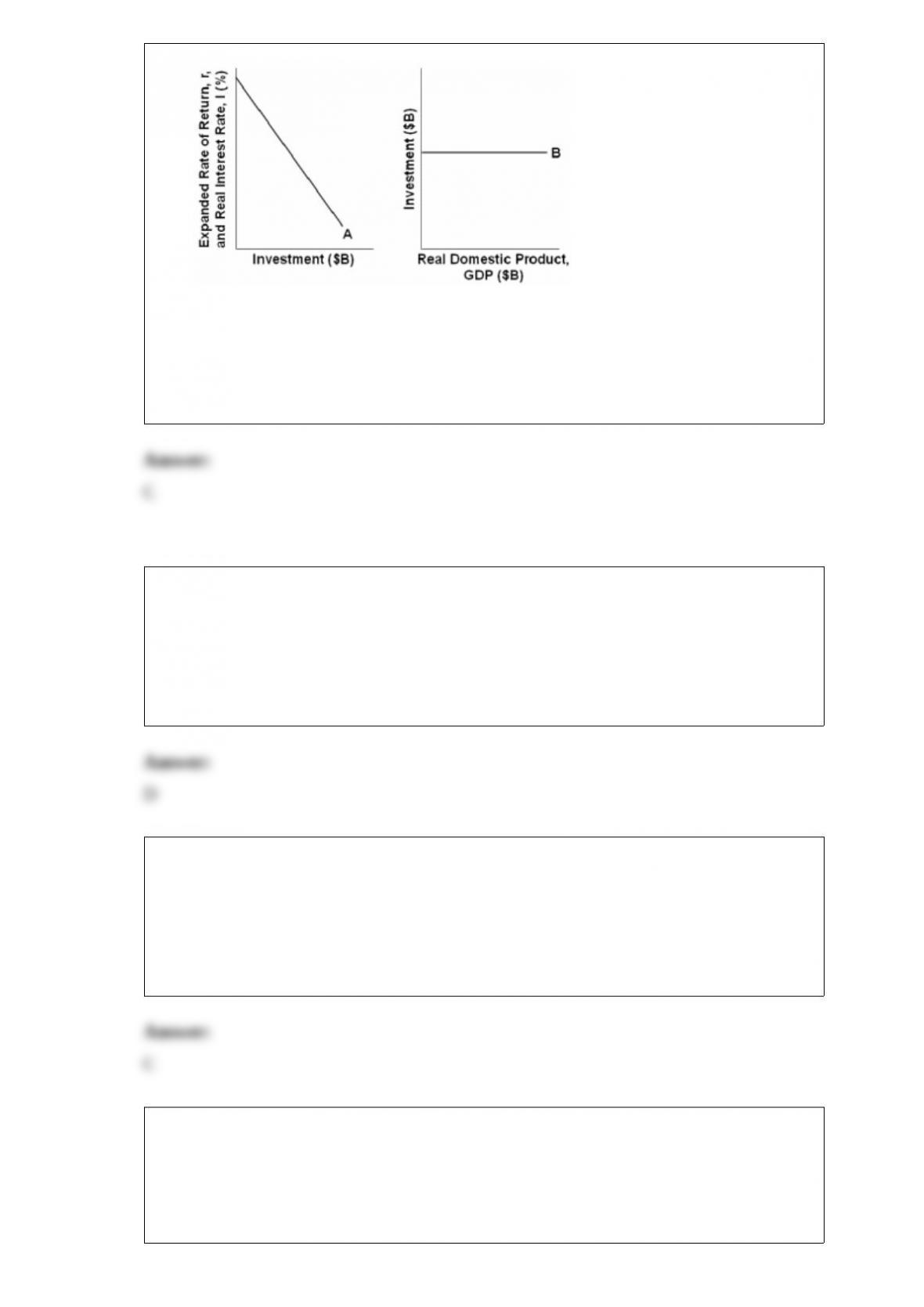
Refer to the above diagrams. Other things equal, an interest rate increase will:
A.shift curve A to the right and shift curve B upward.
B.shift curve A to the left and shift curve B downward.
C.leave curve A in place but shift curve B downward.
D. leave curve A in place but shift curve B upward.
19) The ideas of economist Arthur Laffer became the centerpiece for tax policy during
the:
A.Ford administration.
B.Clinton administration.
C.Nixon administration.
D.Reagan administration.
20) A higher wage could result in a lower labor cost per unit of output than a lower
wage if the higher wage:
A.is accompanied by an offsetting decline in fringe benefits.
B.increases supervision costs.
C.reduces job turnover.
D.increases worker absenteeism.
21) Wealth:
A.is a flow concept.
B.refers to accumulated financial assets only.
C.refers to accumulated real assets only.
D.refers to accumulated financial and real assets.

22) nontariff barriers are:
a.maximum limits on the quantity or total value of specific products imported to a
nation.
b.excise taxes or duties placed on imported products.
c.licensing requirements, unreasonable quality standards, and the like designed to
impede imports.
d.government payments to domestic producers to reduce the world prices of exported
goods.
23) If the equilibrium exchange rate changes so that fewer dollars are needed to buy a
South Korean won, then:
A.Americans will buy fewer Korean goods and services.
B.the won has appreciated in value.
C.fewer U.S. goods and services will be demanded by the South Koreans.
D.the dollar has depreciated in value.
24) in determining real gdp, economists adjust the nominal gdp by using the:
a.national productivity index.
b.wholesale (producers’) price index.
c.gdp price index.
d.consumer price index.
25) which of the following best expresses the law of diminishing returns?
a.because large-scale production allows the realization of economies of scale, the real
costs of production vary directly with the level of output.
b.population growth automatically adjusts to that level at which the average product per
worker will be at a maximum.
c.as successive amounts of one resource (labor) are added to fixed amounts of other
resources (capital), beyond some point the resulting extra output will decline.
d.proportionate increases in the inputs of all resources will result in a
less-than-proportionate increase in total output.
26) Country A limits other nation’s exports to Country A to 1,000 tons of coal annually.
This is an example of a(n):
A.protective tariff.
B.export subsidy.
C.import quota.
D.voluntary export restriction.
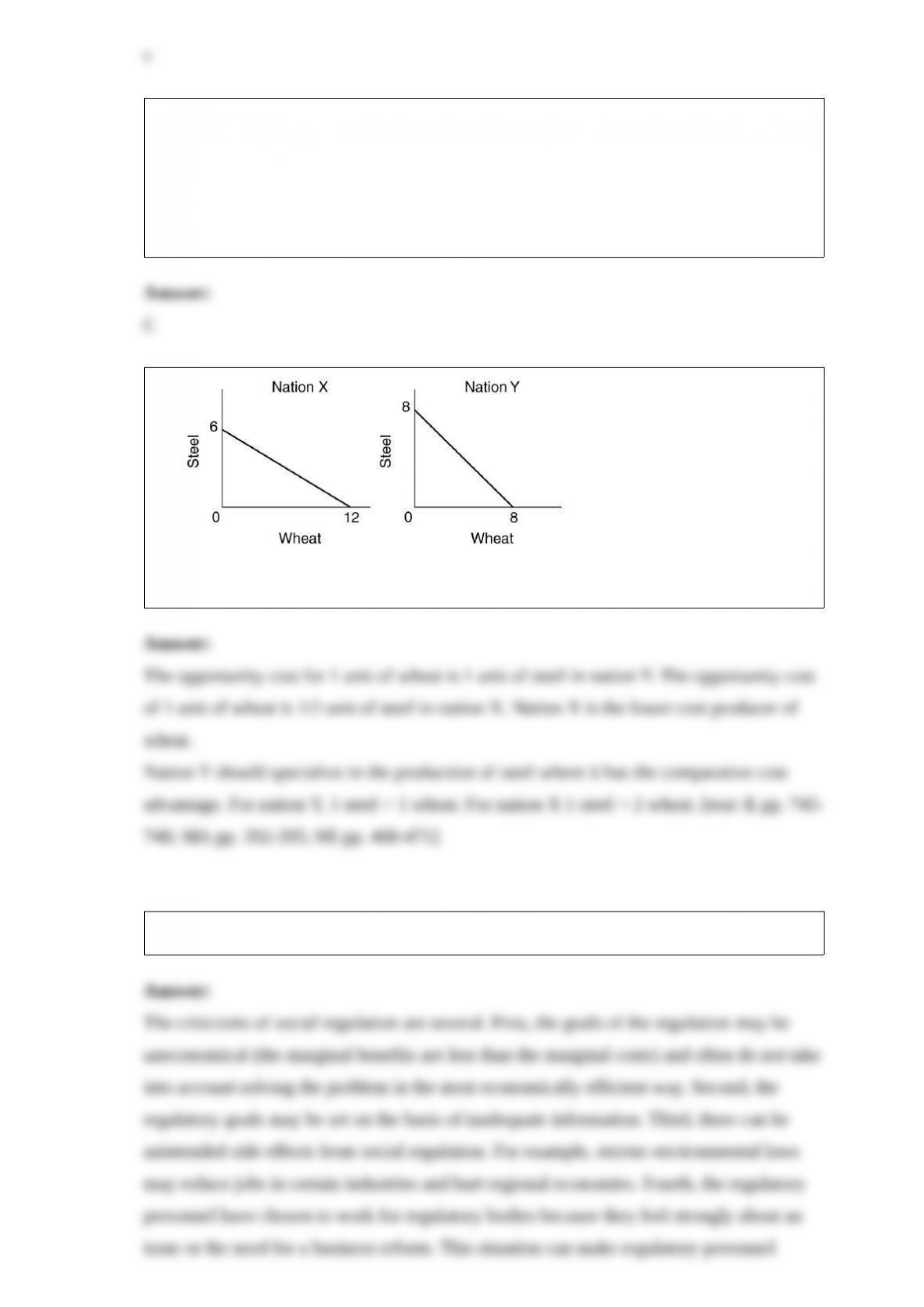
27) Given the data in the graph
below, which nation should specialize in steel production and which nation in wheat
production? Why?
28) What are four criticisms of social regulation?
29) Use the following data to answer the question.
How many units of labor will this firm hire in maximizing its profits?
30) How do high rates of inflation affect the acceptability of a nations currency?
31) Explain how a change in the reserve ratio affects the money supply.