
Suppose Ginger is going to buy a house and a dishwasher. Assuming the marginal cost
of searching for both is the same, one can predict that Ginger will:
A. spend more time searching for the house than the dishwasher.
B. spend more time searching for the dishwasher than the house.
C. spend equal amounts of time searching for the dishwasher and the house.
D. trust the information from her real estate agent but not from the dishwasher
salesperson.
Last summer, real estate prices in your town soared. You started noticing more “For
Sale” signs in your neighbors’ yards. You conclude that:
A. people don’t like to live in your neighborhood anymore.
B. when housing prices rose, they started to exceed some of your neighbors’ reservation
prices.
C. the demand curve for housing in your town has shifted to the left while supply
remained constant.
D. the supply curve for housing in your town has shifted to the right while demand has
remained constant.

In the market for labor, the price of labor is the:
A. same as price of the product produced by the labor.
B. real wage.
C. marginal product of labor.
D. number of hours employed per year.
The situation in which central bankers are insulated from short-term political
considerations and are allowed to take a long-term view of the economy is called:
A. being an inflation dove.
B. being an inflation hawk.
C. central bank independence.
D. the inside lag of monetary policy.
GDP would be a better measure of economic well-being if it included:
A. the costs of education.

B. the total value of intermediate goods.
C. the market value of final goods.
D. the value of leisure.
When actual output is less than potential output, there is ______ output gap and the
inflation rate will ____.
A. an expansionary; exceed the expected rate of inflation
B. an expansionary; be lower than the expected rate of inflation
C. a recessionary; be lower than the expected rate of inflation
D. a recessionary; exceed the expected rate of inflation
The substitution bias in the CPI refers to the failure of statisticians to:
A. allow for the possibility that consumers switch from products whose prices are
rising.
B. allow for the possibility that consumers switch stores at which they shop.
C. take into account improvements in goods and services.
D. take into account new products purchased by consumers.
Which of the following is most likely to occur in the labor market during a recession?
A. The growth rate of real wages declines.
B. Bonuses and promotions become more frequent.
C. New entrants to the labor market have an easier time finding jobs.
D. The supply of labor increases dramatically.
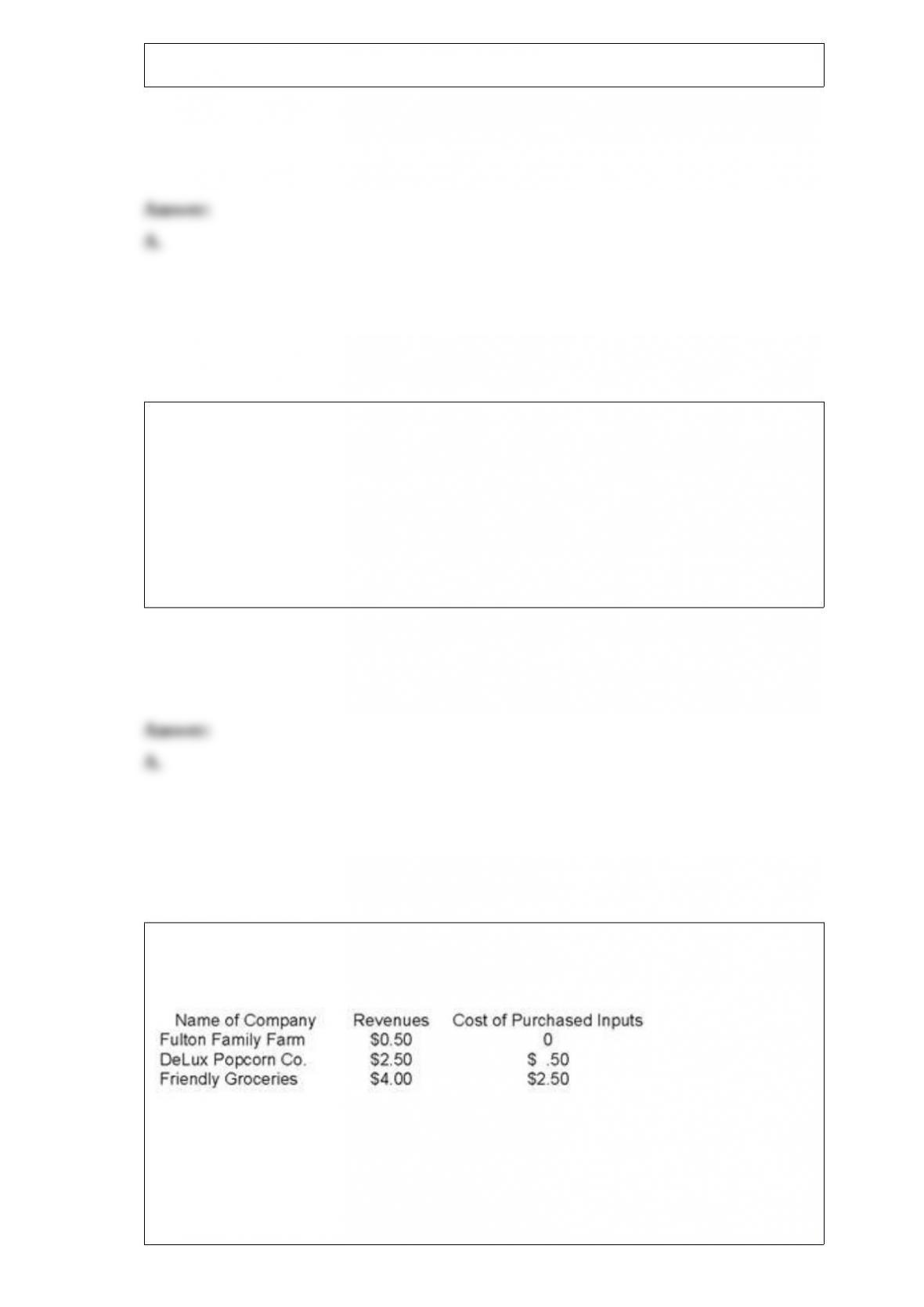
Suppose a jar of DeLux popcorn that is ultimately sold to a customer at Friendly
Groceries is produced by the following production process:
What is the value added of DeLux Popcorn Co.?
A. $0.50
B. $1.50
C. $2.00

D. $2.50
At each value of the domestic interest rate, increases in the riskiness of domestic assets
______ capital inflows, ______ capital outflows, and ______ net capital inflows.
A. increase; increase; increase
B. increase; increase; decrease
C. increase; decrease; increase
D. decrease; increase; decrease
Real GDP per person in the Canada was $7,377 in 1950. Over the next 48 years it grew
at a compound annual rate of 2.0%. If instead real GDP per person had grown at an
average compound annual rate 2.5%, then real GDP per capita in the Canada in 1998
would have been approximately ______ larger.
A. $1,770
B. $5,049
C. $9,370
D. $24,130

Growing rice requires extensive irrigation in California. Economists consider water to
be a (n) ______ for rice farmers in California.
A. want
B. need
C. luxury
D. inferior good
Matt has decided to purchase his textbooks for the semester. His options are to purchase
the books online with next day delivery at a cost of $175, or to drive to campus
tomorrow to buy the books at the university bookstore at a cost of $170. Last week he
drove to campus to buy a concert ticket because they offered 25 percent off the regular
price of $16. Assume the minimum that Matt would be willing to accept to drive to
campus is equal to the $4 he saved on the concert ticket. What would his economic
surplus be if he bought his textbooks at the university bookstore rather than online?
A. $5
B. $1

C. $50
D. $20
Pat used to work as an aerobics instructor at the local gym earning $35,000 a year. Pat
quit that job and started working as a personal trainer. Pat makes $50,000 in total annual
revenue. Pat’s only out-of-pocket costs are $12,000 per year for rent and utilities,
$1,000 per year for advertising and $3,000 per year for equipment.
For Pat to earn normal profit, Pat’s accounting profit would have to be ______.
A. $50,000
B. $35,000
C. $15,000
D. 0
Suppose when you are 21 years old, you deposit $1,000 into a bank account that pays
annual compound interest, and you do not withdraw from the account until your
retirement at the age of 65, 44 years later. How much more will be in your account if

the interest rate is 6 percent rather than 5 percent?
A. $440
B. $1,549
C. $4,428
D. $8,557
Suppose that two recent studies conclude that increased fiber in the diet does not reduce
the risk of developing colon cancer as was previously thought. The likely result will be
that the:
A. quantity demanded of high-fiber foods will fall.
B. demand for high-fiber foods will decrease.
C. supply of high-fiber foods will increase.
D. price of high-fiber foods will rise.
Real GDP per person in Richland is $20,000, while real GDP per person in Poorland is

$10,000. However, Richland’s real GDP per person is growing at 1 percent per year, and
Poorland’s real GDP per person is growing at 3 percent per year. After 50 years, real
GDP per person in Richland minus real GDP in Poorland is:
A. positive and greater than $10,000.
B. positive but less than $10,000.
C. zero.
D. negative.
Which of the following determines whether a firm will earn higher revenues when it
raises its price?
A. The cost of the firm’s inputs.
B. Government regulation of the industry.
C. The price elasticity of demand.
D. None of the above, because companies always earn higher revenues when they
increase price.
Refer to the figure below. As Jeff watches more movies, his marginal utility:

A. gets larger
B. gets smaller
C. does not change
D. gets close to one
One concern regarding the North American Free Trade Agreement (NAFTA) was that it
would lead:
A. the total value of goods and services produced by the United States to fall.
B. wages in Mexico to rise.
C. highly skilled workers in the United States to lose their jobs.
D. unskilled workers in the United States to lose their jobs.
The number of U.S. households with access to the Internet is growing rapidly.
Compared to 50 years ago, one would predict that when considering a major purchase,
people today will gather:
A. less information because the Internet has lowered the cost of gathering information.
B. less information because the Internet has increased the benefit of gathering
information.
C. more information because the Internet has lowered the cost of gathering information.
D. more information because the Internet has increased the cost of gathering
information.
If the income elasticity for a particular good is negative, then:
A. the good is a normal good.
B. as income increases, consumers will tend to purchase more of the good.
C. as income increases, consumers will tend to purchase less of the good.
D. the good is a luxury good.

The price of a gallon of gasoline at the pump increased by 5 percent at the same time
that the inflation rate was also 5 percent. The nominal price of gasoline _____, and the
real price of gasoline _____.
A. did not change; increased
B. did not change; did not change
C. increased; did not change
D. increased; decreased
In perfectly competitive markets, an implication of entry and exit in response to
economic profit and loss is that:
A. firms must earn positive economic profits in the long run.
B. firms will produce the quantity that minimizes average variable costs in the short
run.
C. firms will produce the quantity that minimizes average total costs in the long run.
D. market demand is completely elastic.
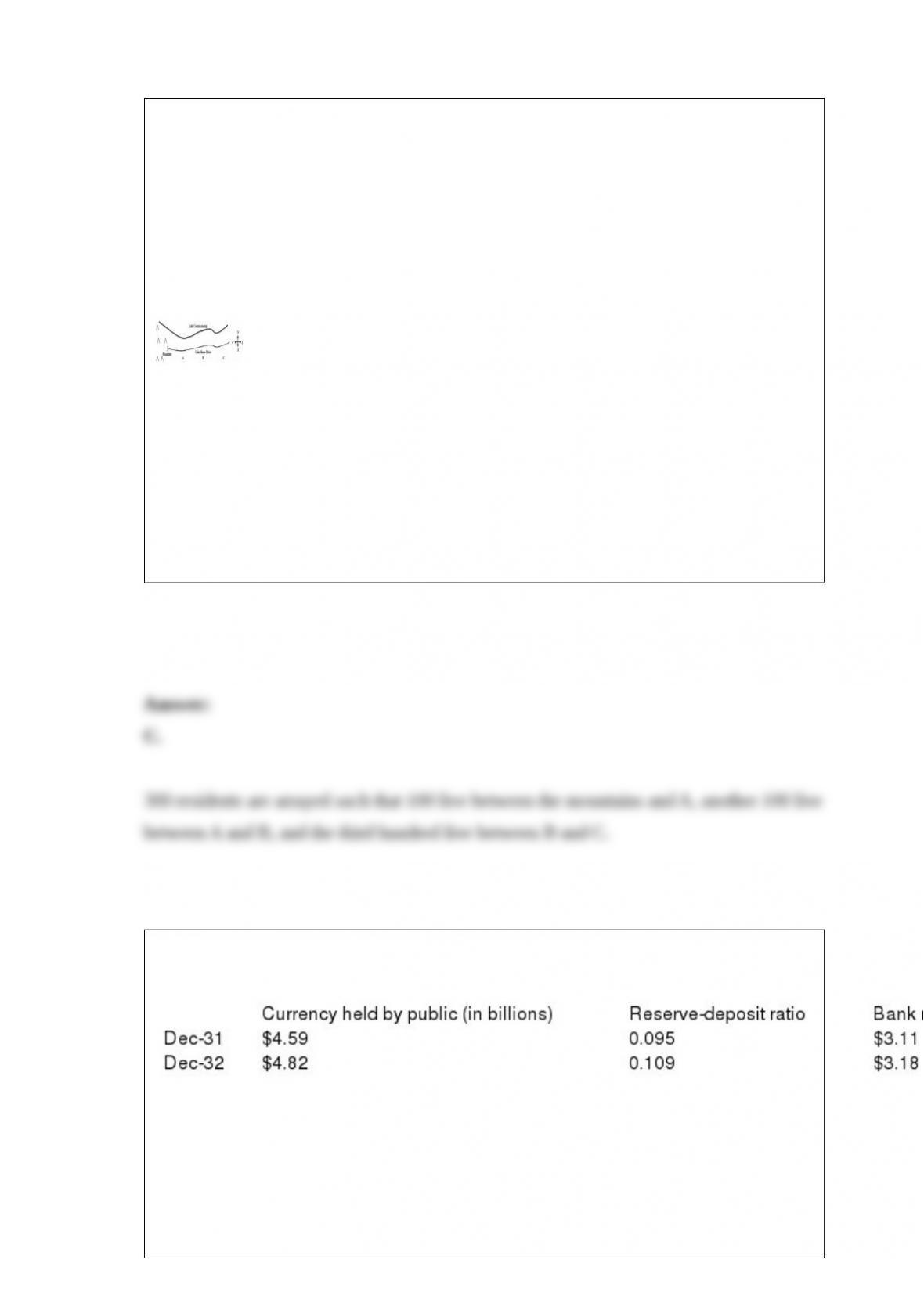
Miniville is an isolated town located on the southern shore of Lake Condescending, a
very large lake. The western edge of Miniville is adjacent to impassable mountains and
there are no towns or businesses for many miles to the east. The 300 residents of
Miniville are evenly distributed along 3 miles of shoreline on the lake, east of the
mountains. Lake Shore Drive, the only street in town, provides access to Miniville’s
homes and businesses. All residents live between the lake and the street; businesses
locate on the other side of the street. Lake Shore Drive is 3 miles long, and the points
labeled A, B, and C are 1, 2, and 3 miles from the western end of Lake Shore Drive,
respectively. All residents of Miniville shop at the store located closest to their homes.
______ residents of Miniville live west of point B, and _____ live east of point A.
A. 100; 200
B. 150; 150
C. 200; 200
D. 200; 100
Based on the information in the table, the total amount of bank deposits decreased from
______ to ______ over the course of 1932.
A. $37.3 billion; $32.7 billion
B. $32.7 billion; $29.2 billion
C. $34.2 billion; $30.8 billion
D. $37.3 billion; $34.0 billion

According to the textbook, Manning and his colleagues found that people with
$1,000-deductible policies spent ______ on health care relative to people with
first-dollar coverage.
A. less
B. 40 percent more
C. the same amount
D. 50 percent more
One problem with cost-plus regulation is that:
A. there is no way for a regulated firm’s owners to recoup their opportunity costs.
B. it blunts regulated firms’ incentives to cut costs.
C. government ownership is often inefficient.
D. consumers would be willing to pay more for higher quality goods.

Refer to the figure above. What might cause Demand to shift from the Original Demand
to the New Demand?
A. An expectation that coffee prices will fall in the future.
B. An increase in the price of coffee creamer.
C. A decrease in the price of tea.
D. An increase in incomes.
Which of the following is an example of an activity with an external cost?
A. Raising honeybees where neighbors on all sides grow apples.
B. Keeping your front yard clean.
C. Speeding on the interstate.
D. Having to buy batteries for the new remote that came with a TV.
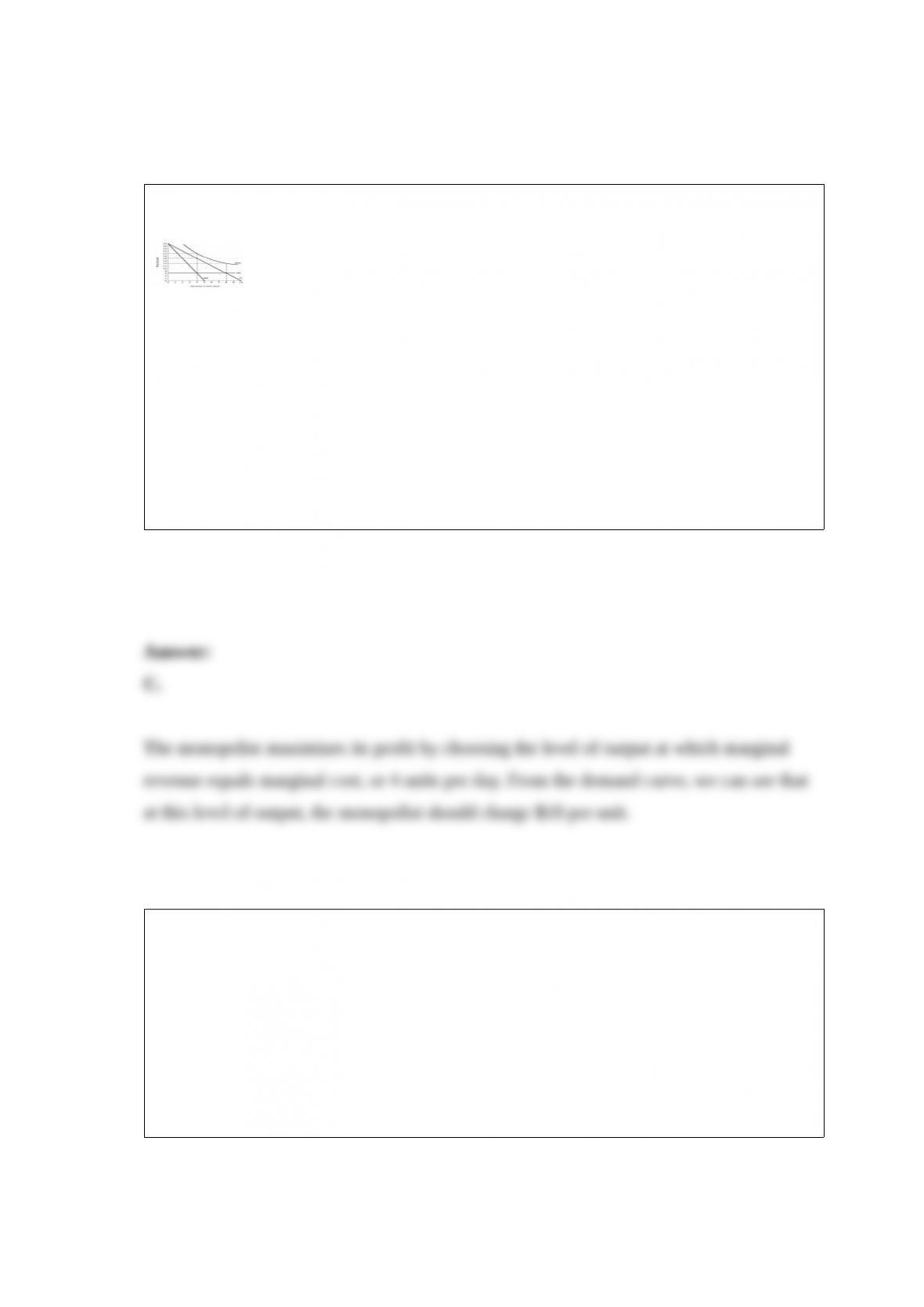
The figure below shows the demand curve, marginal revenue curve, marginal cost curve
and average total cost curve for a monopolist.
This monopolist maximizes its profit by producing ______ units per day and charging a
price of ______ per unit.
A. 4; $6
B. 8; $6
C. 4; $18
D. 8; $14
Changes in the growth rate of potential output and deviations of actual output from
potential output are two logical explanations for:
A. the decline in the natural rate of unemployment.
B. short-term economic fluctuations.
C. increasing wage inequality.
D. skill-biased technological change.
Choosing to study for an exam until the extra benefit (e.g., improved score) equals the
extra cost (e.g., the value of foregone activities) is:
A. not an economic choice.
B. an application of the Cost-Benefit Principle.
C. an application of the Scarcity Principle.
D. not rational because it ignores the importance of total benefits and total costs.
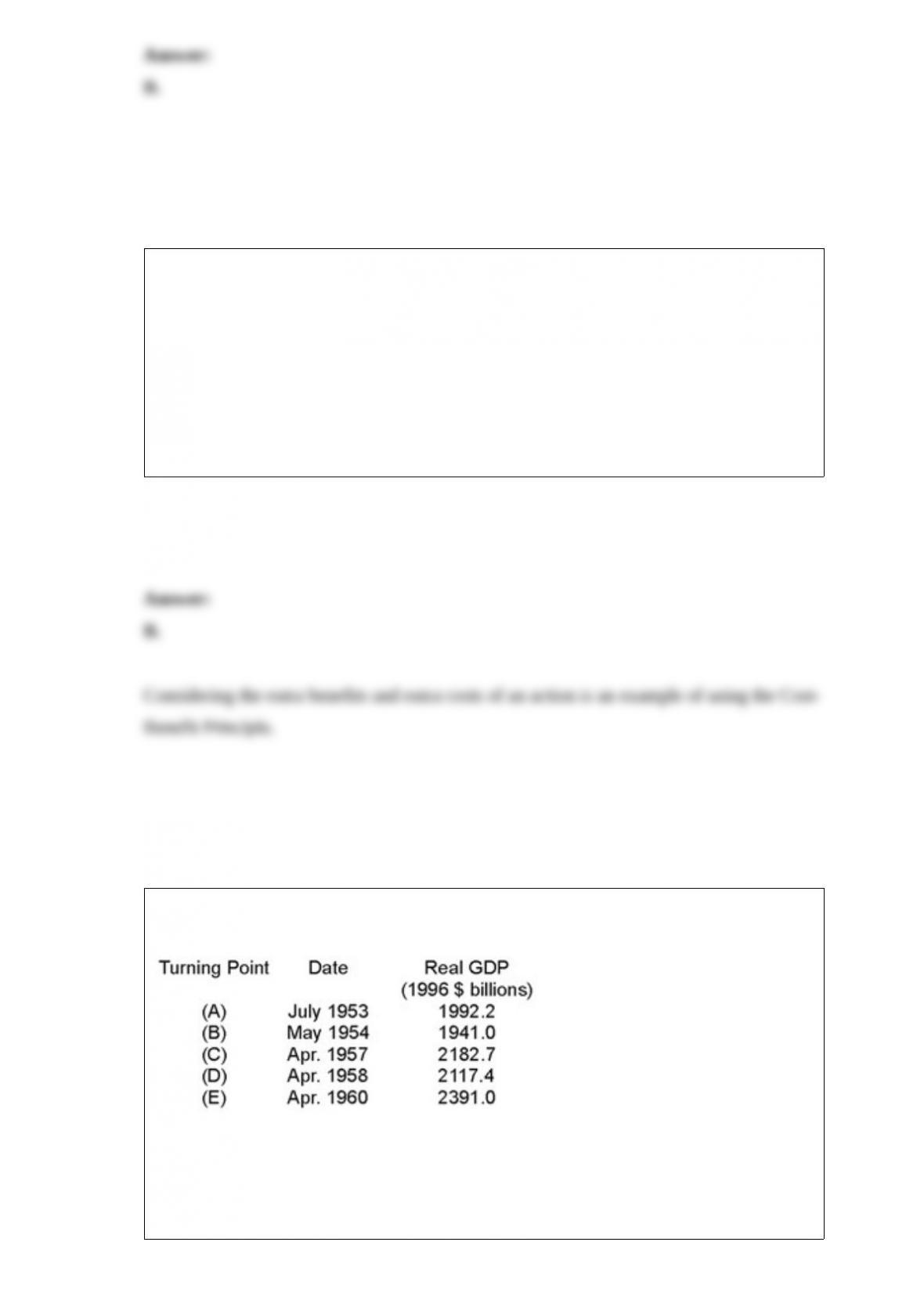
The following data give the dates of successive turning points in U.S. economic activity
and the corresponding levels of real GDP at the time.
The economy experienced an expansion that lasted from:
A. July 1953 to May 1954.
B. May 1954 to April 1957.

C. July 1953 to April 1957.
D. May 1954 to April 1958.
If a firm spends $400 to produce 20 units of output and spends $880 to produce 40
units, then between 20 and 40 units of output, the marginal cost of production is:
A. $20.
B. $24.
C. $22.
D. $480.