
1) The aggregate expenditures model is built upon which of the following assumptions?
A.Prices are sticky downward.
B.The economy is at full employment.
C.Prices are fully flexible.
D.Government spending policy has no ability to affect the level of output.
2) Which of the following is not a significant contributor to the U.S. public debt?
A.war financing
B.tax cuts and expenditure increases in the 1980s
C.recessions
D.demand-pull inflation
3) suppose that gdp was $200 billion in year 1 and that all other components of
expenditures remained the same in year 2 except that business inventories fell by $10
billion. gdp in year 2 is:
a.$180 billion.
b.$190 billion.
c.$200 billion.
d.$210 billion.
4) In the insider-outsider theory:
A.outsiders are workers who retain employment during recession.
B.insiders are managers who have more information about their firms’ performance
than outsiders.
C.insiders are “principals” and outsiders are “agents.”
D.outsiders are laid off workers and other qualified unemployed workers.
5) If the equilibrium level of GDP in a private open economy is $1000 billion and
consumption is $700 billion at that level of GDP, then:
A.saving must be $300 billion.
B.net exports must be $300 billion.
C.S + C must equal $300 billion.
D.Ig + Xn must equal $300 billion.
6) Which of the following gave the Federal Trade Commission responsibility to protect
the public against false and misleading advertising?
A.Celler-Kefauver Act of 1950
B.Wheeler-Lea Act of 1938
C.Clayton Act of 1914
D.Sherman Act of 1890
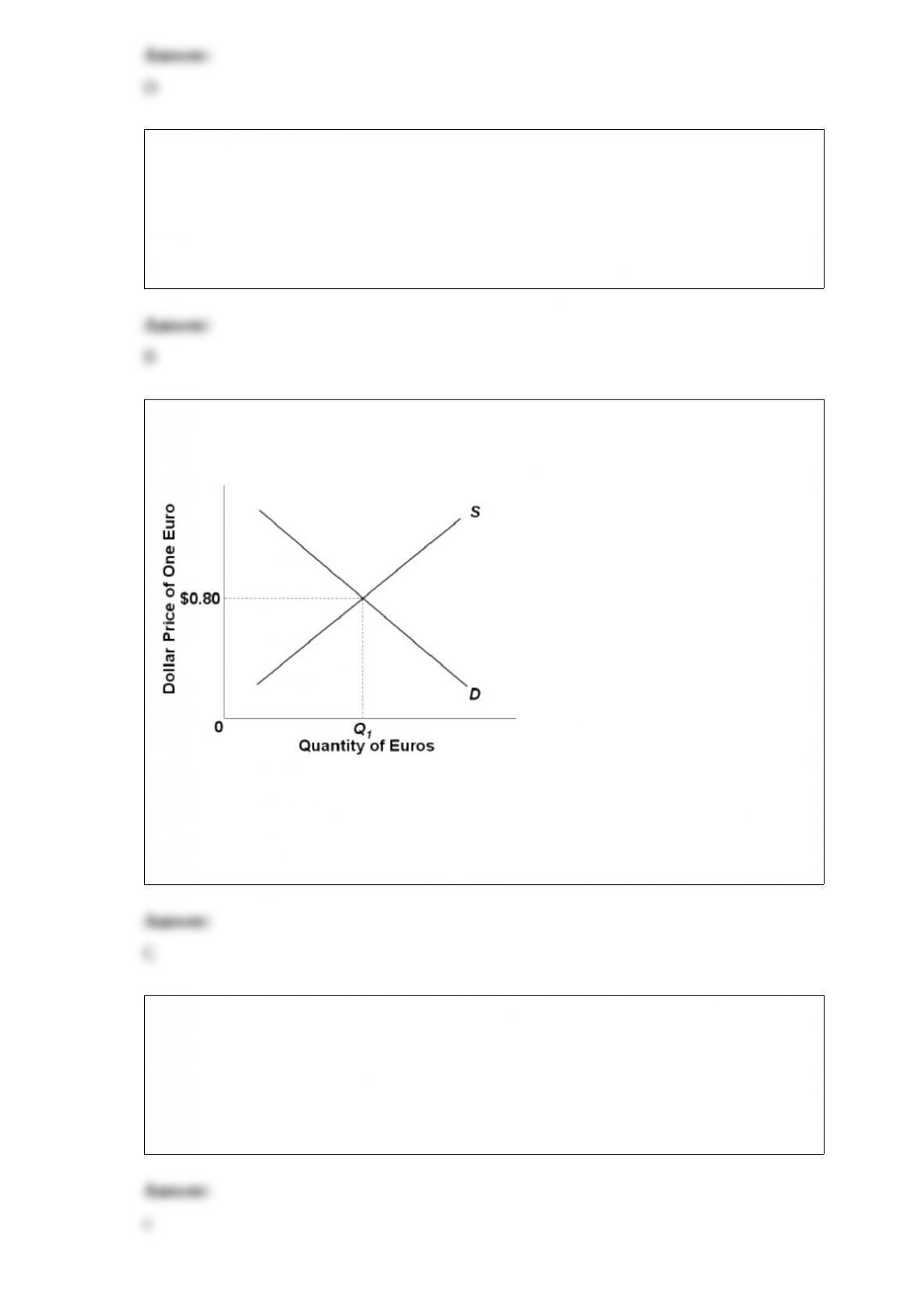
7) The following diagram is a flexible exchange market for foreign currency:
Refer to the above diagram. At the equilibrium exchange rate:
A.$8 will buy 1 euro.
B.0.8 euros will buy $1.
C.1.25 euros will buy $1.
D.$1 will buy 8 euros.
8) price discrimination refers to:
a.selling a given product for different prices at two different points in time.
b.any price above that which is equal to a minimum average total cost.
c.the selling of a given product at different prices that do not reflect cost differences.
d.the difference between the prices a purely competitive seller and a purely
monopolistic seller would charge.

9) the production of durable goods varies more than the production of nondurable goods
because:
a.durables purchases are nonpostponable.
b.durables purchases are postponable.
c.the producers of nondurables have monopoly power.
d.producers of durables are highly competitive.
10) an otherwise unprofitable motel located on a largely abandoned roadway might be
able to stay open for several years by:
a.increasing its nightly room rates.
b.reducing or eliminating its annual maintenance expenses.
c.charging room rates that exceed marginal revenue.
d.eliminating its fixed costs, including its opportunity costs.
11) the law of supply indicates that:
a.producers will offer more of a product at high prices than they will at low prices.
b.the product supply curve is downsloping.
c.consumers will purchase less of a good at high prices than they will at low prices.
d.producers will offer more of a product at low prices than they will at high prices.