
Many economists think that, in the long run, the Phillips curve is
a. a horizontal line.
b. a vertical line.
c. the same as the short-run curve.
d. a 45-degree line from the origin.
The recent experience in Greece, Portugal, and Ireland make the euro
a. seem very unlikely to fail because of decreasing debt levels.
b. seem very unlikely to fail because of increasing interest rates.
c. seem somewhat likely to fail because of increasing debt levels.
d. seem somewhat likely to fail because of increasing interest rates.
International per capita GDP comparisons are misleading when countries involved
differ greatly in
a. the type of economic system each country uses to solve its economic problem.
b. the freedom of their election processes.
c. the percentage of economic activity that is transacted in organized markets.
d. the quantity of human and natural resources they possess.
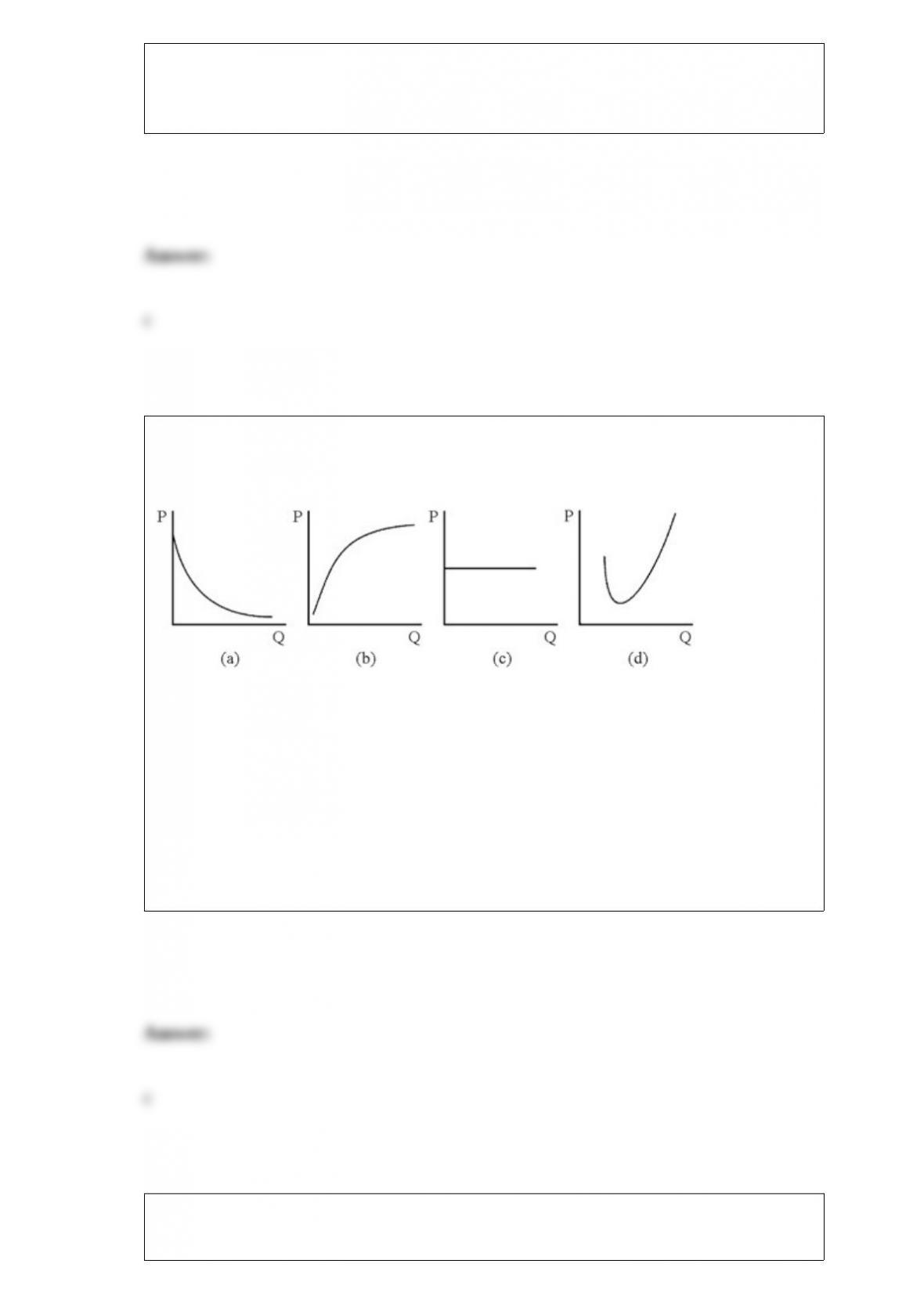
Figure 7-5
Which of the graphs in Figure 7-5 could be a firm’s total fixed cost curve?
a. (a)
b. (b)
c. (c)
d. (d)
The market system provides a way

a. to allow specialization and exchange to work in tandem.
b. to improve the well-being of mankind.
c. to harness self-interest.
d. to allocate goods and services.
e. All of the above are correct.
Taxation may improve the social welfare when the taxed good
a. is socially undesirable (like, in some views, liquor and pornography).
b. imposes negative externalities.
c. is overproduced under a free-market system.
d. All of the above are correct.
The long-run average cost curve
a. is a composite of short-run AC curves.
b. shows the lowest possible short-run AC corresponding to each output level.
c. depends on the firm’s planning horizon.

d. All of the above are correct.
A currency appreciation is disinflationary and contractionary if the
a. inward shift of the aggregate demand curve due to the fall in exports exceeds the
outward shift of the aggregate supply curve due to lower input prices.
b. outward shift of the aggregate demand curve due to the rise in exports exceeds the
outward shift of the aggregate supply curve due to lower input prices.
c. outward shift of the aggregate demand curve due to the fall in exports exceeds the
inward shift of the aggregate supply curve due to higher input prices.
d. inward shift of the aggregate demand curve due to lower input prices exceeds the
outward shift of the aggregate supply curve due to the rise in exports.
The major difference between nominal GDP and real GDP is that
a. real GDP is the absolute value of goods and services and nominal GDP is a relative
value.
b. real GDP refers to products made in the United States and nominal GDP refers to
both exports and imports.
c. nominal GDP is the market value and real GDP has been adjusted for inflation.

d. real GDP is a relative value and nominal GDP is an absolute value.
If Mexico experiences a period of stable prices while the United States experiences
rapid inflation, what will happen in Mexico?
a. an increase in aggregate supply
b. a decrease in aggregate supply
c. a decrease in aggregate demand
d. an increase in aggregate demand
To eliminate a recessionary gap, the expenditure schedule should be
a. shifted downward.
b. shifted upward.
c. made steeper.
d. made flatter.

A change in the income of buyers will normally change demand.
a. True
b. False
Appreciation of the dollar will make imported goods more expensive and shift the
aggregate demand curve outward.
a. True
b. False
A decrease in the price level in Japan will shift the U.S. aggregate demand curve
outward.
a. True
b. False

The United States Social Security system
a. pays benefits in direct accordance to what each individual has paid into the system.
b. has paid the current generation of recipients less in benefits than it paid in payroll
taxes.
c. has paid the current generation of recipients more than it paid in payroll taxes.
d. paid the earlier generations more and the current generation less than each paid in
payroll taxes.
Very few societies have used price controls.
a. True
b. False

A quota is
a. a tax on exported items.
b. a tax on imported items.
c. a limit on the amount of imports.
d. a subsidy to export.
Despite the elimination of the federal budget deficit in the late 1990s, the trade deficit
increased due to
a. increased household saving.
b. decreased household saving.
c. a depreciation of the dollar.
d. an increase in inflation rates.
Low interest rates will persuade corporations to invest more right now.
a. True
b. False

An example of investment is the purchase of machinery by a manufacturing company.
a. True
b. False
If England uses one week’s time to produce ten yards of cloth or two barrels of wine
and Portugal uses one week’s time to produce twelve yards of cloth or six barrels of
wine, England has the comparative advantage in both goods.
a. True
b. False
Marginal land is land that is not worth anything under any circumstances.

a. True
b. False
Probably the simplest approach to the problem of oligopolistic interdependence is to
a. conduct market experiments.
b. assume that rivals will pursue a course most detrimental to the firm concerned.
c. ignore the actions of rivals.
d. increase the firm’s advertising outlay considerably.
Economists believe that the same explanation for the rapid growth of costs applies to
services, theatrical performances and restaurant meals.
a. True
b. False

An individual’s supply curve is backward bending.
a. True
b. False
The only major disadvantage of paper money is that it is hard to divide into smaller
denominations.
a. True
b. False
A stock market
a. guarantees that a seller of a stock will get the price at which the stock was purchased.
b. is used only to sell new stock issues from corporations and not to transfer existing
stocks.
c. is used only to sell stocks, not to buy stocks.

d. gives an individual a chance to invest in stocks without committing funds for long
periods of time.
One problem with the European Union’s choice regarding equality versus efficiency is
that it may inadvertently shrink the size of its “economic pie”.
a. True
b. False
An increase in aggregate demand will result in inflation.
a. True
b. False

The assignment of inputs to specific industries by central planners is made difficult by
a. the interdependency among industries.
b. lack of data for decision making.
c. the danger of a chain reaction among industries if an error is made at any point.
d. All of the above are correct.
The force that leads to zero economic profits for monopolistically competitive firms in
the long run is
a. excess capacity.
b. price wars among firms.
c. entry by new firms.
d. excessive advertising.
Workers expecting inflation will expect wage increases to be built into their wage
contracts.
a. True
b. False

The interest rate is determined purely by market forces, and not by government
involvement.
a. True
b. False
In comparing the changes in actual budget surplus and the structural surplus between
1993 and 1999, it is clear that the
a. actual surplus rose less than the structural surplus.
b. actual surplus and the structural surplus rose about the same.
c. actual surplus rose much more than the structural surplus.
d. tax increases of 1993 decreased the structural surplus more than they decreased the
actual surplus.

Production indifference curves show the combination of inputs that produce a given
output.
a. True
b. False
Will depletable resources such as oil, coal, and aluminum be exhausted if their prices
are left to the market?
Briefly explain Schumpeter’s model of innovation. Why does an innovator’s economic
profit eventually reduce to zero?
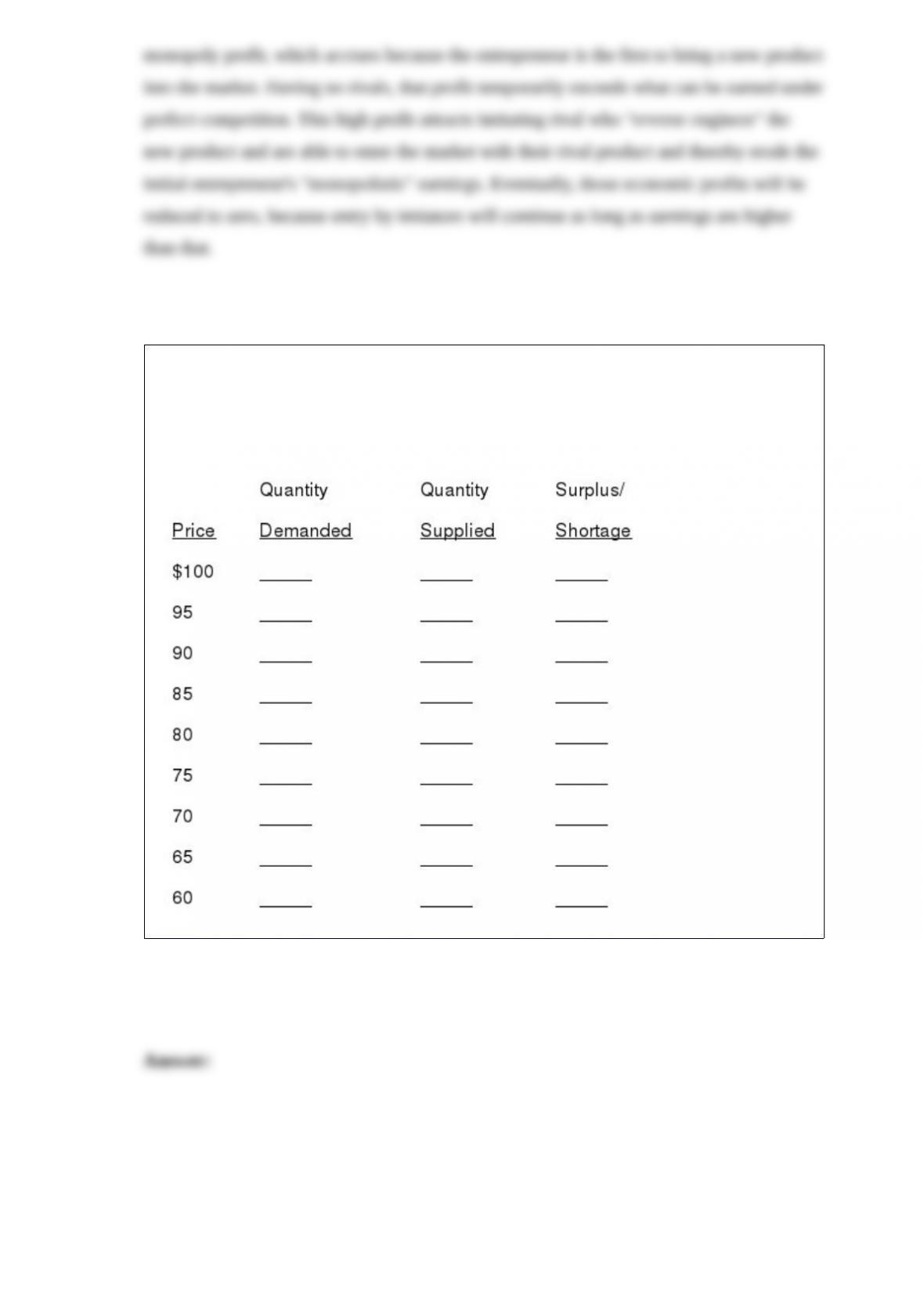
Suppose demand can be described with the equation Q = 900 − 5P and supply with the
equation Q = 100 + 5P. Complete the following table. Determine the equilibrium price
and quantity.
Explain the relationship between interest rates and (1) investments in housing, and (2)
business investments.
Explain how a “conservative” and a “liberal” might differ in the types of policies they
advocate to counteract a recessionary gap.
How do rising prices slow resource depletion?
If a manager has determined that a particular piece of capital is likely to increase the
cash flow of a business by $10,000 for the next five years, what is the present value of
the capital at an interest rate of 10 percent? (Assume that the cash flow first increases
one year from today.)

A large airline calculates that the additional cost of a having a passenger on a flight to
the Bahamas as the cost of a bag of peanuts and a soft drink, which totals $1.50, but the
airline’s price is $600 for potential customers who want to buy vacant seats on the day
of the flight. Which economic principle is this airline failing to utilize?
Explain the relationship between opportunity costs and money costs. Can they be
treated as identical?

What does cross elasticity of demand between goods reveal about the nature of
relationship between them?
Explain how a bilateral monopoly equilibrium outcome differs from a purely
competitive outcome.
Economics is often described as a science of constrained choice. How do you justify
this argument?
From the viewpoint of the individual investor, are stocks or bonds riskier? Explain.
Explain the theory of investment in human capital and the specific role that education
plays in the theory.
Contrast the economic performance of the American economy of 2001 with the
economic performance of the 1996 to 2001 period. Use the appropriate aggregate
demand and aggregate supply curves to distinguish the differing economic condition of
the two periods.
If an economy wants to experience economic growth, what decision must it make and
carry out? Explain.
The quantity theory of money builds on the equation of exchange. What specific
assumptions are made that turn the equation of exchange from an accounting identity
into an economic theory?
Why are sellers willing to sell more at a higher price?
What are the two important programs in practice in America that strongly resemble a
negative income tax?