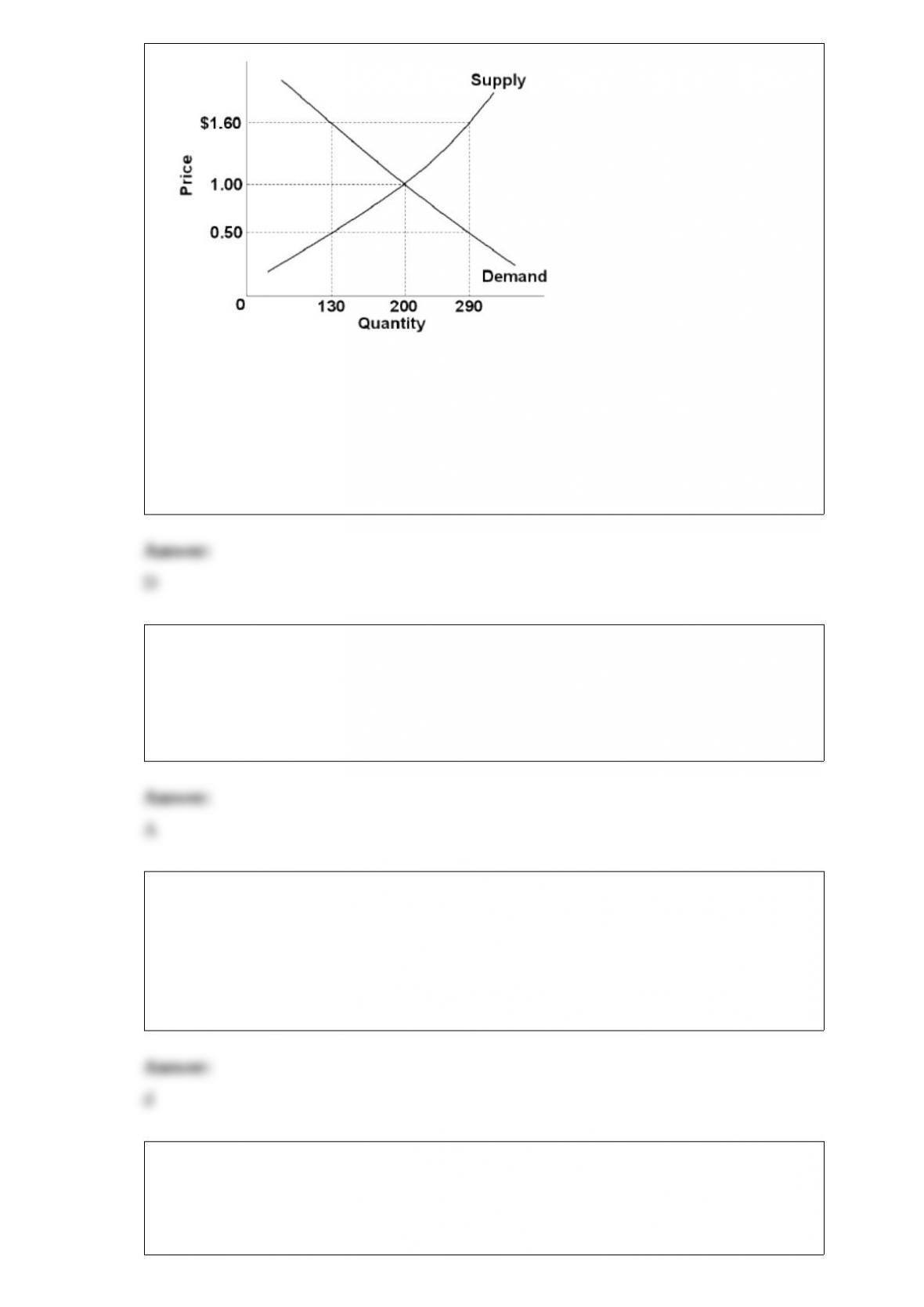
1)
Refer to the above diagram showing the domestic demand and supply curves for a
specific standardized product in a particular nation. If the world price of this product is
$1, this nation will:
A.export all of the product.
B.import all of the product.
C.import some of the product and produce some of the product domestically.
D.neither export nor import the product.
2) When the Fed lends money to a commercial bank, the bank:
A.increases its reserves and enhances its ability to extend credit to bank customers.
B.decreases its reserves and reduces its ability to extend credit to bank customers.
C.pays the Federal funds interest rate on the loan.
D.pays the prime rate interest rate on the loan.
3) assuming competitive markets with typical supply and demand curves, which of the
following statements is correct?
a.an increase in supply with a decrease in demand will result in an increase in price.
b.an increase in supply with no change in demand will result in an increase in price.
c.an increase in supply with no change in demand will result in a decline in sales.
d.an increase in demand with no change in supply will result in an increase in sales.
4) The electricians union is a good example of:
A.exclusive unionism.
B.an industrial union.
C.how unions can simultaneously increase wage rates and employment by increasing
the demand for labor.
D.inclusive unionism.
5) The kinked-demand schedule that an oligopolist believes confronts the firm is given
in the table below. Compute the oligopolists total revenue at each of the nine prices, and
enter these figures in the table. Also compute marginal revenue for each unit between
the nine prices and enter these figures in the table.
(a)Where is the kink in the demand curve? What is the current selling price at that kink
and how much output will be demanded?
(b)What is the range of marginal cost that will keep the price set at the kink?
6) Suppose Leslie is considering developing an asset portfolio. She must receive a
minimum of 5% to compensate for her delayed consumption and given her investment
bundle, receive 10% in return.
(a)What is if?
(b)What is the risk premium?
(c)What is the average expected return?
7) The U.S. demand for British pounds is:
A.downsloping because a higher dollar price of pounds means British goods are
cheaper to Americans.
B.downsloping because a lower dollar price of pounds means British goods are more
expensive to Americans.

C.upsloping because a lower dollar price of pounds means British goods are cheaper to
Americans.
D.downsloping because a lower dollar price of pounds means British goods are cheaper
to Americans.
8) costs to an economist:
a.consist only of explicit costs.
b.may or may not involve monetary outlays.
c.never reflect monetary outlays.
d.always reflect monetary outlays.
9) the corporate form of business enterprise has promoted the development of
large-scale business operations because:
a.the corporate form of enterprise is in a highly advantageous position to protect itself
from the effects of long-run inflation.
b.corporations have been able to marshal large amounts of financial capital through the
sale of stocks and bonds.
c.corporations have been more successful than unincorporated businesses in keeping
labor unions out of their plants.
d.this legal form of enterprise has been subject to fewer government controls than have
proprietorships and partnerships.
10) (Last Word) Which of the following is a reason why changes in the price of
imported oil have less of an effect on the U.S. economy than in the 1970s and early
1980s?
A.The United States is now more reliant on domestic oil and less reliant on imported
oil.
B.The amount of energy consumed in producing each dollar of GDP has greatly
declined.
C.The United States has vastly expanded its hydroelectric capacity (dams and
reservoirs).
D.The United States has greatly expanded its passenger train services.

11) Which of the following is correct?
A.Vertical mergers are more likely to be acceptable under antitrust laws than are
horizontal mergers.
B.A vertical merger entails the merging of two or more competing firms.
C.Horizontal mergers are more likely to be acceptable under antitrust laws than are
vertical mergers.
D.Conglomerate mergers occur when two or more firms at various stages in a good’s
production are combined.