
The speculative demand for money may not exist because
A. banks now pay interest on some types of checkable deposits.
B. there are alternative riskless assets paying higher returns than the return on money.
C. the transactions demand can be shown to depend on interest rates.
D. government regulations have eliminated risk in the financial markets.
Answer:
The bailout of the savings and loan industry was much delayed and, therefore, much
more costly to taxpayers because
A. of regulators’ initial attempts to downplay the seriousness of problems within the
thrift industry.
B. politicians listened to the taxpayers rather than the S&L lobbyists.
C. Congress did not wait long enough for many of the problems in the thrift industry to
correct themselves.
D. regulators could not be fired, therefore, they didn’t care if they did a good job or not.
Answer:
Conflicts of interest may arise within the credit rating agencies because

A. the investors pay the credit agencies for ratings.
B. the issuers of debt securities pay the credit agencies for ratings.
C. the credit rating agencies provide auditing services to issuers of debt securities.
D. the credit rating agencies are involved in offering credit counseling to investors.
Answer:
Which of the following statements are TRUE?
A. A bank’s assets are its sources of funds.
B. A bank’s liabilities are its uses of funds.
C. A bank’s balance sheet shows that total assets equal total liabilities plus equity
capital.
D. A bank’s balance sheet indicates whether or not the bank is profitable.
Answer:
Suppose that there is a negative aggregate supply shock and the central bank commits
to an inflation rate target.
A. If the commitment is credible, the public’s expected inflation will remain unchanged.

B. Credible policy produces better outcomes on both inflation and output in the short
run.
C. Policies that are not credible produce worse economic contraction.
D. all of the above.
E. both A and C.
Answer:
Which of the following statements about financial markets and securities is TRUE?
A. Many common stocks are traded over-the-counter, although the largest corporations
usually have their shares traded at organized stock exchanges such as the New York
Stock Exchange.
B. As a corporation gets a share of the broker’s commission, a corporation acquires new
funds whenever its securities are sold.
C. Capital market securities are usually more widely traded than shorter-term securities
and so tend to be more liquid.
D. Prices of capital market securities are usually more stable than prices of money
market securities, and so are often used to hold temporary surplus funds of
corporations.
Answer:

The long-run aggregate supply curve is a vertical line passing through
A. the natural rate of output.
B. the natural-rate price level.
C. the actual rate of unemployment.
D. the expected rate of inflation.
Answer:
Open market sales ________ reserves and the monetary base thereby ________ the
money supply.
A. raise; lowering
B. raise; raising
C. lower; lowering
D. lower; raising
Answer:
If there isn’t sufficient information available, then which of the following approaches to
reduce conflicts of interest will have the lowest probability of working?

A. leave it to the market
B. supervisory oversight
C. separation of functions
D. socialization of information production
Answer:
An autonomous rise in ________ shifts the LM curve to the ________, everything else
held constant.
A. net exports; right
B. net exports; left
C. money demand; right
D. money demand; left
Answer:
The advantage of a “buy-and-hold strategy” is that
A. net profits will tend to be higher because there will be fewer brokerage commissions.
B. losses will eventually be eliminated.

C. the longer a stock is held, the higher will be its price.
D. profits are guaranteed.
Answer:
Since the early 1990s, the Fed has conducted monetary policy by setting a target for the
A. level of borrowed reserves.
B. monetary base.
C. federal funds rate.
D. inflation rate.
Answer:
A possible sequence for the three stages of a financial crisis might be ________ leads to
________ leads to ________.
A. asset price declines; banking crises; unanticipated decline in price level
B. unanticipated decline in price level; banking crises; increase in interest rates
C. banking crises; increase in interest rates; unanticipated decline in price level

D. banking crises; increase in uncertainty; increase in interest rates
Answer:
Which of the following securities has the lowest interest rate?
A. junk bonds
B. U.S. Treasury bonds
C. investment-grade bonds
D. corporate Baa bonds
Answer:
A short contract requires that the investor
A. sell securities in the future.
B. buy securities in the future.
C. hedge in the future.
D. close out his position in the future.

Answer:
Everything else held constant, increased demand for a country’s exports causes its
currency to ________ in the long run, while increased demand for imports causes its
currency to ________.
A. appreciate; appreciate
B. appreciate; depreciate
C. depreciate; appreciate
D. depreciate; depreciate
Answer:
In the simple deposit expansion model, if the banking system has excess reserves of
$75, and the required reserve ratio is 20%, the potential expansion of checkable
deposits is
A. $75.
B. $750.
C. $37.50.
D. $375.
Answer:
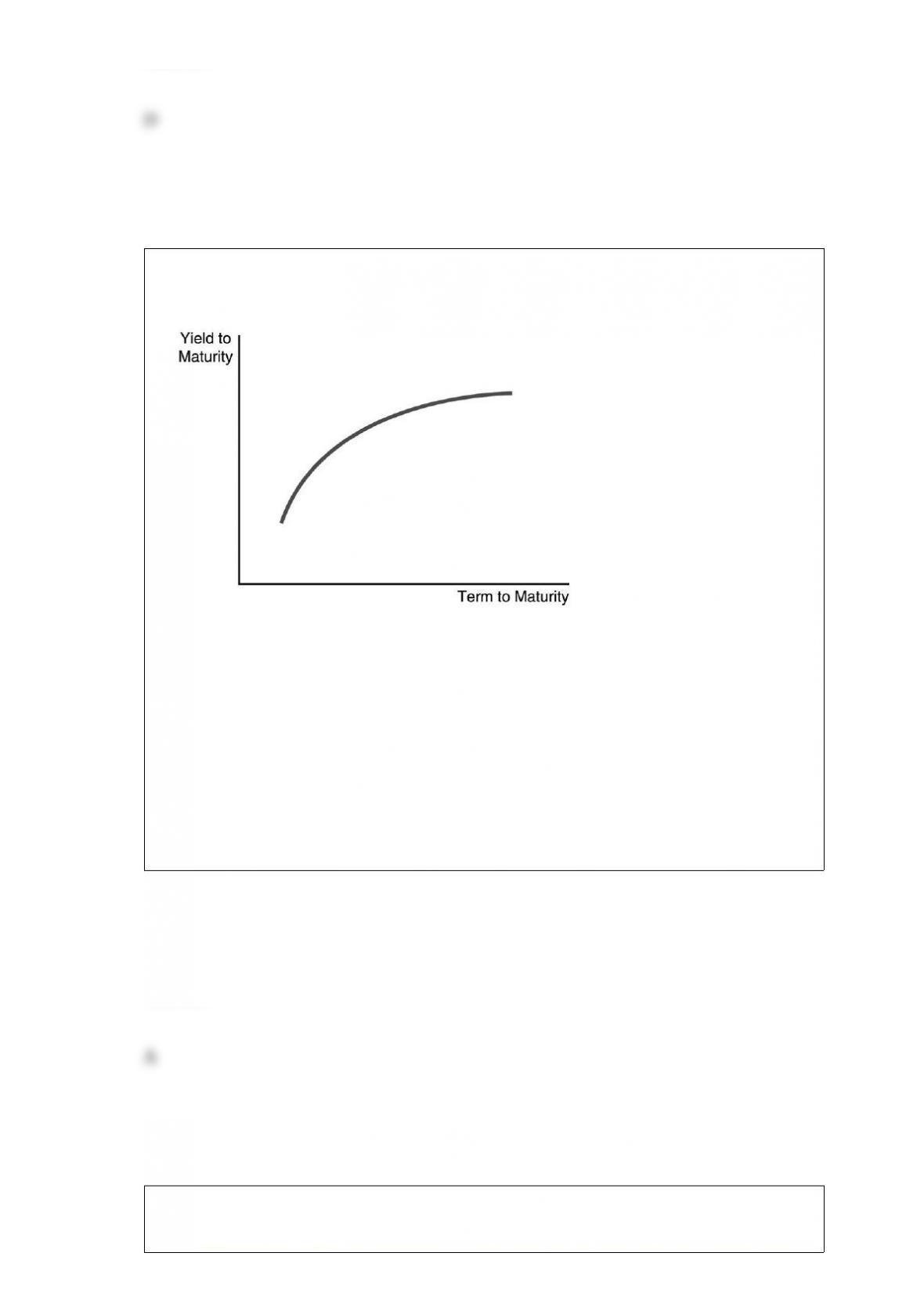
The steeply upward sloping yield curve in the figure above indicates that
A. short-term interest rates are expected to rise in the future.
B. short-term interest rates are expected to fall moderately in the future.
C. short-term interest rates are expected to fall sharply in the future.
D. short-term interest rates are expected to remain unchanged in the future.
Answer:
The small-firm effect refers to the

A. negative returns earned by small firms.
B. returns equal to large firms earned by small firms.
C. abnormally high returns earned by small firms.
D. low returns after adjusting for risk earned by small firms.
Answer:
Fear of a major recession causes stock prices to fall, everything else held constant,
which in turn causes consumer spending to
A. increase.
B. remain unchanged.
C. decrease.
D. cannot be determined.
Answer:
When a new depositor opens a checking account at the First National Bank, the bank’s
assets ________ and its liabilities ________.
A. increase; increase

B. increase; decrease
C. decrease; increase
D. decrease; decrease
Answer:
The ________ problem helps to explain why the private production and sale of
information cannot eliminate ________.
A. free-rider; adverse selection
B. free-rider; moral hazard
C. principal-agent; adverse selection
D. principal-agent; moral hazard
Answer:
Which of the following is NOT an operating instrument?
A. nonborrowed reserves
B. monetary base
C. federal funds interest rate

D. discount rate
Answer:
Suppose that the Federal Reserve conducts an open market sale. Everything else held
constant, this will cause the demand for U.S. assets to ________ and the U.S. dollar
will ________.
A. increase; appreciate
B. increase; depreciate
C. decrease; appreciate
D. decrease; depreciate
Answer:
A speculative attack involves massive sales of a ________ currency or purchases of a
currency that cause a ________ sharp change in the exchange rate under a ________
exchange rate system.
A) weak; strong; fixed
B) strong; weak; fixed
C) weak; strong; floating

D) strong; weak; floating
Answer:
If Treasury deposits at the Fed are predicted to ________, the manager of the trading
desk at the New York Fed bank will likely conduct ________ open market operations to
________ reserves.
A. rise; defensive; drain
B. fall; defensive; drain
C. rise; dynamic; inject
D. fall; dynamic; drain
Answer:
Which of the following is NOT a disadvantage of controls on capital outflows?
A) The controls may lead to excessive risk taking by the domestic banks.
B) They are seldom effective during a crisis.
C) Capital flight may increase after they are put in place.
D) Controls often lead to an increase in government corruption.

Answer:
The financial panic of 1907 resulted in such widespread bank failures and substantial
losses to depositors that the American public finally became convinced that
A. the First Bank of the United States had failed to serve as a lender of last resort.
B. the Second Bank of the United States had failed to serve as a lender of last resort.
C. the Federal Reserve System had failed to serve as a lender of last resort.
D. a central bank was needed to prevent future panics.
Answer:
The amount of checkable deposits that banks are required by regulation to hold are the
A. excess reserves.
B. required reserves.
C. vault cash.
D. total reserves.
Answer:

In the Keynesian framework, as long as output is ________ the equilibrium level,
unplanned inventory investment will remain positive and firms will continue to
________ production.
A. below; lower
B. above; lower
C. below; raise
D. above; raise
Answer:
One way the venture capital firm avoids the free-rider problem is by
A) prohibiting the sale of equity in the firm to anyone except the venture capital firm.
B) prohibiting members from serving on the board of directors.
C) prohibiting the borrowing firm from replacing management.
D) requiring collateral equal to the value of the borrowed funds.
Answer:

Measuring the sensitivity of bank profits to changes in interest rates by multiplying the
gap times the change in the interest rate is called
A. basic duration analysis.
B. basic gap analysis.
C. interest-exposure analysis.
D. gap-exposure analysis.
Answer:
Describe the two methods of organizing a secondary market.
Answer:
Explain the similarities and differences between the European System of Central Banks
and the Federal Reserve System.
Answer:
Your bank has the following balance sheet
Assets Liabilities
Rate-sensitive $100 million Rate-sensitive $75
million
Fixed-rate 100 million Fixed-rate 125
million
What would happen to bank profits if the interest rates in the economy go down? Is
there anything that you could do to keep your bank from being so vulnerable to interest
rate movements?
Answer:
Using the long-run ISLM model, explain and demonstrate graphically the neutrality of
money, for the case of an increase in the money supply.
Answer:
Using the liquidity preference framework, show what happens to interest rates during a
business cycle recession.
Answer:
What factors determine the demand for money in the Baumol-Tobin analysis of
transactions demand for money? How does a change in each factor affect the quantity
of money demanded?
Answer:
Explain two ways by which the Federal Reserve System can increase the monetary
base. Why is the effect of Federal Reserve actions on bank reserves less exact than the
effect on the monetary base?
Answer:
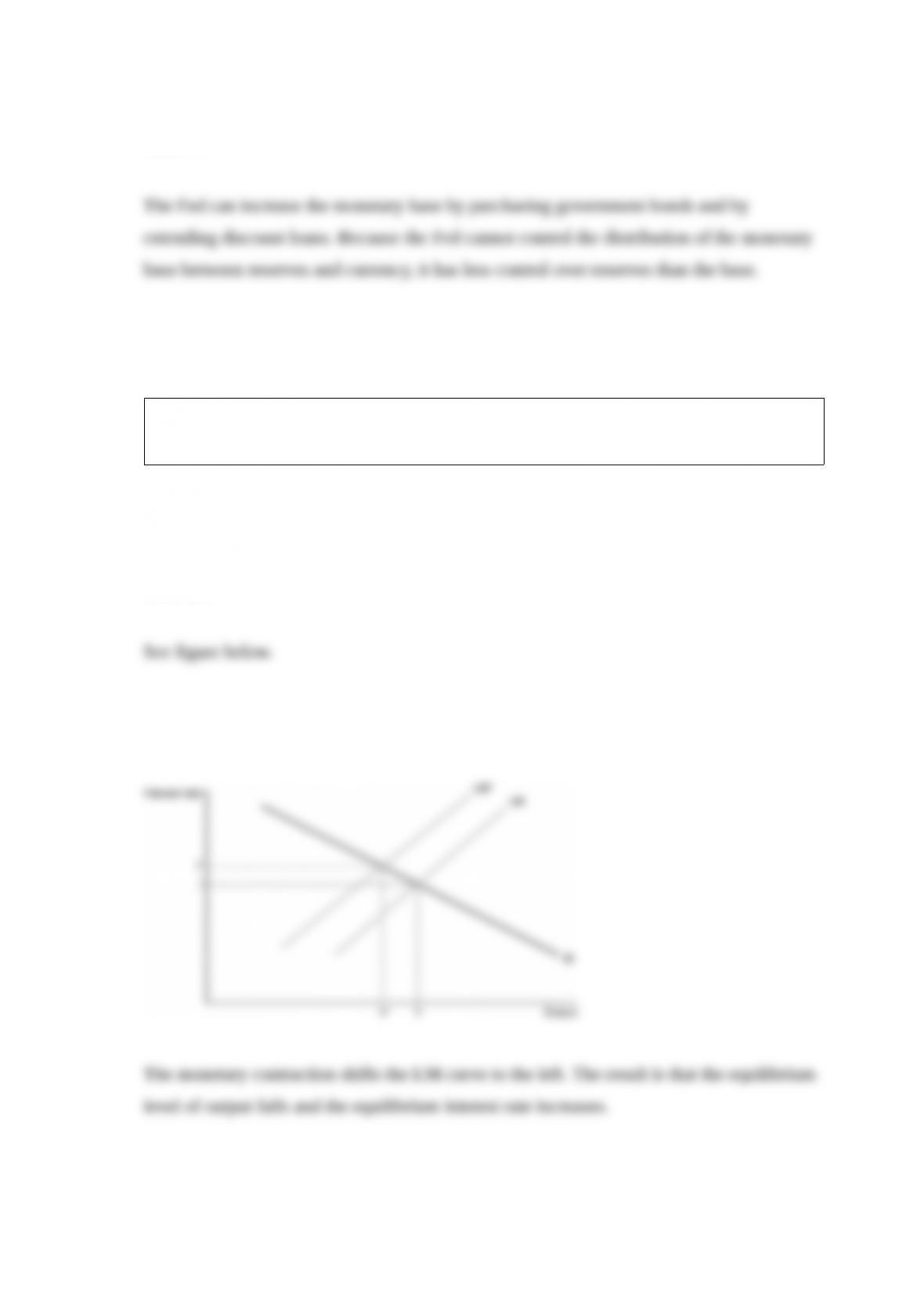
Using the ISLM model, show graphically and explain the effects of a monetary
contraction. What is the effect on the equilibrium interest rate and level of output?
Answer:
Why did the interest rate volatility of the 1970s spur financial innovation?
Answer:
If a corporation announces that it expects quarterly earnings to increase by 25% and it
actually sees an increase of 22%, what should happen to the price of the corporation’s
stock if the efficient markets hypothesis holds, everything else held constant?
Answer:
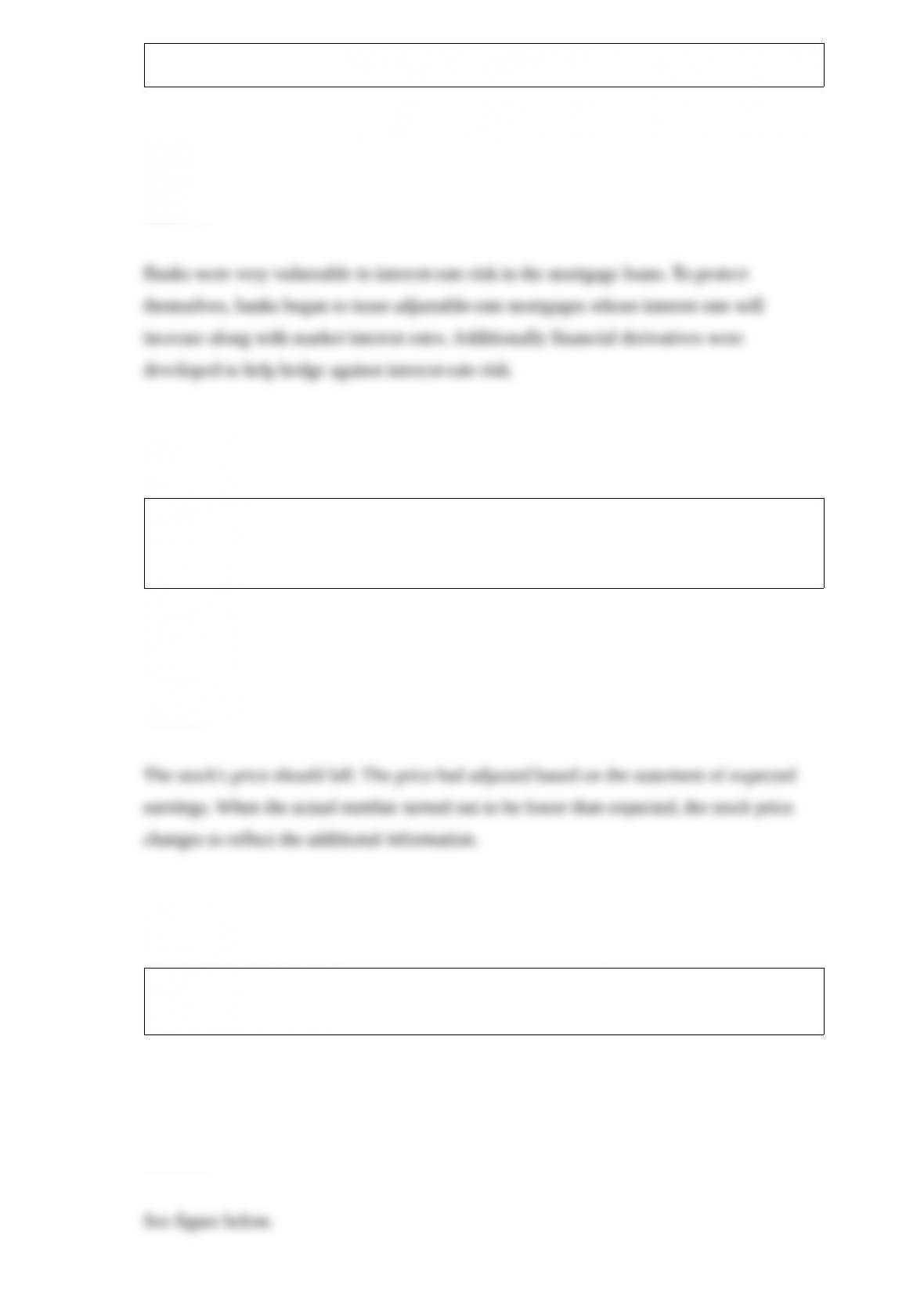
Show graphically and explain why targeting an interest rate is preferable when money
demand is unstable and the IS curve is stable.
Answer:
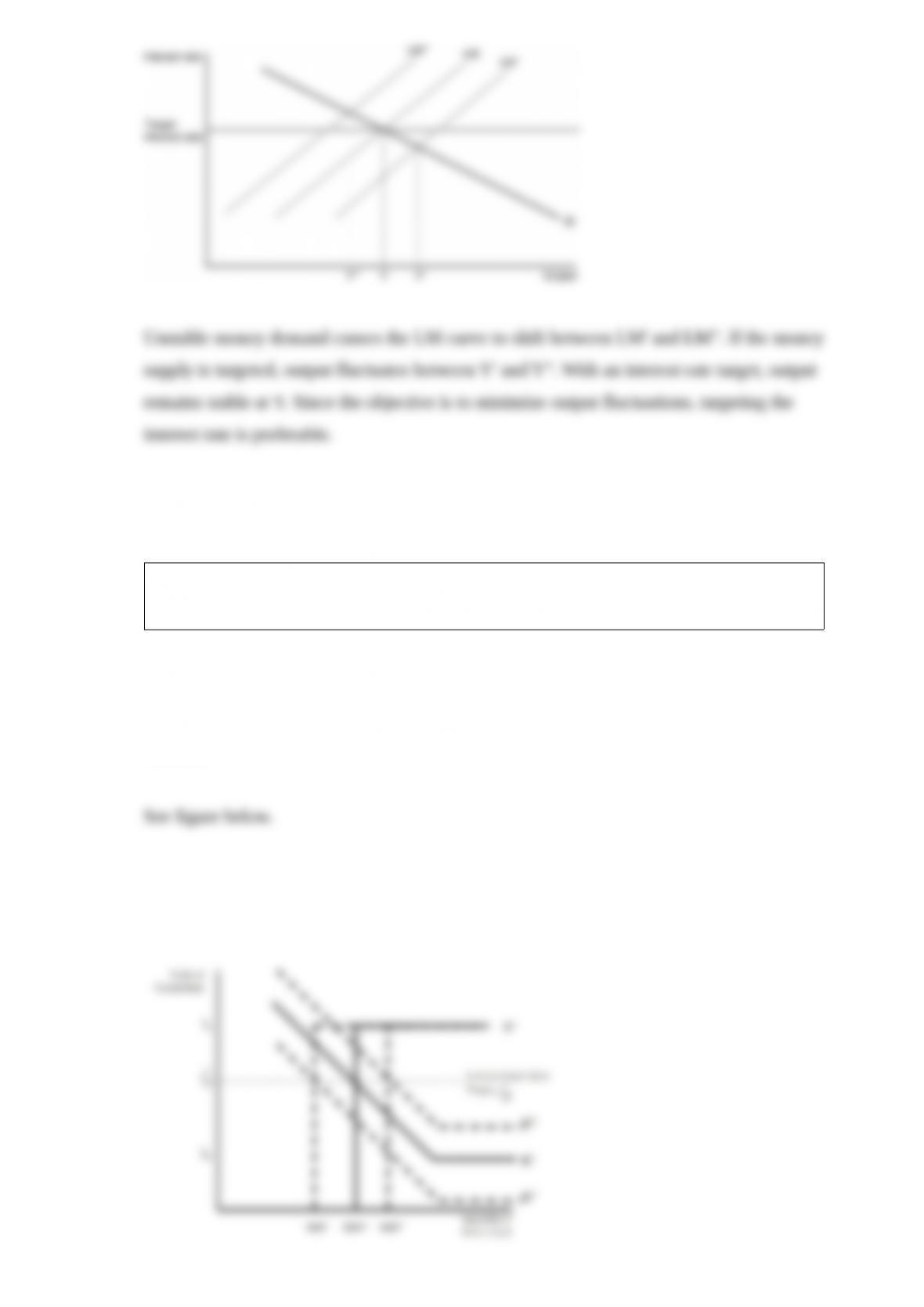
Explain and demonstrate graphically how targeting the federal funds rate can result in
fluctuations in nonborrowed reserves.
Answer:
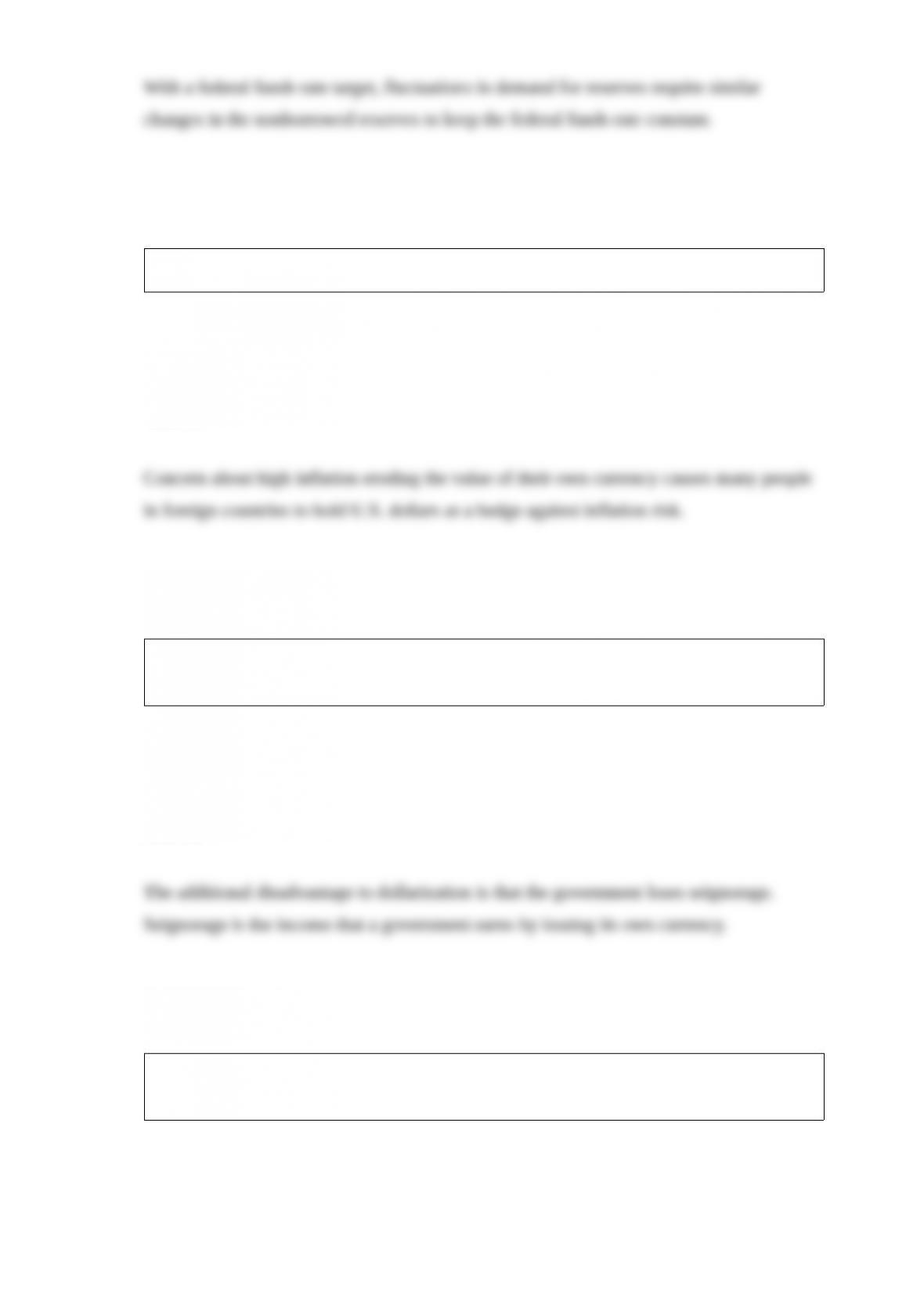
Why are most of the U.S. dollars held outside of the United States?
Answer:
Explain an additional disadvantage for a country undergoing dollarization compared to
a currency board or other exchange-rate targeting regimes.
Answer:
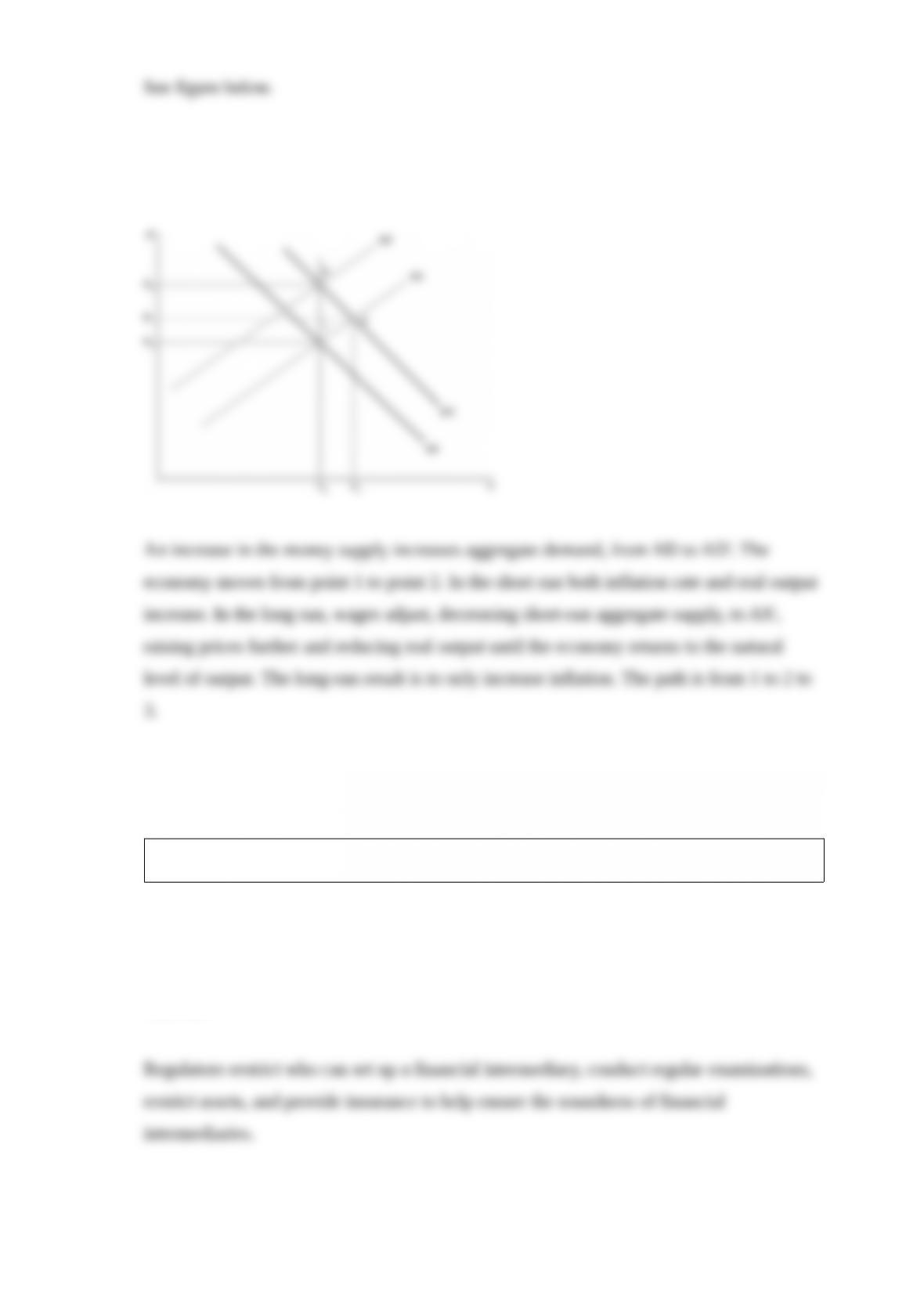
Using the aggregate demand-aggregate supply model, explain and demonstrate
graphically the short-run and long-run effects of an increase in the money supply.
Answer:
How do regulators help to ensure the soundness of financial intermediaries?
Answer:
You believe that a corporation’s dividends will grow 5% on average into the foreseeable
future. If the company’s last dividend payment was $5 what should be the current price
of the stock assuming a 12% required return?
Answer:
Explain how the market can reduce the incentive for credit-rating firms to take
advantage of conflicts of interest.
Answer: