
1) Determine whether the following statement is true or false and provide an
explanation for your answer: An economy would adjust through changes in output if
there are demand shocks and prices are flexible.
2) in the long run a pure monopolist must produce at that output where average total
cost is at a minimum.
3) a firm’s economic profit is usually higher than its accounting profit.
4) over half of the legal immigrants to the united states in 2007 were family-sponsored.
5) a decrease in supply of x increases the equilibrium price of x, which reduces the
demand for x and automatically returns the price of x to its initial level.
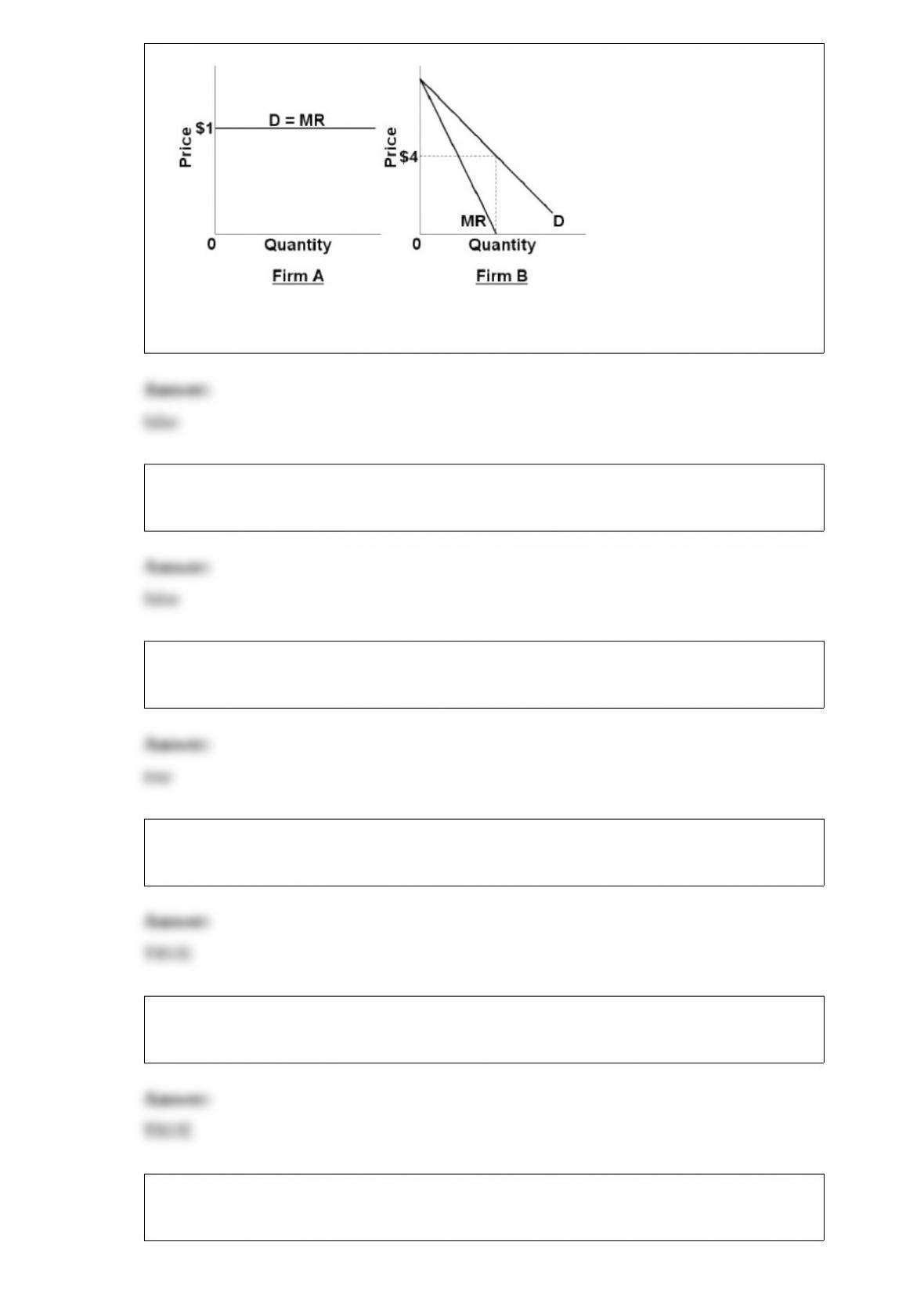
6)
refer to the above diagrams. firm b’s average revenue curve coincides with its marginal
revenue curve.
7) if total income is $200 billion, personal taxes are $40 billion, and consumption is
$140 billion, then personal saving must be $60 billion.
8) marginal utility theory and indifference curve analysis are both consistent with the
law of demand.
9) Other things equal, an increase in productivity will shift the short-run aggregate
supply curve rightward.
10) Since the mid-1950s, union membership has declined as a percentage of employed
wage and salary workers.
11) income elasticity measures the effect of a change in income on the purchases of
some good or service.
12) Proposed ergonomics regulations are an example of industrial regulation (rather
than social regulation).
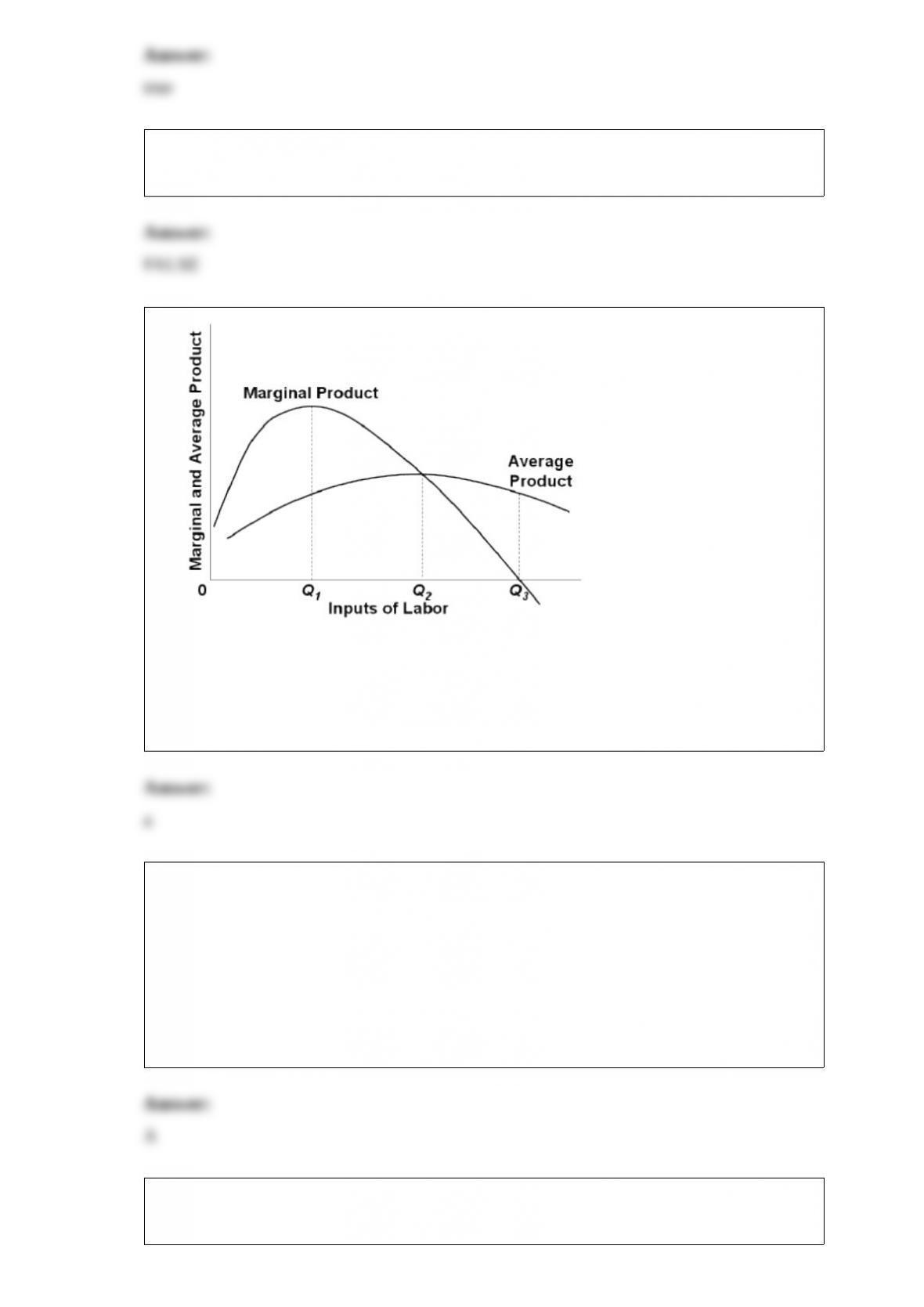
13)
in the above diagram, total product will be at a maximum at:
a.q3 units of labor
b.q2 units of labor
c.q1 units of labor
d.some point that cannot be determined with the above information.
14) Assume monetary equilibrium exists-that is, the desired and the actual supply of
money are equal-when nominal GDP equals $480 billion and the money supply is $160
billion. According to a strict monetarist view, an increase in the money supply of $10
billion will increase the nominal GDP by:
A.$30 billion.
B.$25 billion.
C.$20 billion.
D.$10 billion.
15) In a mixed open economy the equilibrium GDP is determined at that point where:
A.Sa + M + T = Ig + X + G.
B.the 45-degree line and the saving schedule intersect.
C.Sa + X + G = Ig + T.
D.Sa + Ig + X = G + T.
16) Kara and Kyle are competing Sockeye Salmon fishers. Both have been allocated
ITQs that limit their catch to 2,000 tons of Sockeye Salmon each. Kara’s cost per ton is
$8; Kyle’s cost per ton is $12.
Refer to the information above. If the market price of Sockeye Salmon is $15 per ton,
what is the maximum amount Kara would be willing to pay per ton for Kyle’s ITQs?
A.$3.
B.$7.
C.$8.
D.$15.
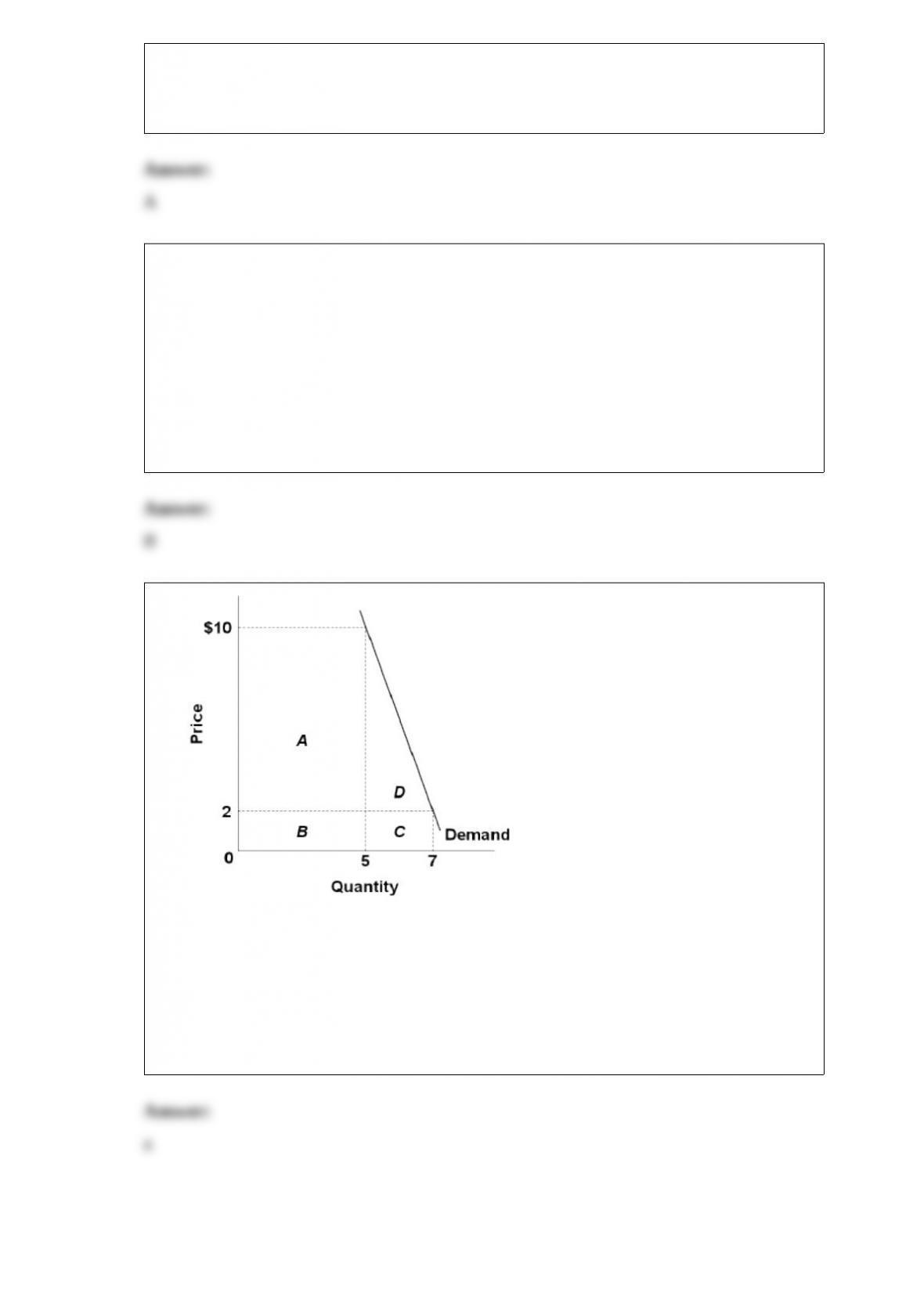
17)
refer to the above diagram and assume that price increases from $2 to $10. the
coefficient of price elasticity of demand (midpoints formula) relating to this change in
price is about:
a..25 and demand is inelastic.
b.1.5 and demand is elastic.
c.1 and demand is unit elastic.
d..67 and demand is inelastic.
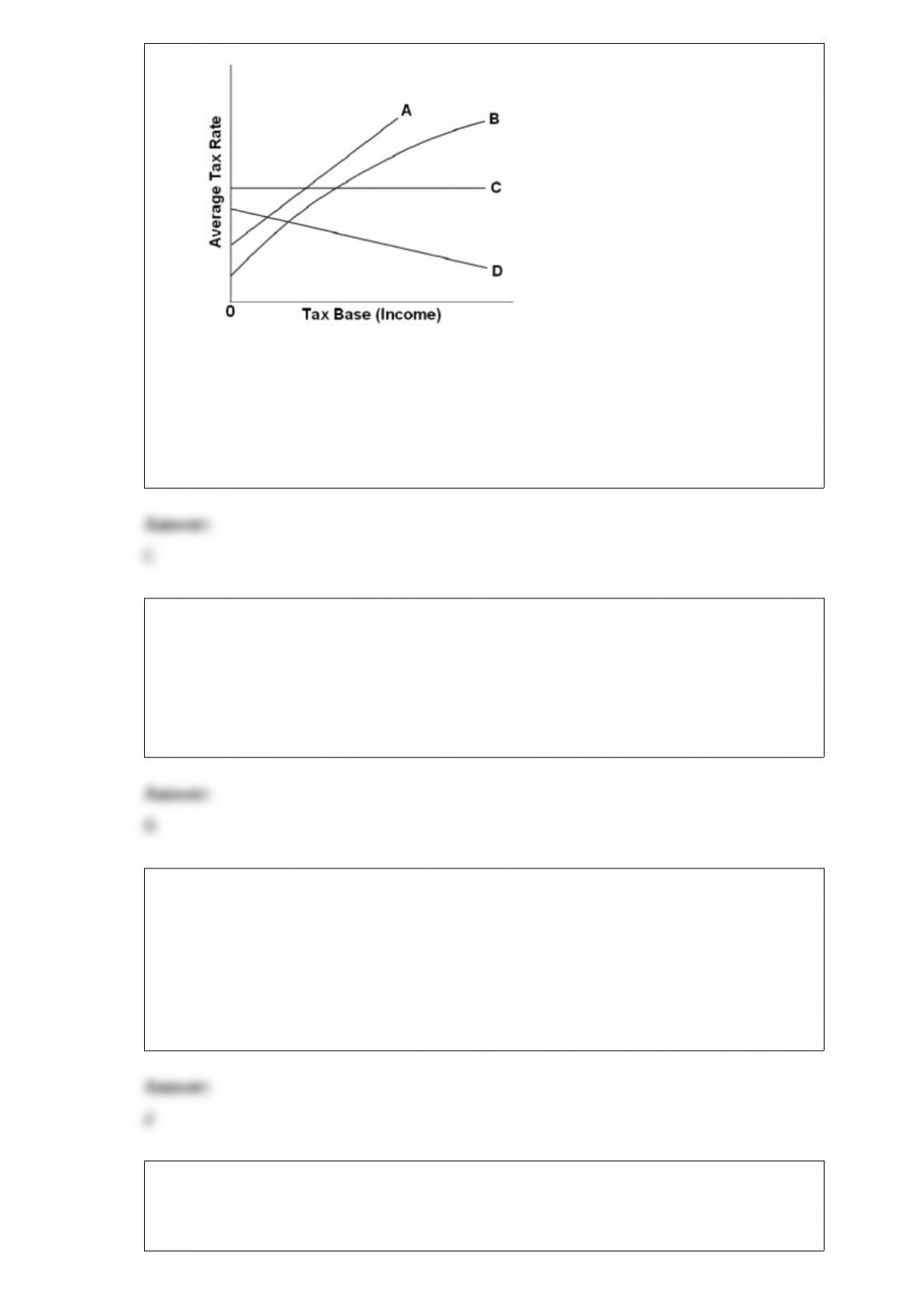
18)
Refer to the above graph. Which of the lines in the above diagram represent(s) a
proportional tax?
A.both A and B.
B.D only.
C.C only.
D.B only.
19) In comparing a tariff and an import quota we find that:
A.the tariff and quota both generate the same amount of revenue for the United States
Treasury.
B.the tariff generates revenue for the United States Treasury but the quota does not.
C.the quota generates revenue for the United States Treasury but the tariff does not.
D.neither the tariff nor the quota generates revenue for the United States Treasury.
20) assume that in year 1 your average tax rate is 20 percent on a taxable income of
$20,000. if the marginal tax rate on the next $10,000 of taxable income is 30 percent,
what will be the average tax rate if your taxable income rises to $30,000?
a.7 percent
b.30 percent
c.16 percent
d.about 23 percent
21) other things equal, which of the following would shift an economy’s production
possibilities curve to the left?
a.the discovery of a low-cost means of generating and storing solar energy

b.the entrance of more women into the labor force
c.a law requiring mandatory retirement from the labor force at age 55
d.an increase in the proportion of total output that consists of capital or investment
goods
22) a perfectly inelastic demand curve:
a.has a price elasticity coefficient greater than unity.
b.has a price elasticity coefficient of unity throughout.
c.graphs as a line parallel to the vertical axis.
d.graphs as a line parallel to the horizontal axis.
23) which of the following is correct?
a.real and nominal incomes always move in the same direction.
b.inflation increases the purchasing power of the dollar and necessarily reduces one’s
nominal income.
c.inflation reduces the purchasing power of the dollar and necessarily reduces one’s real
income.
d.inflation reduces the purchasing power of the dollar, but does not necessarily reduce
one’s real income.
24) which of the following is the largest dollar amount in the united states?
a.disposable income
b.personal income
c.gross domestic product
d.national income
25) Are currency and checkable deposits owned by the government (U.S. Treasury) and
the Federal Reserve Bank, commercial banks, and other financial institutions part of the
money supply? Explain.
26) Give an equation that shows the relationship between excess reserves, maximum
checkable-deposit expansion, and the monetary multiplier.
27) In the short run, a monopolistically competitive firm calculates that marginal cost is
$6.00, average total costs are $4.00, and marginal revenue is $3.00. The firm is
charging a price of $6.00 and producing 200 units of output. How much profit is the
firm making? What output recommendation would you make as the company
economist?
28) How is price fixing among firms treated under antitrust policy? Give two examples
of legal actions against price fixing.
29) Suppose that by devoting all of its resources to the production of rice (R), Japan can
produce 40 units. By devoting all of its resources to corn (C), it can produce 20 units.
Comparable figures for Mexico are 15 units of rice (R) and 15 units of corn (C).
Explain why each nation will specialize in which product. What are the limits to the
terms of trade?