
Knowledge capital is
A) rival.
B) nonrival.
C) nonexcludable.
D) both B and C
Suppose a bank has $100,000 in checking account deposits with no excess reserves and
the required reserve ratio is 10 percent. If the Federal Reserve raises the required
reserve ratio to 12 percent, then the bank will now have excess reserves of
A) $12,000.
B) $0.
C) -$2,000.
D) -$12,000.

The coupon rate of a bond is equal to
A) the coupon payment.
B) the interest payment.
C) the interest rate.
D) the face value.
Investment spending increases during ________, and decreases during ________.
A) an expansion; a recession
B) a recession; an expansion
C) a recession; a depression
D) a deflation; an inflation
Globalization refers to
A) the process of establishing a common world currency.
B) the willingness of individuals within a given country to share knowledge with one
another.

C) the process of countries becoming more open to foreign trade and investment.
D) the reduction in growth rates of real GDP per capita as a result of trade with foreign
countries.
Most doctors are employed by the government and most hospitals are owned by the
government in
A) Canada.
B) Japan.
C) the United Kingdom.
D) the United States.
There is a government budget surplus if
A) T – TR > G.
B) G > T.
C) G > TR.
D) TR < T.
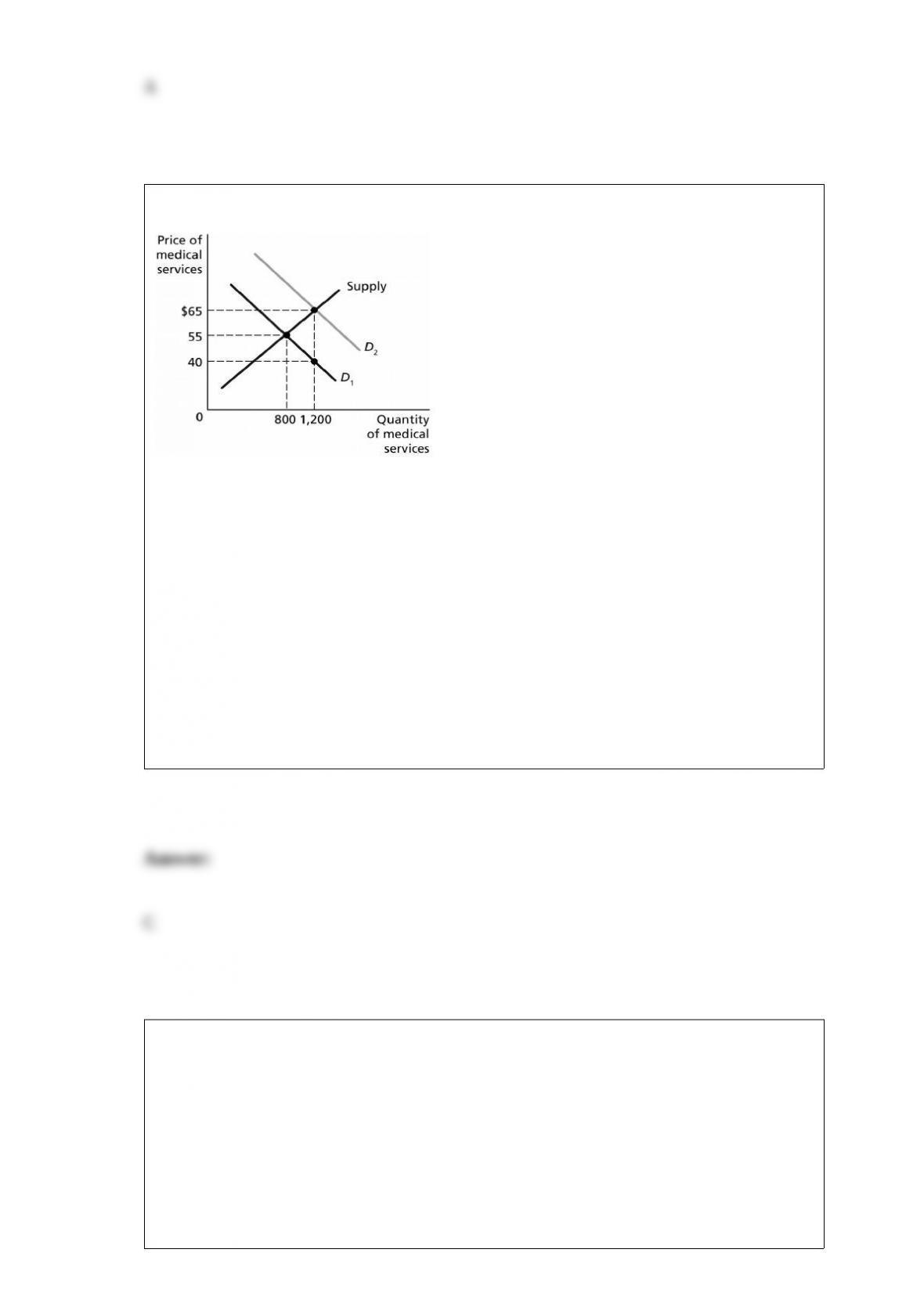
Figure 5-3
Figure 5-3 represents the market for medical services with and without insurance, and
the effect of a third-party payer system on the demand for medical services.
Refer to Figure 5-3. With insurance and a third-party payer system, what is the amount
of the deadweight loss?
A) $0
B) $2,500
C) $5,000
D) $24,000
Article Summary
In an August 2013 speech from the Lincoln Memorial, President Obama was expected
to emphasize that increased economic equality is needed to improve racial equality.
Economic gaps based on race have endured for 50 years, with the differences in
unemployment rates between blacks and whites remaining virtually unchanged and the
gap in wealth actually increasing. “If you look at 50 years after the 1960s civil rights
movement, the most stubborn and persistent challenge when it comes to the nation’s
racial challenge remains in the areas of economics and wealth,” said Marc Morial,

president of the National Urban League.
Source: Zachary A. Goldfarb, “For Obama, 50 years after historic march, economic
equality the path to racial justice,” Washington Post, August 17, 2013.
Refer to the Article Summary. The article mentions increased economic equality is
needed in terms of wealth. How would a more equal distribution of wealth differ from a
more equitable distribution of wealth?
A) They both mean the same thing, which is a more even distribution of wealth.
B) A more equal distribution of wealth is a more fair distribution, and a more equitable
distribution of wealth is a more even distribution.
C) A more equal distribution of wealth is a more even distribution, and a more equitable
distribution of wealth is a more fair distribution.
D) They both mean the same thing, which is a more fair distribution of wealth.
Foreign direct investment declined worldwide during the recession of 2007-2009. The
decline in foreign direct investment in developing countries can make it more difficult
for these countries to break out of the vicious cycle of low economic growth and
A) overpopulation.
B) low saving and investment.
C) a low import/export ratio.
D) low government spending.

Shrimp is an increasingly popular part of the American diet. Louisiana shrimpers who
represent the bulk of the U.S. industry were almost all put out of business by Hurricane
Katrina. How did this affect the equilibrium price and quantity of shrimp?
Net exports usually ________ when the U.S. economy is in a recession and ________
when the U.S. economy is expanding.
A) increase; increase
B) decrease; increase
C) increase; decrease
D) decrease; decrease
An increase in unemployment insurance payments would, in effect, ________ the
amount of time spent searching for a job, which would increase ________
unemployment.
A) increase; cyclical
B) increase; frictional
C) decrease; cyclical
D) decrease; frictional

The current account deficits incurred by the United States in the 1980s were caused, in
the opinion of many economists, by
A) federal budget deficits.
B) “flight to quality” as foreign investors favored U.S. investments.
C) a sharp decline in private saving.
D) Both B and C are correct.