
The FOMC no longer sets targets for M1 and M2 to meet its goals of price stability and
high employment.
If a country produces only two goods, then it is not possible to have an absolute
advantage in the production of both those goods.
A snack shop inside a hotel in a busy city has a monopoly on food sales if it is the only
food vendor in the hotel that is open 24 hours a day.
An increase in imports increases aggregate demand.

An increase in the money supply is a discretionary fiscal policy which will increase
aggregate demand.
Monetary policy has a greater impact in an open economy than it does in a closed
economy.
Using “chain-weighted” prices to calculate real GDP remedies the distortions causes by
changes in relative prices over time.
Contractionary monetary policy and expansionary fiscal policy both reduce net exports
in an open economy.

Suppose the government mandates the installation of certain type of pollution
abatement equipment for the leather tannery industry. For some firms in the industry,
installing this equipment may not be the most cost effective method of reducing
pollution.
The decisions General Motors makes in determining production levels for its Chevy
Volt is an example of a microeconomics topic.
A key insight of the public choice model is that public policymakers are likely to pursue
the public’s interest, even if their self-interests conflict with the public interest.
The actual division of a tax between buyers and sellers in a market is the excess burden
of the tax.

If marginal product is equal to average product, then total product is at a maximum.
All of the following are considered among the four most important determinants in
explaining exchange rate fluctuations in the long run except
A) tariffs and quotas.
B) preferences for domestic and foreign goods.
C) interest rates.
D) relative rates of productivity growth across countries.
In the United States in 2012, the percentage of people that directly purchased an
individual or family health insurance policy from an insurance company was about
A) 2%.
B) 10%.
C) 17%.

D) 26%.
The main tool that the Federal Reserve uses to conduct monetary policy is
A) open market operations.
B) discount policy.
C) setting reserve requirements.
D) acting as the lender of last resort.
E) check clearing.
Utility is
A) easily measured in units called utils.
B) subjective and difficult to measure.
C) the consumption of a quasi-public good like electricity or natural gas.
D) the production of a quasi-public good like electricity or natural gas.

Last year, Joan bought 50 pounds of hamburger when her household income was
$40,000. This year, her household income was only $30,000 and Joan bought 60 pounds
of hamburger. Holding everything else constant, Joan’s income elasticity of demand for
hamburger is
A) positive, so Joan considers hamburger to be an inferior good.
B) negative, so Joan considers hamburger to be an inferior good.
C) positive, so Joan considers hamburger to be a normal good and a necessity.
D) negative, so Joan considers hamburger to be a normal good.
The financial statement that sums up a firm’s revenues, costs, and profit over a period of
time is its
A) income statement.
B) balance sheet.
C) dividend yield statement.
D) price-earnings statement.
A price maker is
A) a person who actively seeks out the best price for a product that he or she wishes to
buy.
B) a firm that has some control over the price of the product it sells.
C) a firm that is able to sell any quantity at the highest possible price.
D) a consumer who participates in an auction where she announces her willingness to
pay for a product.
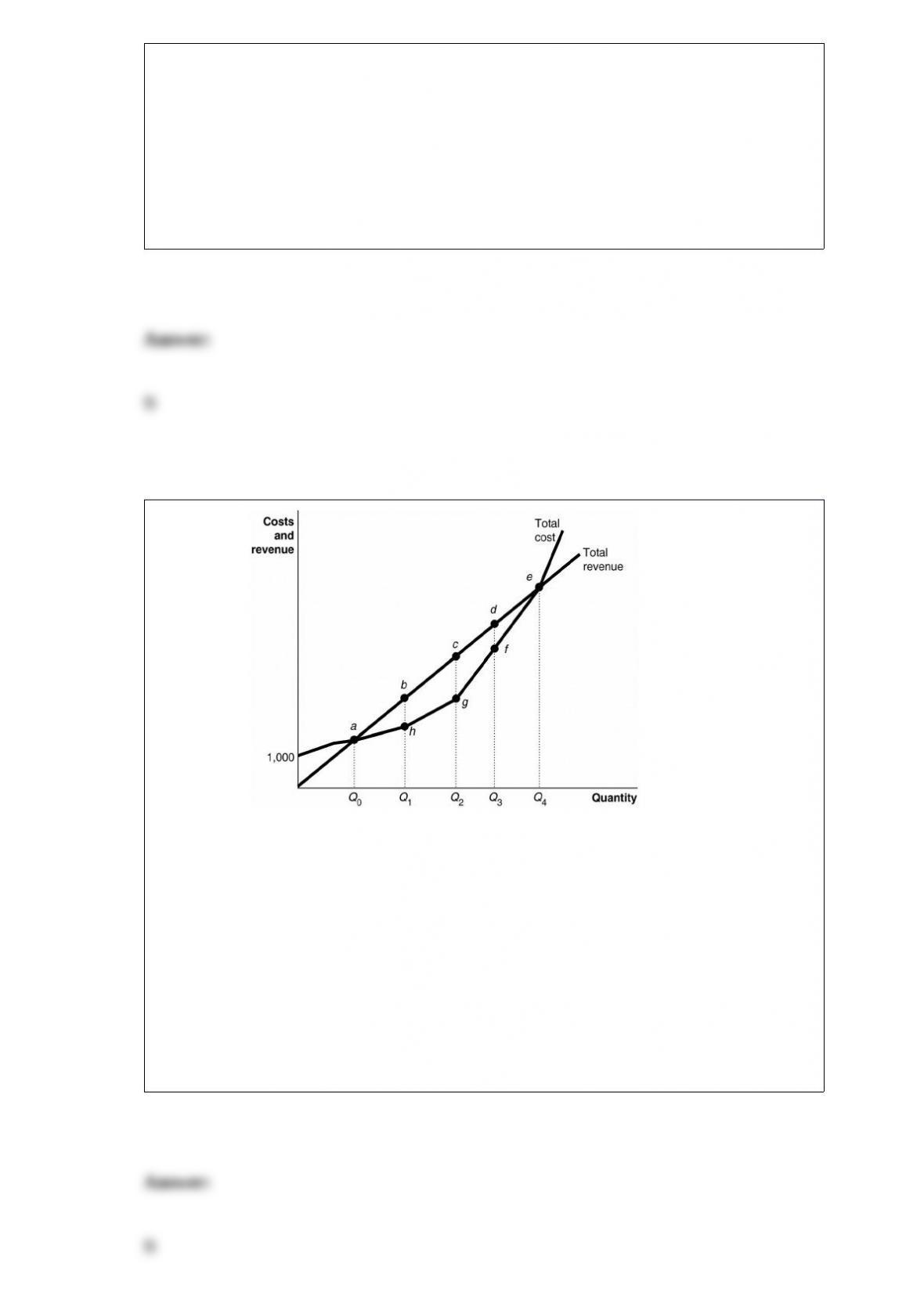
Figure 12-2
Suppose the firm is currently producing Q2units. What happens if it expands output to
Q3units?
A) Its profit increases by the size of the vertical distance df.
B) It makes less profit.
C) It incurs a loss.
D) It will be moving toward its profit maximizing output.

The tax multiplier
A) is negative.
B) is larger in absolute value as compared to the government spending multiplier.
C) is a measure of how much taxes will fall when income is falling.
D) is always less than one.
If the price of hairspray is represented by equation P = 10 – 0.2 QD, then the
corresponding quantity of hairspray demanded is represented by the equation
A) QD = 5P – 2.
B) QD = 0.5P + 2.
C) QD = 50 -5P.
D) QD = -10 + 0.2P.
Suppose a competitive firm is paying a wage of $12 an hour and sells its product at $3
per unit. Assume that labor is the only input. If the last worker hired increases output by
three units per hour, then to maximize profits the firm should
A) not change the number of workers it currently hires.

B) lay off some of its workers.
C) hire additional workers.
D) There is not enough information to answer the question.
In order to be binding a price floor
A) must lie above the free market equilibrium price.
B) must lie below the free market equilibrium price.
C) must coincide with the free market equilibrium price.
D) must be high enough for firms to earn a profit.
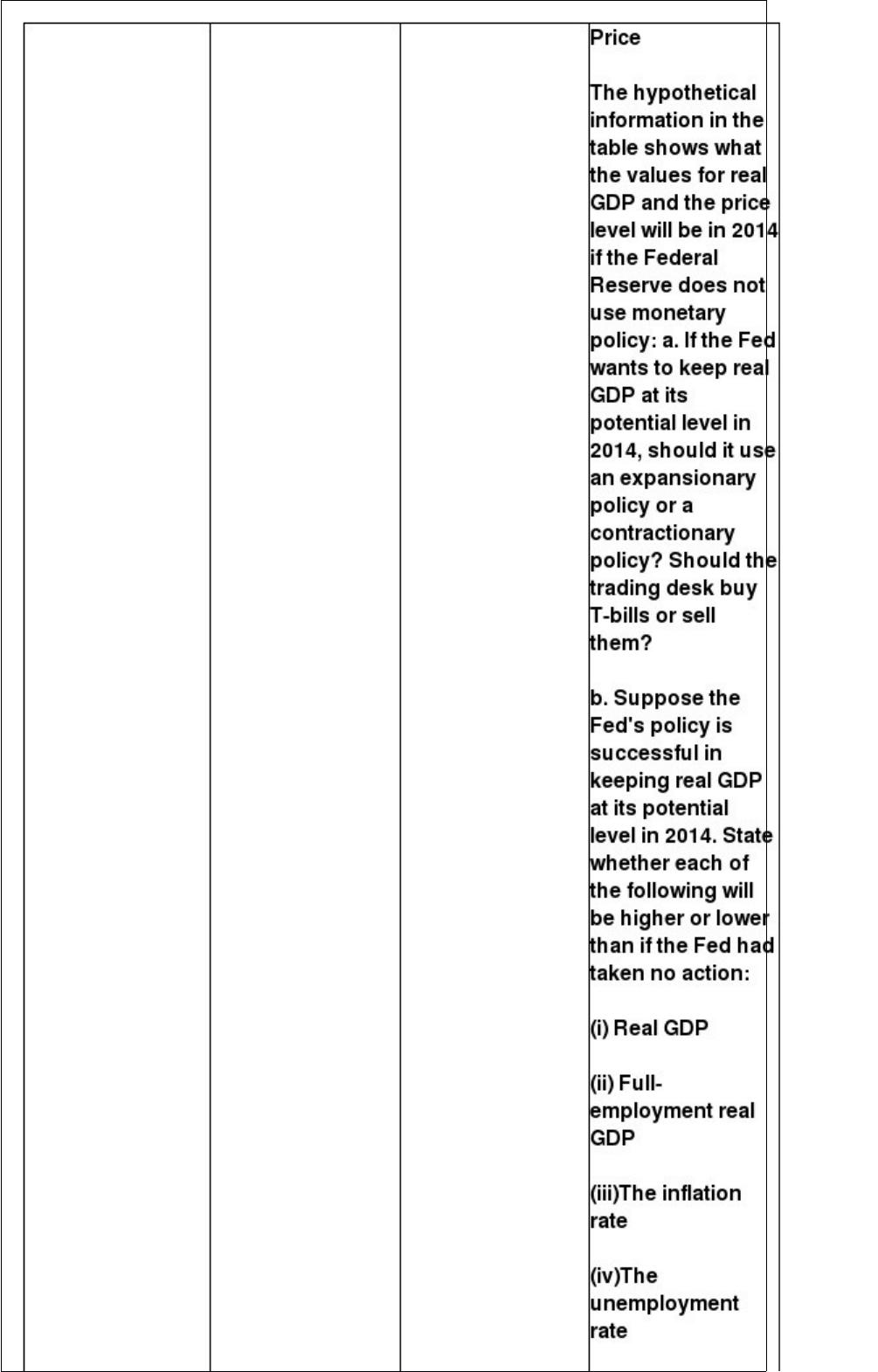
Table 15-8
When the Bretton Woods system was set up, the United States agreed initially to buy
and sell gold at a price of ________ per ounce.
A) $24
B) $35
C) $42
D) $48
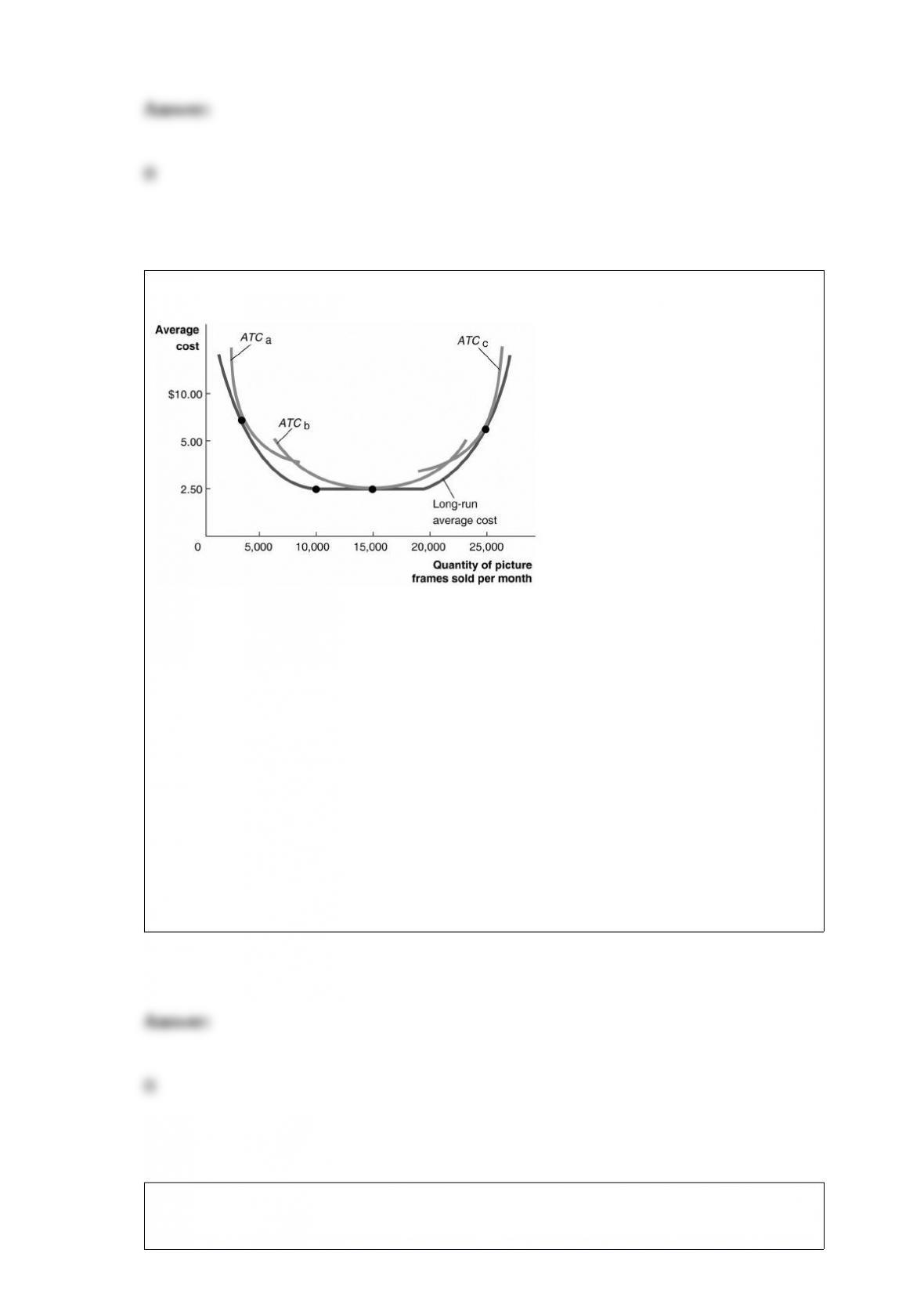
Figure 11-11
Figure 11-11 illustrates the long-run
average cost curve for a firm that produces picture frames. The graph also includes
short-run average cost curves for three firm sizes: ATCa, ATC and ATCc.
For output rates greater than 20,000 picture frames per month
A) the firm will not make a profit because the average cost of production will be too
high.
B) the firm will experience diseconomies of scale.
C) the firm will experience diminishing returns.
D) the short-run average total cost will equal the long-run average total cost of
production.
In the long run, a perfectly competitive market will
A) produce only the quantity of output that yields a long-run profit for the typical firm.
B) supply whatever amount consumers will buy at a price which earns the market an
economic profit.
C) supply whatever amount consumers demand at a price determined by the minimum
point on the typical firm’s average total cost curve.
D) generate a long-run equilibrium where the typical firm operates at a loss.
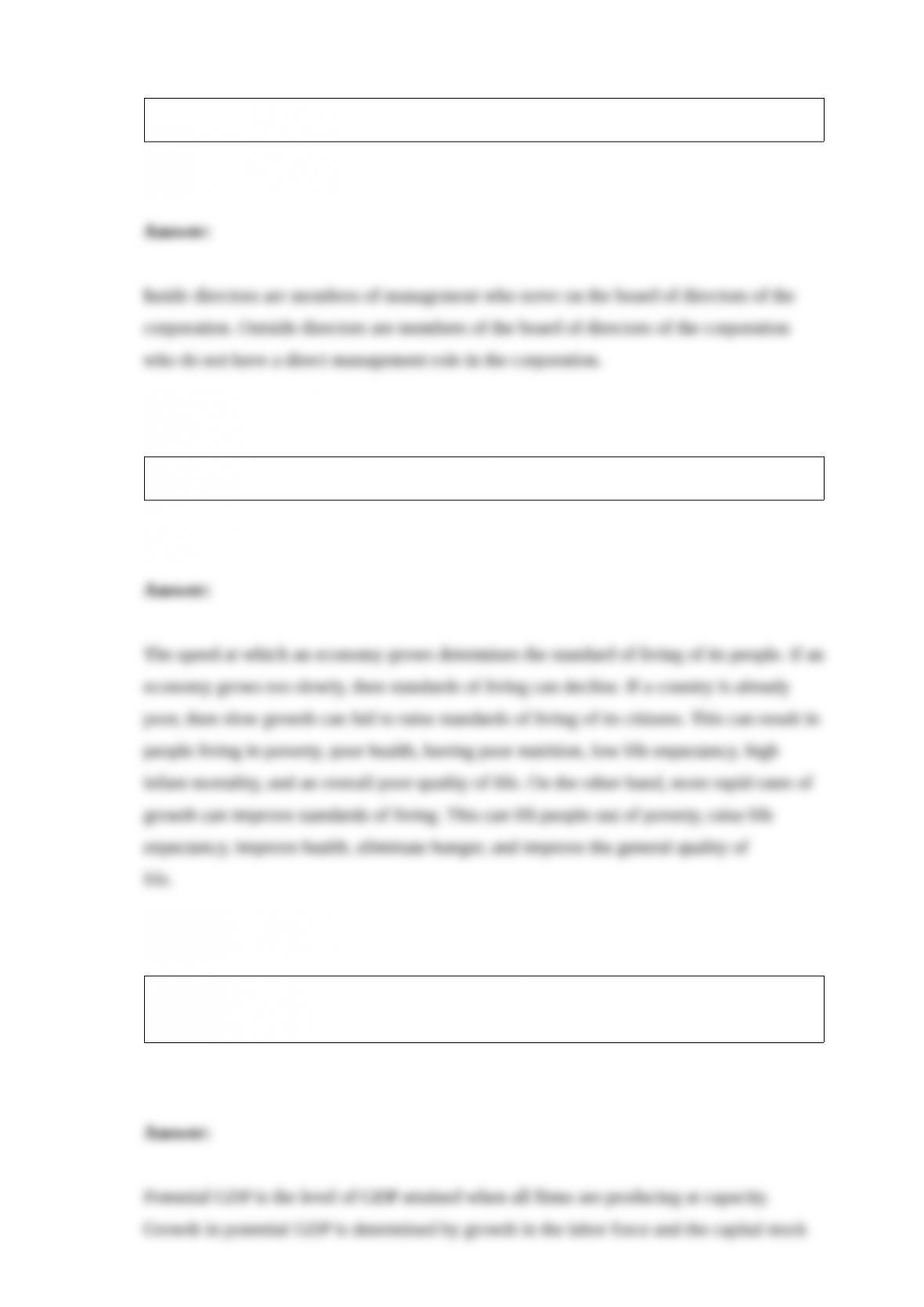
Table 2-14
Table 2-14 shows the number of labor hours required to produce a motorcycle and a
guitar in Ireland and Scotland.
Scotland has a comparative advantage in the production of
A) both products.
B) guitars.
C) motorcycles.
D) neither product.

For a perfectly competitive firm, average revenue is equal to
A) marginal cost.
B) the market price.
C) total revenue.
D) average fixed cost.
The marginal productivity theory of income distribution was developed by
A) Edward Lazear.
B) George Akerlof.
C) William Stanley Jevons.
D) John Bates Clark.
What area on a supply and demand graph represents consumer surplus?
In a corporation, what are “inside directors” and “outside directors”?
How do economic growth rates affect a nation’s standard of living?
What factors increase potential GDP? Include a definition of potential GDP in your
answer.
Why does the short-run aggregate supply curve slope upward?
When will a decrease in aggregate demand not result in a lower inflation rate in the
short run?
Serafina was earning $75 per hour and working 50 hours per week. Serafina’s wage rose
to $90 per hour, and as a result, she now works 60 hours per week. What can you
conclude from this information about the income effect and the substitution effect of a
wage change for Serafina?