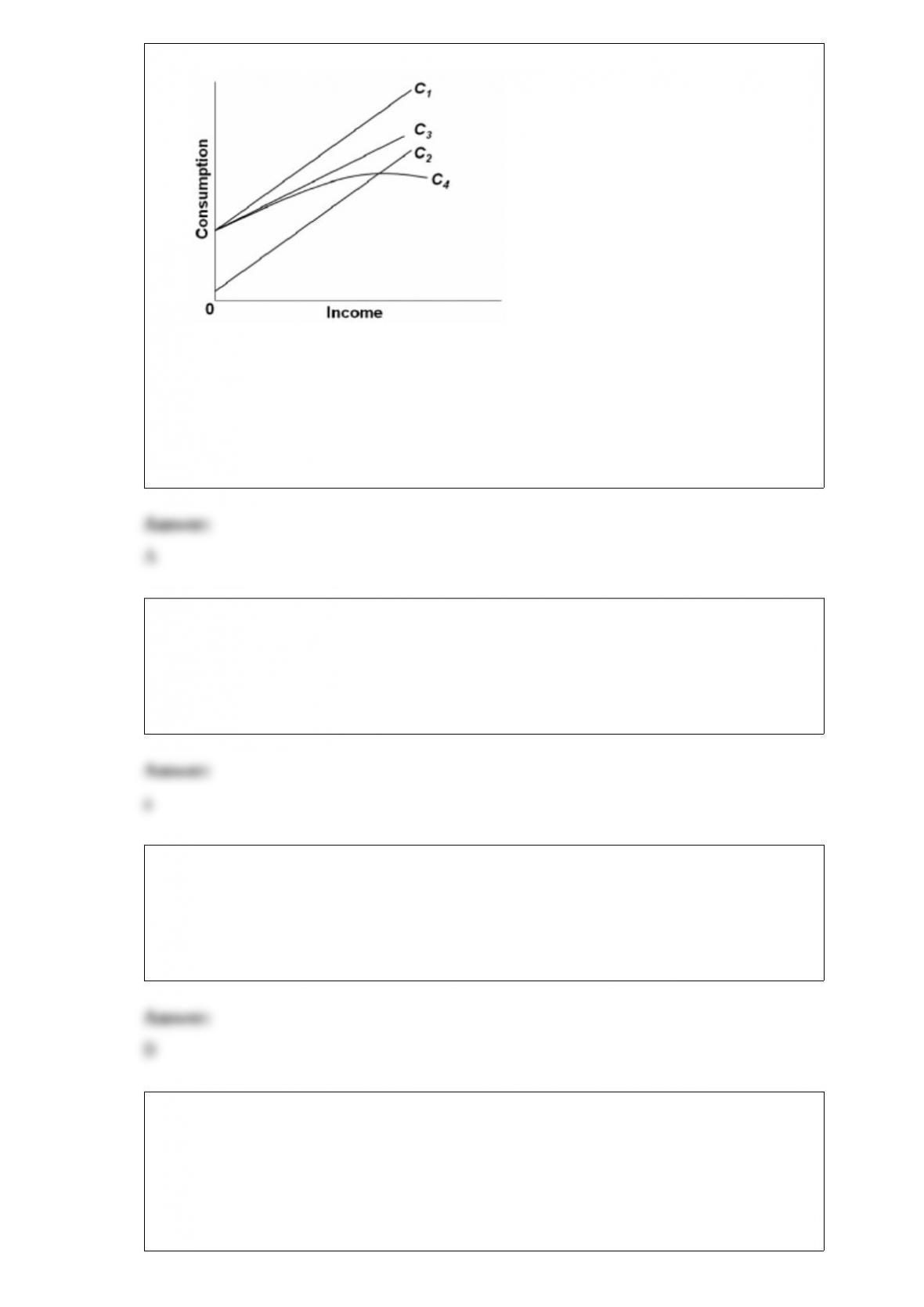
1)
(Advanced analysis) Refer to the above diagram, in which C1 is the before-tax
consumption schedule. The consumption schedule represented by C4 reflects:
A.a progressive tax system.
B.a proportional tax system.
C.a regressive tax system.
D.a higher MPC than is embodied in C1.
2) suppose the income elasticity of demand for toys is +2.00. this means that:
a.a 10 percent increase in income will increase the purchase of toys by 20 percent.
b.a 10 percent increase in income will increase the purchase of toys by 2 percent.
c.a 10 percent increase in income will decrease the purchase of toys by 2 percent.
d.toys are an inferior good.
3) Saving is always equal to:
A.planned investment less unintended increases in inventories.
B.actual investment.
C.planned investment.
D.unintended changes in inventories.
4) The following information about a banking system: new currency deposited in the
system = $40 billion; legal reserve ratio = 0.20; excess reserves prior to the currency
deposit = $0.
Refer to the above information. The $40 billion deposit of currency into checking
accounts will initially create:
A.$8 billion of new checkable deposits.

B.$10 billion of new checkable deposits.
C.$40 billion of new checkable deposits.
D.$160 billion of new checkable deposits.
5) a price index can rise from one year to the next even though:
a.some individual prices in the economy fall.
b.nominal gdp falls.
c.real gdp falls.
d.all of these occur.
6) The user cost of extracting a non-renewable resource is:
A.inversely related to how much of the resource remains.
B.directly related to how much of the resource remains.
C.unrelated to how much of the resource remains.
D.inversely related to the expected future price of the resource.
7) the total amount of income earned by u.s. resource suppliers in a year, plus taxes on
production and imports, is measured by:
a.gross domestic product.
b.national income.
c.personal income.
d.disposable income.
8) Which of the following tools of monetary policy has not been used since 1992?
A.the term auction facility
B.the reserve ratio
C.open market operations
D.the Federal funds rate
9) The persistence of large subsidies to farmers can be explained in terms of:
A.public choice theory.
B.the inelasticity of demand for farm products.
C.the paradox of voting.
D.cost-benefit analysis.
10) if two goods are complements:
a.they are consumed independently.
b.an increase in the price of one will increase the demand for the other.
c.a decrease in the price of one will increase the demand for the other.
d.they are necessarily inferior goods.
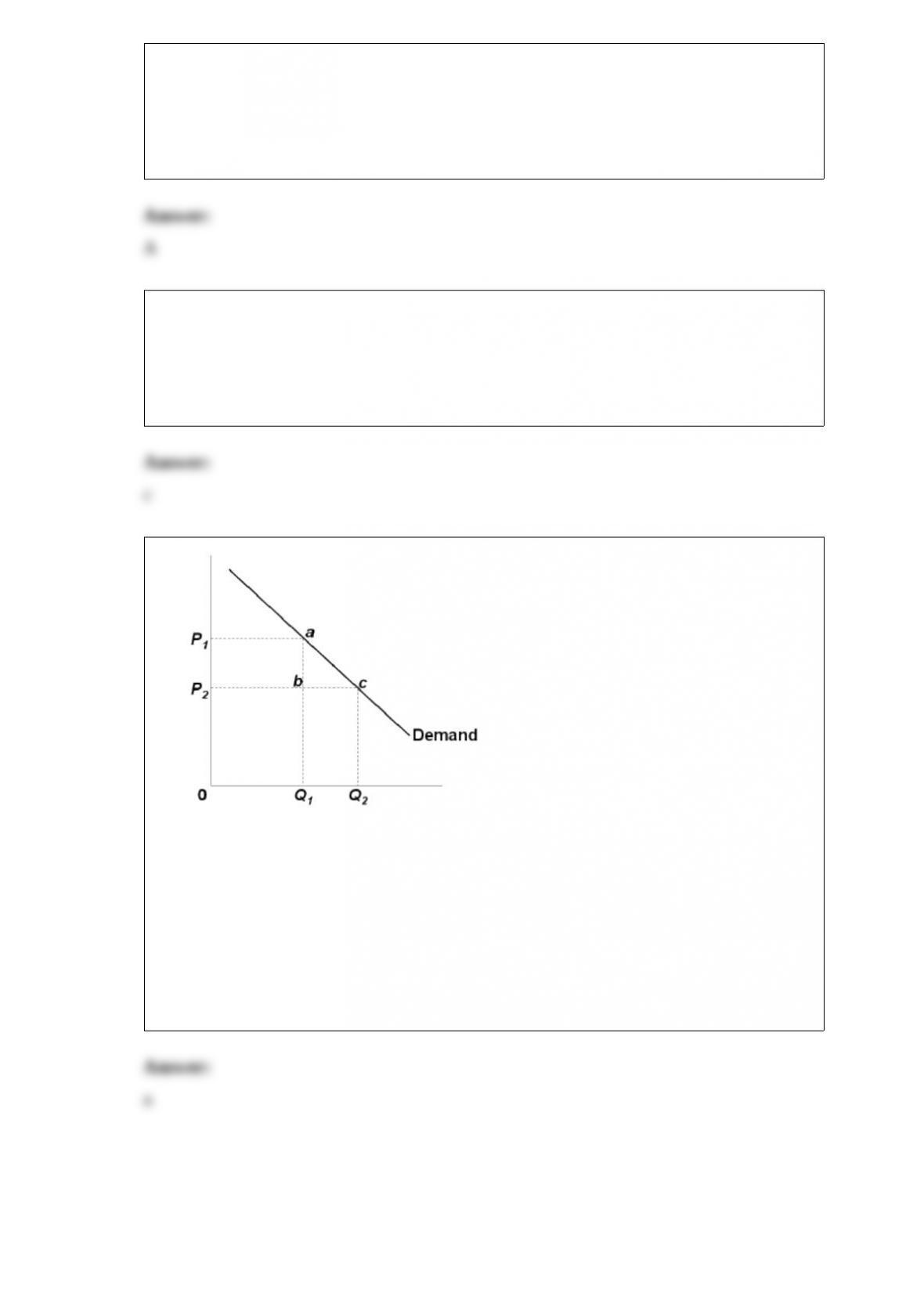
11)
if the firm in the above diagram lowers price from p1 to p2, it will:
a.lose p1p2ba in revenue from the price cut but increase revenue by q1bcq2 from the
increase in sales.
b.lose p1p2ca in revenue from the price cut but increase revenue by q1acq2 from the
increase in sales.
c.incur a decline in total revenue because it is operating on the elastic segment of the
demand curve.
d.incur an increase in total revenue because it is operating on the inelastic segment of
the demand curve.
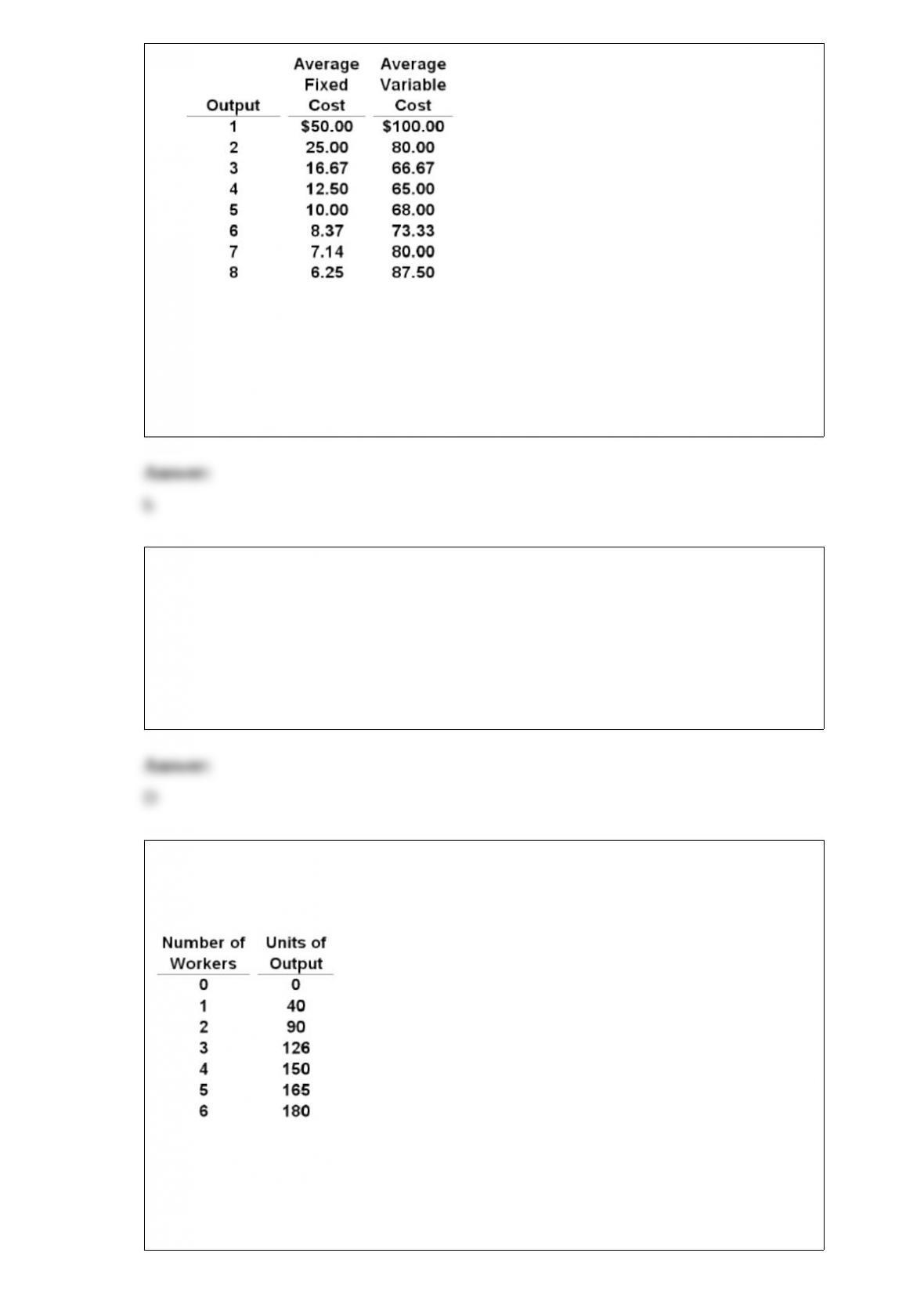
12)
refer to the above data. the marginal cost curve would intersect the average variable
cost curve at about:
a.2 units of output.
b.4 units of output.
c.6 units of output.
d.7 units of output.
13) Which of the following statements is false?
A.In recent years the United States has had large annual trade deficits in goods and
services.
B.The United States imports some of the same categories of goods as it exports.
C.The United States is the world’s leading exporter in terms of absolute dollar volume.
D.As a percentage of GDP, U.S. exports are the highest among the industrially
advanced nations.
14) the following output data for a firm. assume that the amounts of all non-labor
resources are fixed.
refer to the above data. the marginal product of the sixth worker is:
a.180 units of output.
b.30 units of output.
c.15 units of output.
d.negative.
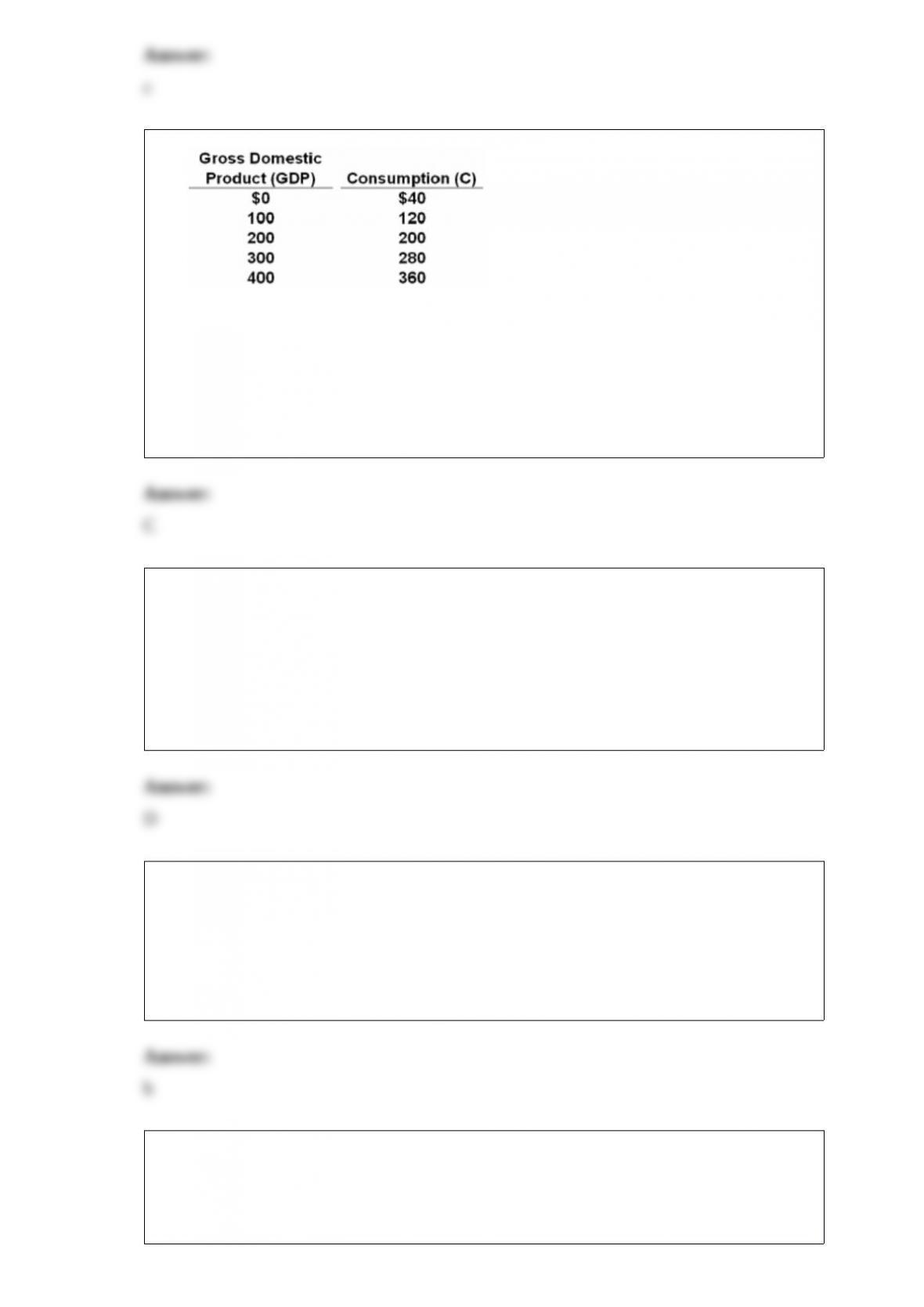
15)
Refer to the above data. If a lump-sum tax (the same tax amount at each level of GDP)
of $40 is imposed in this economy, we can conclude that the tax:
A.enhances the economy’s built-in stability.
B.reduces the economy’s built-in stability.
C.neither increases nor decreases built-in stability.
D.increases the MPC and therefore increases the size of the multiplier.
16) The government of a DVC may force the economy to save by deliberately causing
inflation. This policy is undesirable because inflation may:
A.distort investment away from productive facilities and toward luxury housing and
precious metals.
B.reduce voluntary saving because the value of money is depreciating.
C.contribute to a balance of trade deficit.
D.entail all of these problems.
17) economists define durable goods as those products expected to last at least _____
year(s).
a.1
b.3
c.5
d.10
18) if a competitive industry is neither expanding nor contracting, we would expect:
a.total revenue to be zero.
b.economic profits to be zero.
c.total opportunity cost to be zero.
d.more resources to flow to that industry.
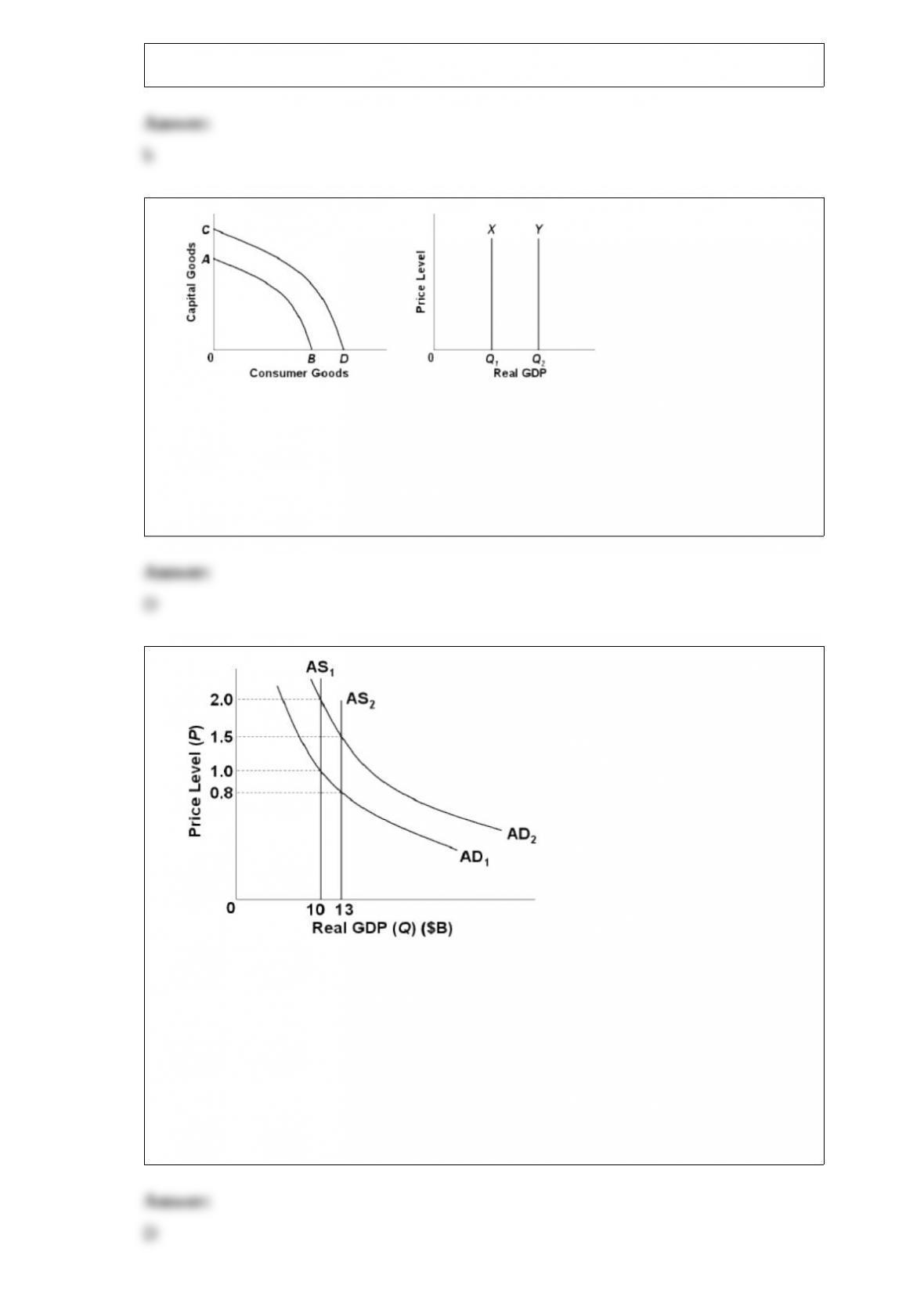
19)
Refer to the above graphs. An increase in the economy’s human capital would shift
curve:
A.AB to CD and curve Y to X
B.CD to AB and curve X to Y
C.X to Y while leaving curve AB in place.
D.AB to CD and curve X to Y
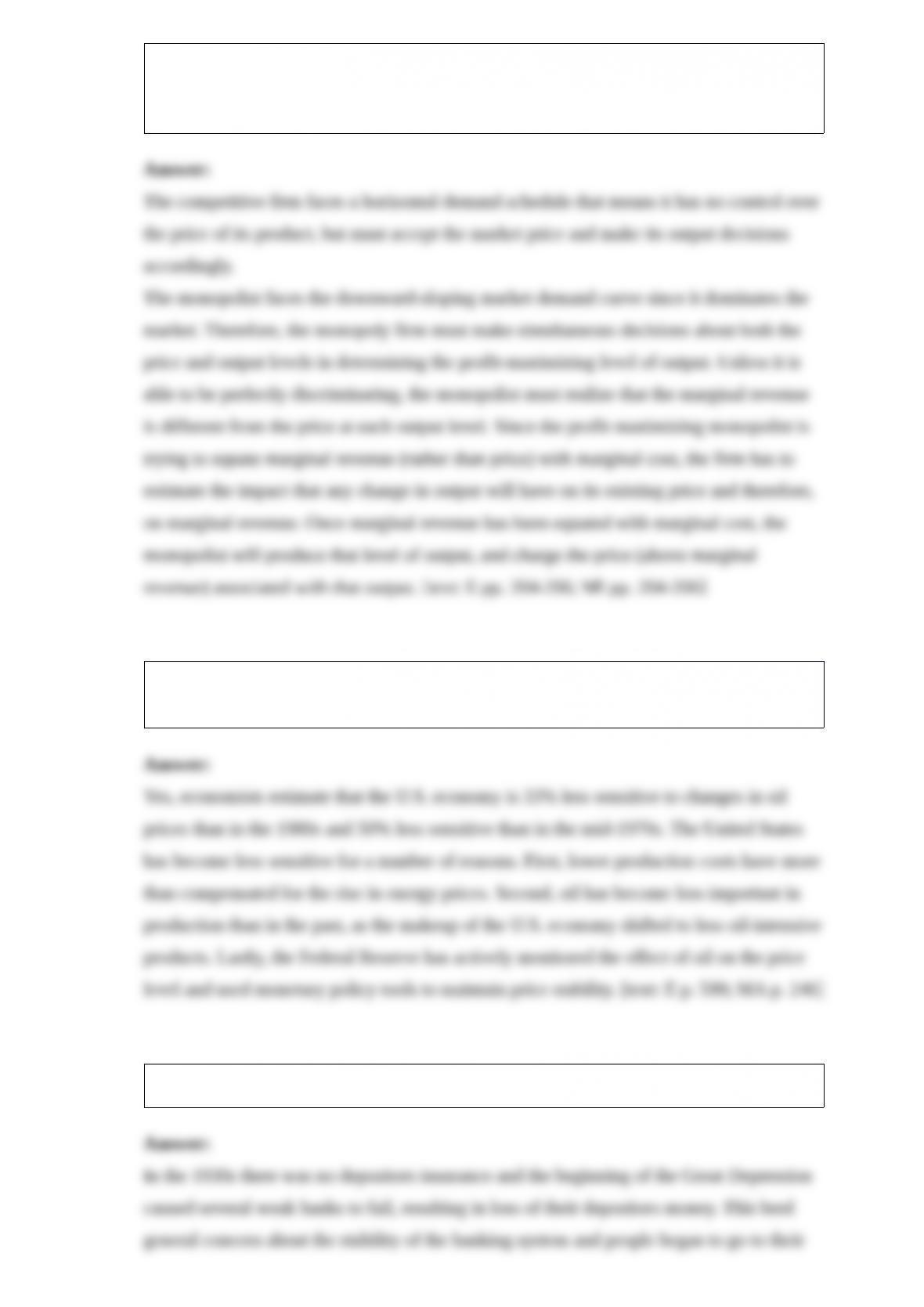
20)
Answer this question on the basis of the above diagram and the equation of exchange.
Assume that the velocity of money is constant at 4. Suppose that the increase of
aggregate supply from AS1 to AS2 indicates the economy’s average increase in real
output per year. According to monetarists, the proper monetary rule for price stability
would be to increase the money supply by:
A.zero percent per year.
B.4 percent per year.
C.10 percent per year.
D.30 percent per year.
21) In what ways, if any, do the demand schedules for a purely competitive firm and a
pure monopolist differ? What significance does this have for the price-output behavior
of each?
22) (Last Word) Have rises in oil prices lost their inflationary punch in the United
States? If so, why?
23) What led to the bank runs of the early 1930s?
24) What is the supply of loanable funds not perfectly inelastic? (In other words, why is
the supply curve upward sloping?)
25)
MR
Draw a graph of the short-run cost curves for a purely competitive firm that shows a
short-run supply curve for the individual firm. Identify the shutdown point, the break-even
point, the profit-maximizing point, and the levels of output associated with those points.
26) Indicate how the following events will shift the firms demand curve for labor:
increase it (I); decrease it (D); keep it the same (S).
___Technological advances increase labors productivity.
___The wage rate increases.
___The demand for the product that labor produces decreases.

___The wage rate decreases.
___Absenteeism reduces labors productivity.
___The price of labor-saving machinery is reduced and the substitution effect is greater
than the output effect.
27) Lower prices are always good for business. Evaluate this statement.