1) economists use the term “demand” to refer to:
a.a particular price-quantity combination on a stable demand curve.
b.the total amount spent on a particular commodity over a stipulated time period.
c.an upsloping line on a graph that relates consumer purchases and product price.
d.a schedule of various combinations of market prices and amounts demanded.
2) other things equal, the provision of a per unit subsidy for a product will:
a.increase its supply.
b.increase its price.
c.decrease the quantity sold.
d.decrease its demand.
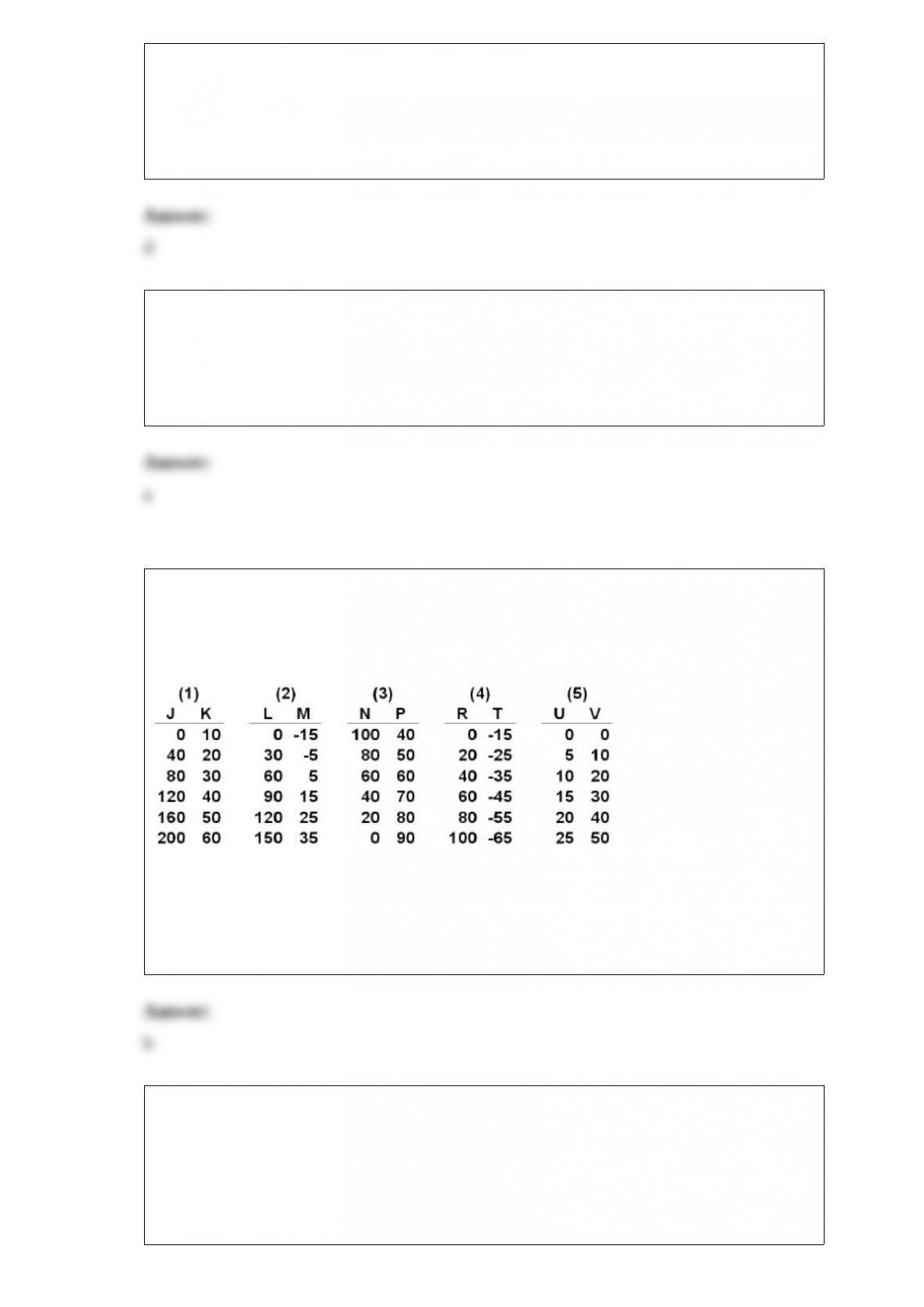
3) answer the next question(s) on the basis of the following five data sets wherein it is
assumed that the variable shown on the left is the independent variable and the one on
the right is the dependent variable. assume in graphing these data that the independent
variable is shown on the horizontal axis and the dependent variable on the vertical axis.
refer to the above data sets. the vertical intercept is positive for:
a.all five data sets.
b.data sets 1 and 3 only.
c.data sets 1, 3, and 5 only.
d.data set 2 only.
4) indifference curve analysis:
a.presumes, as does utility analysis, that satisfaction is numerically measurable.
b.presumes, unlike utility analysis, that satisfaction is numerically measurable.
c.presumes only that the consumer can say one combination of two goods yields more
or less utility than some other combination.
d.is in conflict with the idea of a downsloping demand curve.

5) in the short run the individual competitive firm’s supply curve is that segment of the:
a.average variable cost curve lying below the marginal cost curve.
b.marginal cost curve lying above the average variable cost curve.
c.marginal revenue curve lying below the demand curve.
d.marginal cost curve lying between the average total cost and average variable cost
curves.
6) Import quotas on sugar may cost consumers $2 billion per year. But this quota goes
unchallenged because the $10 average annual cost per person is so small that probably
not one voter in 200 knows the quota exists. This statement describes:
A.the voting paradox.
B.the special-interest effect.
C.the median-voter model.
D.free-rider problem.
7) (Consider This) According to the Consider This box on catfish and art, which of the
following airlines in 2007 agreed to pay $300 million fines for fixing fuel surcharges on
passenger tickets and cargo?
A.Korean Air and British Airlines
B.Qantas and Lufthansa
C.United Airlines and American Airlines
D.Virgin Atlantic and Aeroflot
8) compared to coffee, we would expect the cross elasticity of demand for:
a.tea to be negative, but positive for cream.
b.tea to be positive, but negative for cream.
c.both tea and cream to be negative.
d.both tea and cream to be positive.
9) In a two-nation model, the equilibrium world price will occur where:
A.one nation’s export supply curve intersects the other nation’s import demand curve.
B.exports are exactly twice the level of imports.
C.both nations’ export supply curves are horizontal.
D.both nations’ import demand curves are vertical.
10) Which of the following actions by the Fed would cause the money supply to
increase?
A.purchases of government bonds from banks.
B.an increase in the reserve requirement.
C.an increase in the discount rate.
D.sales of government bonds to the public.
11) the united states’ most important trading partner in terms of dollar volume is:
a.mexico.
b.canada.
c.germany.
d.china.
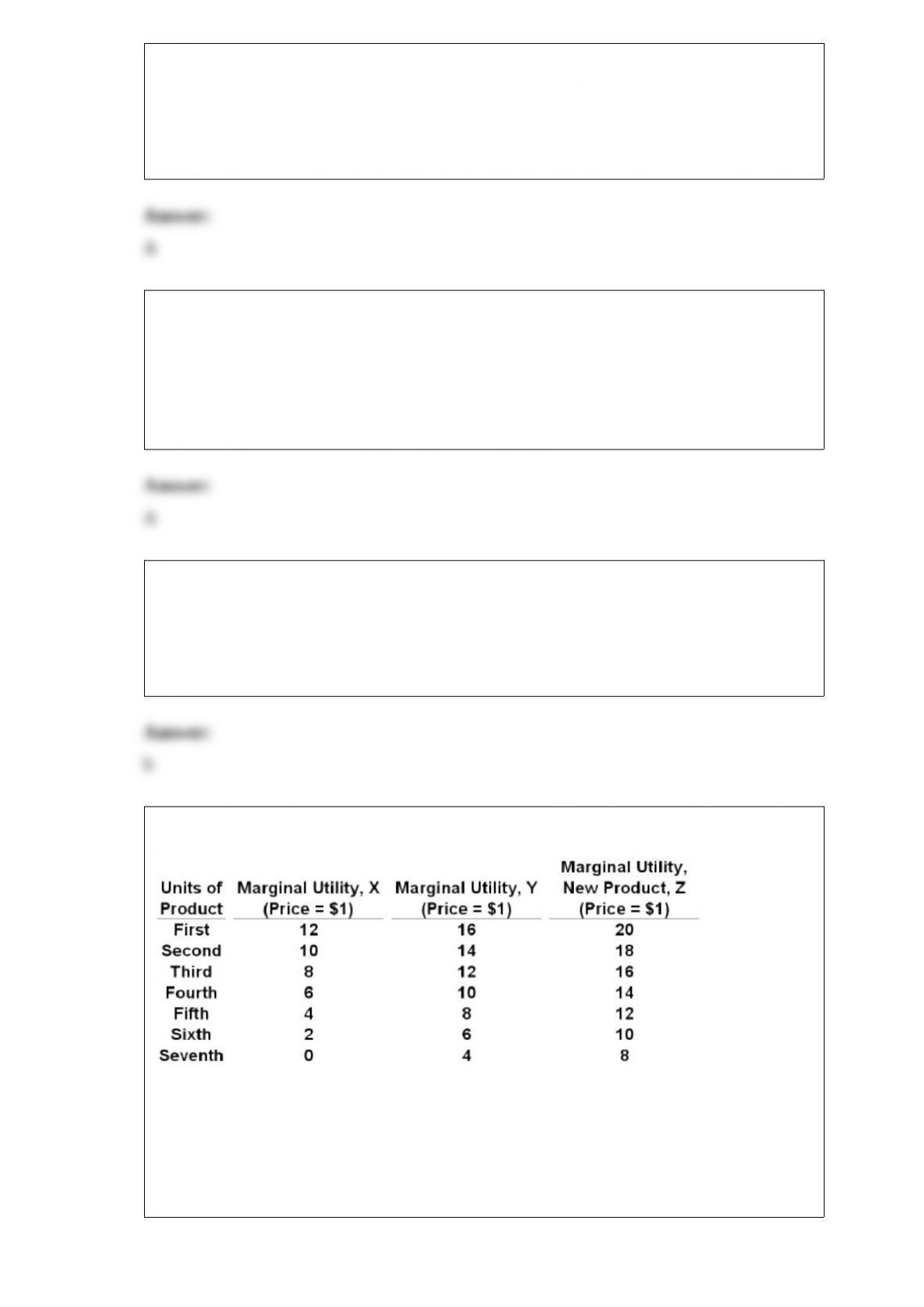
12) Consumer’s income = $12
Refer to the above data. Suppose the price of new product Z is $10 rather than $1. This
consumer would purchase:
A.some of Z but not as much as if the price were $1.
B.none of Z.
C.less of X, Y, and Z than if the price were $1.
D.more of X, Y, and Z than if the price were $1.
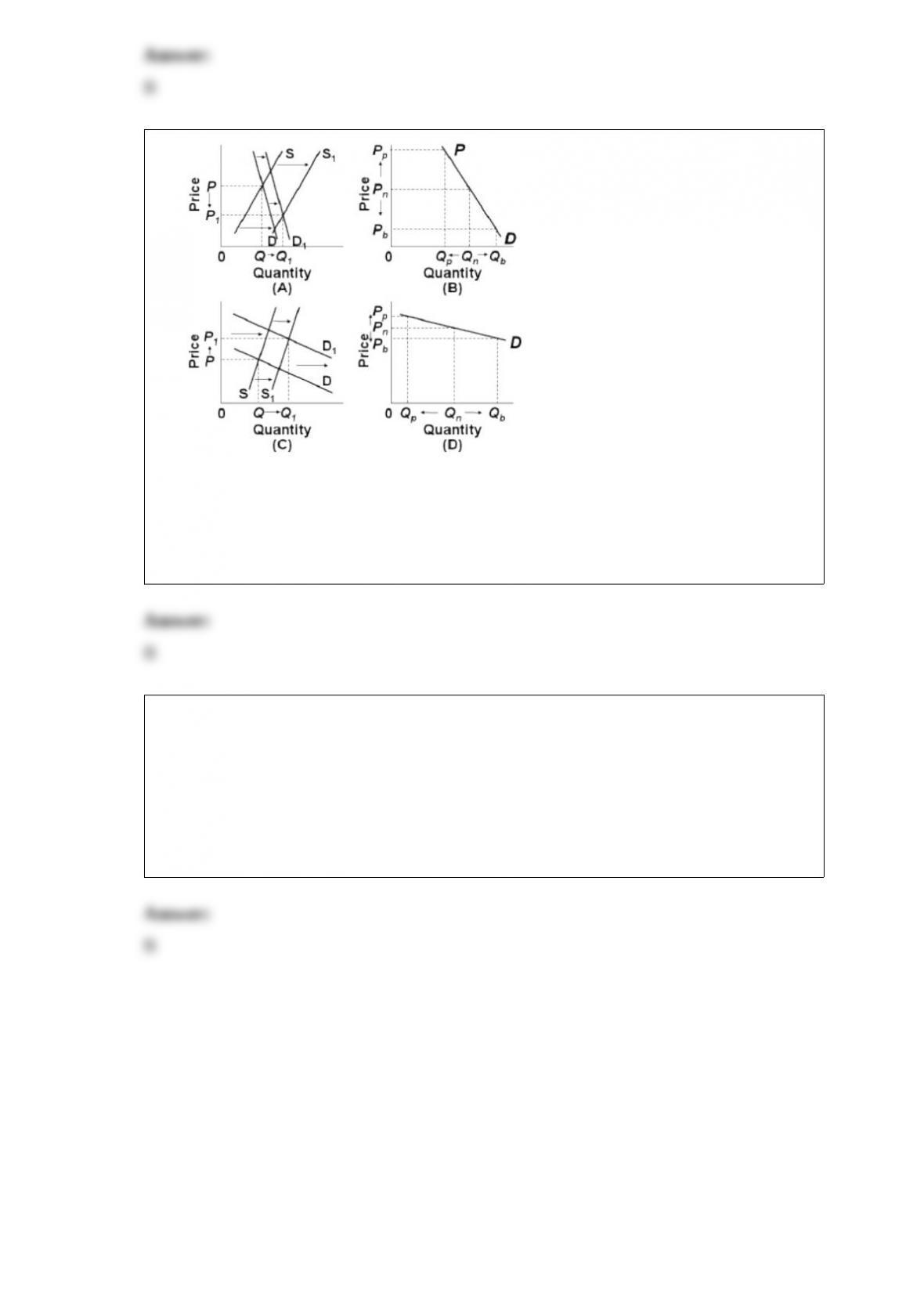
13)
Which diagram above best represents the problem faced by farms in the short-run?
A.A
B.B
C.C
D.D
14) One of the consequences of the U.S. trade deficit is that:
A.domestic inflation has resulted.
B.the accumulation of American dollars in foreign hands has enabled foreign firms to
build factories in America.
C.the distribution of income in the United States has become less unequal.
D.the system of flexible exchange rates has been abandoned in favor of a new gold
standard.
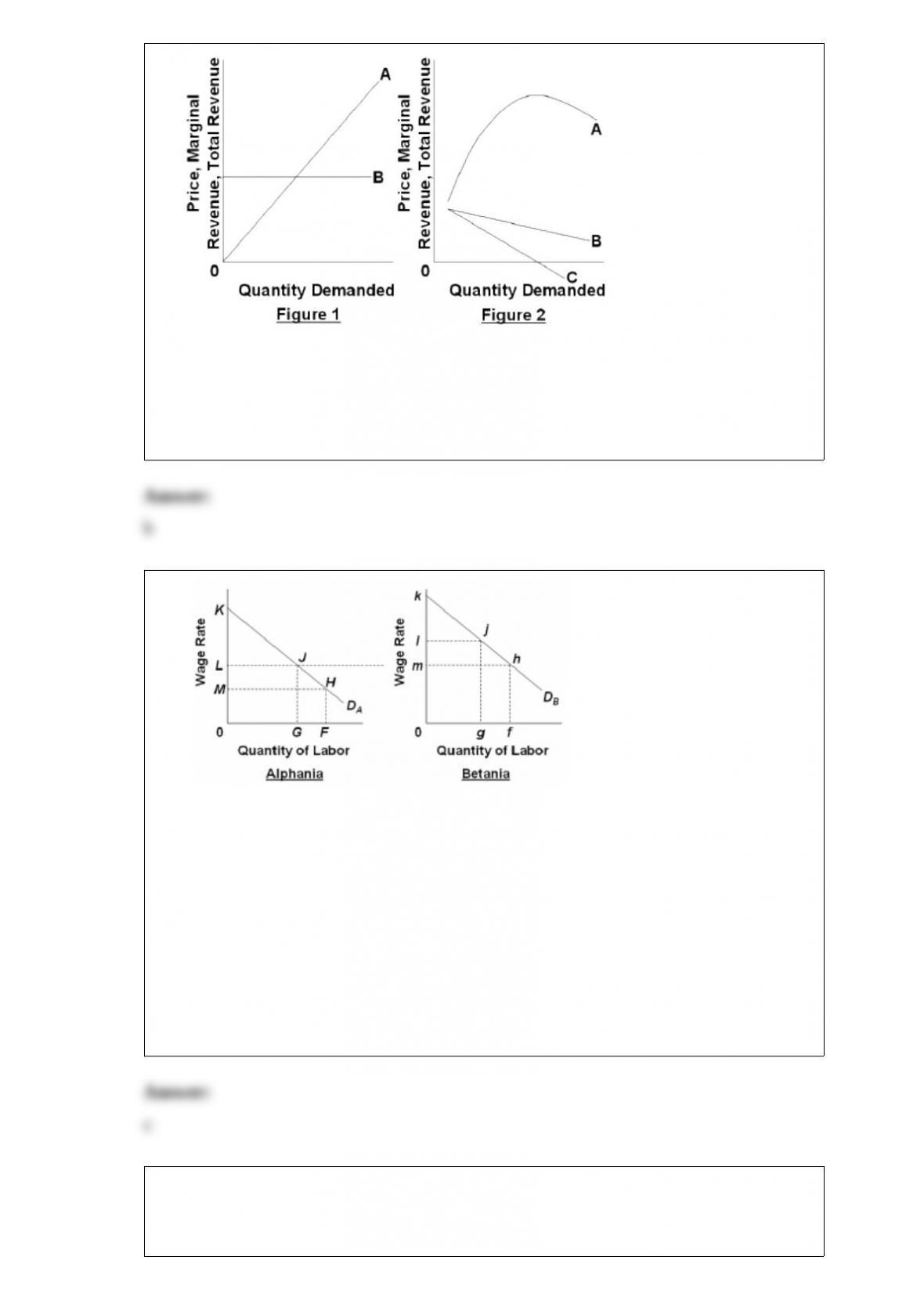
15)
refer to the above two diagrams for individual firms. figure 1 pertains to:
a.an imperfectly competitive firm.
b.a purely competitive firm.
c.an oligopolist.
d.a pure monopolist.
16)
assumptions: (1) the demand for labor in alphania and betania are as shown by da and
db, respectively; (2) alphania’s native labor force is f and that of betania is g; (3) wage l
in alphania is equal to wage m in betania; and (4) full employment exists in both
countries.
refer to the above diagram and assumptions. if unemployment, rather than full
employment, had initially existed in alphania:
a.then betania’s loss of output would have been greater.
b.then betania’s gain of output would have been less.
c.its loss of output would have been less.
d.its loss of output would have been greater.
17) suppose the production of a certain good creates substantial positive externalities. if
government adopts a policy that adjusts demand to take these benefits into account,
then:

a.firms in this industry will go out of business.
b.the output of the product will increase.
c.the output of the product will decrease.
d.the price of the product will decrease.