1) in industrially advanced countries estimates suggest the income elasticity of demand
for health care is about:
a.+3.
b.+6.
c.-2.
d.+1.
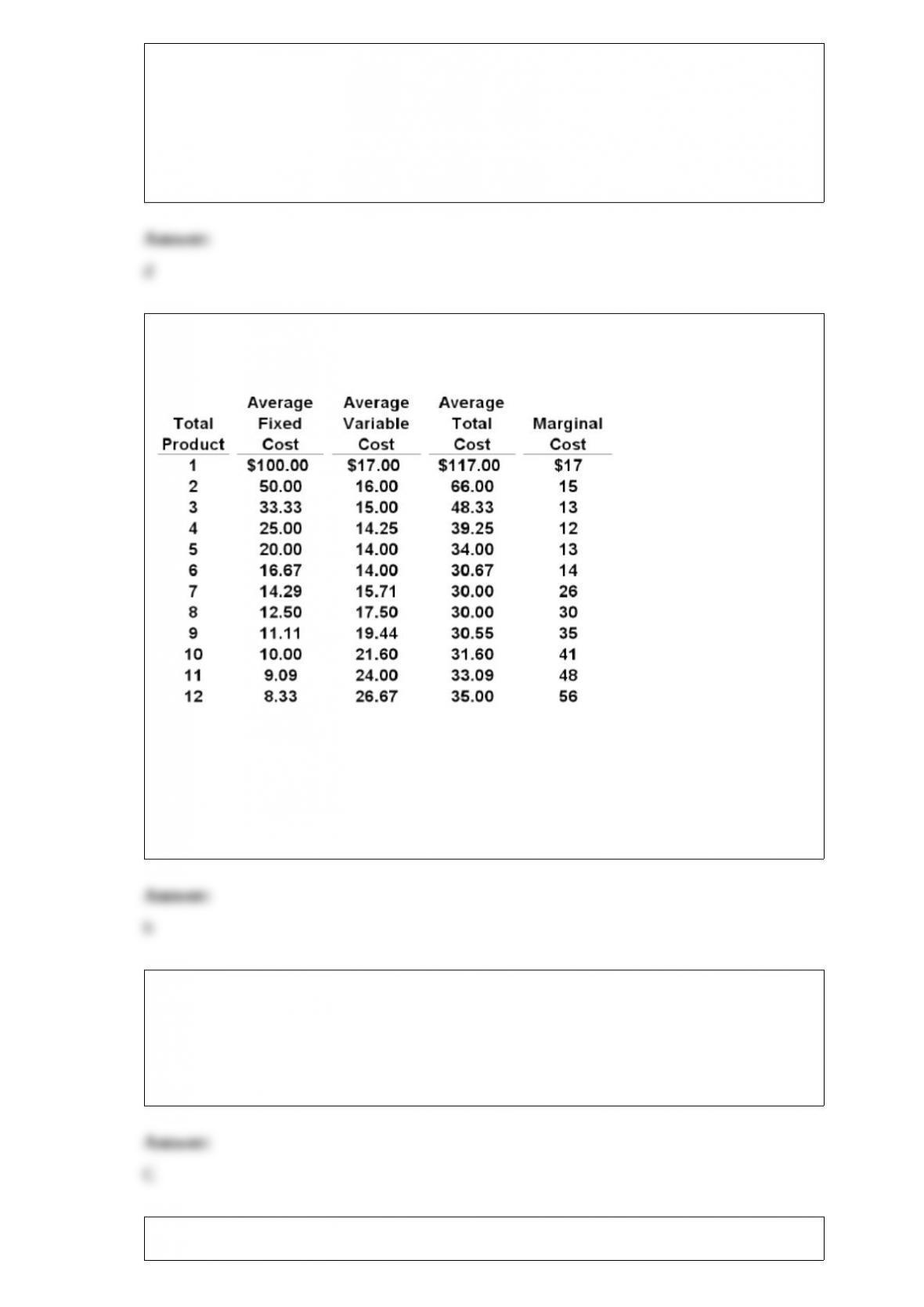
2) the following cost data for a firm that is selling in a purely competitive market:
refer to the above data. if the market price for the firm’s product is $28, the competitive
firm will:
a.produce 4 units at a loss of $17.40.
b.produce 7 units at a loss of $14.00.
c.close down in the short run.
d.produce 6 units at a loss of $23.80.
3) Which of these sets of nations are considered high-income economies?
A.Brazil, Poland, South Africa
B.China, India, and Russia
C.Canada, Switzerland, and France
D.United States, South Korea, and Mexico
4) Extraction costs of a non-renewable resource include the:
A.cost of removal from the ground only.
B.cost of removal from the ground plus the cost of preparation for sale.
C.cost of removal from the ground, the cost of preparation for sale, and the cost of not
being able to extract and sell the resource in the future.
D.cost of removal from the ground plus replanting costs.
5) Suppose the Federal Reserve Banks sell $2 billion of government bonds to the public
which pays for them by drawing checks. As a result, commercial bank reserves will:
A.increase by $10 billion.
B.remain unchanged.
C.decrease by $2 billion.
D.increase by $2 billion.
6) ben is exhausting his money income consuming products a and b in such quantities
that mua/pa = 5 and mub/pb = 8. ben should purchase:
a.more of a and less of b
b.more of b and less of a
c.more of both a and b
d.less of both a and b
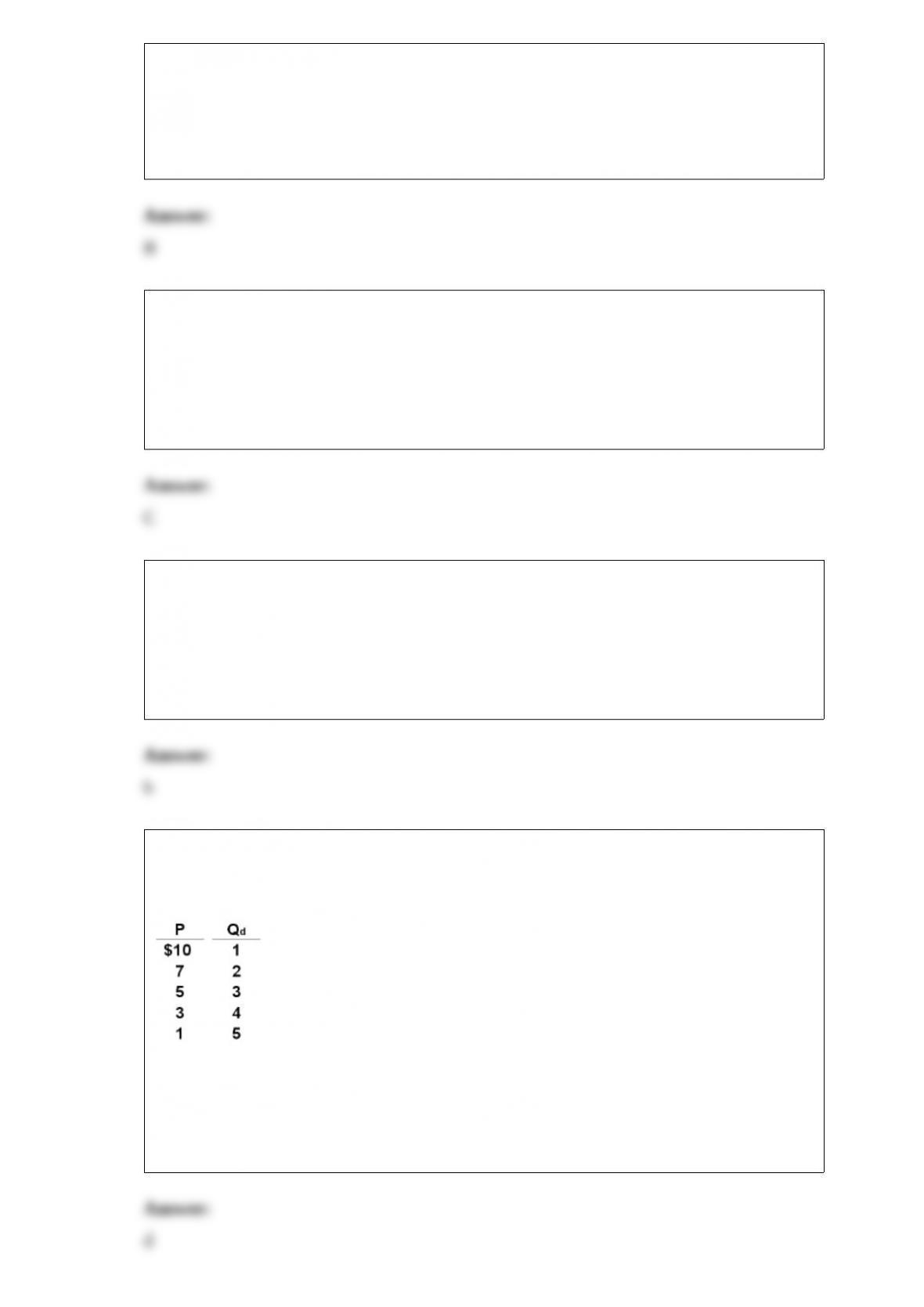
7) the following table showing the demand schedule facing a nondiscriminating
monopolist:
refer to the above table. the profit-maximizing monopolist will sell at a price:
a.of $10.
b.of $7.
c.of $5
d.that cannot be determined with the information provided.

8) One of the morals of the supply-side anecdote is that:
A.there is no such thing as a free breakfast (or lunch).
B.the people who pay the highest taxes get the most benefit from a tax reduction.
C.tax cuts increase tax revenue.
D.the U.S. tax system is regressive.
9) An expansionary monetary policy may be less effective than a restrictive monetary
policy because:
A.the Federal Reserve Banks are always willing to make loans to commercial banks
which are short of reserves.
B.fiscal policy always works at cross purposes with an expansionary monetary policy.
C.changes in exchange rates complicate an expansionary monetary policy more than it
does a restrictive monetary policy.
D.commercial banks may not be able to find loan customers.
10) Domestic price supports on, say, sugar:
A.generate trade barriers to reduce imports of foreign sugar.
B.increase world sugar prices.
C.keep the domestic price of sugar artificially low.
D.increase the earnings of foreign sugar producers.
11) In the extended aggregate demand-aggregate supply model:
A.long-run equilibrium occurs wherever the aggregate demand curve intersects the
short-run aggregate supply curve.
B.the long-run aggregate supply curve is horizontal.
C.the level of real output is the same in the long run regardless of the location of the
aggregate demand curve.
D.the short-run aggregate supply curve is downsloping.
12) Suppose the economy’s multiplier is 2. Other things equal, a $25 billion decrease in
government expenditures on national defense will cause equilibrium GDP to:
A.decrease by $50 billion.
B.decrease by $150 billion.

C.remain unchanged since spending on military goods is unproductive and usually
wasteful.
D.decrease by $25 billion.