
Ceteris paribus, a rise in interest rates in the United States will cause the yen price of
the dollar in international exchange markets to ________. I.e., the dollar ________ in
value against the yen.
A) increase; appreciates
B) increase; depreciates
C) decrease; depreciates
D) decrease; appreciates
Suppose a drought resulted in a major reduction in the California lettuce crop. In the
market for lettuce,
A) the supply curve shifted to the left resulting in an increase in the equilibrium price.
B) the supply curve shifted to the left resulting in a decrease in the equilibrium price.
C) the demand curve shifted to the right resulting in an increase in the equilibrium
price.
D) the demand curve shifted to the left resulting in a decrease in the equilibrium price.

Figure 24-3
Which of the points in the above graph are possible short-run equilibria?
A) A and B
B) A and C
C) A and D
D) A, B, C, and D
If the United States has a net export deficit, which of the following must be true?
(Assume that the capital account is zero and net transfers are zero.)
A) The balance on the financial account must equal the balance on the current account.
B) Net foreign investment must be negative as well.
C) Domestic private saving must be less than net foreign investment.
D) Domestic public saving must be less than net foreign investment.
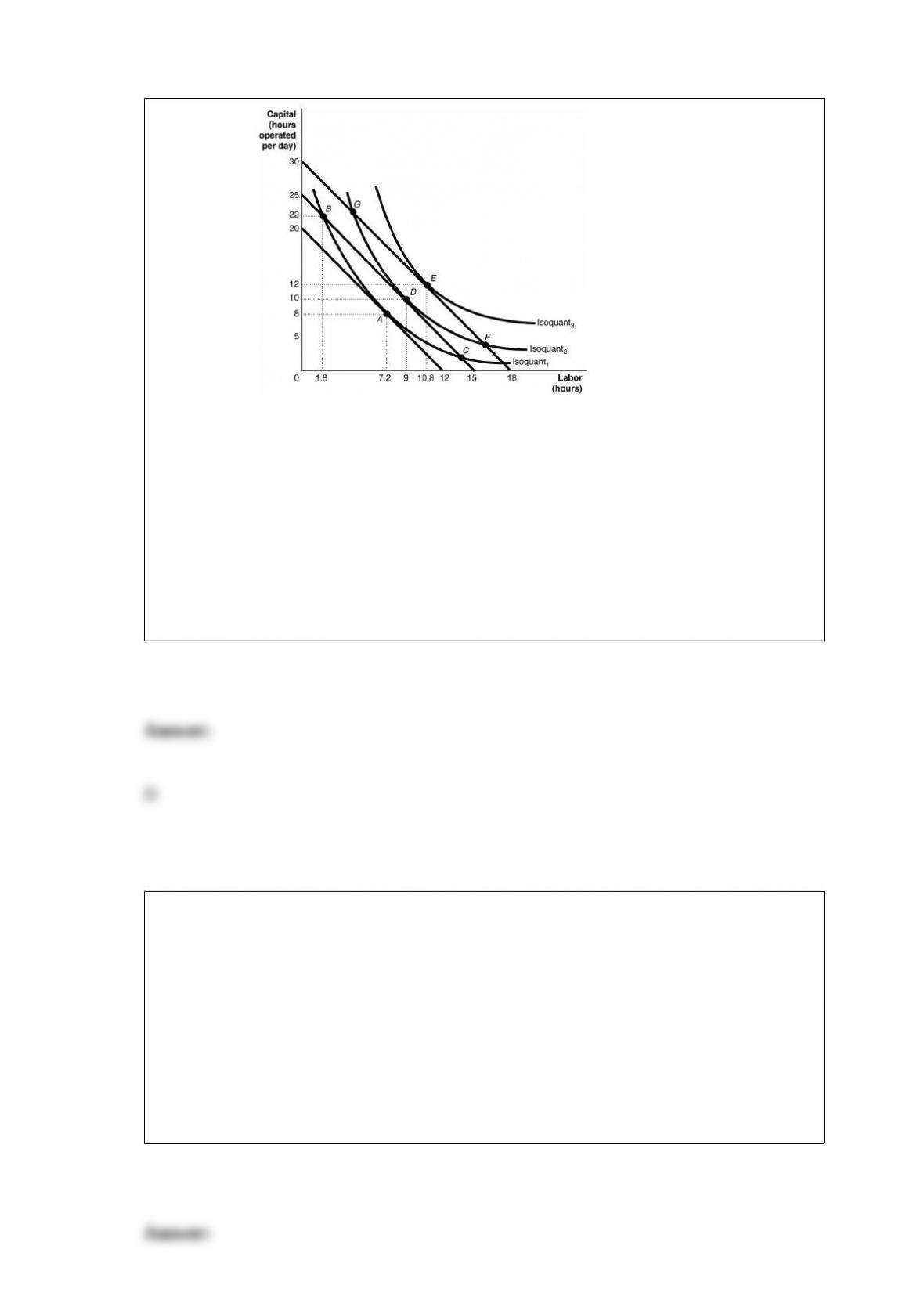
Figure 11-18
Starting from point e, a movement along the isocost to point f
A) decreases the total cost of production but not output.
B) increases the total cost of production and decreases output.
C) decreases both the total cost of production and output.
D) decreases output but not the total cost of production.
The total output produced by a firm divided by the quantity of workers employed by the
firm is the definition of
A) the marginal product of labor.
B) the division of labor.
C) the average product of labor.
D) the average cost of production.

Economists refer to the series of induced increases in consumption spending that result
from an initial increase in autonomous expenditures as the ________ effect.
A) multiplier
B) expenditure
C) consumption
D) aggregate demand
The market demand for a public good can be determined by
A) adding up the total private benefits and external benefits that each quantity provides
the citizens of a country.
B) adding up how much each citizen expects to consume at each possible price.
C) adding up how much each consumer is willing to pay for each unit of the public
good.
D) estimating the value of the benefit that each unit provides and multiplying that by
the number of consumers.

Long-run equilibrium under monopolistic competition and perfect competition is
similar in that
A) firms produce at the minimum point of their average cost curves.
B) price equals marginal cost.
C) firms break even.
D) price equals marginal revenue.
Suppose the equilibrium real federal funds rate is 5 percent, the target rate of inflation is
3 percent, the current inflation rate is 5 percent, and real GDP is 4 percent above
potential real GDP. If the weights for the inflation gap and the output gap are both 1/2,
then according to the Taylor rule the federal funds target rate equals
A) 1 percent.
B) 9 percent.
C) 13 percent.
D) 17 percent.
A curve that shows all the combinations of two inputs, such as labor and capital, that
will produce the same level of output is called
A) an isoquant.
B) an isocost line.
C) a budget line.
D) an optimal input combination curve.
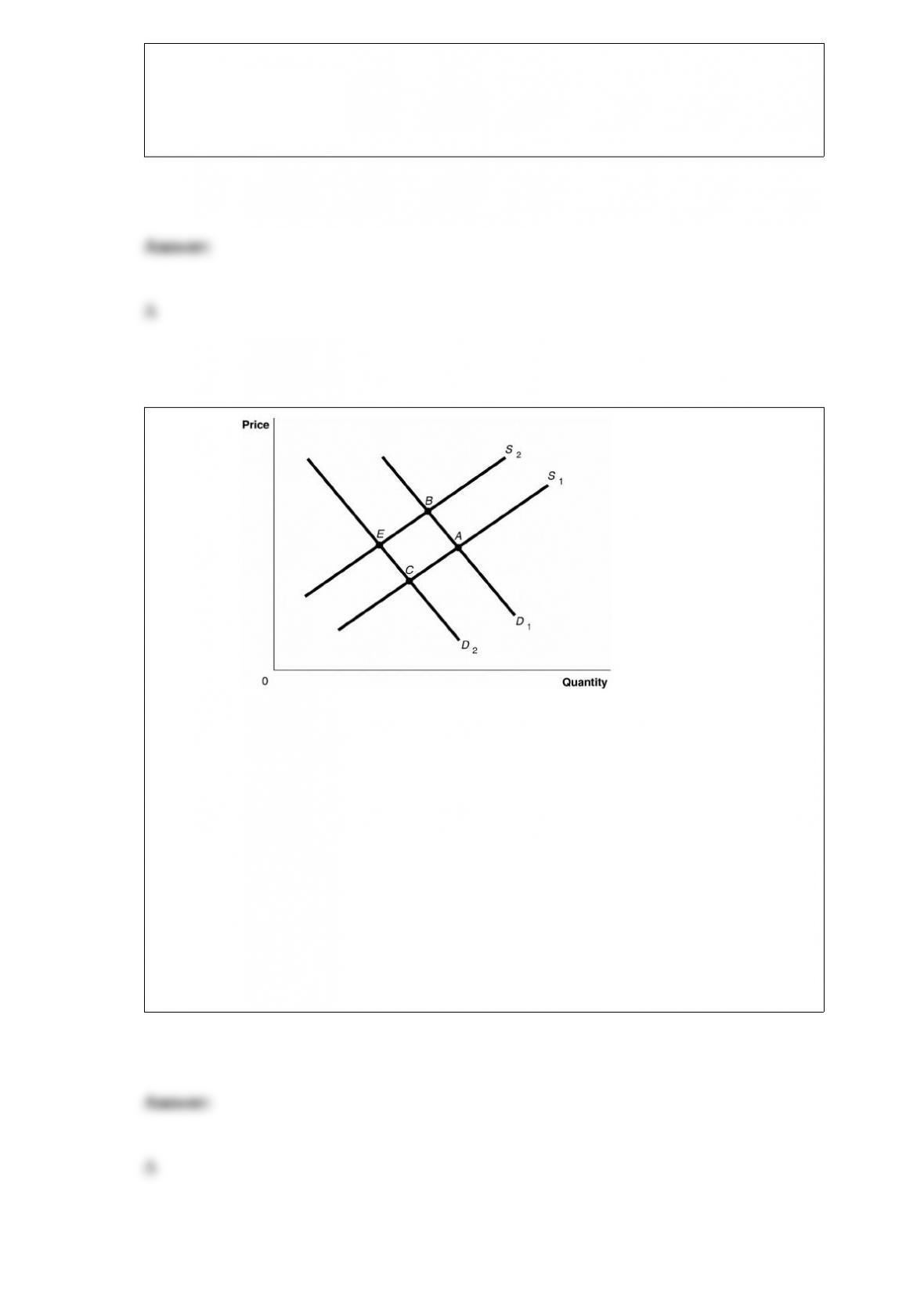
Figure 3-8
The graph in this figure illustrates an initial competitive equilibrium in the market for
apples at the intersection of D1 and S1 (point A). If the price of oranges, a substitute for
apples, decreases and the wages of apple workers increase, how will the equilibrium
point change?
A) The equilibrium point will move from A to E.
B) The equilibrium point will move from A to B.
C) The equilibrium point will move from A to C.
D) The equilibrium will first move from A to B, then return to A.