
Natural resource cartels such as OPEC are inherently unstable because their members
operate with excess capacity and have an incentive to cheat on their output quotas.
The marginal cost curve is U-shaped because of the law of increasing opportunity costs.
Firms in perfect competition produce the allocatively efficient output in the short run
and in the long run.
A perfectly competitive firm’s horizontal demand curve implies that the firm does not
have to lower its price to sell more output.

If additional units of a good could be produced at an increasing opportunity cost, the
production possibility frontier would be linear.
Any output combination outside a production possibility frontier is associated with
unused or
underutilized resources.
A monopoly is a firm that is the only seller of a good or service that does not have a
close substitute.

In the short run, if a firm shuts down its maximum loss equals the amount of its fixed
cost.
An externality is an example of a market failure.
Assume that price exceeds average variable cost over the relevant range of demand. If a
monopolistically competitive firm is producing at an output where marginal revenue is
$111.11 and marginal cost is $118, then to maximize profits the firm should increase its
output.
Unlike the market process, in the political market it is possible for some individuals to
receive very large benefits from the political process without any significant impact on
their tax bills.

An important reason why diseconomies of scale arise is because firms may have to hire
lower skilled workers as firms expand.
A perfectly competitive firm in long-run equilibrium produces output at the lowest
possible average total cost.
Technological advancements that increase labor’s productivity shift the labor supply
curve to the right.

Accounting costs exclude implicit costs.
All economic questions arise from the fact that resources are unlimited.
The total amount of consumer surplus in a market is equal to the area below the demand
curve.
The General Agreement on Tariffs and Trade (GATT) was designed to promote free
trade by reducing both tariffs and nontariff barriers to international trade.

Vaccinations tend to result in a positive externality.
A normal good is a good for which the demanded increases as income decreases,
holding everything else constant.
The ability of a firm or country to produce a good or service at a lower opportunity cost
than other producers is called absolute advantage.

A quota is the same as a voluntary export restraint.
A firm might prefer to choose a salary system rather than a commission or piece-rate
system of compensation when there are concerns about output quality.
The additional cost to a producer of hiring an additional unit of labor is called the
marginal cost.
Necessities tend to have more inelastic demands than luxuries.

One problem with using a command and control approach to pollution reduction is that
the monitoring costs may be too high.
The demand curve for a luxury good is upward-sloping.
Producer surplus is the difference between the lowest price a firm is willing to accept
for a product and the price it actually receives for the product.

To maximize profit, a monopolist will produce and sell a quantity such that for the last
unit sold, marginal revenue equals marginal cost, and charges a price given by the
demand curve at that output level.
Economic rent refers to the price of a factor of production which is fixed in supply.
Selling a product at a price below its cost is known as dumping.
The law of one price holds exactly only if there are transactions costs associated with
buying a product in one location and selling it in another location.

The government proposes a tax on imported champagne. Buyers will bear the entire
burden of the tax if the
A) supply curve for imported champagne is vertical.
B) demand curve for imported champagne is vertical.
C) demand curve for imported champagne is horizontal.
D) demand curve is downward sloping and the supply curve is upward sloping.
Which of the following is a common mistake consumers commit when they make
decisions?
A) They take into account nonmonetary opportunity costs but ignore monetary costs.
B) They are overly pessimistic about their future behavior.
C) They fail to ignore sunk costs.
D) They sometimes value fairness too much.
Congressman Murphy made the following proposal: “We should establish policies that
completely eliminate air pollution. This is the only way to ensure that none of our
citizens suffers the negative effects of air pollution.” If Congressman Murphy’s proposal
was adopted and all forms of air pollution were eliminated, which of the following
would be true?
A) The total cost of pollution reductions would equal the total benefit to society.
B) Economic efficiency would be maximized
C) The total benefit to society from reductions in air pollution would be maximized.
D) The marginal cost from pollution reductions would exceed the marginal benefit.
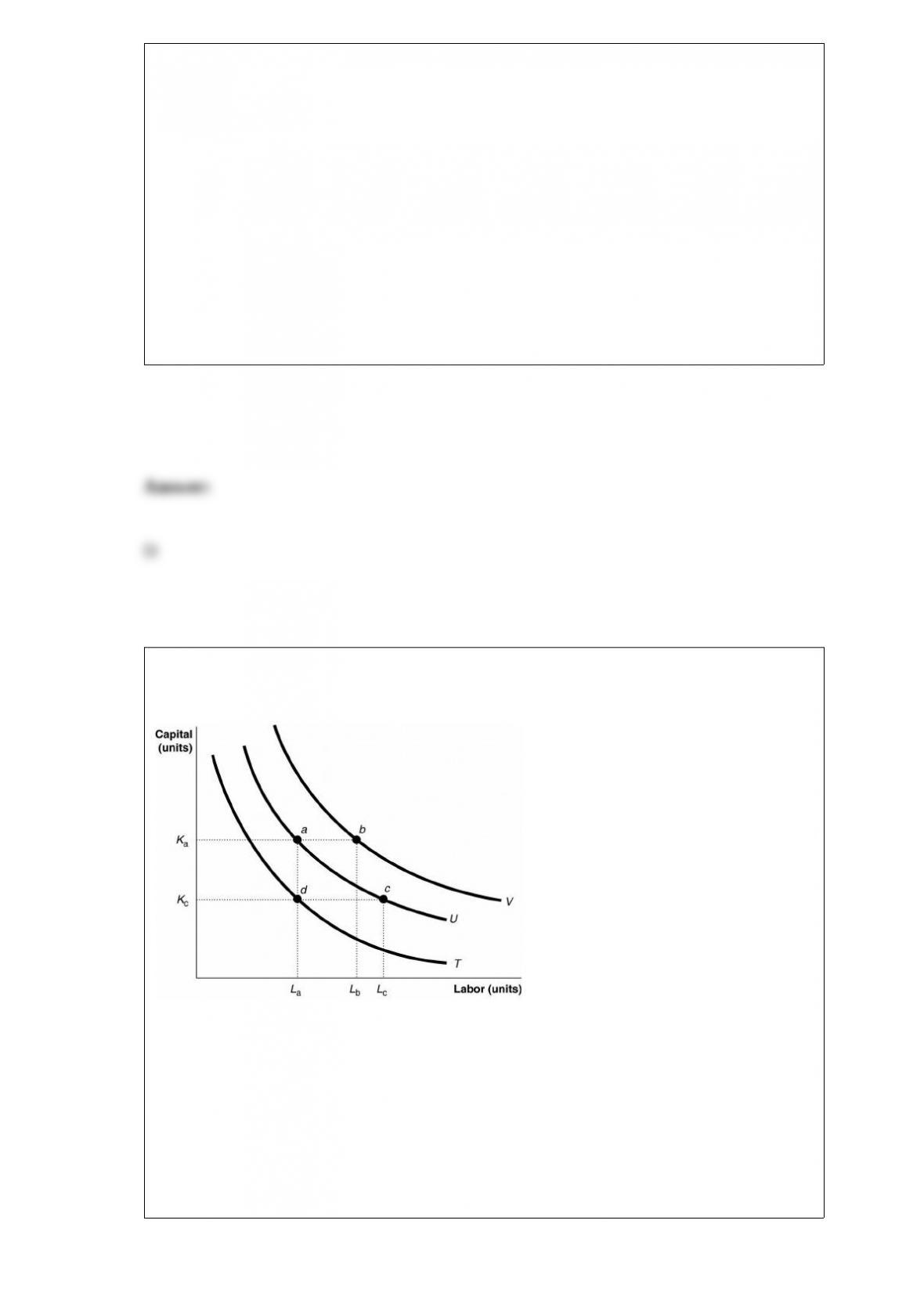
Figure 11-12
Refer to Figure 11-12. The movement from isoquant T to isoquant U depicts
A) a change in preferences with regards to input usage.
B) an increase in the cost of production.
C) an increase in output.
D) an increase in labor usage holding capital and output constant.

Which of the following is true at the output level where average total cost is at its
minimum?
A) Marginal cost equals average total cost.
B) Average variable cost equals fixed cost.
C) Marginal cost equals average variable cost.
D) Average total cost equals average fixed cost.
Lucinda buys a new GPS system for $250. She receives consumer surplus of $75 from
the purchase. How much does Lucinda value her GPS system?
A) $75
B) $175
C) $250
D) $325
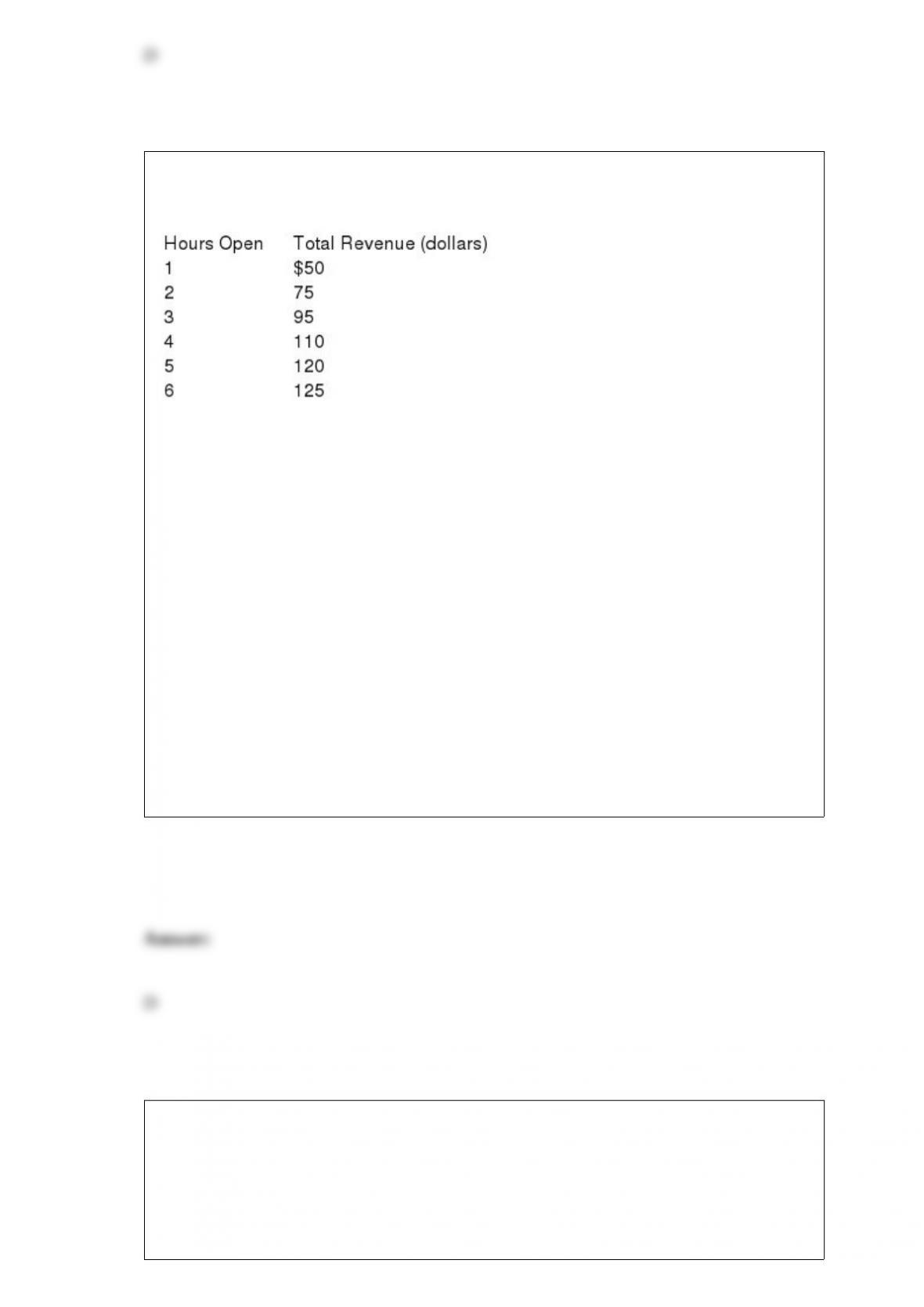
Table 1-1
Lydia runs a small nail salon in the town of New Hope. She is debating whether she
should extend her hours of operation. Lydia figures that her sales revenue will depend
on the number of hours the nail salon is open as shown in the table above. She would
have to hire a worker for those hours at a wage rate of $10 per hour.
Refer to Table 1-1. Using marginal analysis, how many hours should Lydia extend her
nail salon’s hours of operations?
A) 2 hours
B) 3 hours
C) 4 hours
D) 5 hours
E) 6 hours
Free trade ________ living standards by ________ economic efficiency.
A) raises; increasing
B) lowers; decreasing

C) raises; equalizing
D) lowers; eliminating
A perfectly competitive firm will maximize its profit at the rate of output where the
vertical distance between its total revenue and total cost is the largest. This is the same
rate of output where
A) average total cost equals marginal revenue.
B) marginal revenue equals marginal profit.
C) marginal revenue equals marginal cost.
D) marginal revenue equals average revenue.
Table 4-1
Refer to Table 4-1. The table above lists the highest prices three consumers, Tom, Dick
and Harriet, are willing to pay for a short-sleeved polo shirt. If the price of the shirts
falls from $28 to $20

A) consumer surplus increases from $14 to $35.
B) Tom will buy two shirts; Dick and Harriet will each buy one shirt.
C) consumer surplus will increase from $70 to $95.
D) Harriet will receive more consumer surplus than Tom or Dick.
The price elasticity of demand for Stork ice cream is -4. Suppose you’re told that
following a price increase, quantity demanded fell by 10 percent. What was the
percentage change in price that brought about this change in quantity demanded?
A) 40 percent
B) 25 percent
C) 2.5 percent
D) 0.4 percent
Profit is the difference between
A) marginal revenue and marginal cost.
B) total revenue and variable cost.
C) total revenue and total explicit cost.

D) total revenue and total cost.
Vipsana’s Gyros House sells gyros. The cost of ingredients (pita, meat, spices, etc.) to
make a gyro is $2.00. Vipsana pays her employees $60 per day. She also incurs a fixed
cost of $120 per day. Calculate Vipsana’s average fixed cost per day when she produces
50 gyros using two workers?
A) $2.00
B) $2.40
C) $4.40
D) $6.80
Jenna runs a small boutique in Capitola. She tells one of her suppliers that she is willing
to pay $6 for a pair of wool hand warmers and not a dime more. On the basis of this
information, what can you conclude about her price elasticity of demand for wool hand
warmers?
A) It is elastic.
B) It is perfectly elastic.
C) It is perfectly inelastic.

D) The price elasticity coefficient is 0.
Which of the following is likely to occur as the result of the law of diminishing
marginal utility?
A) Petra’s utility from her second apple was less than her satisfaction from her first
orange.
B) Hudson enjoyed his second slice of pizza more than his first.
C) Sabine’s utility from her first granola bar is greater than Rachel’s utility from her
second granola bar.
D) Wesley enjoyed his second bottle of iced tea less than his first bottle, other things
constant.
Costs that have already been incurred, and which cannot be recovered, are known as
A) short-run fixed costs.
B) implicit costs.
C) unavoidable costs.
D) sunk costs.
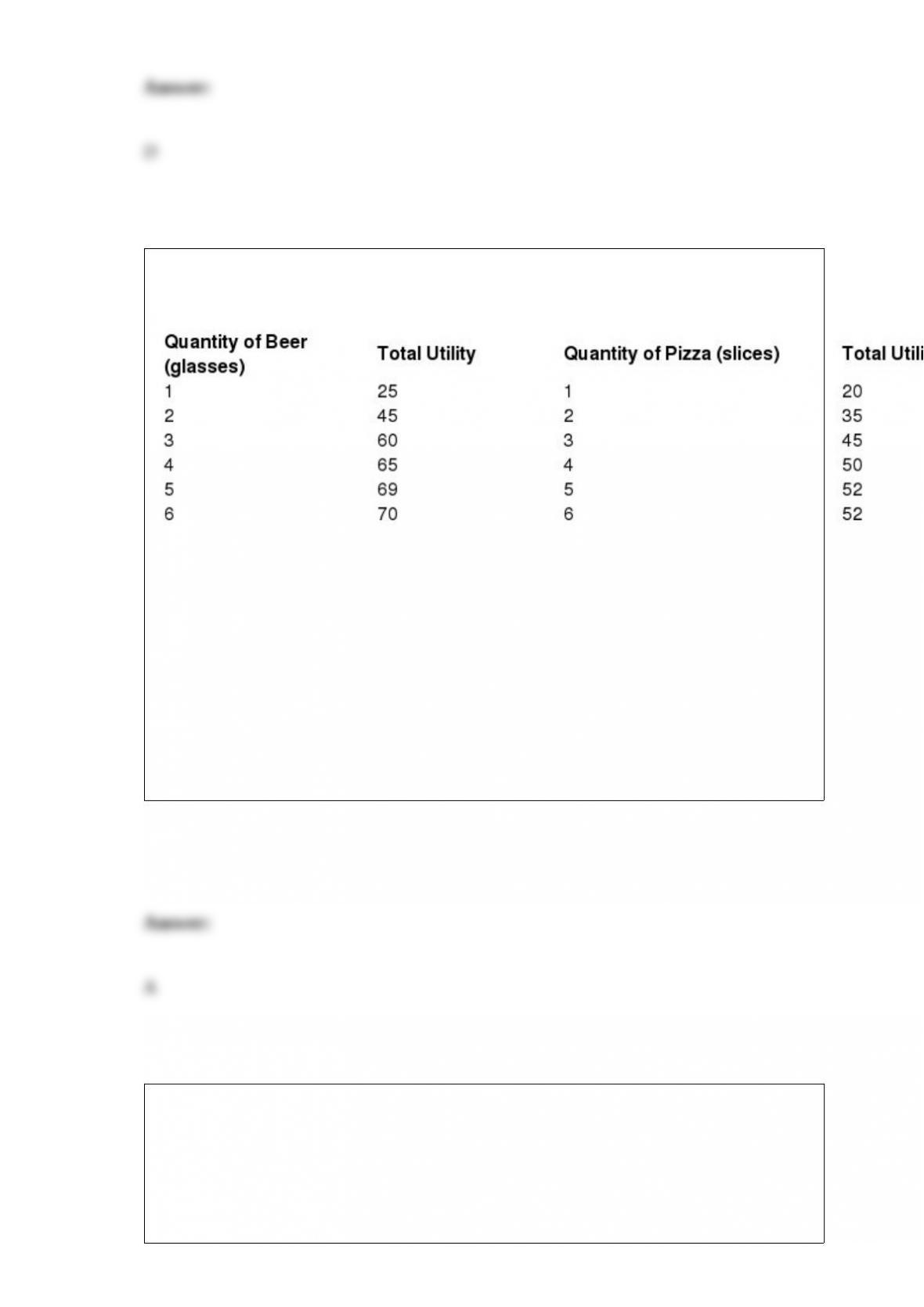
Table 10-7
Table 10-7 shows Antonio’s utility from beer and pizza.
Refer to Table 10-7. What is Antonio’s marginal utility from consuming the fifth beer?
A) 4 utils
B) 13.6 utils
C) 69 utils
D) 134 utils
Which of the following is not a reason for firms to choose a salary system rather than a
commission system to compensate their employees?
A) Research has shown that most companies will find that a salary system will be more
profitable than a commission system.
B) It is often difficult to attribute output to particular workers.
C) If workers are paid on the basis of the number of units of output they produce, they
may become less concerned about quality.
D) Commission compensation systems are riskier for employees than a salary system,
and many workers dislike risk.
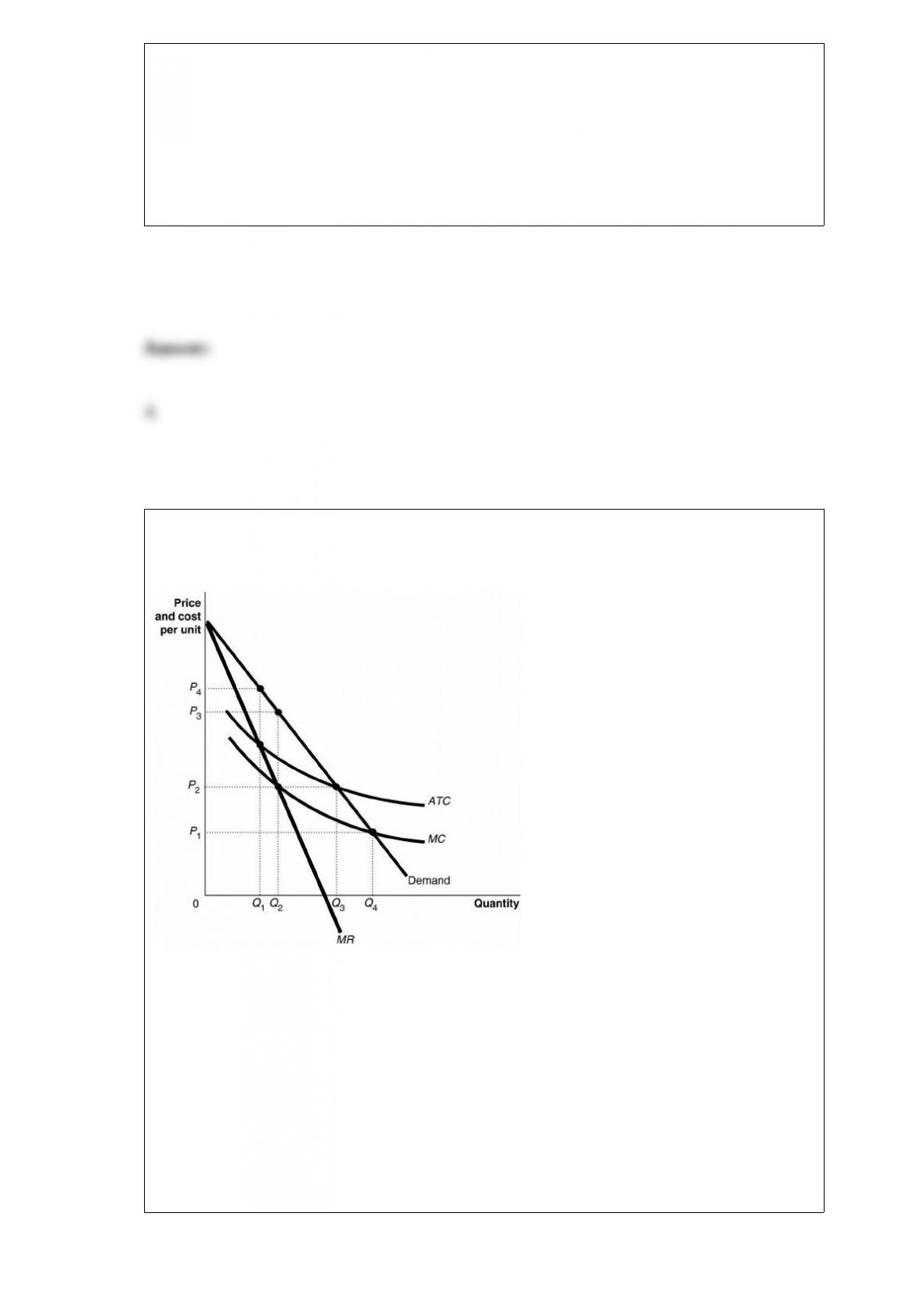
Figure 15-15
Figure 15-15 shows the cost and demand curves for the Erickson Power Company.
Refer to Figure 15-15. Erickson Power is a natural monopoly because
A) it is a power company and all power companies are natural monopolies.
B) average total cost is still declining when it intersects demand.
C) of its continually declining marginal revenue curve as output rises.
D) its marginal cost lies entirely below its long-run average cost.
An increase in the price of off-road vehicles will result in
A) a smaller quantity of off-road vehicles supplied.
B) a larger quantity of off-road vehicles supplied.
C) an increase in the demand for off-road vehicles.
D) a decrease in the supply of off-road vehicles.
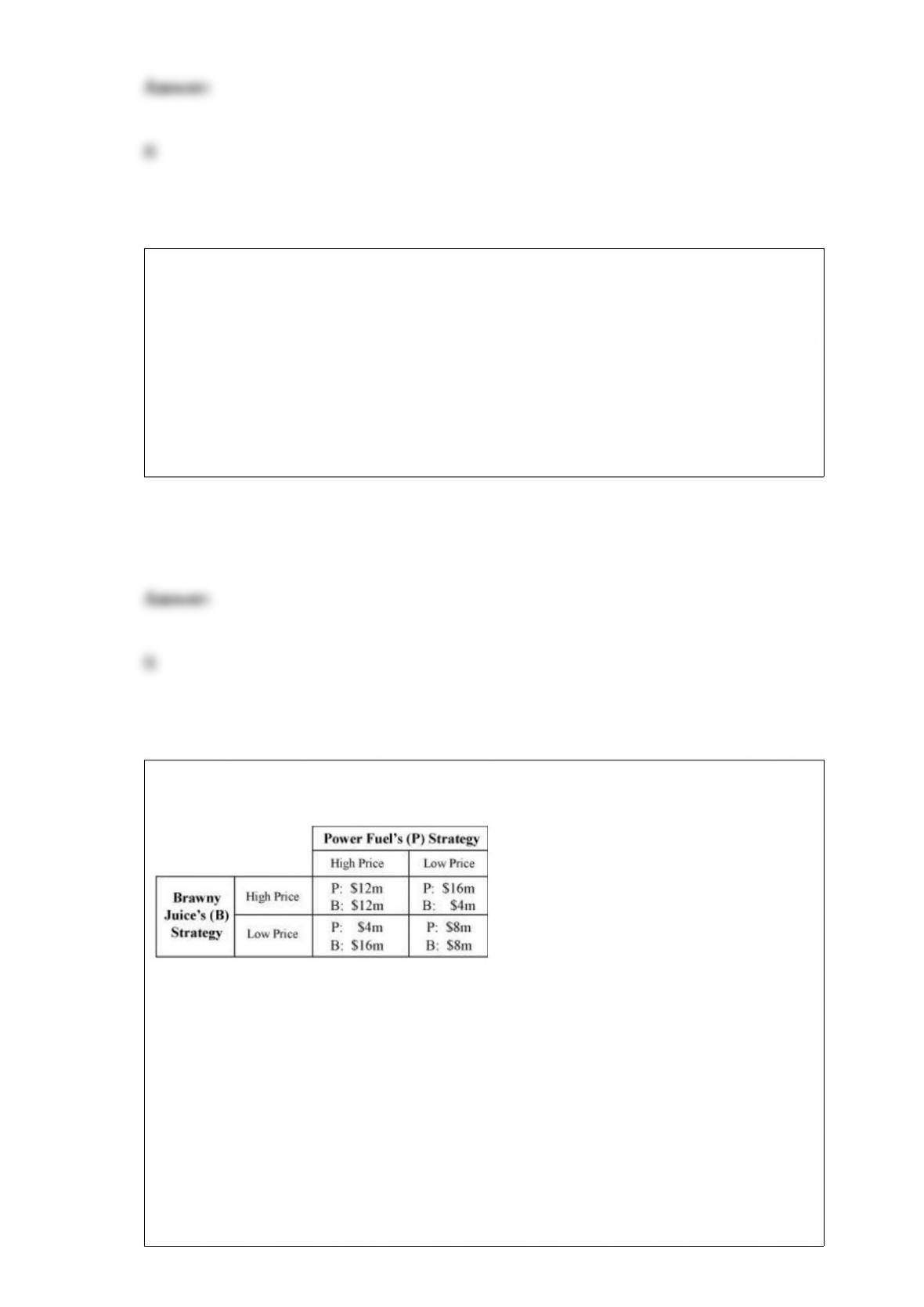
Table 14-8
Two rival oligopolists in the athletic supplements industry, the Power Fuel Company
and the Brawny Juice Company, have to decide on their pricing strategy. Each can
choose either a high price or a low price. Table 14-8 shows the payoff matrix with the
profits that each firm can expect to earn depending on the pricing strategy it adopts.
Refer to Table 14-8. Which of the following is true?
A) Power Fuel’s dominant strategy is to select a low price.
B) Brawny Juice’s dominant strategy is to select a high price.
C) Power Fuel does not have a dominant strategy.

D) Brawny Juice does not have a dominant strategy.
Suppose we want to use game theory to analyze how an oligopolist selects its optimal
price. The cells of the payoff matrix show
A) the profit that each producer can expect to earn by pursuing a single strategy.
B) the profit that each producer can expect to earn from every combination of strategies
by the firms in the market.
C) the strategy that a firm must pursue to earn various levels of profit.
D) the expected profits of rival firms.
Figure 2-4
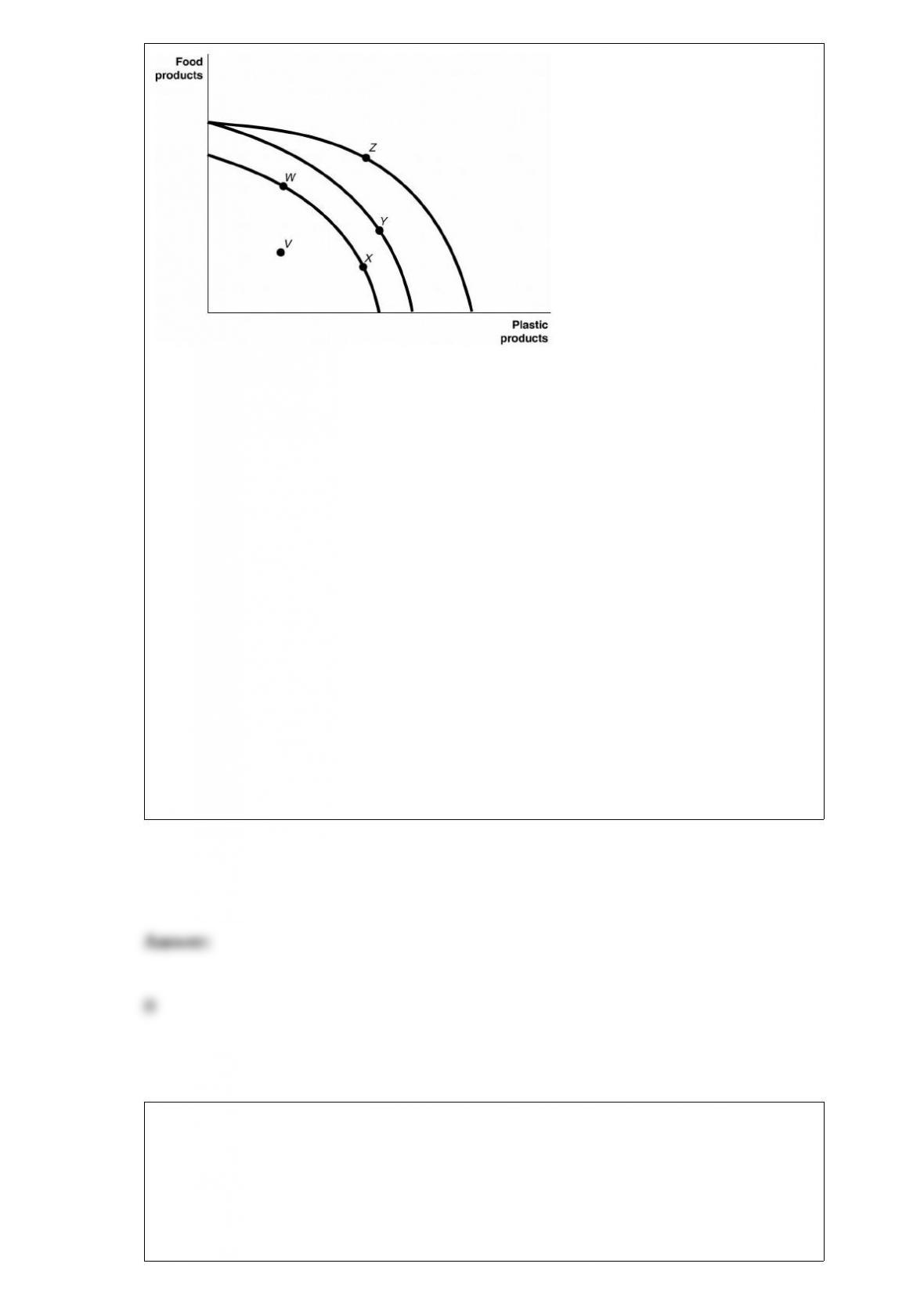
Figure 2-4 shows various points on three different production possibilities frontiers for
a nation.
Refer to Figure 2-4. Consider the following movements:
a. from point V to point W
b. from point W to point Y
c. from point Y to point Z
Which of the movements listed above represents economic growth?
A) a, b, and c
B) b and c only
C) a only
D) b only
Article Summary
The article describes three key ways startup companies can get the most benefit from
celebrity endorsements. One way is choosing a celebrity that can bring credibility to the
company and then incorporating the celebrity into the company’s marketing strategy.
Second, get public relations value from the celebrity by offering exclusive interviews,
contests, and photos and videos of the celebrity with the product. Finally, make sure to
choose a celebrity who will represent the product at all times, giving the product
maximum exposure.
Source: Kevin Tighe II, “3 Ways Startups Can Turn Celebrity Endorsements Into Big
Gains,” Forbes, March 8, 2013.
Refer to the Article Summary. One explanation for the increase in product sales
because of celebrity endorsements is that people seem to receive ________ from goods
they believe are popular.
A) more utility
B) diminishing utility
C) greater network externalities
D) increased path dependency
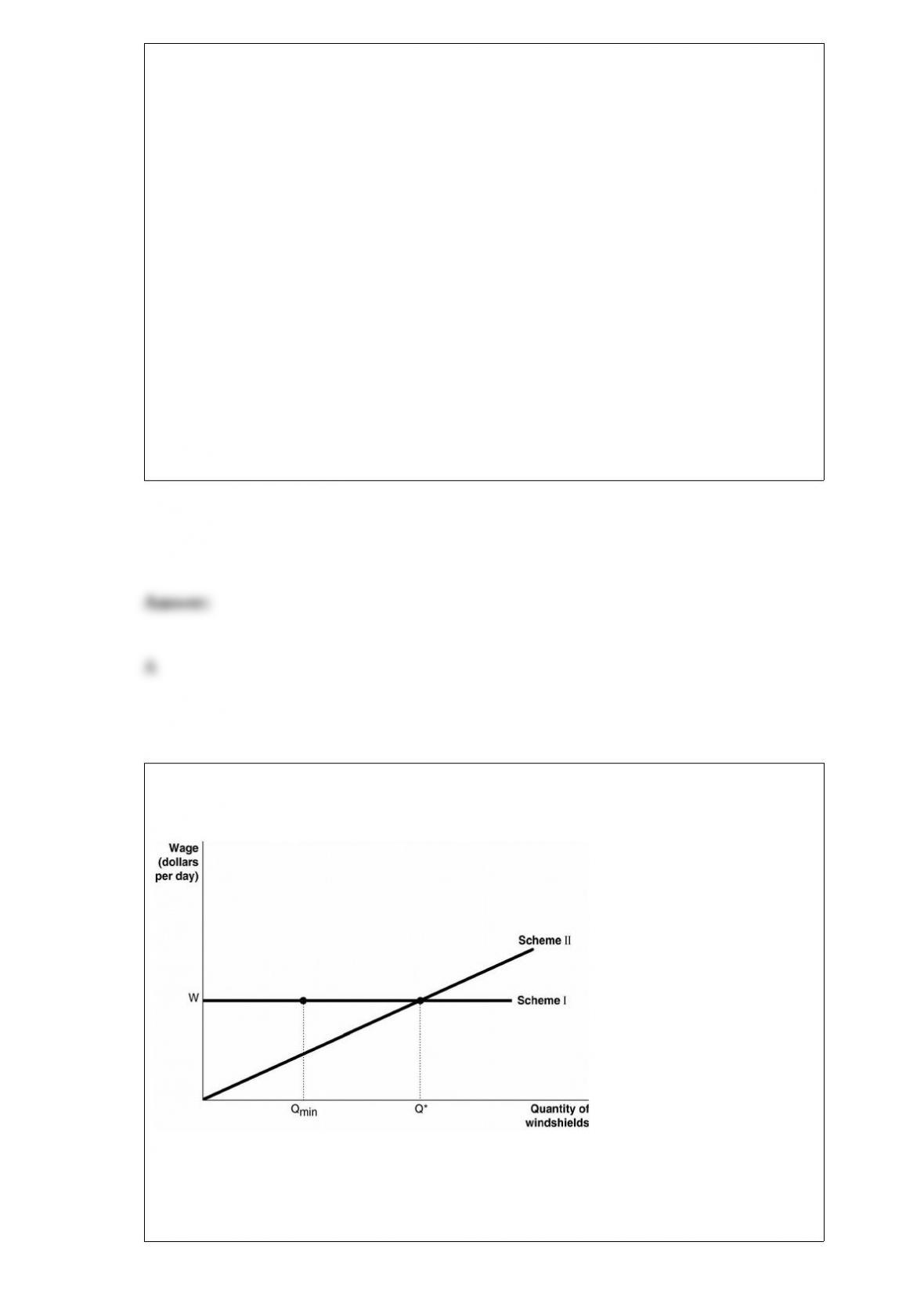
Figure 17-6
Figure 17-6 shows two different compensation schemes for the Safelite Glass
Corporation, an installer of auto glass windshields. Under Scheme I, the firm pays a
consistent wage of $80 per day based on an 8-hour workday. Qmin represents the cut-off
point under the hourly-wage system: if a worker installed fewer than Qmin windshields,
the worker got fired. Scheme II represents a piece-rate scheme with an earnings floor:
no worker would get less than $80 per day (for an 8-hour workday) and would have to
produce at least Qmin. For any output level beyond Q* the worker earned an additional
$20 for each unit produced.
Refer to Figure 17-6. Under Scheme I
A) workers compete with each other to see who can produce beyond Qmin in the
shortest possible time.
B) workers have no incentive to produce beyond Qmin.
C) workers signal their productivity to the firm by consistently producing above Qmin.
D) the incentive to increase productivity depends on where Qmin is set; if it is at a very
high level, then workers will rise to the challenge for fear of losing their jobs.
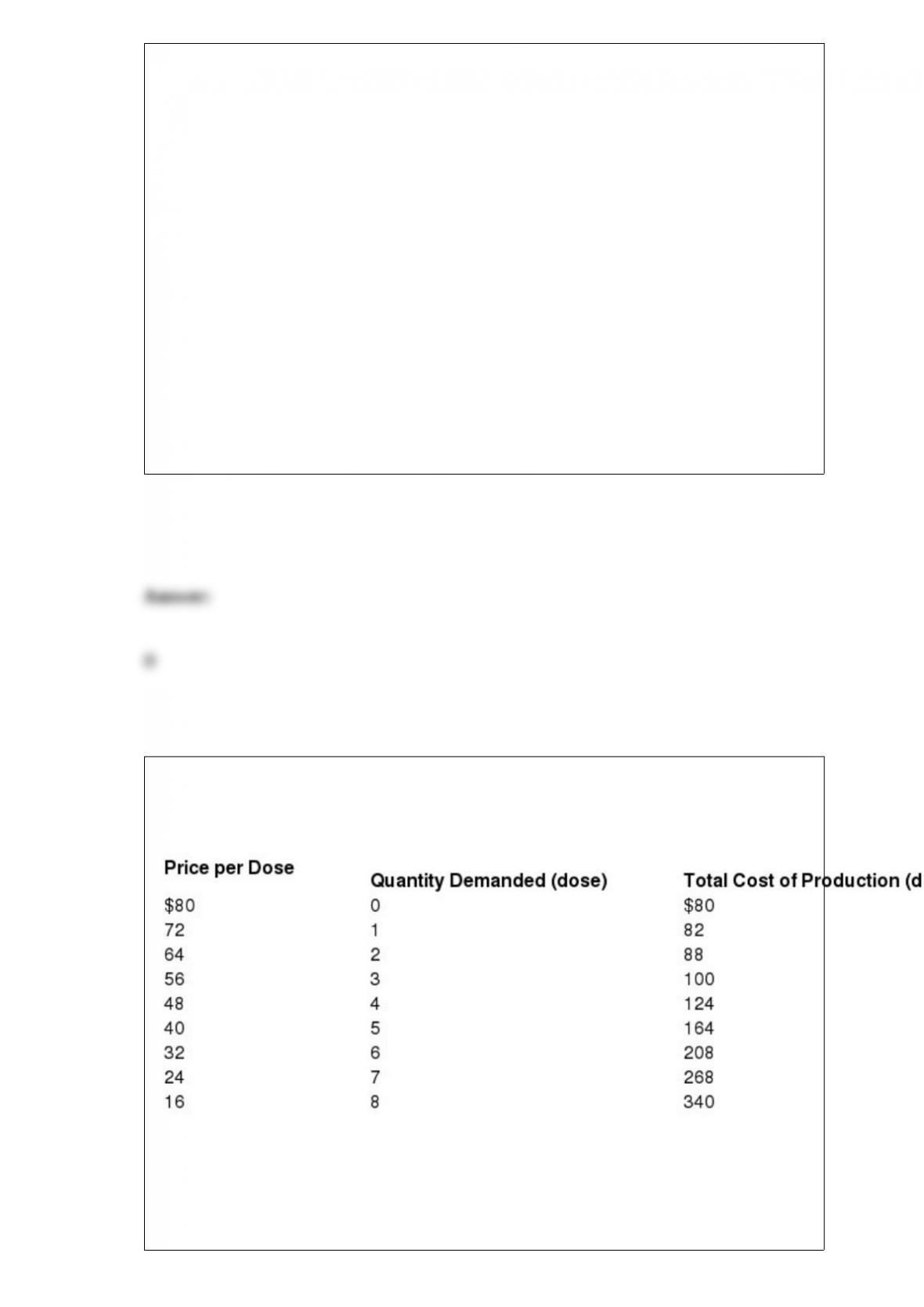
Table 15-4
Shakti Inc. has been granted a patent for its Arnica toothache balm. Table 15-4 shows
the demand and the total cost schedule for the firm.
Refer to Table 15-4. What is the amount of the deadweight loss generated by Shakti
when it produces the monopoly output?

A) $124
B) $42
C) $36
D) $12
Consider an industry that is made up of six firms with the following market shares:
Firm A – 50%, Firm B – 20%, Firms C and D – 10% each, and Firms E and F – 5% each.
What is the value of the Herfindahl-Hirschman Index and how will the industry be
categorized?
A) 2,500; mildly concentrated
B) 3,150; highly concentrated
C) 8,100; highly concentrated
D) 10,000; effectively competitive
Table 4-2
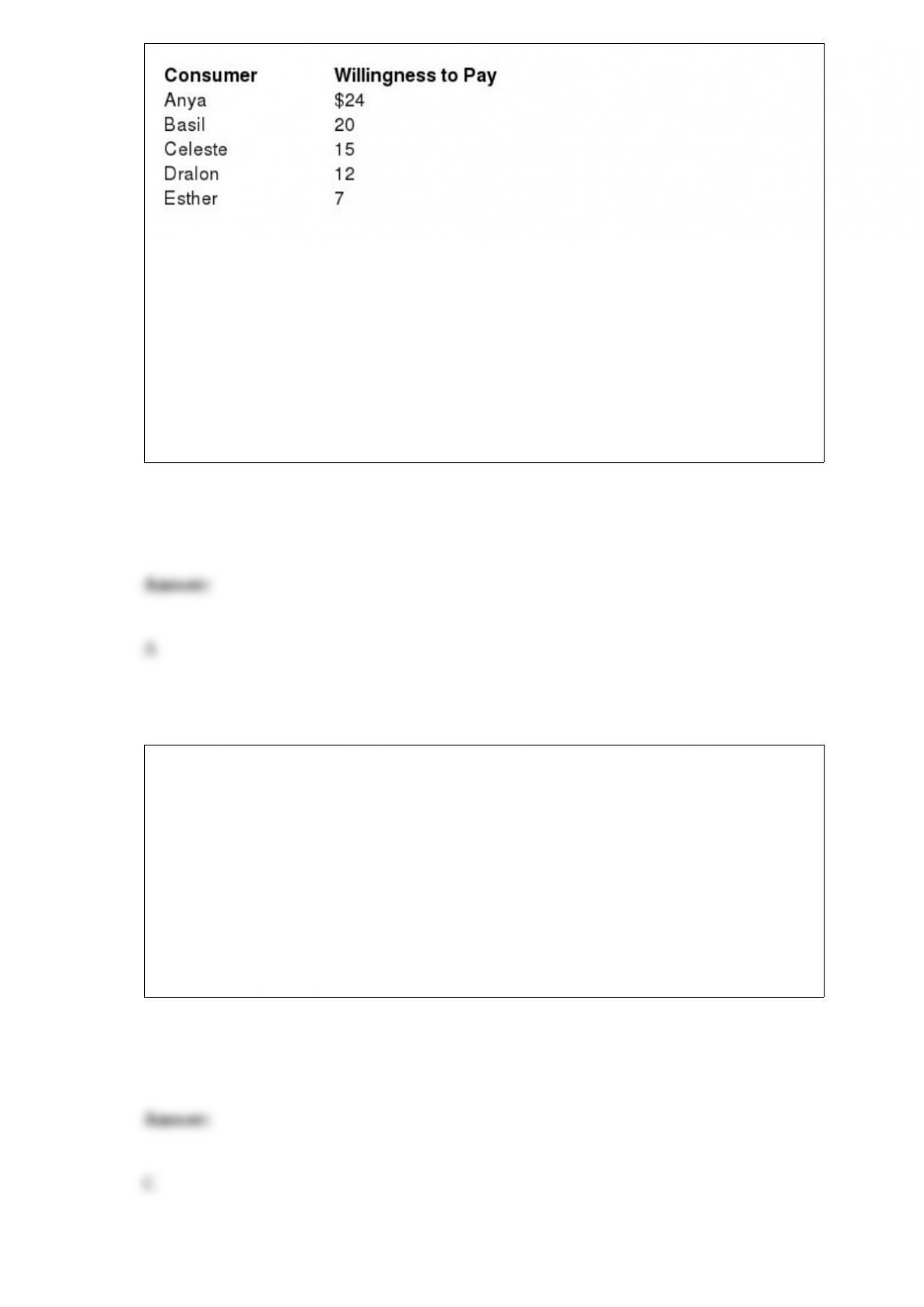
Refer to Table 4-2. The table above lists the highest prices five consumers are willing to
pay for a theater ticket. If the price of one of the tickets is $10
A) everyone will buy a ticket except for Esther.
B) only Anya and Basil will buy tickets.
C) Celeste’s consumer surplus is $25.
D) the total consumer surplus from the purchase of tickets will be $61.
The central role of ________ in a market economy is bringing together savers and
borrowers.
A) corporations
B) sole proprietors
C) financial intermediaries
D) stock exchanges

If a significant number of smokers switch from smoking tobacco cigarettes to
e-cigarettes, a company like NJOY will likely find its demand curve shifting to the
________ and its marginal revenue curve shifting to the ________ as more competitors
enter the market.
A) right; right
B) right; left
C) left; right
D) left; left
By definition, economics is the study of
A) how to make money in the stock market.
B) how to make money in a market economy.
C) the choices people make to attain their goals, given their scarce resources.
D) supply and demand.
The average tax rate is calculated as
A) total income divided by the total tax paid.
B) the change in total tax paid divided by the change in income.
C) total tax paid divided by total income.
D) the change in income divided by the change in total tax paid.
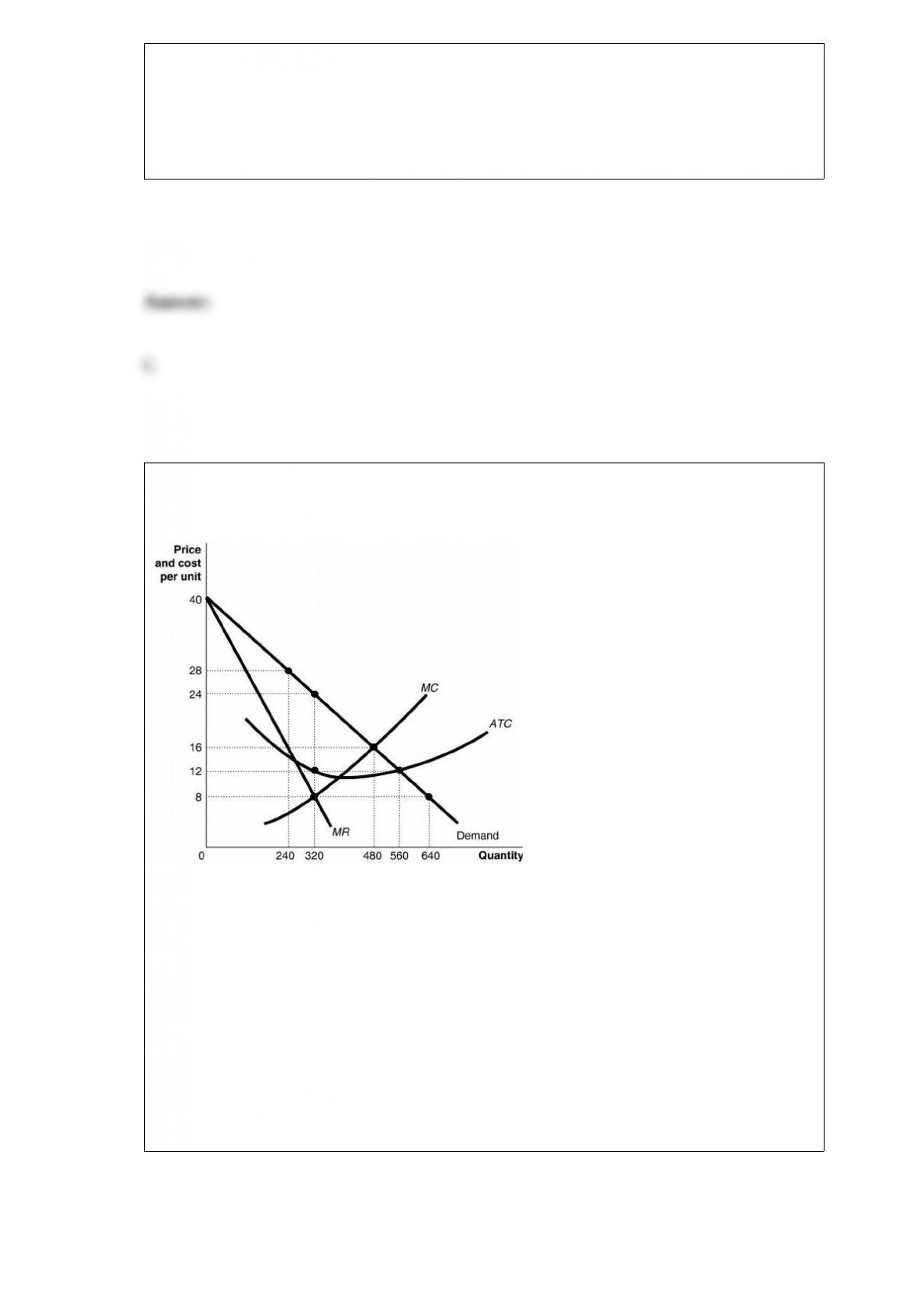
Figure 16-5
Refer to Figure 16-5. Suppose the firm represented in the diagram decides to use a
two-part pricing strategy such that it charges a fixed fee and a per-unit price equal to the
competitive price. (This is also called an optimal two-part tariff.) What is the value of
the consumer surplus from this pricing strategy?
A) $2,560
B) $5,760
C) $7,870
D) 0

Assume that a monopolist practices perfect price discrimination. The firm will produce
an output rate
A) that is less than the efficient level of output.
B) that is greater than the efficient level of output.
C) that is equal to the efficient level of output.
D) that converts consumers surplus into a deadweight loss.
Marginal revenue for an oligopolist is
A) identical to the demand for the firm’s product.
B) difficult to determine because the firm’s demand curve is typically unknown.
C) downward sloping beneath the firm’s demand curve.
D) horizontal on a price-quantity diagram.
Explain the endowment effect.
What is autarky?
What is a black market?
What is moral hazard?
Explain why economics is considered a social science.
What does it mean for a country to have an absolute advantage in producing a product?
How are market price, average revenue, and marginal revenue related for a perfectly
competitive firm and why?
How does Adam Smith’s idea of the “invisible hand” apply to the various parts, made
by many different manufacturers in many different countries, that are used by Apple to
produce an iPad?
Does the fact that monopolistically competitive firms do not achieve productive
efficiency or allocative efficiency mean that there is a significant loss in consumer
welfare?
In the long run, perfectly competitive firms earn zero economic profit. Why do firms
enter an industry when they know that in the long-run they will not earn any profit?
What was the source of the problems encountered by many financial firms during the
late 2000s?
Compare and contrast the purposes of the World Bank and the International Monetary
Fund.
Racial discrimination and other forms of discrimination based on irrelevant factors are
illegal. Can price discrimination be illegal as well?
What are the advantages of setting up a proprietorship or partnership as opposed to a
corporation?
If you pay $3,000 in taxes on an income of $28,000, and $4,450 in taxes on an income
of $38,000, what is your marginal tax rate? Show your work.
You participate in a taste test for a new protein supplement called “Boost.” You are
given five consecutive one ounce vials of the supplement and after consuming each vial
you are asked to note your reaction. You consume the first vial and your response is:
“Hmmm, quite good!” After the second, you say, “Not bad at all.” After the third, you
note, “It’s alright.” and after the fourth you wince, “No more, the after-taste is getting to
me. I need water.” What economic principle does this scenario illustrate? Define the
principle.
Suppose you see a 2006 Scion xB Sport Wagon advertised in the local newspaper for
$8,500. If you knew the car was reliable, you would be willing to pay $10,000 for it. If
you knew the car was unreliable, you would only be willing to pay $5,500 for it. Under
what circumstances should you buy the car?
Why might an amusement park switch from charging admission to the park and
charging for the rides to charging for admission but not charging for the rides?
What are the two effects that explain the Law of Demand? Briefly explain each effect.
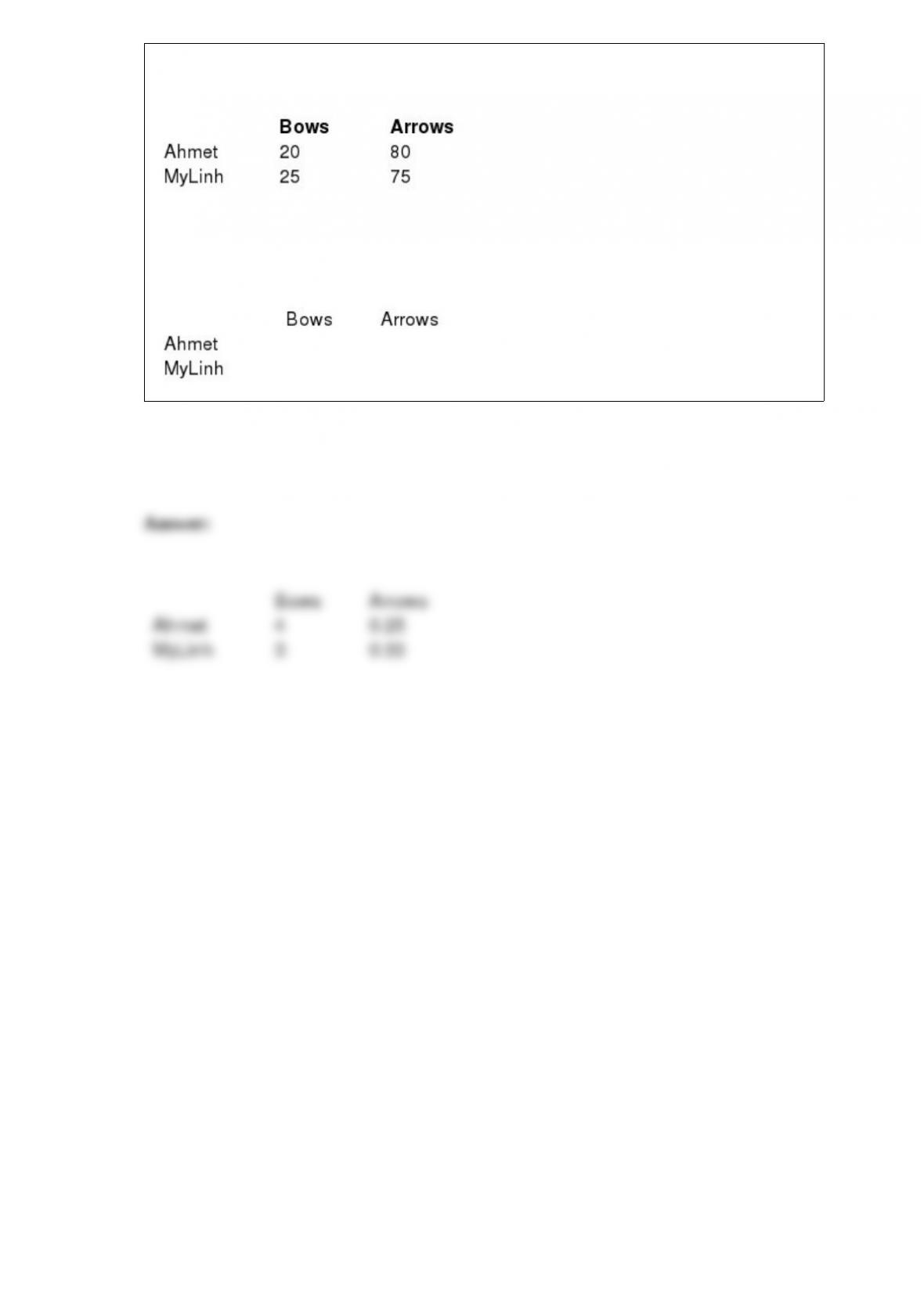
Table 9-5
Table 9-5 shows the output per week for bows and arrows by Ahmet and MyLinh.
Refer to Table 9-5. Fill in the following table with the opportunity costs of producing
bows and arrows for Ahmet and MyLinh.