Neuron activity in the insula represents the benefit of buying a product.
Utility is not easy to measure and quantify.
Oligopoly arises with scale economies that are not large enough to cause a natural
monopoly.
In most cases, taxation is more likely to be inefficient than regulation because taxation
corrects for only external costs at a higher overall cost to society.

A mixed market exists when goods of different qualities are sold for the same price.
If Tom can produce 20 multiple choice questions or 30 true/false questions in an hour,
and Mary can produce 15 multiple choice questions or 15 true/false questions in an
hour, then Tom has a comparative advantage in writing true/false questions.
One example of a microeconomic question is, “How will prices in the satellite TV
industry change if a new firm enters the market?”

When the long-run cost curve is negatively sloped the firm is experiencing
diseconomies of scale.
If the market for a good consists of a downward sloping demand curve and a vertical
supply curve, sellers will have to pay the whole amount of a newly imposed tax.
Most firms seem to exhibit constant returns to scale after some level of output.
The marginal output of labor is the amount of output that can be produced if one more
unit of labor is added.

The deadweight loss from monopoly is a measure of efficiency from monopoly.
The brain gets most of its energy from dopamine.
Government policies concerning the money supply and the control of inflation are topic
of concern in microeconomics.

For a monopolist, price is equal to marginal revenue.
If supply of a product increases and demand for the product decreases, equilibrium
price will definitely change.
If the marginal benefit per dollar spent on good X is greater than the marginal benefit
per dollar spent on good Y, the consumer should consume more X and less Y.
One advantage of command-and-control policy is its power to reduce the prices of the
goods produced by polluting firms.

Education produces only public benefits while costing society billions of dollars.
Since the ice production is constant, the supply curve is vertical.
A nationwide system of marketable pollution permits will reduce pollution overall, but
might increase pollution in some high abatement cost areas.

Recent innovations in photovoltaic technology have reduced the unit cost of solar
power.
The limit price is just low enough to deter entry.
Because the brain rewards near misses with pleasure-generating dopamine, gambling
can be considered a consumer good.
Total utility is the additional satisfaction received from consuming an additional unit of
a product.

Empirical studies have shown that entry leads to lower prices and profit.
If a firm wants to engage in price discrimination it must have some market power.
The excess burden of a tax is the amount paid by consumers.
Microeconomics is the study of aggregate behavior in the economy.

The poverty rate in the United States has been growing for people over age 65.
The government can break up monopolies under federal antitrust legislation.
A decrease in supply will cause the equilibrium price and quantity of a good to fall.
In markets where external costs exist, efficiency cannot be enhanced by the creation of
marketable pollution permits.
People tend to track consumption by the bundles in which a product is delivered rather
than the actual consumption of the product.
A good is nonexcludable in consumption if it is not practical to exclude people who
don’t pay for it from enjoying its benefits.
If the tradeoff between the two goods is constant, the production possibilities curve is:
A) a negatively-sloped straight line.
B) a positively-sloped straight line.

C) a negatively-sloped curve which is bowed outward.
D) a negatively-sloped curve which is bowed inward.
A perfectly competitive firm can:
A) affect the market price for its good.
B) sell as much as it can produce at the market price.
C) prevent entry of other firms into their market.
D) collude with its competitors to set prices.
Recall the Application about the cost of using import restrictions to protect jobs in
the luggage industry to answer the following question(s). According to a report
from the Federal Reserve Bank of Dallas, import restrictions in the luggage
industry protect about 226 jobs and reduce consumer surplus by $290 million.
Recall the Application. Import restrictions in the luggage industry in the United States
have ________ the supply of luggage and ________ the price of luggage in the United
States.
A) increased; increased
B) increased; decreased

C) decreased; increased
D) decreased; decreased
Suppose that in October the price of a cup of cafe latte was $2.50 and 400 lattes were
consumed. In November the price of a latte was $2.00 and 300 lattes were consumed.
What might have caused this change?
A) The price of tea (a substitute for cafe lattes) fell.
B) The price of tea (a substitute for cafe lattes) rose.
C) The price of coffee beans (an input of production of cafe lattes) rose.
D) The price of coffee beans (an input of production of cafe lattes) fell.
Recall the Application about the increase in Chinese demand for pecans to answer
the following question(s). Between 2006 and 2009, Chinese imports of U.S. pecans
increased from 9 million pounds per year to 88 million pounds per year, and as a
result of the increase in demand, the equilibrium price increased by about 50
percent. The increase in demand was caused in part by widespread reports in the
Chinese media extolling the health benefits of pecans.
According to the Application, one reason for the increase in Chinese demand for pecans
was:

A) a decrease in income.
B) the expectation of higher future prices.
C) an increase in consumer preferences.
D) an increase in the price of walnuts, a substitute good.
With respect to the equimarginal rule, a person will maximize utility when the:
A) total utility per dollar spent is equalized across products.
B) marginal utility is equalized across products.
C) total utility is equalized across products.
D) marginal utility per dollar spent is equalized across products.
Recall the application about taxing cigarettes to offset present bias. Accordingly to the
study, how would the cigarette tax effect low-income households?
A) It will be beneficial as low-income households will respond to changes in the higher
price of cigarettes.
B) Low-income households would experience a relatively large increase in lifespan.

C) Low-income households will not benefit from the cigarette tax.
D) A and B are correct.
A monopolist can:
A) sell as much as he wants at the chosen price since he is the only seller.
B) increase price only if he is willing to reduce output sold.
C) increase the price of his output and still sell the same quantity.
D) increase the price of his output and the quantity sold at the same time.
According to the principle of diminishing returns, if the number of workers is increased
beyond the point of diminishing returns, then the additional worker:
A) increases total output by the same amount as previous workers.
B) increases total output by more than the amount of previous workers.
C) increases total output by less than the amount of previous workers.
D) decreases total output.

An informational good, such as a music video, has a ________ first-copy cost and
a_______ marginal cost.
A) large; large
B) large; small
C) small; large
D) small; small
One key difference between profit maximizing firms in monopolistic competition
versus perfect competition is that:
A) monopolistically competitive firms will earn a positive profit in the long run.
B) perfectly competitive firms break even in the long run, but monopolistically
competitive firms do not.
C) monopolistically competitive firms charge a price greater than marginal revenue.
D) none of the above

An individual or country that has a comparative advantage in the production of one
good:
A) must have an absolute advantage in the good’s production.
B) must not have an absolute advantage in the good’s production.
C) may or may not have an absolute advantage in the good’s production.
D) must not have an absolute advantage in the production of the other good.
According to the application regarding options for reducing CO2 emissions from
international shipping, 3% of global CO2 emissions come from international shipping.
What tool did the policy analysts use for comparing the cost of alternative reduction
methods?
A) compute the average marginal cost of each method
B) compute the marginal abatement cost of each method
C) compute the total marginal cost of each method
D) The analysts were unable to compare the cost of alternative reduction methods.
A medicine such as insulin would most likely have a price elasticity of demand:
A) equal to one.
B) close to zero.
C) greater than one in absolute value.
D) close to infinity.
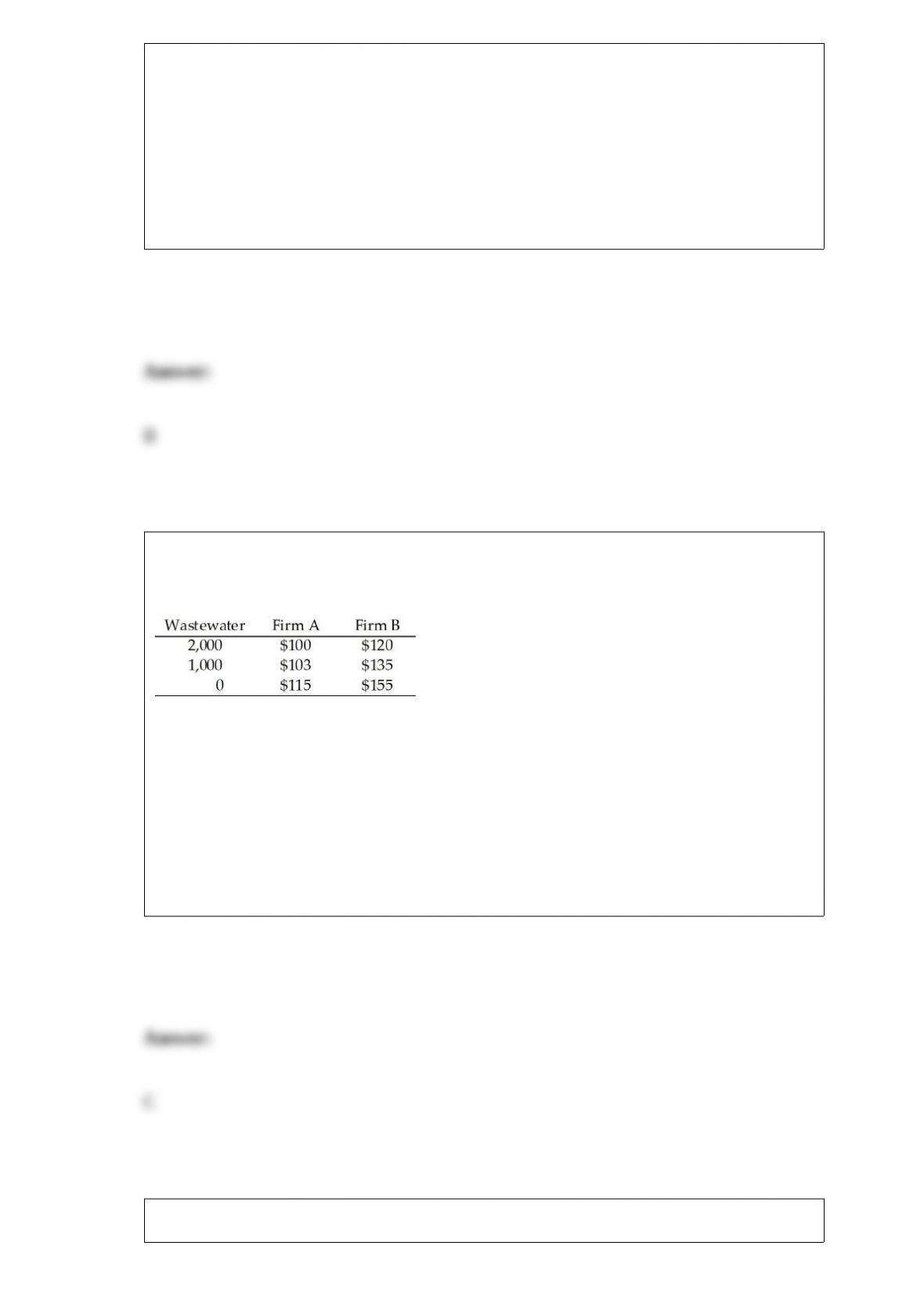
If each firm depicted in Table 16.1 is currently generating 1,000 gallons of wastewater
per day, Firm A would need to be paid at least ________ from Firm B to reduce
wastewater production to 0 gallons per day.
Table 16.1
A) $20
B) $15
C) $12
D) $3
A major league baseball player signs a contract that pays $50 million over five years.

The $50 million is its ________ value.
A) real
B) implicit
C) external
D) nominal
The free-rider problem arises because:
A) once provided, a public good is available to all regardless of whether they paid for it.
B) poor people cannot afford to contribute to public goods.
C) enforcement of tax laws is inadequate.
D) people disagree with how the government spends it s money.
The saying that “There is no such thing as a free lunch” refers to:
A) the principle of reality in a modern world.
B) the price of fast food in today’s economy.
C) the principle of diminishing returns.
D) the principle of opportunity cost.
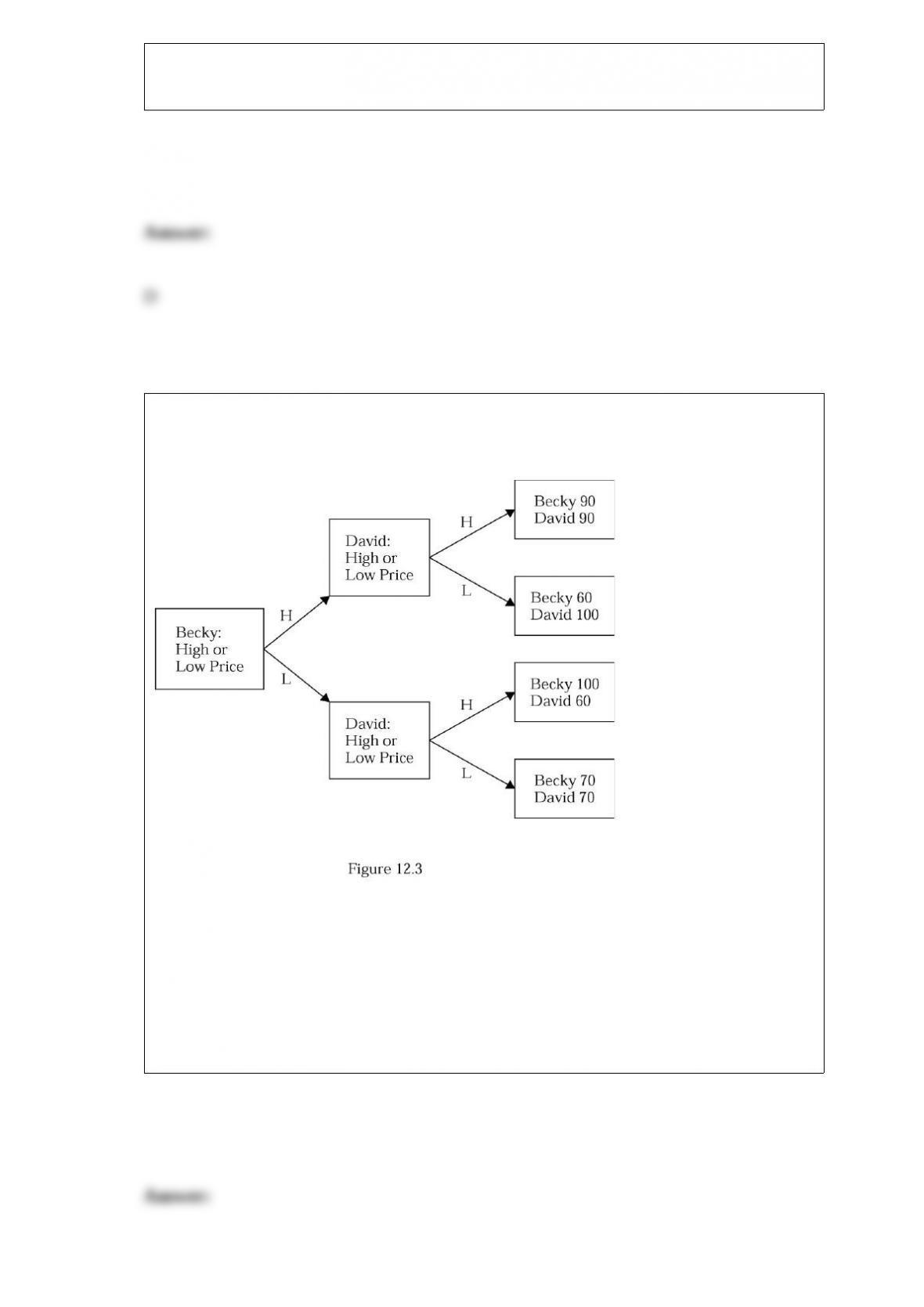
Consider Figure 12.3. Relative to the dominant strategy outcome, guaranteed price
fixing would lead to:
A) lower prices but higher profits.
B) lower prices and lower profits.
C) higher prices and higher profits.
D) higher prices and lower profits.
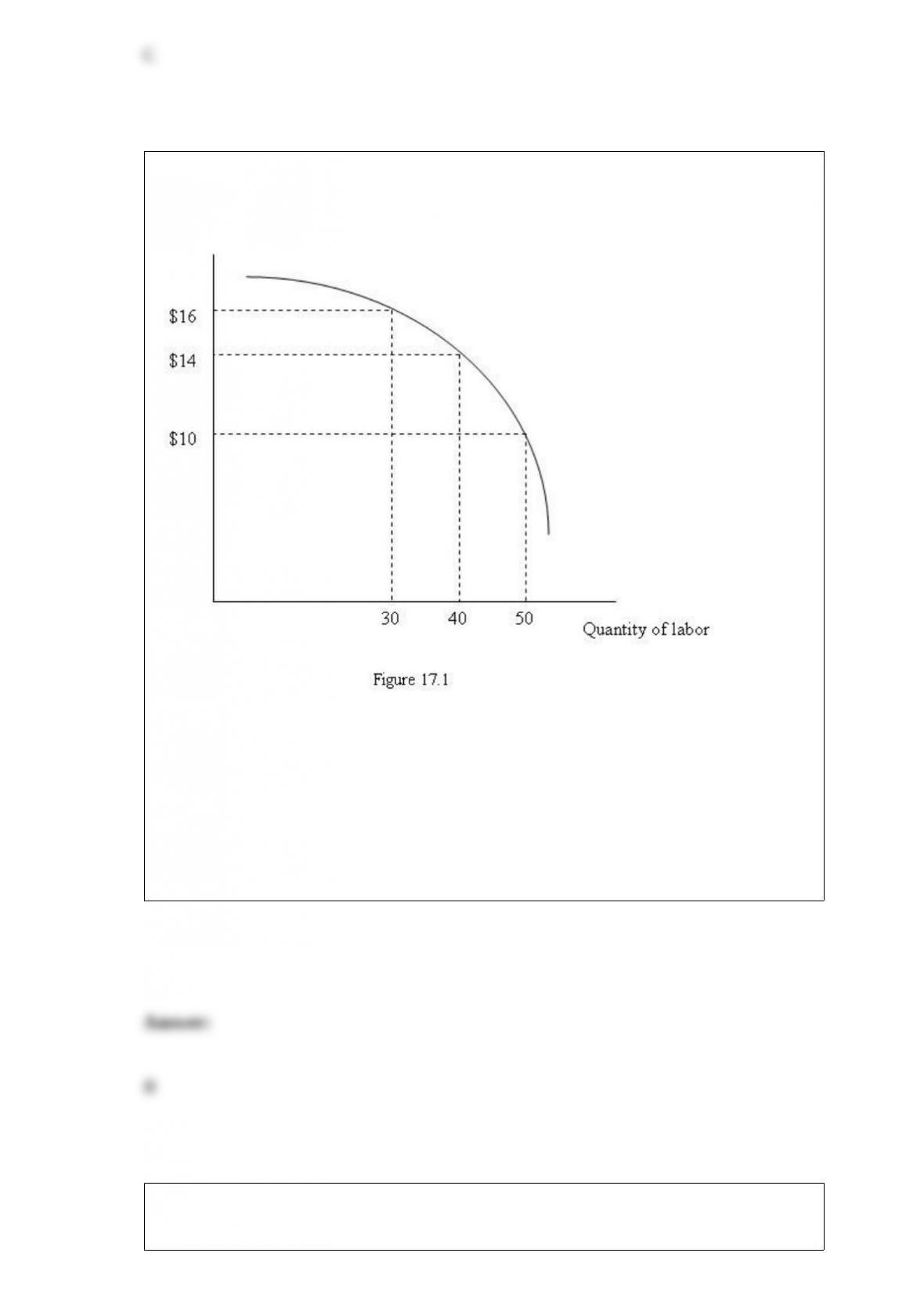
Figure 17.1 depicts a firm’s marginal revenue product curve. If the firm maximizes its
profit and the hourly wage is $15, how many hours of labor will the firm demand?
A) smaller than 30 hours
B) between 30 hours and 40 hours
C) between 40 hours and 50 hours
D) greater than 50 hours
What are the two largest categories in state government spending?
A) public welfare and highways
B) education and highways
C) education and public welfare
D) public welfare and health & hospitals
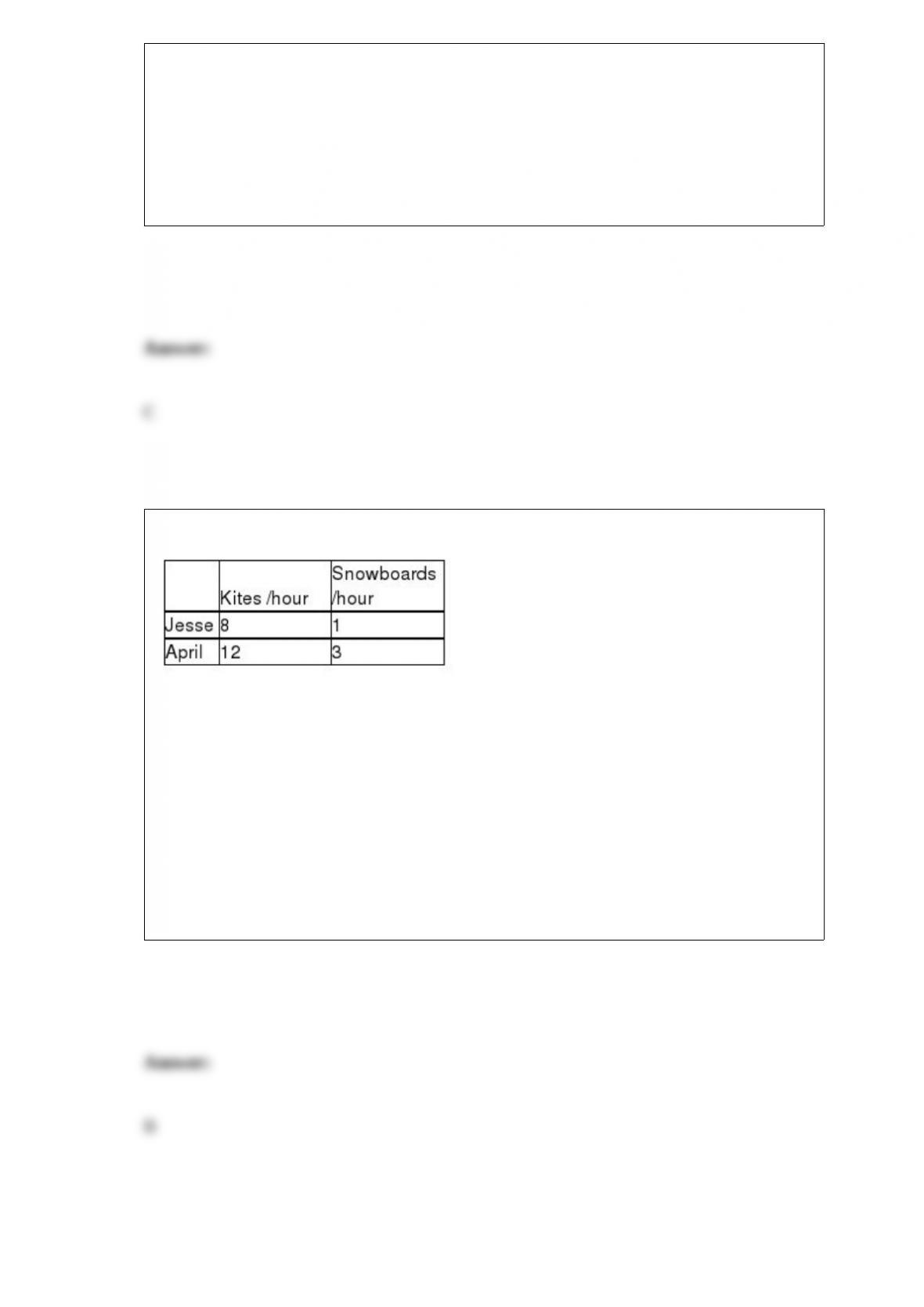
Based on the data in Table 3.1:
Table 3.1
If Jesse and April choose to specialize and trade, then:
A) April will specialize in painting kites and trade kites for snowboards.
B) April will specialize in painting snowboards and trade snowboards for kites.
C) Jesse will specialize in painting snowboards and trade snowboards for kites.
D) None of the above; specialization and trade are not beneficial for Jesse and April.
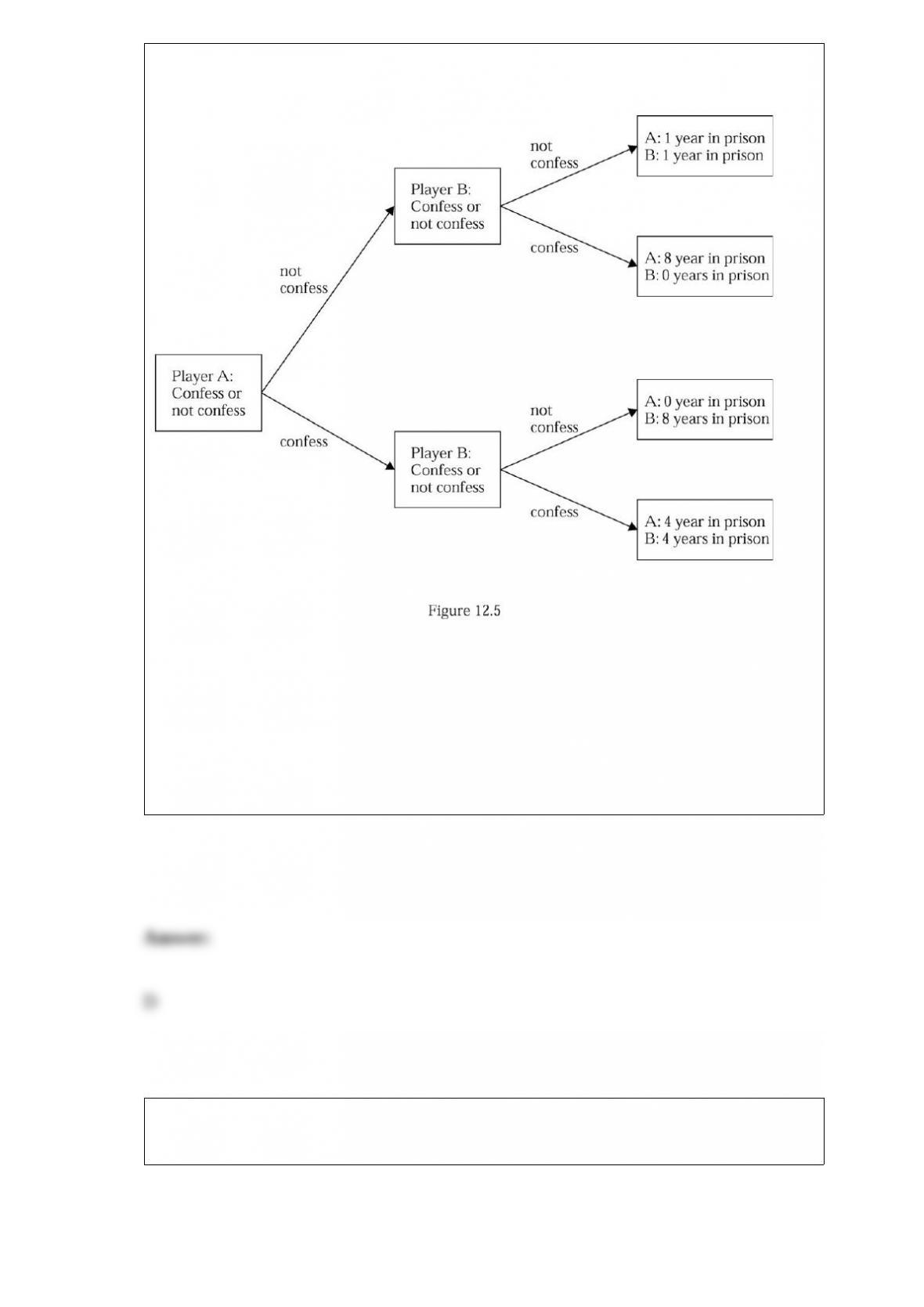
Consider Figure 12.5. If player A and Player B could cooperate then:
A) A would spend 8 years in jail and B would spend 0 years in jail.
B) A would spend 0 years in jail and B would spend 8 years in jail.
C) A would spend 4 years in jail and B would spend 4 years in jail.
D) A would spend 1 year in jail and B would spend 1 year in jail.
Refer to Table 7.3. For the consumer whose preferences are depicted, the marginal
utility of the fifth movie is:
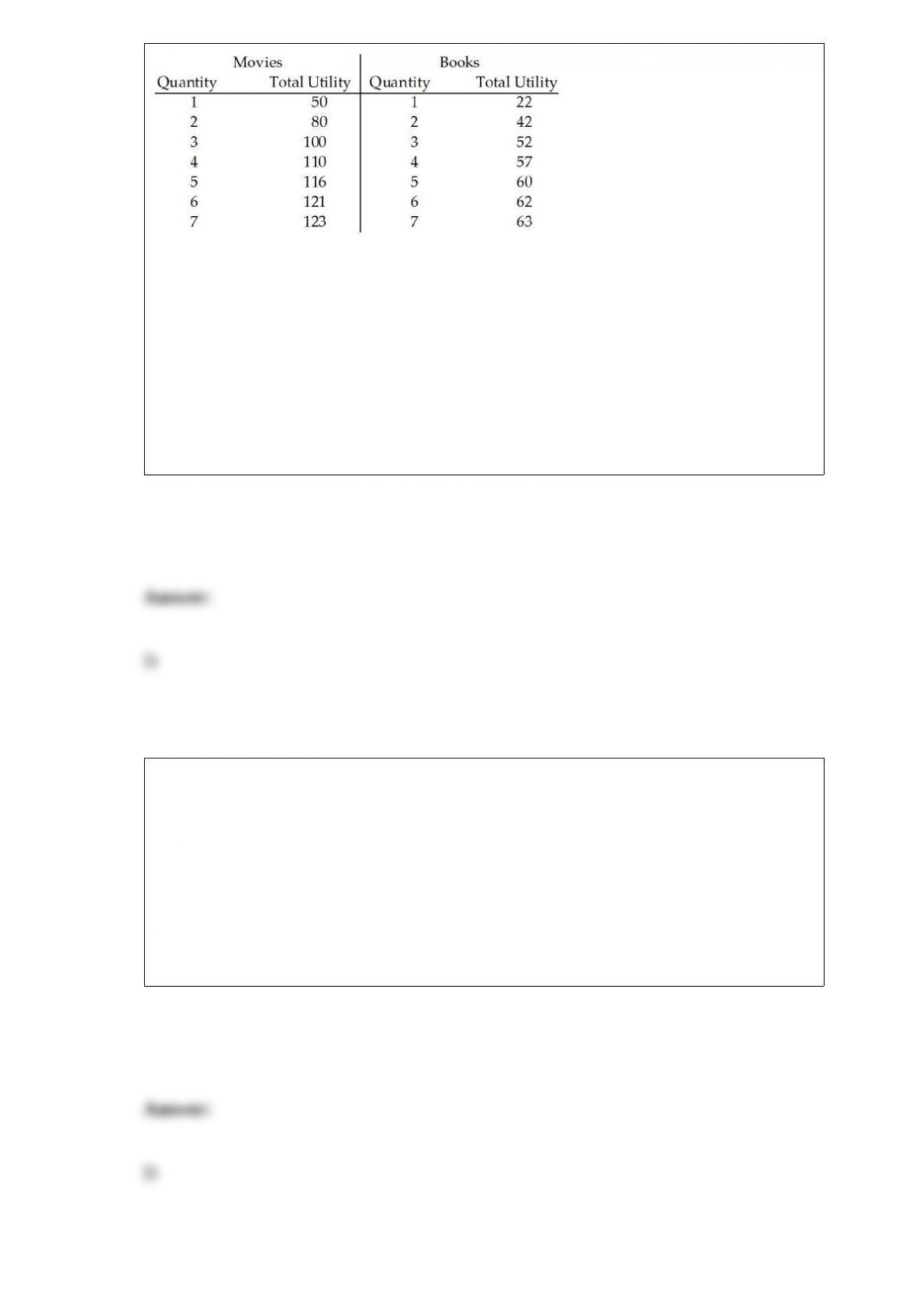
Table 7.3
A) zero.
B) 12.
C) 3.
D) 6.
In which of the following market structures do you no barriers to entry?
A) monopoly
B) perfect competition
C) monopolistic competition
D) monopolistic competition and perfect competition

If a competitive market operates perfectly, it relies on:
A) the number of people buying goods.
B) the laws of supply and demand.
C) how many products can be produced for sale.
D) how much people are willing to pay for the products.
Suppose McDonald’s puts up five new stores in San Francisco using exactly the same
floor plan, capital equipment and number of workers, then the long run average cost
curve of McDonald’s would be ________ and the company experiences ________.
A) horizontal; constant returns to scale
B) horizontal; economies of scale
C) upward sloping; economies of scale
D) horizontal; diseconomies of scale
If Figure 11.1 depicts the current situation for a monopolistically competitive firm, then
in the long run we expect:
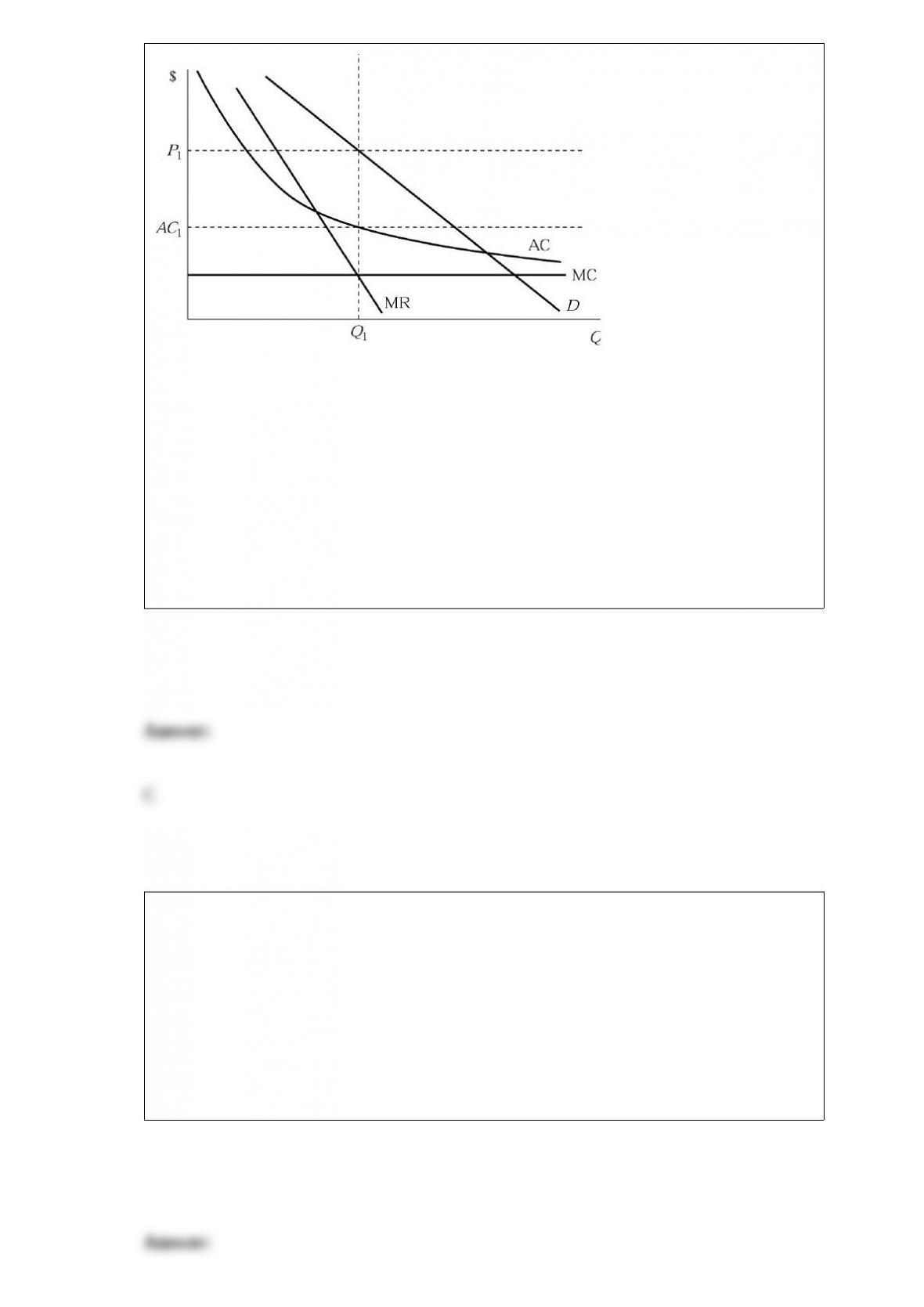
Figure 11.1
A) the firm to charge a price higher than P1.
B) the firm to produce and sell more than Q1.
C) the firm’s average cost of production to rise above AC1.
D) the firm to earn higher economic profits.
One of the most obvious clues to the relative scarcity of a product is:
A) the variations in available sizes.
B) its current market price.
C) the limited selection of colors.
D) the quality of the product.
When the buyer is more knowledgeable than the seller, there is a(n):
A) moral hazard problem.
B) asymmetric information problem.
C) perfect information problem.
D) the lemon problem.
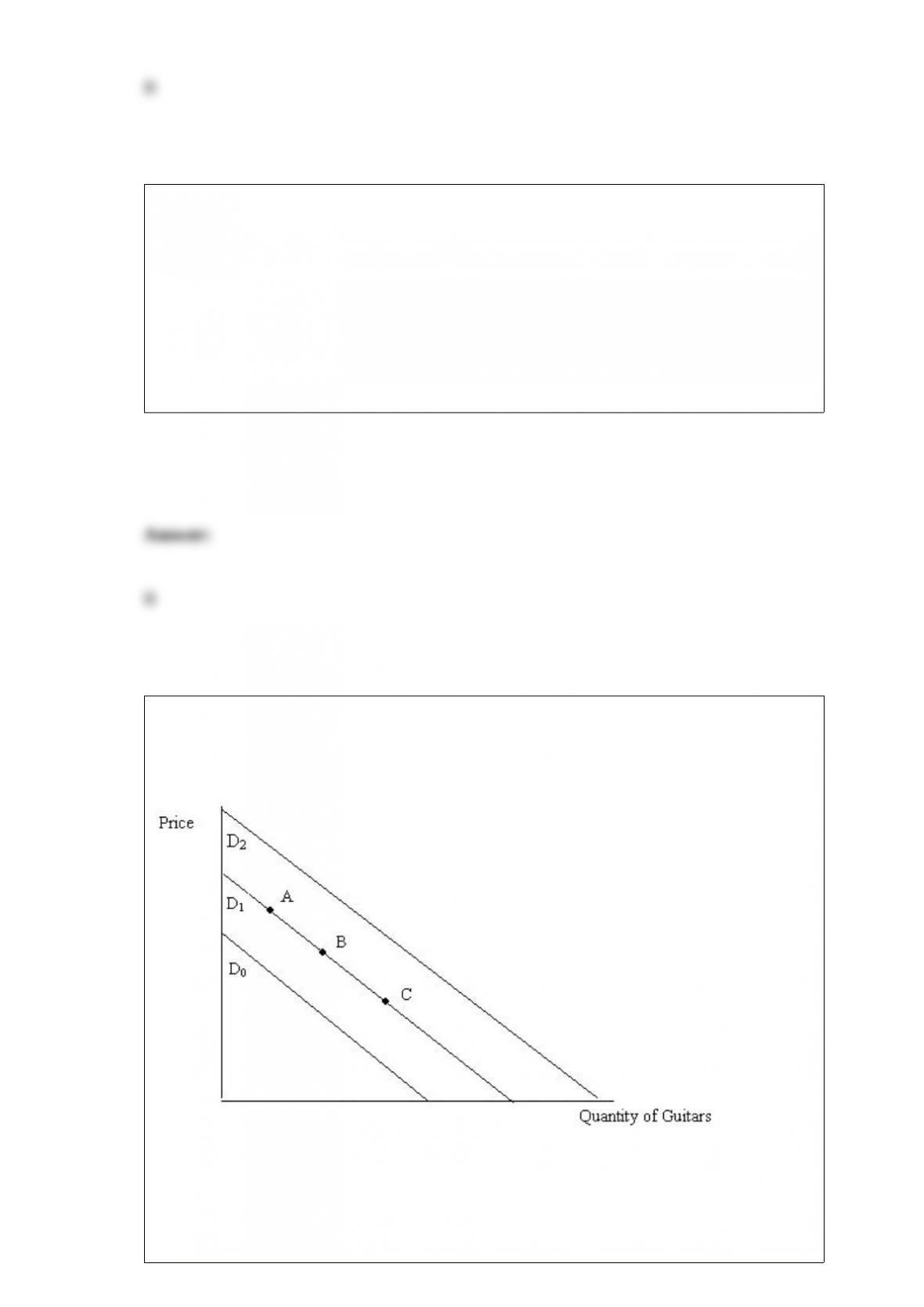
Figure 4.4 illustrates the demand for guitars. Assume that guitars and guitar strings are
complements. A decrease in the price of guitar strings would bring about a movement
from:
Figure 4.4
A) point B to point C.

B) point B to point A.
C) D1 to D0.
D) D1 to D2.
Which of the following is a characteristic of a monopolistically competitive market?
I. Firms sell differentiated products.
II. Each firm earns a positive economic profit in the long run.
III. Firms freely enter and exit the market.
A) II only
B) I and II only
C) I and III only
D) I, II, and III
The best example of a monopolistic industry is:
A) grocery stores.

B) toothbrushes.
C) patented drugs.
D) automobiles.
What are the characteristics of perfect competition?
What is a “change in quantity demanded”? How is a “change in quantity demanded”
illustrated in a demand diagram?
Is it possible for nominal wages to decrease while real wages increase?
Suppose that everybody pays the same price for auto insurance. What should happen to
the price of insurance if the law changes from a system where there is mandatory auto
insurance to one where there is voluntary auto insurance?
What is “monopolistic” about monopolistic competition?
Why does the government grant patents to companies that research new drugs?
What would happen if the government chooses to increase the number of years that a
firm can enjoy patent protection from 20 years to 25 years?
What is a price floor and why must it be above the equilibrium price to be effective?
Give an example where individuals “vote with their feet” in choosing among bundles of
public goods and tax rates.
Does the threat of entry reduce the monopoly problem?
What are the characteristics of oligopoly?

What is dopamine? With respect to consumer choice, when does dopamine flow
increase and when does it decrease?
List four protectionist policies.
When was the Clayton Act passed, and what were the main practices that it outlawed?
The price elasticity of demand for gasoline is 0.5 and the price elasticity of supply of
gasoline is 1.5. If the demand for gasoline falls by 10%, what will happen to the price
of gasoline?