
Table 9-11 Production and
Consumption Production
Without Trade With Trade
Denmark and Belize can produce both clocks and hats. Table 9-11 shows the production
and consumption quantities without trade, and the production numbers with trade.
Prior to trade, what was the opportunity cost to produce 1 hat in Denmark?
A) 1/6 of a clock
B) 2/3 of a clock
C) 1.5 clocks
D) 6 clocks
Among potential stores of value, money
A) offers the highest rate of return.
B) increases in value during periods of inflation.
C) has the advantage of being the most liquid asset.
D) provides more services than the other assets.
How does the decreasing use of traditional cameras affect the market for traditional
camera film?
A) The demand curve for traditional camera film shifts to the right.
B) The quantity of traditional camera film demanded decreases.
C) The quantity of traditional camera film demanded increases.
D) The demand curve for traditional camera film shifts to the left.
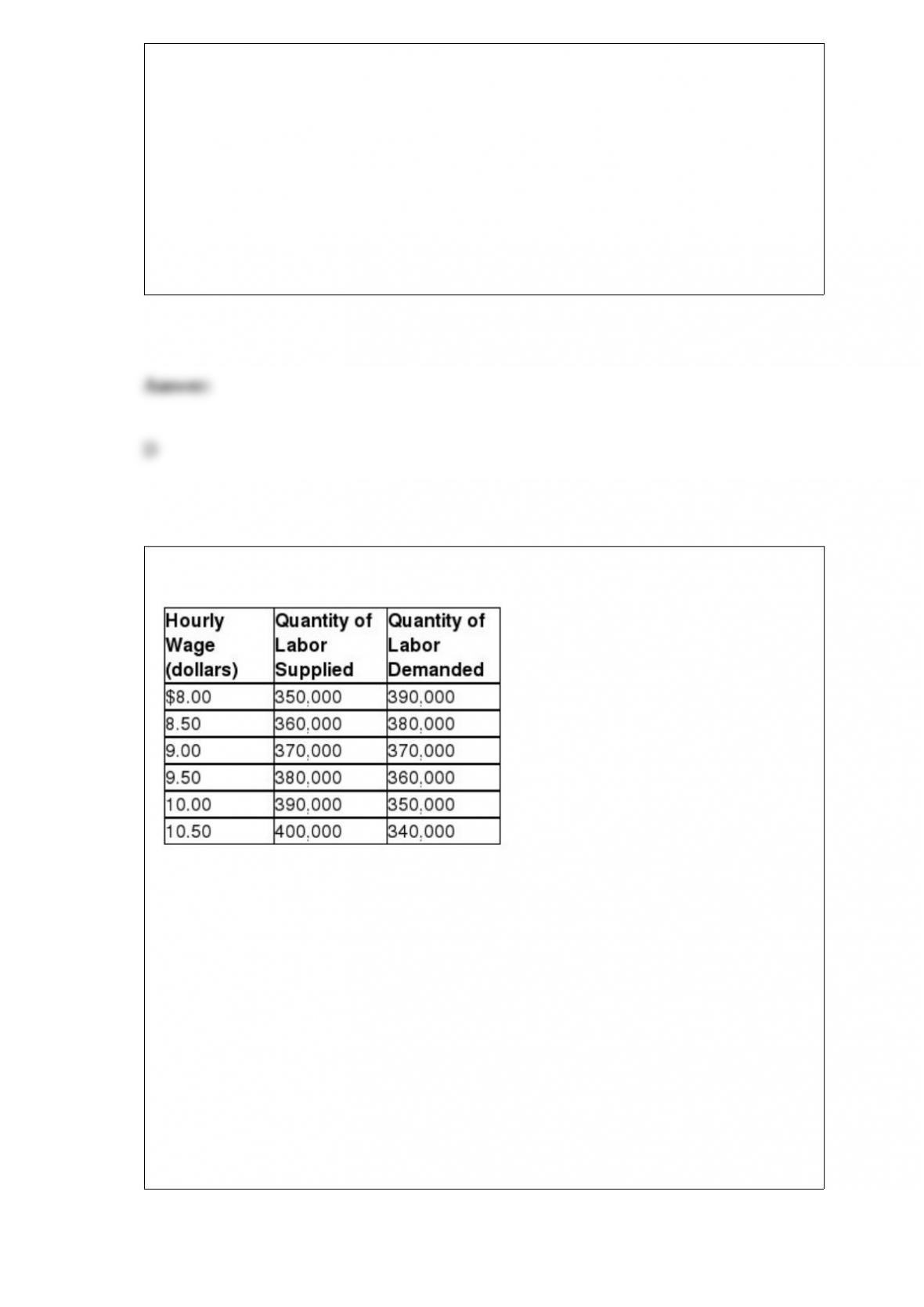
Table 4-4
Table 4-4 shows the demand and supply schedules for the low-skilled labor market in
the city of Westover.
Suppose that the quantity of labor supplied increases by 40,000 at each wage level.
What are the new free market equilibrium hourly wage and the new equilibrium
quantity of labor?
A) W = $9.00; Q = 410,000
B) W = $9.50; Q = 420,000
C) W = $8.50; Q = 400,000
D) W = $8.00; Q = 390,000

Suppose Dublin Electronics charges regular customers $90 for a Blu-ray player but
allows senior citizens to purchase the same item for $75. Is this likely to be a successful
price discriminating strategy?
A) Yes, firms price discriminate to maximize profits.
B) No, price discrimination will not be effective because the store cannot prevent senior
citizens from buying large quantities of Blu-ray players and reselling them for a profit.
C) Yes, because senior citizens are likely to have a more elastic demand and therefore
will be willing to pay a lower price compared to regular customers.
D) No, because there are many different brands of Blu-ray players and consumers will
shop around.
Suppose there is some unemployment in the economy and society decides that it wants
more of one good. Which of the following statements is true?
A) It is not possible to achieve this unless technology advances.
B) It can increase output without giving up another good by employing more resources.
C) It will have to increase resource supplies.
D) It will have to give up production and consumption of some other good.
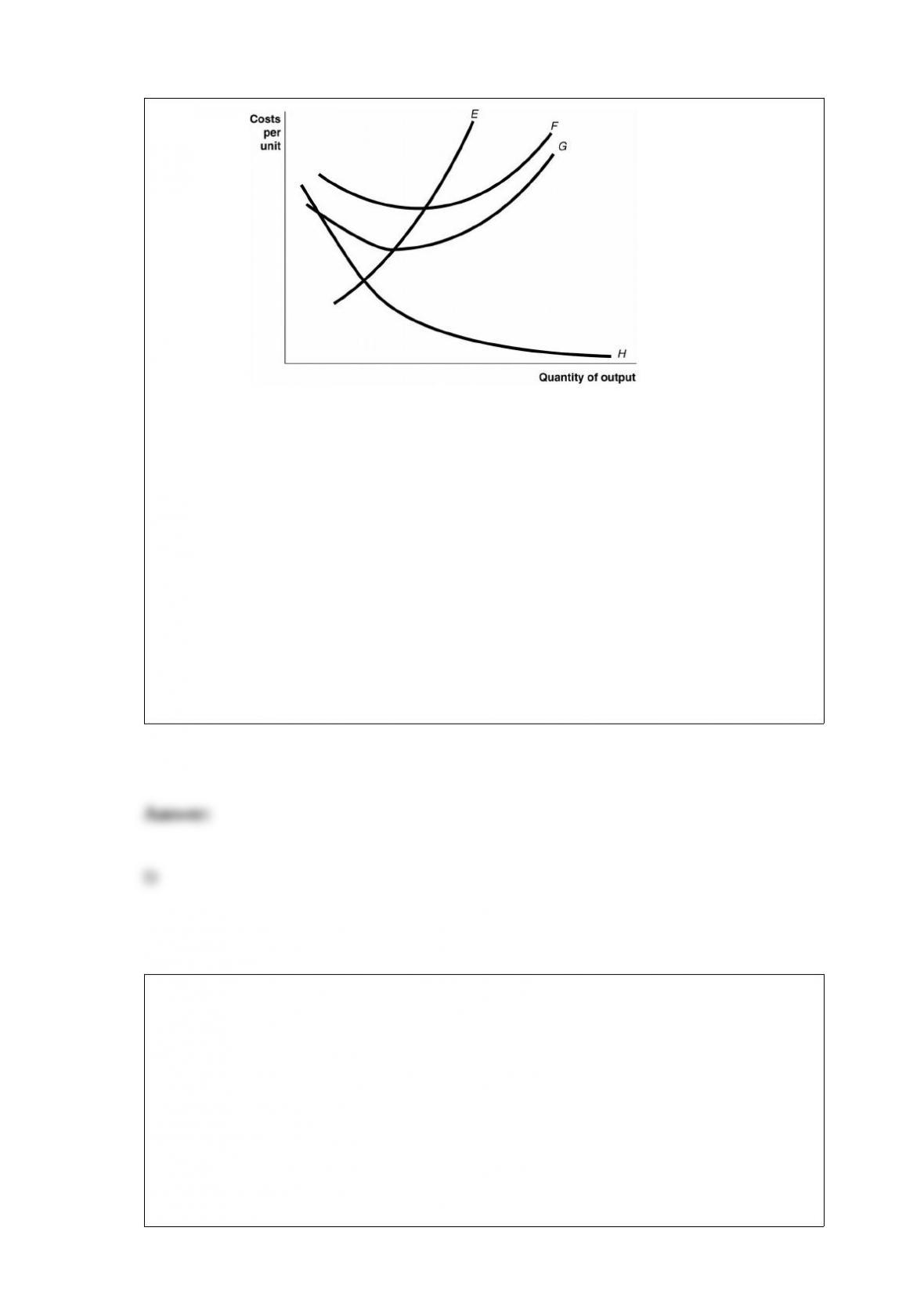
Figure 11-5
Identify the curves in the diagram.
A) E = average fixed cost curve; F = variable cost curve; G = total cost curve; H =
marginal cost curve
B) E = marginal cost curve; F = total cost curve; G = variable cost curve; H = average
fixed cost curve
C) E = average fixed cost curve; F = average total cost curve; G = average variable cost
curve; H = marginal cost curve
D) E = marginal cost curve; F = average total cost curve; G = average variable cost
curve; H = average fixed cost curve
Trinh quits his $80,000-a-year job to become a full-time volunteer at a museum. What
is the opportunity cost of his decision?
A) 0 since he will no longer be earning a salary
B) depends on the “going rate” of museum employees
C) at least $80,000
D) the value he attributes to the joy of working at a museum

New York Times writer Michael Lewis wrote that “The sad truth, for investors, seems to
be that most of the benefits….are passed through to consumers free of charge.” To
which of the following did Lewis refer?
A) apple farming in New York state
B) the Enron accounting scandal
C) the medical screening industry
D) new technologies developed in the 1990s
The long-run aggregate supply curve
A) has a negative slope.
B) has a steep but positive slope.
C) is horizontal.
D) is vertical.
Suppose the U.S. GDP growth rate is faster relative to other countries’ GDP growth
rates. This will
A) move the economy up along a stationary aggregate demand curve.
B) move the economy down along a stationary aggregate demand curve.
C) shift the aggregate demand curve to the left.
D) shift the aggregate demand curve to the right.
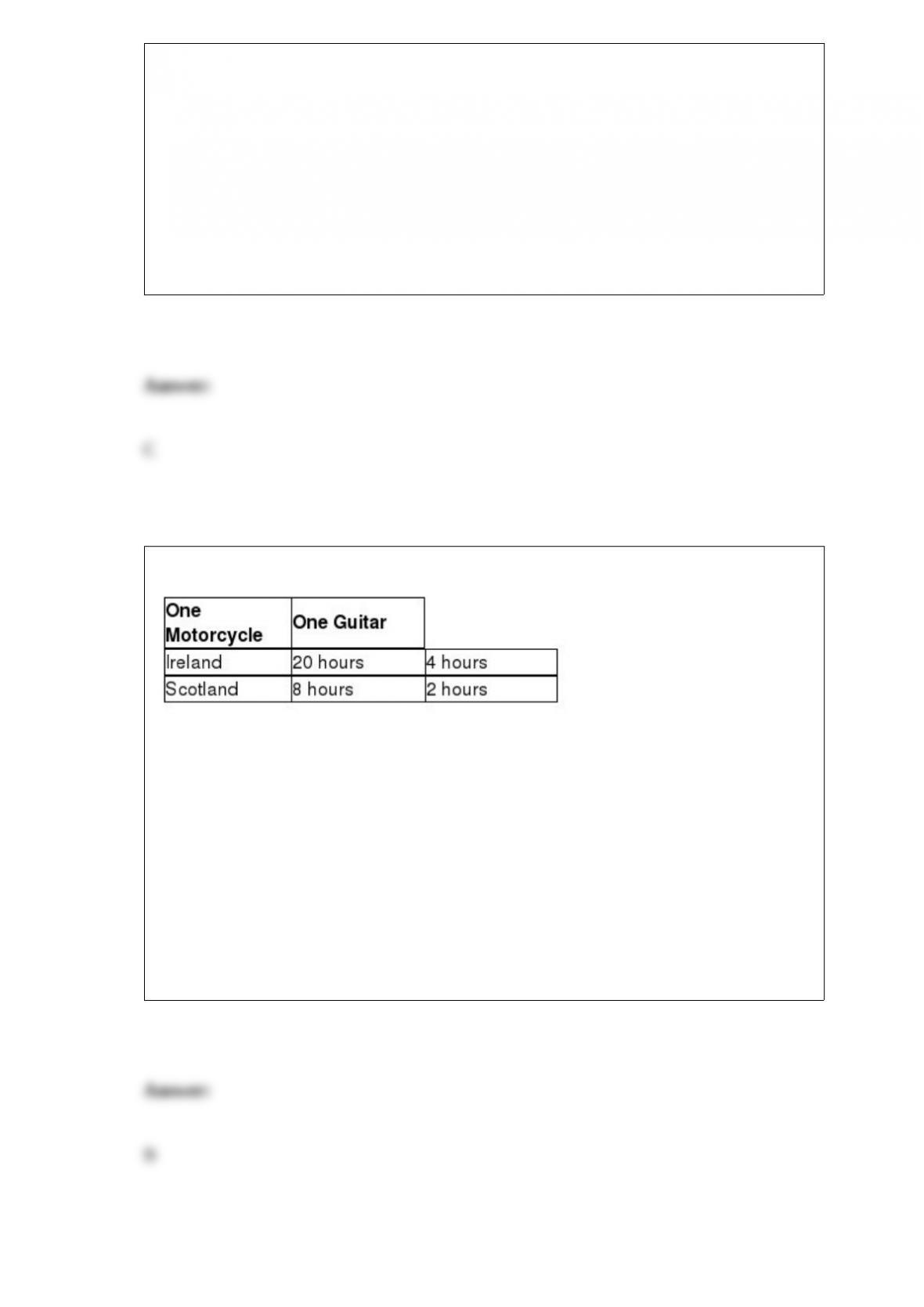
Table 2-14
Table 2-14 shows the number of labor hours required to produce a motorcycle and a
guitar in Ireland and Scotland.
What is Ireland’s opportunity cost of producing one motorcycle?
A) 0.2 guitar
B) 5 guitars
C) 8 guitars
D) 32 guitars
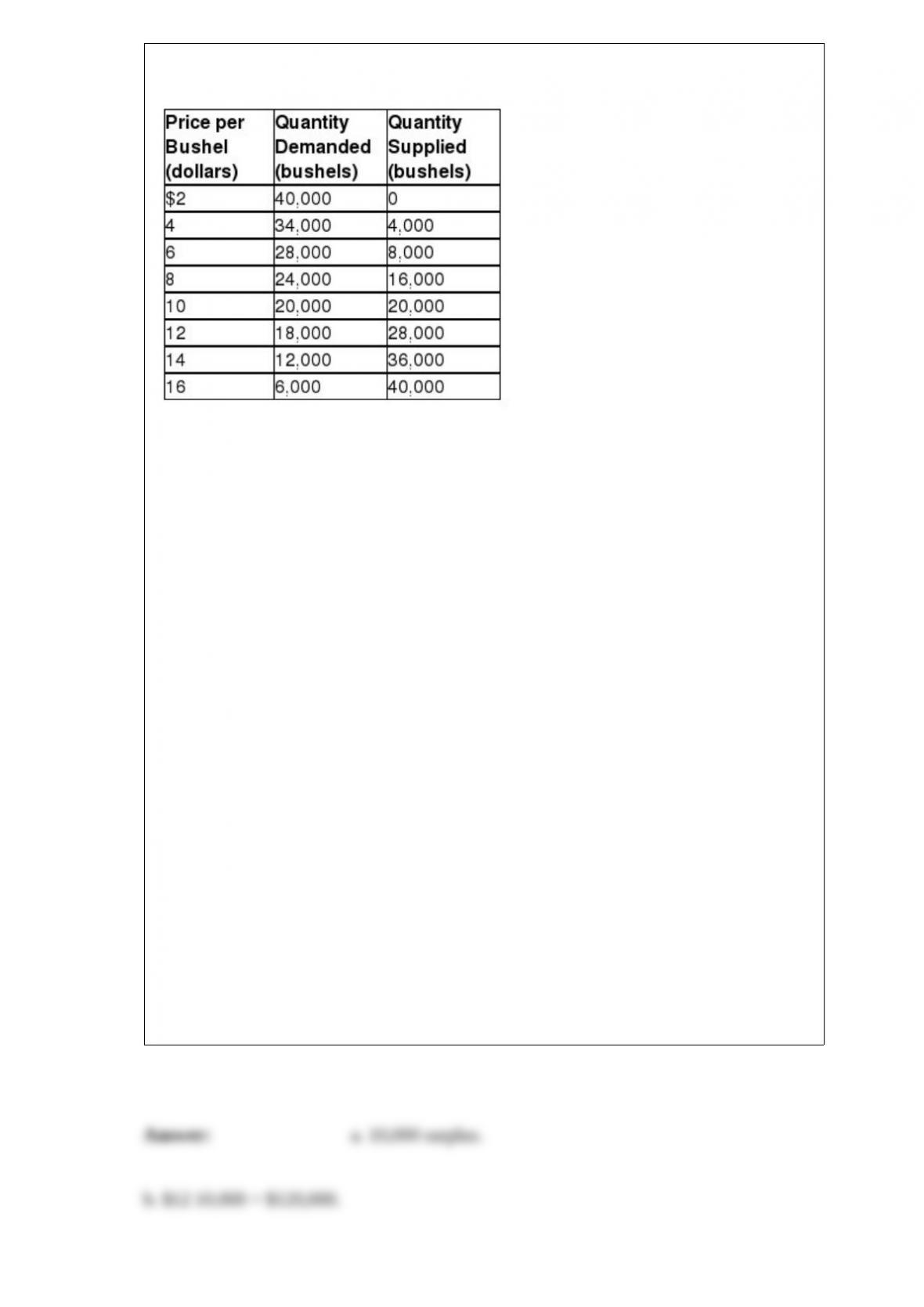
Table 4-5
Table 4-5 above contains information about the corn market. Answer the following
questions based on this table. An agricultural price floor is a price that the government
guarantees farmers will receive for a particular crop. Suppose the federal government
sets a price floor for corn at $12 per bushel.
a. What is the amount of shortage or surplus in the corn market as result of the price
floor?
b. If the government agrees to purchase any surplus output at $12, how much will it
cost the government?
c. If the government buys all of the farmers’ output at the floor price, how many bushels
of corn will it have to purchase and how much will it cost the government?
d. Suppose the government buys up all of the farmers’ output at the floor price and then
sells the output to consumers at whatever price it can get. Under this scheme, what is
the price at which the government will be able to sell off all of the output it had
purchased from farmers? What is the revenue received from the government’s sale?
e. In this problem we have considered two government schemes: (1) a price floor is
established and the government purchases any excess output and (2) the government
buys all the farmers’ output at the floor price and resells at whatever price it can get.
Which scheme will taxpayers prefer?
f. Consider again the two schemes. Which scheme will the farmers prefer?
g. Consider again the two schemes. Which scheme will corn buyers prefer?

Imports are goods and services bought domestically
A) and produced domestically.
B) but produced in other countries.
C) and resold at a profit.
D) and not subject to tariffs.
Which of the following transactions would take place in the “underground economy”?
A) Elizabeth tells her mother she’s going to work but really goes to see a movie.
B) Paul buys 15 gallons of gasoline for $3.29 a gallon, not realizing that $1.50 per
gallon of that price goes to the government as tax revenue.
C) John makes chain-link belts and necklaces and sells them at a local flea market for
cash to avoid paying taxes.
D) Matt bought an iPad for $499 but decided to sell it on eBay instead of keeping it.

Lou buys an Iron Man 2 poster from Evan for $30 and resells it on eBay for $60. Which
of the following statements is false?
A) Lou has earned some arbitrage profits, assuming that transaction costs are
negligible.
B) The transaction has made Evan worse off because he undersold the poster.
C) Lou has probably incurred some costs in connection with this sale.
D) It is possible that Evan has earned some producer surplus from this transaction.
The existence of the principal-agent problem
A) increases the risk of buying stock in a corporation.
B) increases the risk of becoming the sole proprietor of a business.
C) implies that managers that have the same incentives as the board of directors.
D) does all of the above.

The cost to firms of changing prices
A) is small even when there is rapid inflation.
B) is called a menu cost.
C) does not exist if inflation is perfectly anticipated.
D) all of the above