
A monopolistic competitive firm is a price taker, while an oligopolist is a price searcher.
a. True
b. False
Involuntary transfers are the type of transfers used in the case against government.
a. True
b. False
The law of diminishing marginal utility helps to explain why supply curves are
generally upward sloping.
a. True
b. False

A market is said to be in disequilibrium if
a. it exhibits either a surplus or a shortage.
b. the number of units that individuals are willing to buy exceeds the number of units
they can afford.
c. it is a market for an inferior good.
d. none of the above
It usually takes less time to buy a six-pack of 7-Up, a loaf of bread, and a half-gallon of
ice cream at a small convenience store (such as a 7-Eleven) than at a large, full-service
grocery store. Which of the following persons is most likely to buy these items at a
convenience store?
a. a person with a high opportunity cost of time
b. a person with a low opportunity cost of time
c. a person who is out of work
d. a person who works at a full-service grocery store
Exhibit 28-5
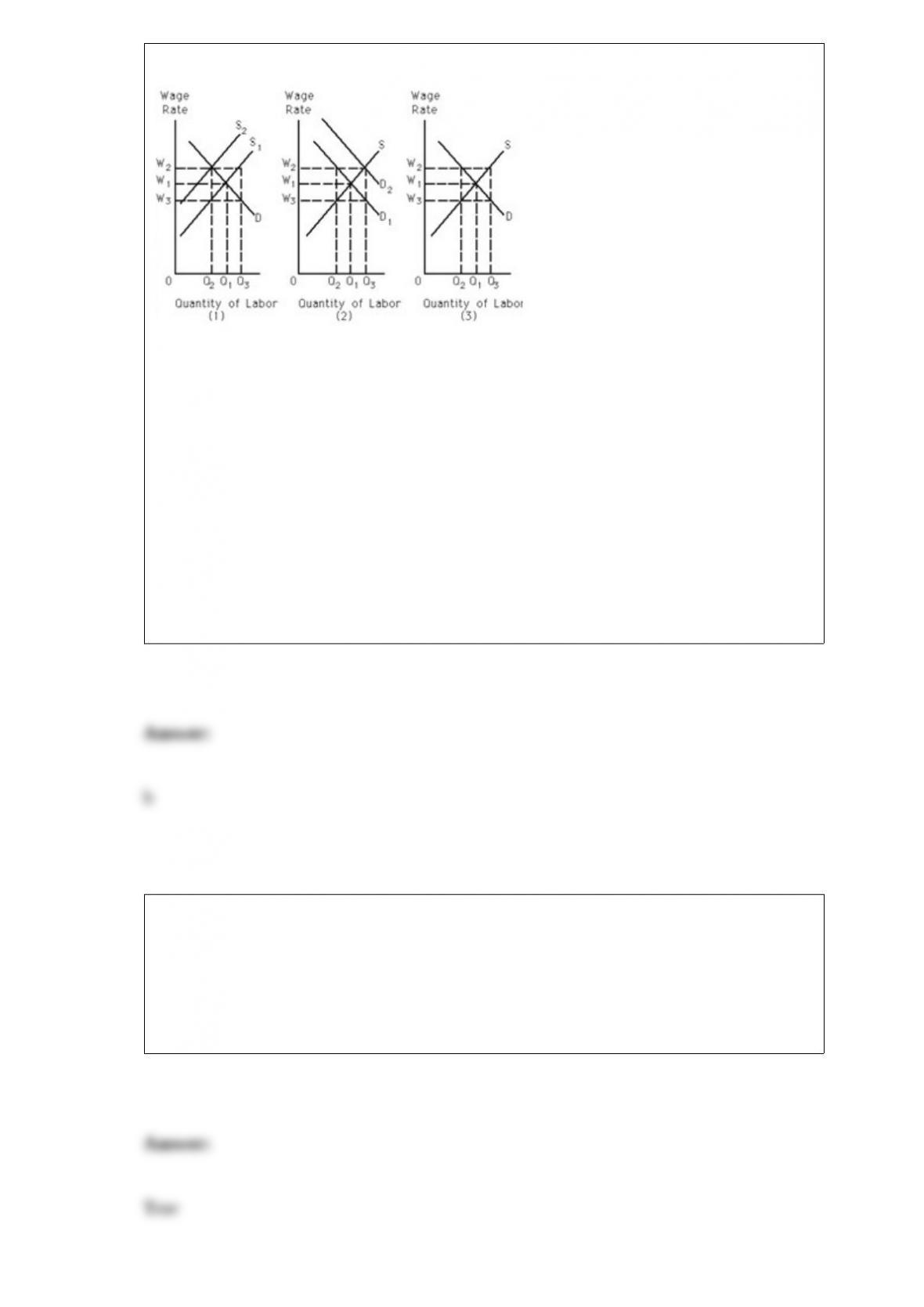
In which case or cases does the increase in the wage rate from W1 to W2 definitely
cause the total wage bill to rise?
a. (1)
b. (2)
c. (3)
d. (1) and (2)
e. (1) and (3)
The prisoner’s dilemma can be used to help analyze such diverse topics as the arms race
and the need for speed limit laws.
a. True
b. False

Marginal utility is computed by dividing total utility by the quantity consumed of a
good.
a. True
b. False
Adam Smith observed that often things that have the greatest value in use, or are the
most useful, have a relatively low price, and things that have little or no value in use
have a high price.
a. True
b. False
Which of the following is not a condition of long-run competitive equilibrium?
a. There is no incentive for firms to enter the industry.
b. There is no incentive for firms to exit the industry.
c. There is no incentive for firms to produce more or less output.
d. There is no incentive for firms to change plant size.
e. None of the above; that is, all are conditions of long-run competitive equilibrium.

A futures contract
a. gives the owner the right, but not the obligation, to buy shares of a stock at a
specified price within the time limits of the contract.
b. gives the owner the right, but not the obligation, to sell shares of a stock at a
specified price within the time limits of the contract.
c. is a contract in which the seller agrees to provide a particular good to the buyer on a
specified future date at an agreed-upon price.
d. gives the owner the right, but not the obligation, to buy or sell shares of a stock at a
specified price within the time limits of the contract.
A price floor set above the equilibrium price will
a. clear the market for the good.
b. result in a shortage of the good.
c. result in a surplus of the good.
d. force some firms in this industry to go out of business.

For economists, framing refers to the
a. manner in which a problem is presented.
b. degree of competition present in a given market.
c. total satisfaction a consumer derives from consuming a good.
d. level of total utility derived from consuming a good.
e. c and d
Which of the following statements is false?
a. The Lorenz curve expresses the relationship between cumulative percentage of
households and cumulative percentage of income.
b. If there were perfect income equality, the Lorenz curve would be a 45-degree line.
c. The Gini coefficient is a measurement of the degree of inequality in the income
distribution.
d. The Gini coefficient is a number between 0 and 100.