
Firms
A) have no influence on the circular flow in a market economy.
B) purchase resources in the product market.
C) sell goods in the product market.
D) sell resources in the factor market.
Personal income is defined as
A) national income less retained earnings plus transfer payments and plus interest on
government bonds.
B) national income plus retained earnings less transfer payments and less interest on
government bonds.
C) national income less depreciation.
D) national income less personal taxes.
The River Rouge plant was built by the Ford Motor Company in the 1920s to produce
the company’s Model A car. Which of the following is evidence that the River Rouge
plant suffered from diseconomies of scale?
A) Despite an expensive advertising campaign the Model A did not earn the company a
profit.
B) Model A cars made at the River Rouge plant failed to earn Ford a profit. Ford

eventually constructed smaller plants to make the Model A at a lower average cost.
C) Model A cars made at the River Rouge plant failed to earn a profit. Ford reduced the
average cost of the Model A by cutting its employees’ wages.
D) Model A cars made at the River Rouge plant failed to earn a profit because the price
of steel used to manufacture the Model A rose when workers in the steel industry went
on strike.
A tax imposed by a state or local government on retail sales of most products is
A) an excise tax.
B) a social service tax.
C) a consumption tax.
D) a sales tax.
Figure 19-1
Which of the following would cause the change depicted in the figure above?
A) U.S. productivity rises relative to European productivity.
B) Europeans decrease their preferences for U.S. goods relative to European goods.
C) The European Union increases its quotas on French wine.
D) an increase in the price level of U.S. goods relative to European goods
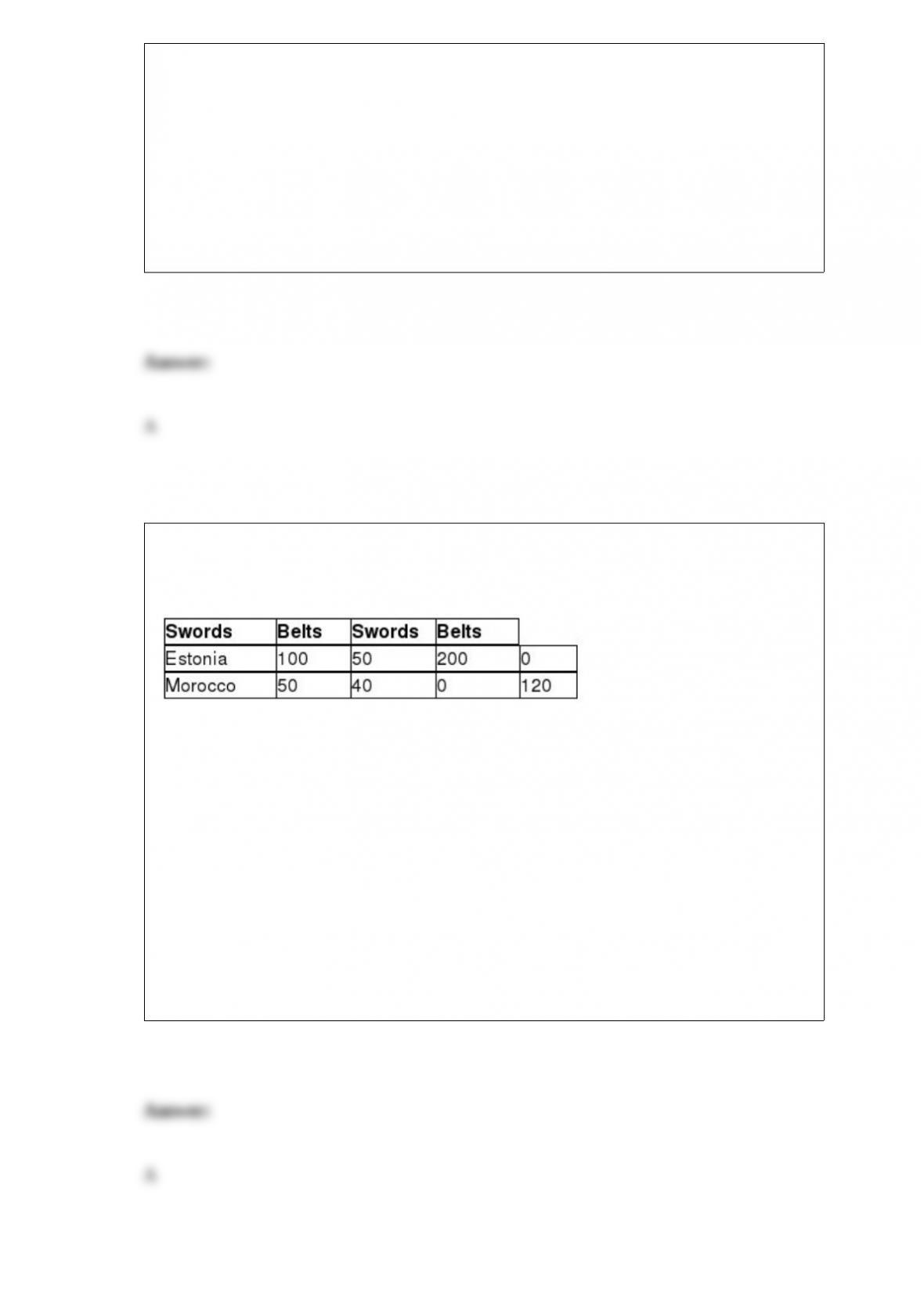
Table 9-12 Production and
Consumption Production
Without Trade With Trade
Estonia and Morocco can produce both swords and belts. Table 9-12 shows the
production and consumption quantities without trade, and the production numbers with
trade.
Which country has an absolute advantage in producing belts?
A) Estonia
B) Morocco
C) both countries
D) neither country

Table 18-1
Suppose $1 billion is available in the budget and Congress is considering allocating the
funds to one of the following three alternatives: 1) Subsidies for education, 2) Research
on Alzheimer’s or 3) Increased border security. Table 18-1 shows three voters’ rankings
of the alternatives. Suppose a series of votes are taken in which each pair of alternatives
is considered in turn. The first pair considered is between subsidies for education and
research on Alzheimer’s. The second pair considered is between Alzheimer’s research
and increased border security. The third pair considered is between education subsidies
and increased border security. In this case, the collective preferences of the voters
A) turn out to be transitive and will yield a consistent outcome.
B) turn out to be transitive but will not result in a consistent outcome.
C) turn out not to be transitive and will not result in a consistent outcome.
D) turn out not to be transitive but will yield a consistent outcome.
If the Federal Reserve chooses to fight high inflation with contractionary monetary
policy and firms and consumers expect this policy to reduce inflation, which of the
following would you expect to see?
A) a downward shift of the short-run Phillips curve
B) a reduction in the unemployment rate
C) a decrease in the long-run aggregate supply curve
D) an increase in inflationary expectations

The portion of ________ that a bank does not loan out or spend on securities is known
as ________.
A) loans; reserves
B) deposits; reserves
C) deposits; securities
D) loans; securities
When the price of tortilla chips rose by 10 percent, the quantity of tortilla chips sold fell
4 percent. This indicates that the demand for tortilla chips is
A) inelastic.
B) elastic.
C) unit-elastic.
D) perfectly inelastic.

Research has shown that most economic profits from selling a prescription drug are
eliminated 20 years after the drug is first offered for sale. The main reason for the
elimination of profits is
A) after 20 years most people who have taken the drug have passed away or are cured
of the illness the drug was intended to treat.
B) firms sell their patent rights to other firms so that they can concentrate on finding
drugs to treat new illnesses.
C) the quantity demanded of the drug has increased enough that the demand becomes
inelastic and revenue falls.
D) after 20 years patent protection is ended and other firms can produce less expensive
generic versions of the drug.
National income equals gross domestic product
A) plus sales taxes.
B) plus government transfer payments.
C) minus the consumption of fixed capital.
D) minus government transfer payments.
Consider the following economic agents:
a. the government

b. consumers
c. producers Who, in a modern mixed economy, decides what goods and services will
be produced with the scarce resources available in that economy?
A) the government
B) producers
C) consumers
D) consumers and producers
E) the government, consumers and producers
Technological change will
A) shift the per-worker production function up.
B) shift the per-worker production function down.
C) move the economy to a point beneath the per-worker production function.
D) move the economy along a given per-worker production function.
Table 1-2
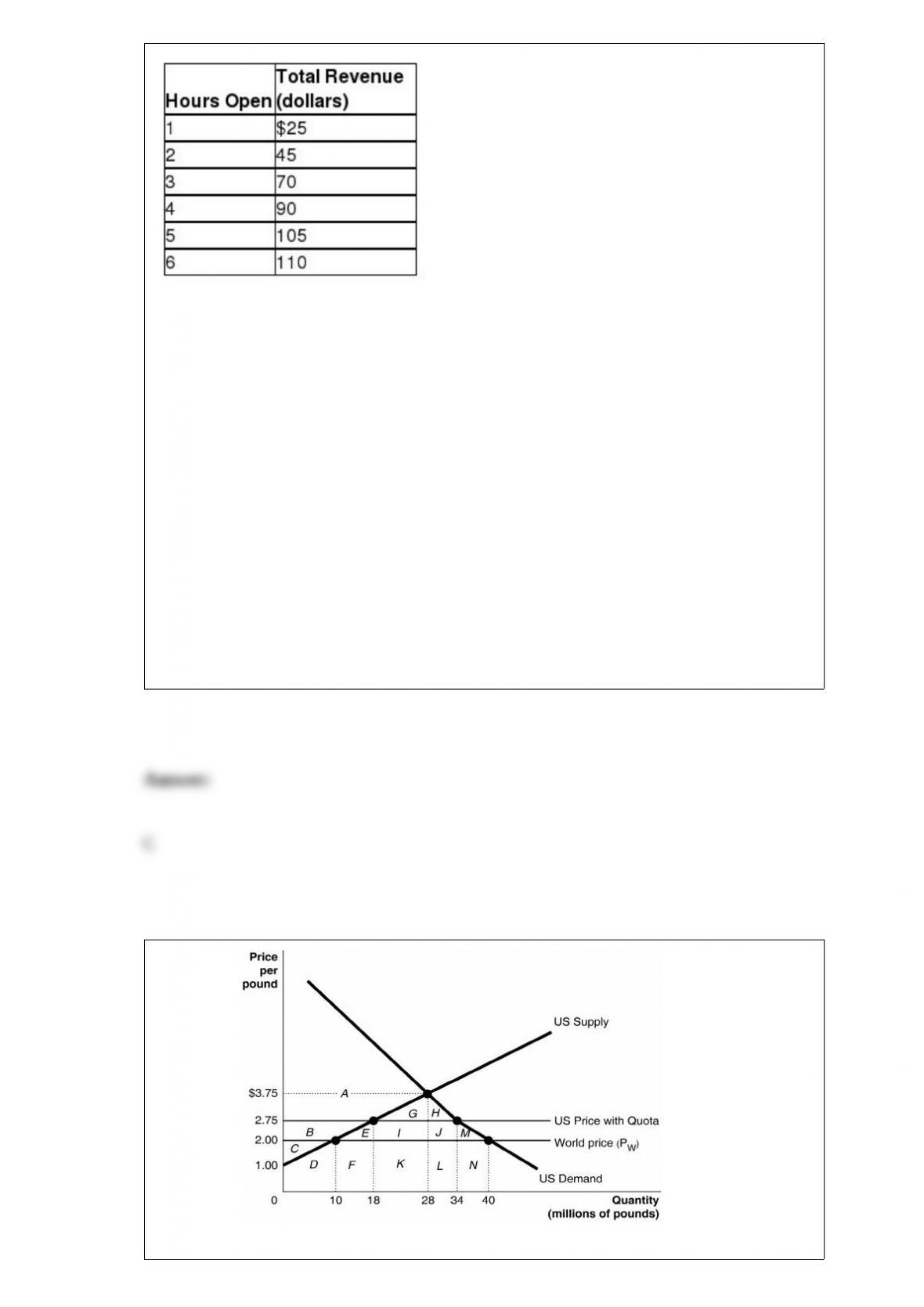
Thuy Anh runs a small flower shop in the town of Florabunda. She is debating whether
she should extend her hours of operation. Thuy Anh figures that her sales revenue will
depend on the number of hours the flower shop is open as shown in the table above.
She would have to hire a worker for those hours at a wage rate of $16 per hour.
What is Thuy Anh’s marginal benefit if she decides to stay open for three hours instead
of two hours?
A) $0
B) $20
C) $25
D) $45
E) $70
Figure 9-3 Since 1953 the
United States has imposed a quota to limit the imports of peanuts. Figure 9-3 illustrates

the impact of the quota. With a quota in place, what is the quantity supplied by
domestic producers?
A) 16 million pounds
B) 18 million pounds
C) 28 million pounds
D) 34 million pounds
From 1990-2012, productivity growth in the United States was ________ the growth
rates of other high-income countries.
A) greater than
B) less than
C) equal to
D) greater than for the first 15 years, then less than
Which of the following is not a characteristic of a monopolistically competitive market
structure?
A) There is a large number of independently acting small sellers.
B) All sellers sell products that are differentiated.
C) There are low barriers to entry of new firms.

D) Each firm must react to actions of other firms.