1) when mexico became a part of nafta, along with canada and the united states, it:
a.eliminated tariffs against canada and the united states but maintained them against
nonmembers
b.eliminated tariffs against canada, the united states, and all nonmember countries
c.increased tariffs against canada the united states, and all nonmember countries
d.increased tariffs against canada and the united states, but did not change them against
nonmember countries
2) under a system of floating exchange rates, a japanese trade surplus against canada
would result in a (an):
a.rise in the dollar price of the yen
b.fall in the dollar price of the yen
c.rise in the yen price of the dollar
d.unchanged dollar/yen exchange rate
3) graphically, consumer surplus is represented by the area above the demand curve and
below the product’s market price.
a.true
b.false
4) an effort to diversify into nonrelated markets is most likely to be undertaken when
firms undergo:
a.horizontal integration
b.vertical integration
c.conglomerate integration
d.none of the above
5) which of the following balance-of-payments adjustment mechanisms is most closely
related to the quantity theory of money?
a.income-adjustment mechanism
b.price-adjustment mechanism
c.interest-rate-adjustment mechanism
d.output-adjustment mechanism
6) if you have a commitment to pay a friend in britain 1,000 pounds in 30 days, you
could remove the risk of loss due to the appreciation of the pound by:
a.buying dollars in the forward market for delivery in 30 days
b.selling dollars in the forward market for delivery in 30 days
c.buying the pounds in the forward market for delivery in 30 days
d.selling the pounds in the forward market for delivery in 30 days
7) the principle of normal trade relations (most-favored-nation)treatment was
established with the passage of the:
a.fordney-mccumber act of 1922
b.smoot-hawley act of 1930
c.reciprocal trade agreements act of 1934
d.trade act of 1974
8) the existence of exit barriers tends to delay the closing of inefficient firms that face
international competitive disadvantages.
a.true
b.false
9) unlike the balance of payments, the balance of international indebtedness indicates
the international:
a.investment position of a country at a given moment in time
b.investment position of a country over a one-year period
c.trade position of a country at a given moment in time
d.trade position of a country over a one-year period
10) which trade theory suggests that a newly produced good, once exported, could
ultimately end up being imported as the technology is transferred to lower- cost
nations?
a.factor endowment theory
b.product life cycle theory
c.overlapping demand theory
d.comparative advantage theory
11) under the classical gold standard, adjustments in domestic prices and short-term
interest rates automatically promoted balance-of-payments equilibrium over the long
run.
a.true
b.false
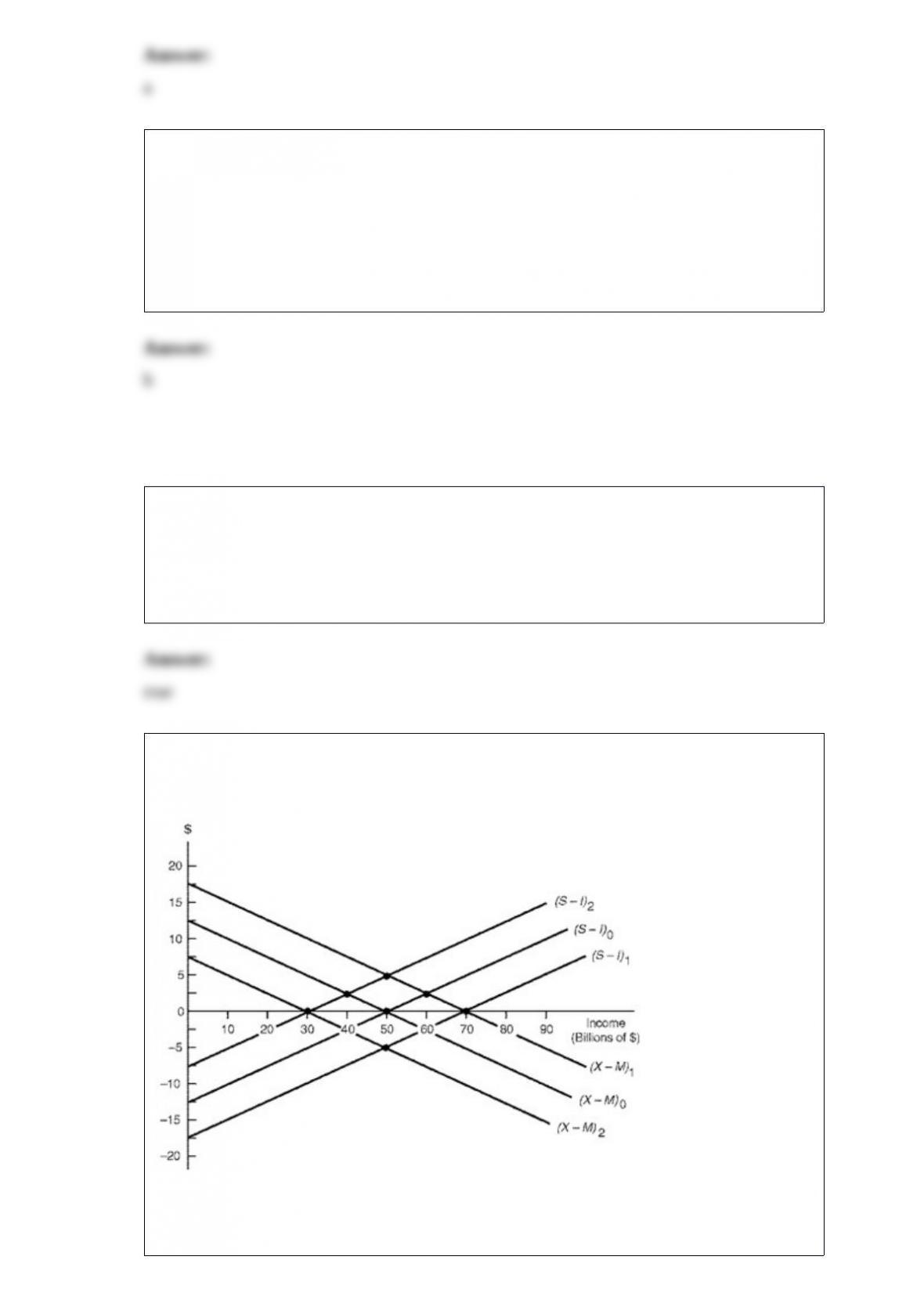
12) figure 13.2. australian economy under a fixed exchange rate system
refer to figure 13.2. starting at equilibrium income $50 billion, where (s-i)0 intersects
(x-m)0, suppose that increased thriftiness leads to an autonomous increase in australian
saving of $5 billion. australian income thus ____ which leads to australia’s trade
account moving to a ____.
a.rises to $60 billion, deficit of $2.5 billion
b.rises to $60 billion, deficit of $5 billion
c.falls to $40 billion, surplus of $2.5 billion
d.falls to $40 billion, surplus of $5 billion
13) a sudden shift from import tariffs to free trade may induce short-term
unemployment in:
a.import-competing industries
b.industries that are only exporters
c.industries that sell domestically as well as export
d.industries that neither import nor export
14) which of the following is not a potential disadvantage of freely floating exchange
rates?
a.they require larger amounts of international reserves than other exchange systems
b.demand schedules for imports and exports may be price speculation
c.there may occur large amounts of destabilizing speculation
d.capital movements among nations may be hindered via exchange rate fluctuations
15) a multilateral contract specifies the maximum price at which exporting countries
agree to sell a product and the minimum price at which importing countries agree to
buy a product.
a.true
b.false
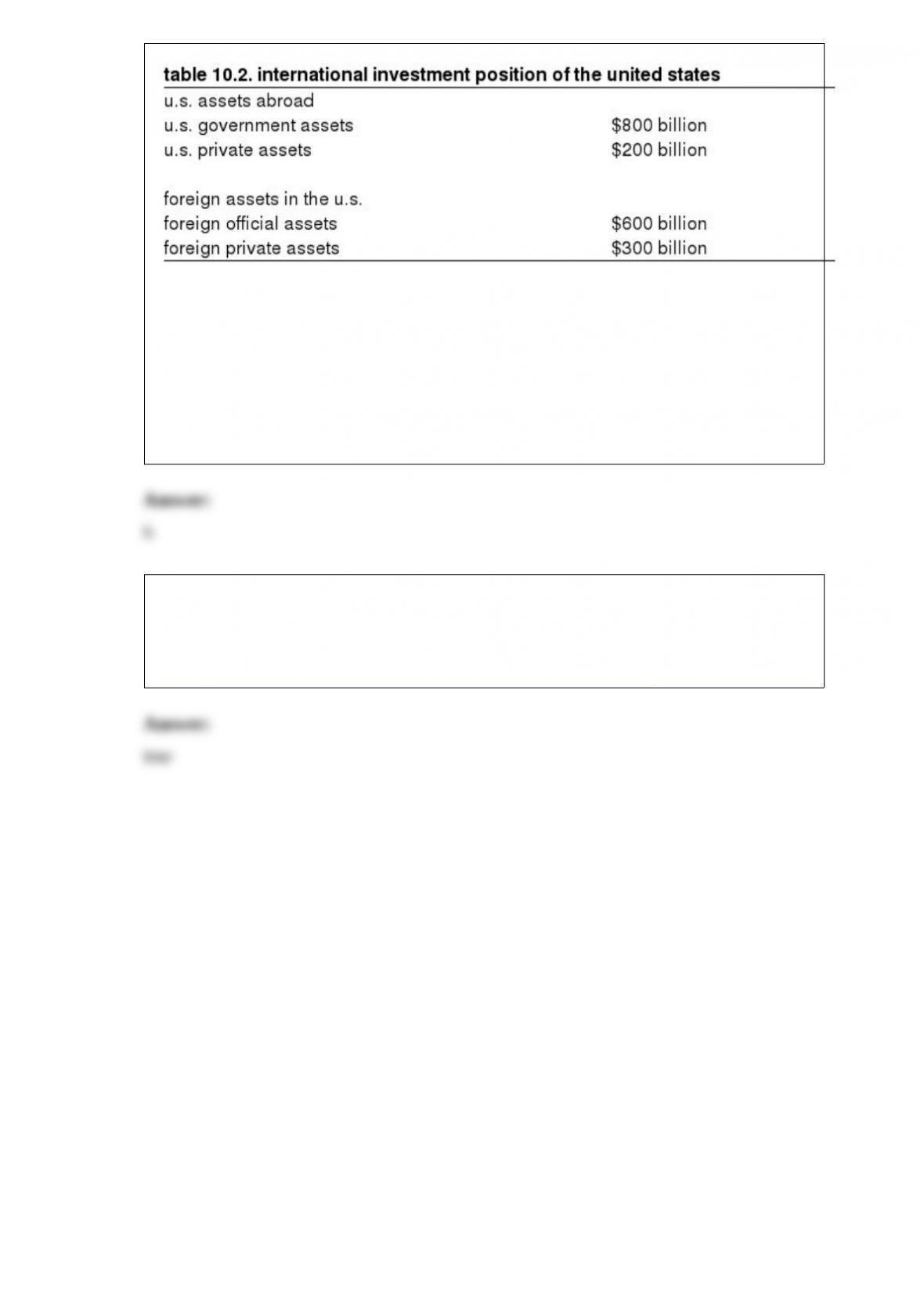
16) consider table 10.2. the u.s. balance of international indebtedness suggests that the
united states is a net:
a.debtor
b.creditor
c.spender
d.exporter
17) in recent decades, the east asian “newly industrializing countries” have pursued
export-led growth (outward orientation) as an industrialization strategy.
a.true
b.false