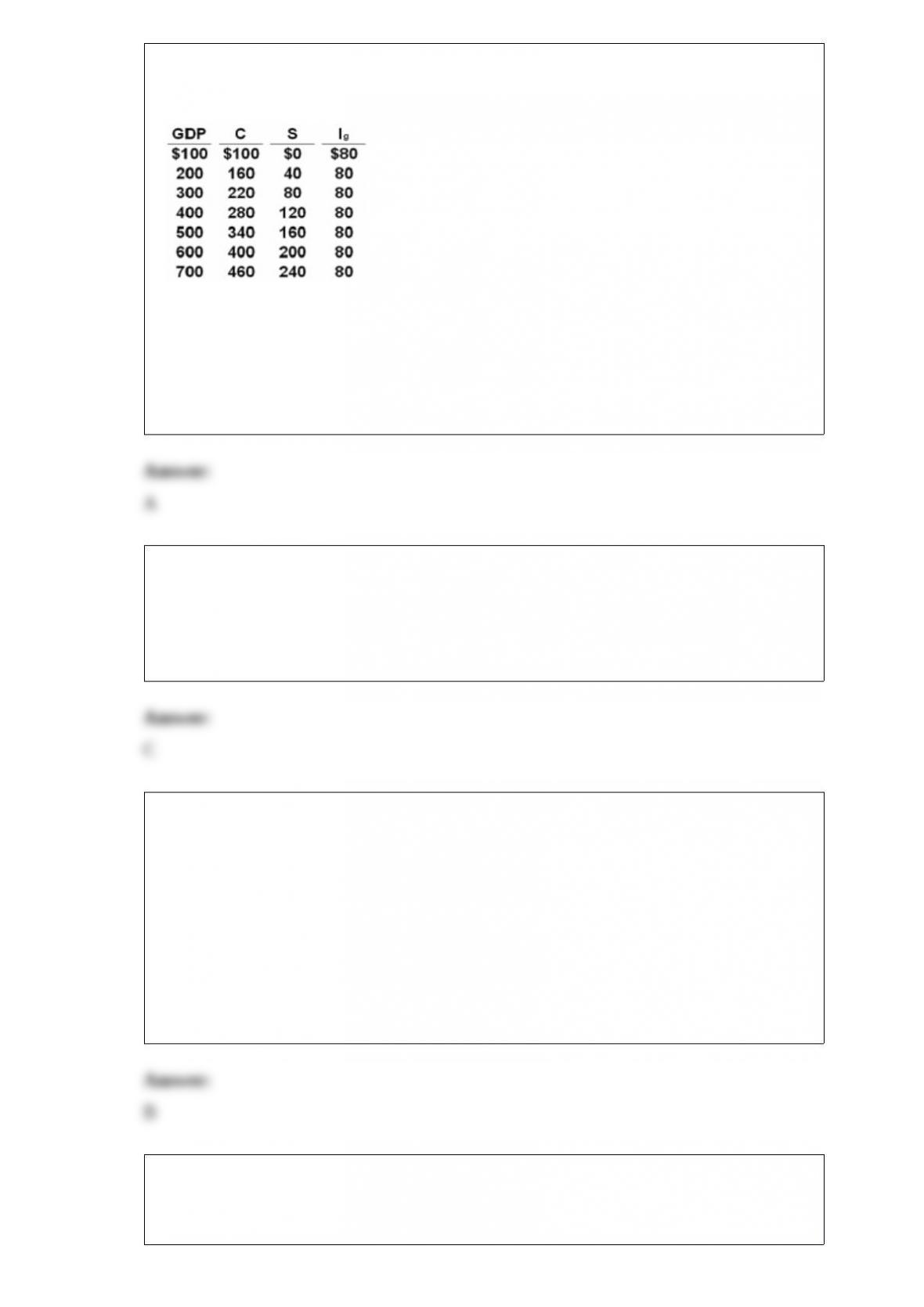
1) The following information is for a closed economy:
Refer to the above information. If in addition to spending $80 billion at each level of
GDP, government imposes a lump-sum tax of $100:
A.equilibrium GDP will now be $350.
B.equilibrium GDP will now be $400.
C.equilibrium GDP will now be $300.
D.the equilibrium GDP cannot be determined.
2) Other things equal, an increase in the equilibrium interest rate will:
A.increase R&D spending.
B.rise when the supply of loanable funds increases.
C.decrease purchases of capital goods and reduce R&D spending.
D.increase bank lending.
3) (Advanced analysis) Answer the next question(s) on the basis of the following
consumption and investment data for a private closed economy. Figures are in billions
of dollars.
C = 60 + .6Y
I = I0 = 30
Refer to the above data. The equilibrium level of income (Y ) is:
A.360.
B.225.
C.200.
D.135.
4) the dollar votes of consumers ultimately determine the composition of output and the
allocation of resources in a market economy. this statement best describes the concept
of:

a.derived demand.
b.consumer sovereignty.
c.the invisible hand.
d.market failure.
5) Which of the following is an example of market failure?
A.information asymmetries
B.externalities
C.public goods
D.all of these
6) over a recently ended 66-year period, debeers:
a.earned only a normal profit because of its high mining and marketing costs.
b.operated substantially in accord with the predictions of the unregulated monopoly
model.
c.was subject to u.s. antimonopoly laws and therefore could not control diamond prices.
d.was regulated by the south african government and thus had to limit prices to average
total cost.
7) The MRP curve for labor:
A.intersects the firm’s labor demand curve from above.
B.is the firm’s labor demand curve.
C.lies below the firm’s labor demand curve.
D.lies above the firm’s labor demand curve.
8) Authoritative estimates suggest that currently union workers on the average:
A.achieve no wage advantage over nonunion workers in the same occupation.
B.realize a 5 percent wage advantage over nonunion workers in the same occupation.
C.realize a 20-30 percent wage advantage over nonunion workers in the same
occupation.
D.realize a 15 percent wage advantage over nonunion workers in the same occupation.

9) if a monopolist engages in price discrimination, it will:
a.realize a smaller profit.
b.charge a higher price where individual demand is inelastic and a lower price where
individual demand is elastic.
c.produce a smaller output than when it did not discriminate.
d.charge a competitive price to all its customers.
10) answer the next question(s) on the basis of the following information: only three
goods are produced in an economy in the following amounts: a = 10, b = 30, c = 5. the
current year per unit prices of these three goods are a = $2, b = $3, and c = $1.
(advanced analysis) refer to the above information. if the per unit prices of the three
goods each were $1 in a base year used to construct a gdp price index, then the gdp
price index in the current year is:
a.205.5.
b.255.5.
c.39.3.
d.100.
11) When aggregate demand declines, some firms may reduce employment rather than
wages because wage reductions may:
A.not be possible due to the minimum wage law.
B.increase the cost of raising money capital.
C.reduce the demands for their products.
D.may set off a price war.
12) If monies added to, or subtracted from, the Social Security trust fund were excluded
from Federal budget calculations, the current Federal budget:
A.deficit would nearly disappear.
B.deficit would be substantially larger.
C.surplus would nearly disappear.
D.surplus would be substantially smaller.
13) The twelve Federal Reserve Banks:
A.are owned and operated by the U.S. Treasury.
B.were created in 1776.
C.hold the reserve deposits of commercial banks.
D.are also known as national banks.
14) an increase in the quantity demanded means that:
a.given supply, the price of the product can be expected to decline.
b.price has declined and consumers therefore want to purchase more of the product.
c.the demand curve has shifted to the right.
d.the demand curve has shifted to the left.
15) A higher wage could result in a lower labor cost per unit of output than a lower
wage if the higher wage:
A.brings forth greater work effort.
B.increases supervision costs.
C.increases job turnover.
D.increases worker absenteeism.
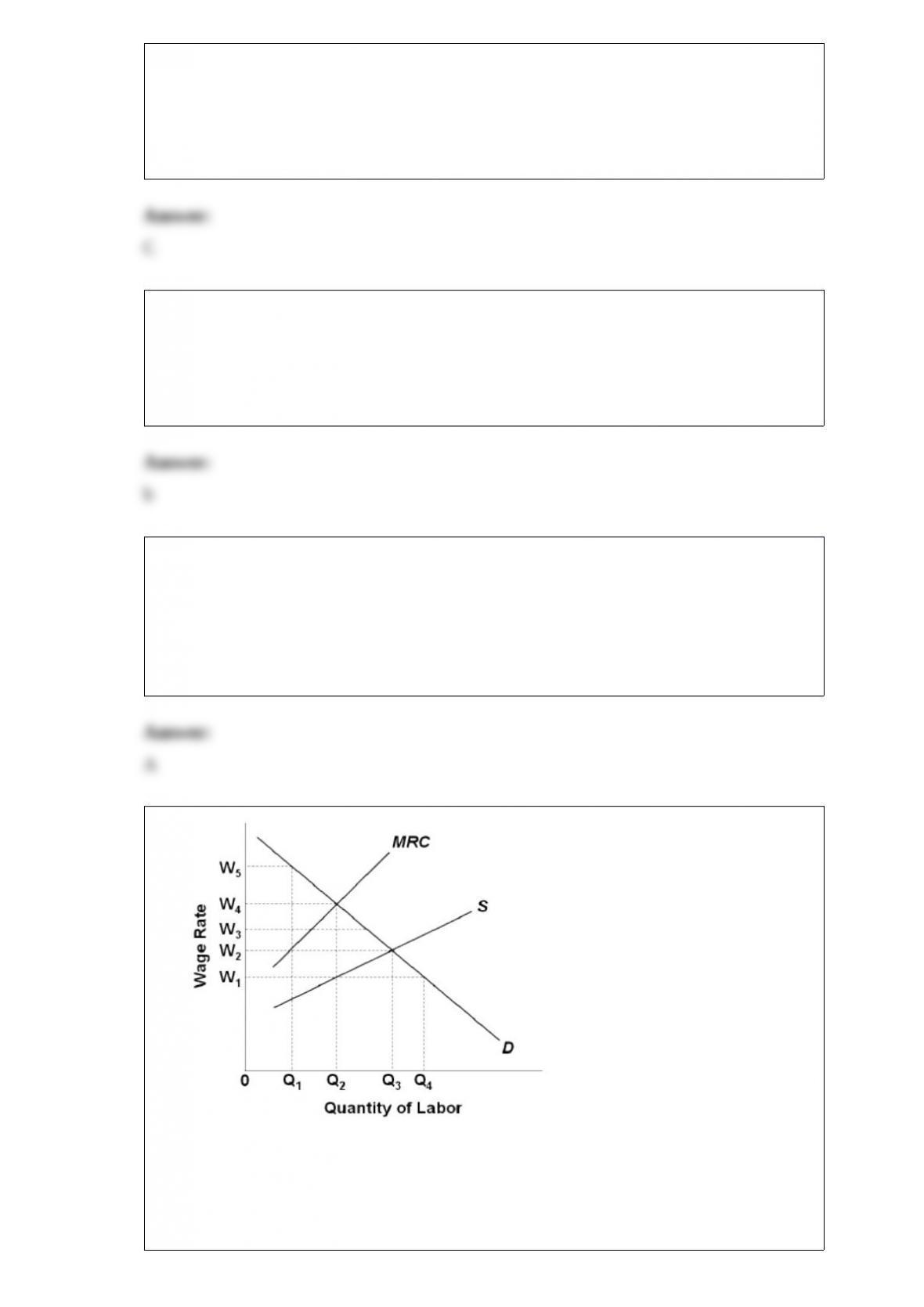
16)
Refer to the above diagram. Assuming no union or relevant minimum wage, the firm
represented will hire:
A.Q2 workers and pay a W4 wage rate.
B.Q2 workers and pay a W1 wage rate.
C.Q3 workers and pay a W2 wage rate.
D.Q4 workers and pay a W1 wage rate.
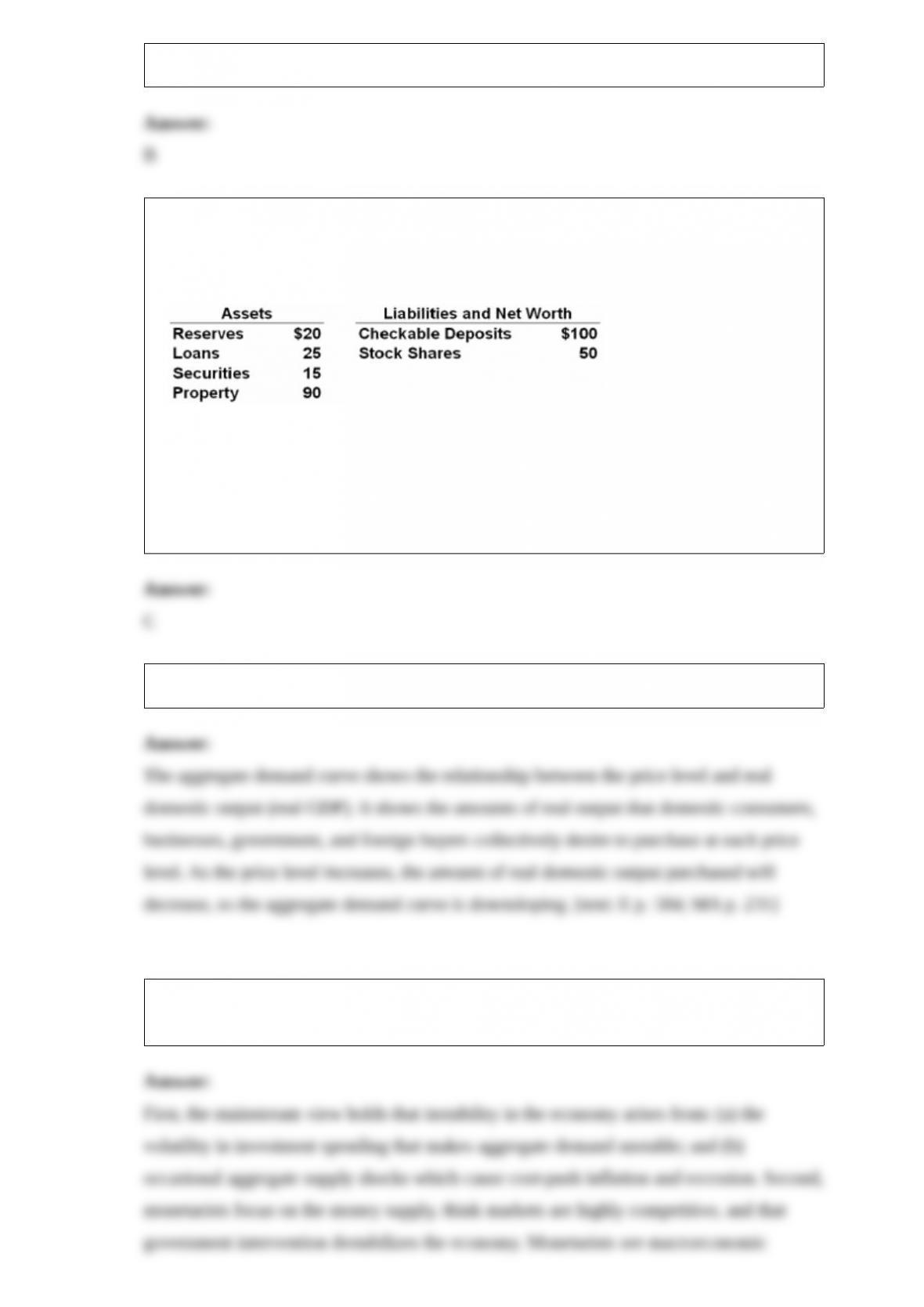
17) The following balance sheet for the First National Bank of Bunco. All figures are in
millions.
Refer to the above data. If this bank has excess reserves of $6 million, the legal reserve
ratio must be:
A.10 percent.
B.12 percent.
C.14 percent.
D.20 percent.
18) What is the aggregate demand curve? What is the character of its slope?
19) What are the four different views of the causes of macroeconomic instability in the
economy?
20) Why does the marginal resource cost exceed the wage rate in the case of a
monopsonistic firm? Explain and illustrate with an example.
21) Comment on the statement: Discretionary fiscal policy offers an ideal approach to
dealing with the nations economic problems. It is without problems, criticisms, or
complications.
22) What was the gold standard?
23) What are three qualifications to the view that allocative and productive efficiency
are not realized in oligopoly?