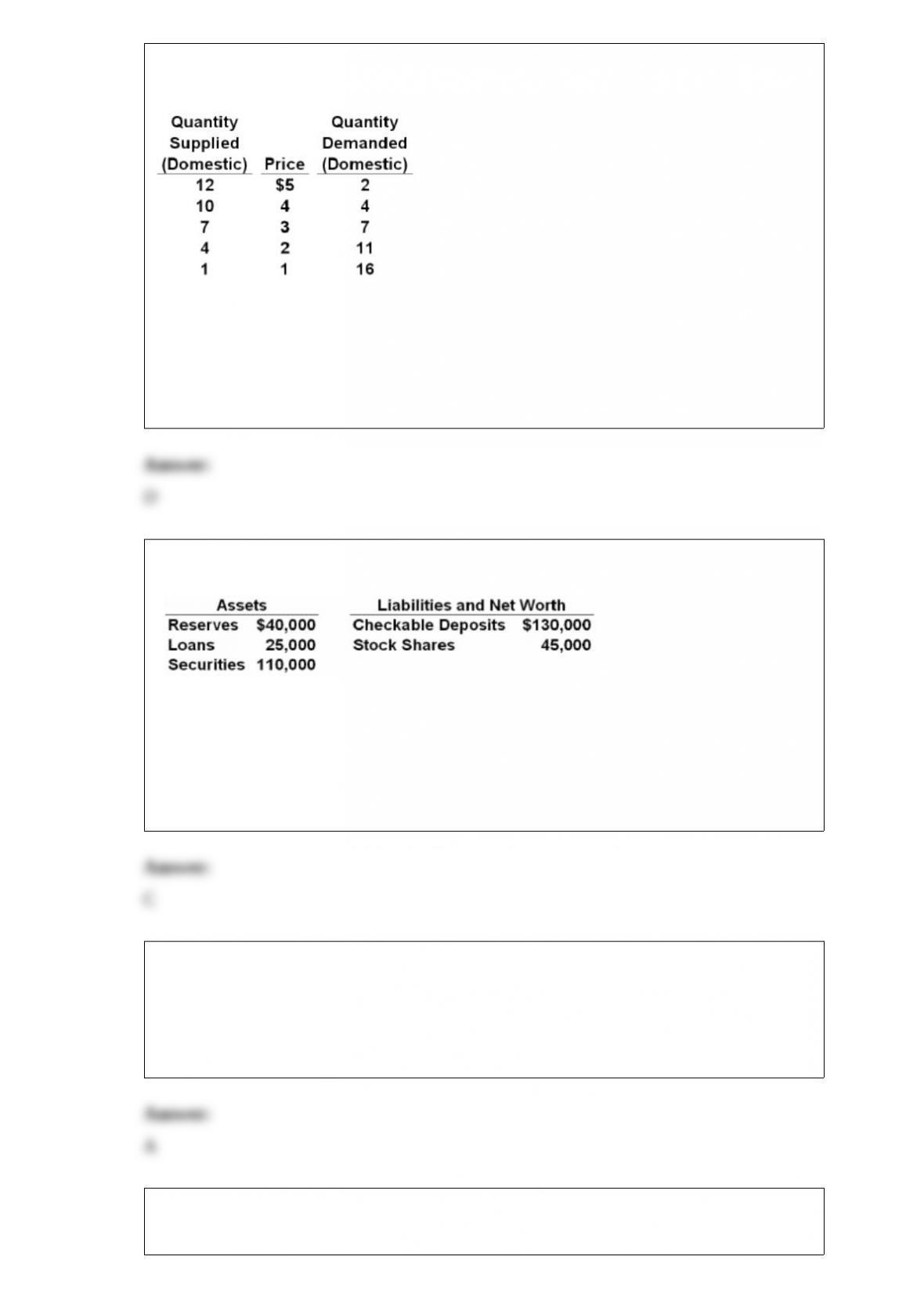
1) The following domestic supply and demand schedules for a product. Suppose that the
world price of the product is $1.
Refer to the above data. If this nation were entirely closed to international trade,
equilibrium price and quantity would be:
A.$5 and 2 units.
B.$1 and 1 unit.
C.$4 and 4 units.
D.$3 and 7 units.
2) Assume the Continental National Bank’s balance statement is as follows:
Assuming a legal reserve ratio of 20 percent, how much in excess reserves would this
bank have after a check for $10,000 was drawn and cleared against it?
A.$3,000
B.$24,000
C.$6,000
D.$16,000
3) To increase the Federal funds rate, the Fed would:
A.sell government securities.
B.buy government securities.
C.reduce the discount rate.
D.decrease the reserve requirement.
4) The following data for the hypothetical nations of Alpha and Beta. Qs is domestic
quantity supplied and Qd is domestic quantity demanded.
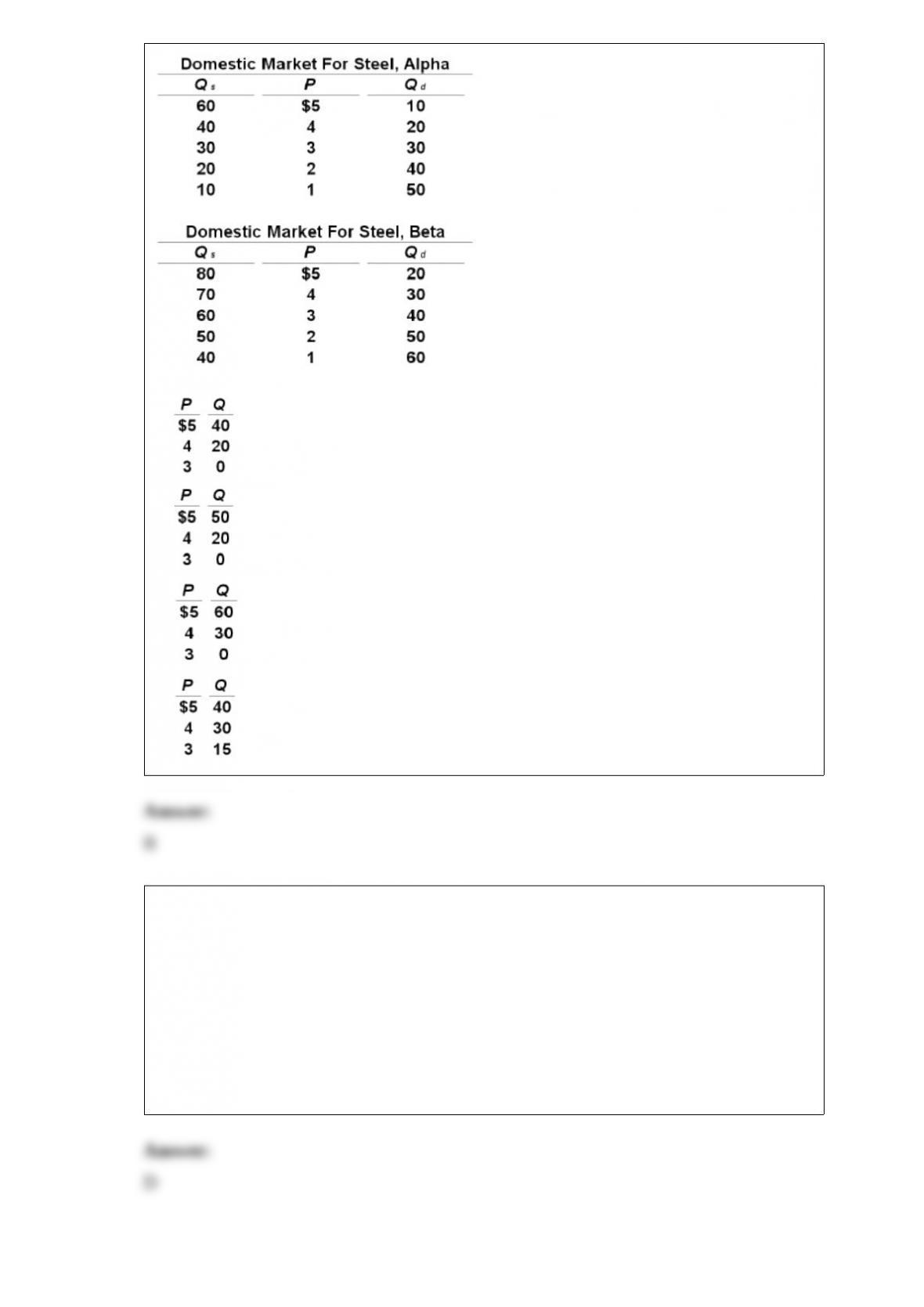
Refer to the above data. Alpha’s export supply is represented by:
A.
B.
C.
D.
5) Which of the following is a true statement?
A.firms and resource suppliers generally find it easier to reduce prices than to raise
them.
B.as the price level increases, interest rates will rise and therefore consumption and
investment spending will also rise.
C.an initial increase in aggregate demand may cause a further increase in aggregate
demand because higher prices mean higher incomes.
D.a decline in aggregate demand will primarily affect real output and employment if
prices are inflexible downward.

6) Pure or economic profit is:
A.the amount by which total revenue exceeds total costs.
B.determined by subtracting explicit costs from total revenue.
C.the return required to retain entrepreneurial talent in some particular line of
production.
D.the return to any resource the supply of which is perfectly inelastic.
7) The TANF program is designed to:
A.increase the minimum wage.
B.shift people from welfare to employment.
C.provide medical insurance to poverty level workers.
D.provide income to the blind and disabled.
8) Assume the economy is at full employment and that investment spending declines
dramatically. If the goal is to restore full employment, government fiscal policy should
be directed toward:
A.an equality of tax receipts and government expenditures.
B.an excess of tax receipts over government expenditures.
C.an excess of government expenditures over tax receipts.
D.a reduction of subsidies and transfer payments and an increase in tax rates.
9) Consider the two diagrams below. Diagram A represents a typical firm in a purely
competitive industry. Diagram B represents the supply and demand conditions in that
industry.
(a)Describe the price, output, and profit situation for the individual firm in the short run.
(b)Describe what will happen to the individual firm and the industry in the long run.
Show the changes on diagrams A and B.
10) based on the number of hours worked per capita, labor supply in the united states
exceeds that of france by about _______ percent.
a.20
b.40
c.51
d.62
11) steve went to his favorite hamburger restaurant with $3, expecting to buy a $2
hamburger and a $1 soda. when he arrived he discovered that hamburgers were on sale
for $1, so steve bought two hamburgers and a soda. steve’s response to the decrease in
the price of hamburgers is best explained by:
a.the substitution effect.
b.the income effect.
c.the price effect.
d.a rightward shift in the demand curve for hamburgers.
12) Behavioralists believe that:
A.if four or fewer firms control more than half of the market for a product, then the
Sherman Act is being violated.
B.industries should be judged on the basis of their price-output behavior and their
technological progressiveness.
C.there is no evidence that any monopolistic industries has abused its market power.
D.all concentrations of economic power are socially undesirable.
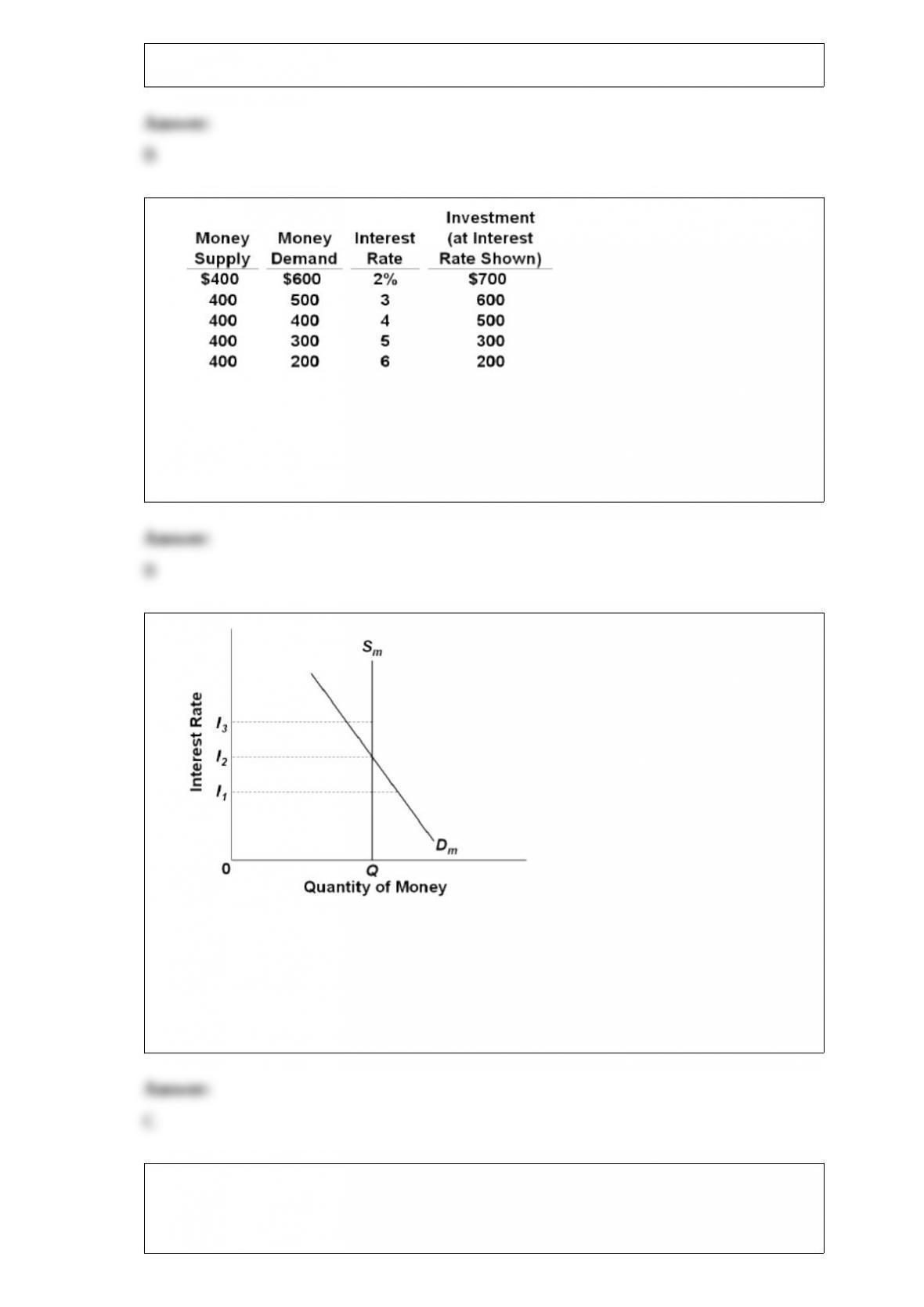
13)
Refer to the above table. The equilibrium interest rate in this economy is:
A.3 percent.
B.4 percent.
C.5 percent.
D.6 percent.
14)
Refer to the above diagram of the market for money. The downward slope of the money
demand curve Dm is best explained in terms of the:
A.transactions demand for money.
B.direct or positive relationship between bond prices and interest rates.
C.asset demand for money.
D.wealth or real-balances effect.
15) in a full-employment economy government can reallocate resources from private to
public employment by:
a.reducing taxes and increasing government expenditures.

b.reducing taxes and reducing government expenditures.
c.increasing taxes and reducing government expenditures.
d.increasing taxes and increasing government expenditures.
16) the demand for commodity x is represented by the equation p = 100 – 2q and supply
by the equation p = 10 + 4q.
refer to the above information. if demand changed from p = 100 – 2q to p = 130 – q, the
new equilibrium price is:
a.$90
b.$110
c.$96
d.$106
17) Entrepreneurship:
A.can be carried out either by individuals or teams of individuals.
B.is no longer important in a world of large corporate R&D laboratories.
C.is, by definition, carried out by a single individual.
D.is relevant to pure competition but not to the other market structures.