
Refer to Situation 22-2. How many widgets is Alejandro producing?
a. 10
b. 15
c. 20
d. 25
e. There is not enough information to answer the question.
A shift of the supply curve for farm products to the right in a price inelastic region of
the demand curve for farm products
a. reduces price and total revenue.
b. increases price and reduces total revenue.
c. reduces price and increases total revenue.
d. increases prices and total revenue.
Refer to Exhibit 28-5. In which of the following cases has the increase in the wage from
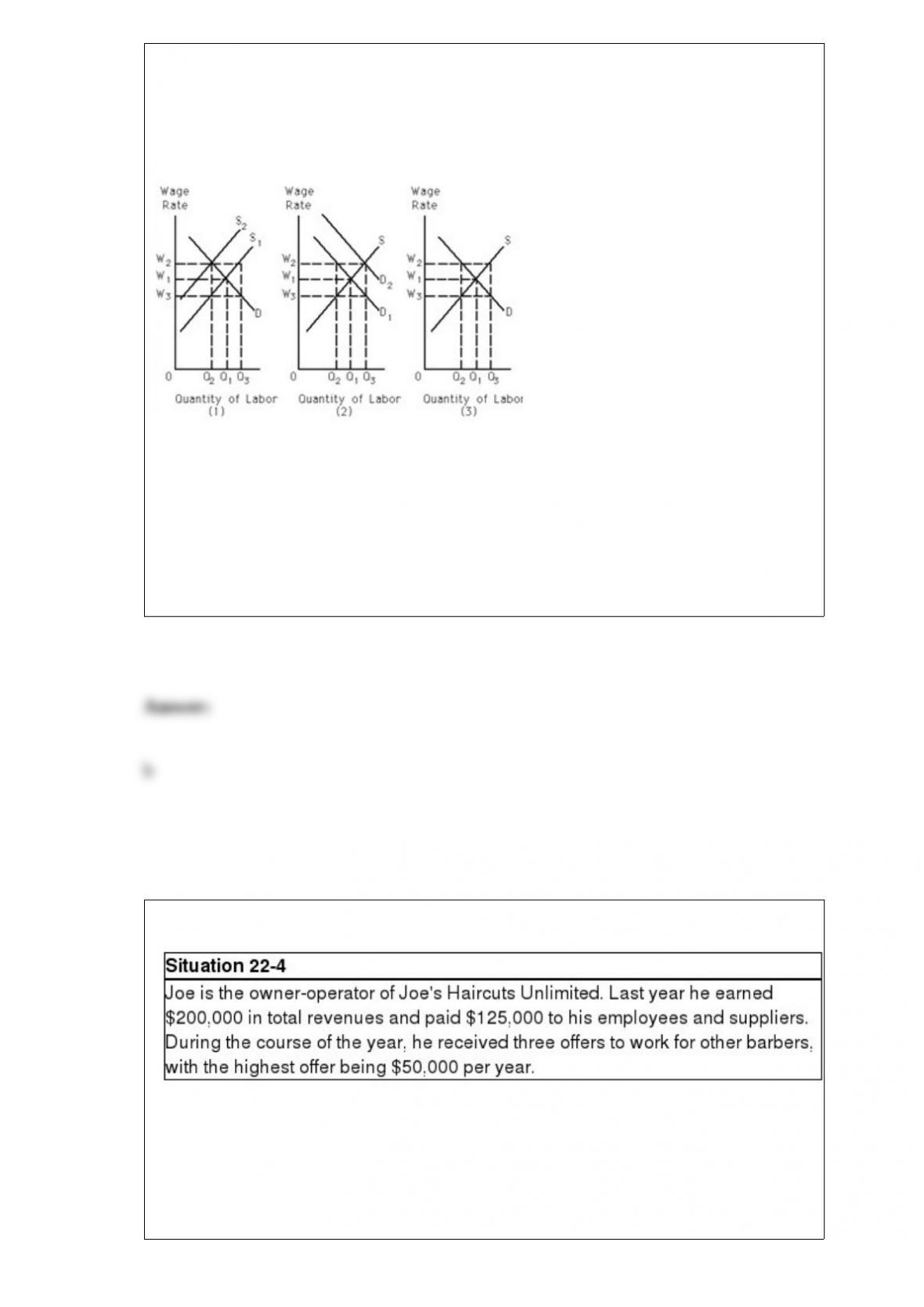
W1 to W2 been brought about by a prolonged successful training program undertaken
by the union for the benefit of its members?
Exhibit 28-5
a. (1)
b. (2)
c. (3)
d. none of the above
Refer to Situation 22-4.What are Joe’s implicit costs?
a. $150,000
b. $175,000
c. $35,000

d. $200,000
e. $50,000
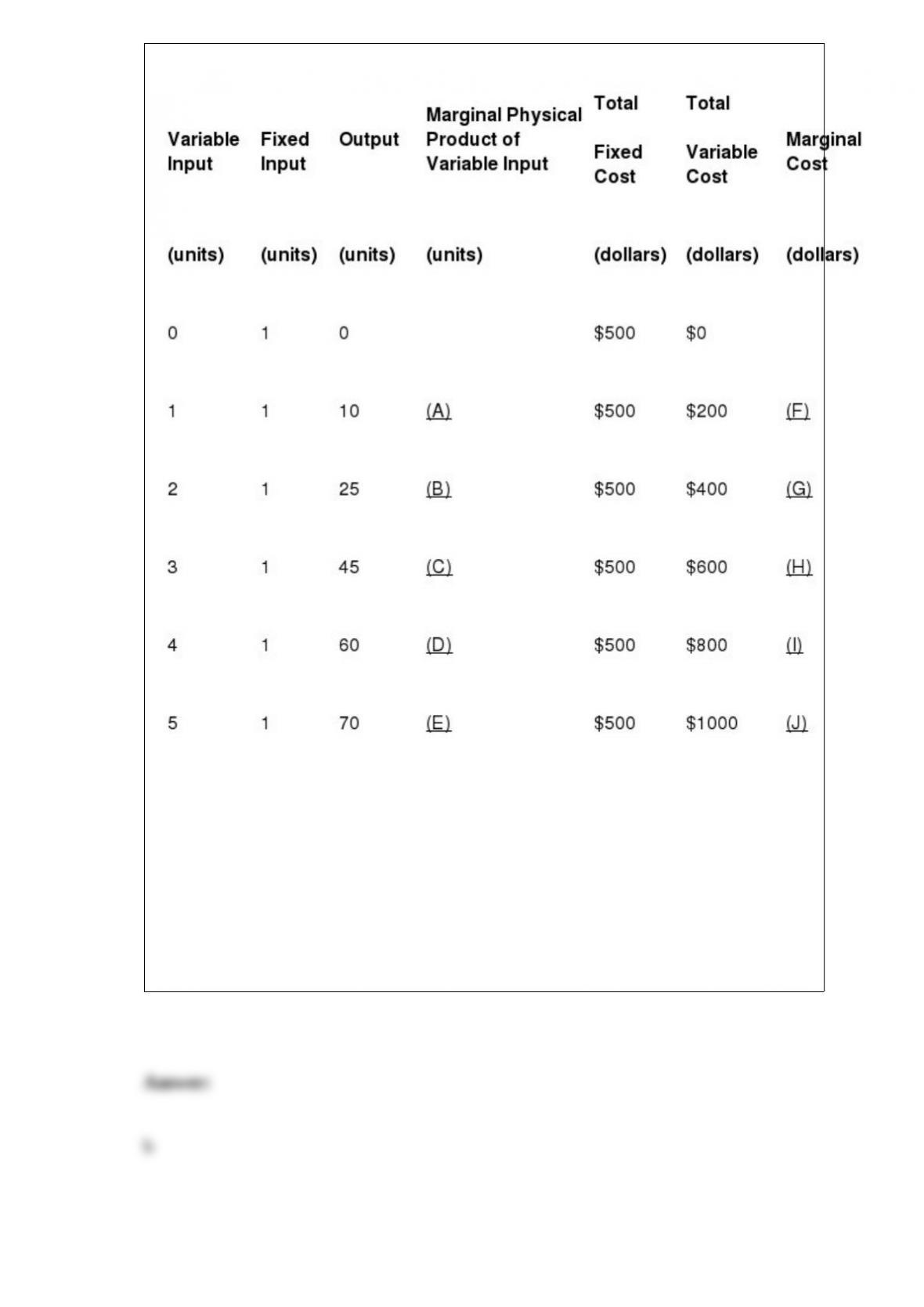
Refer to Exhibit 22-3. The marginal physical product figures in blanks (B) and (C) are,
respectively,
Exhibit 22-3
a. 10 and 15.
b. 15 and 20.
c. 20 and 15.
d. 15 and 10.
e. 10 and 10.
Political candidates tend to identify themselves as being “middle-of-the-roaders”, while
they tend to label their opponents as a member of the political fringe.
a. True
b. False
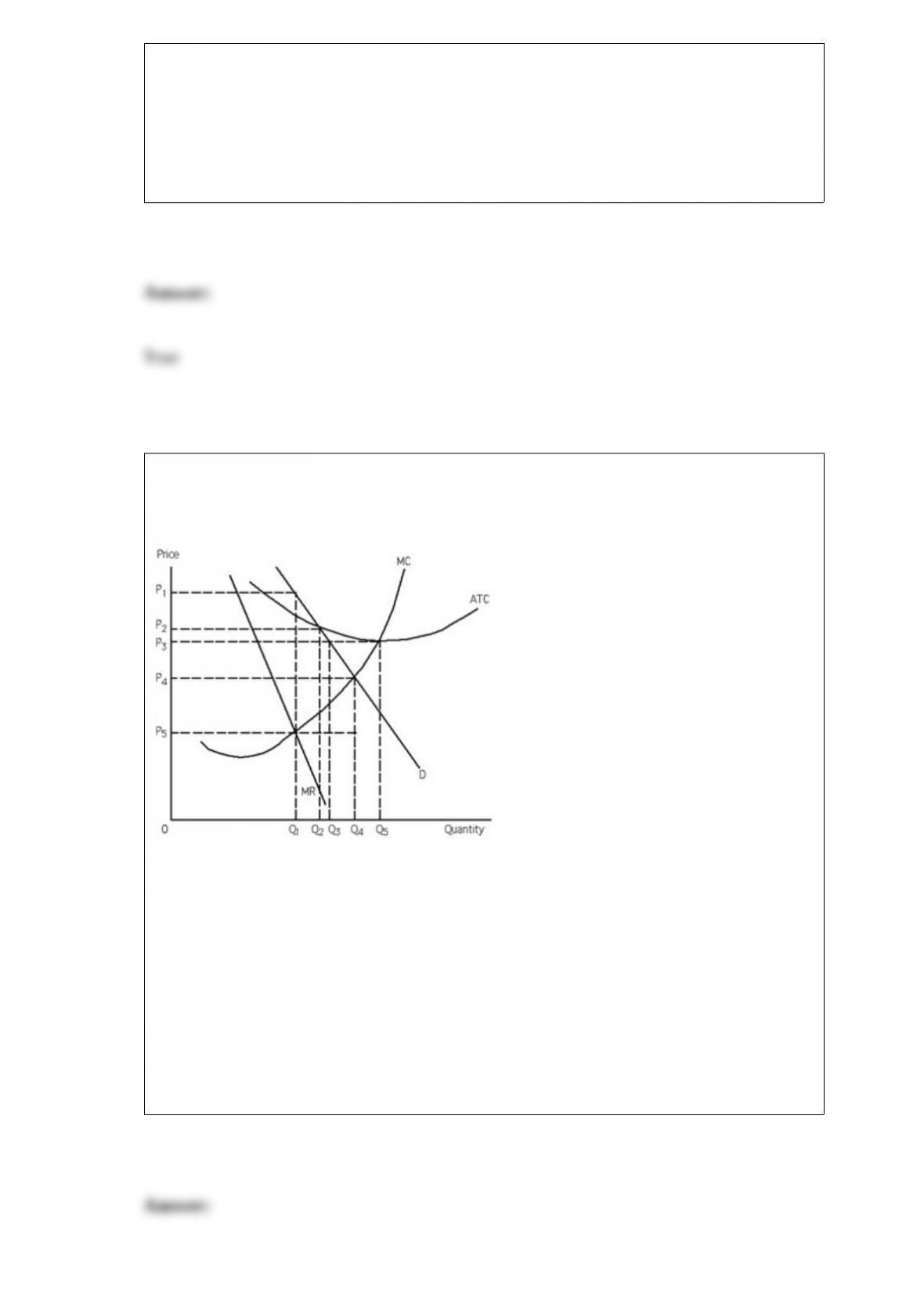
Refer to Exhibit 26-4. What is the productive-efficient level of output?
Exhibit 26-40
a. Q1.
b. Q2.
c. Q3.
d. Q4.
e. Q5.

An industry is composed of 20 firms, all with equal sales. The eight-firm concentration
ratio in this industry is
a. 0.40.
b. 0.32.
c. 2.00.
d. This cannot be determined from the information given.
The percentage change in the quantity demanded of labor divided by the percentage
change in the wage rate is called the
a. marginal revenue product of labor.
b. elasticity of demand for labor.
c. elasticity of supply of labor.
d. marginal factor cost of labor.

The price elasticity of demand for a given good is 2.3. This implies that if price
a. rises by 10 percent, quantity demanded falls 2.3 percent.
b. rises by 2.3 percent, quantity demanded falls 2.3 percent.
c. rises by 20 percent, quantity demanded falls 46 percent.
d. falls by 10 percent, quantity demanded falls 2.3 percent.
e. none of the above
A quota raises the price of the product on which the quota has been placed, decreases
consumers’ surplus, increases producers’ surplus, and generates tariff revenue for the
government.
a. True
b. False
Those economists who argue that the European Union is not a true optimal currency
area cite _______________ and __________________ as justifications for this
position.
a. differences in culture; decreased labor mobility
b. differences in language; culture
c. decreased labor mobility; language differences
d. none of the above
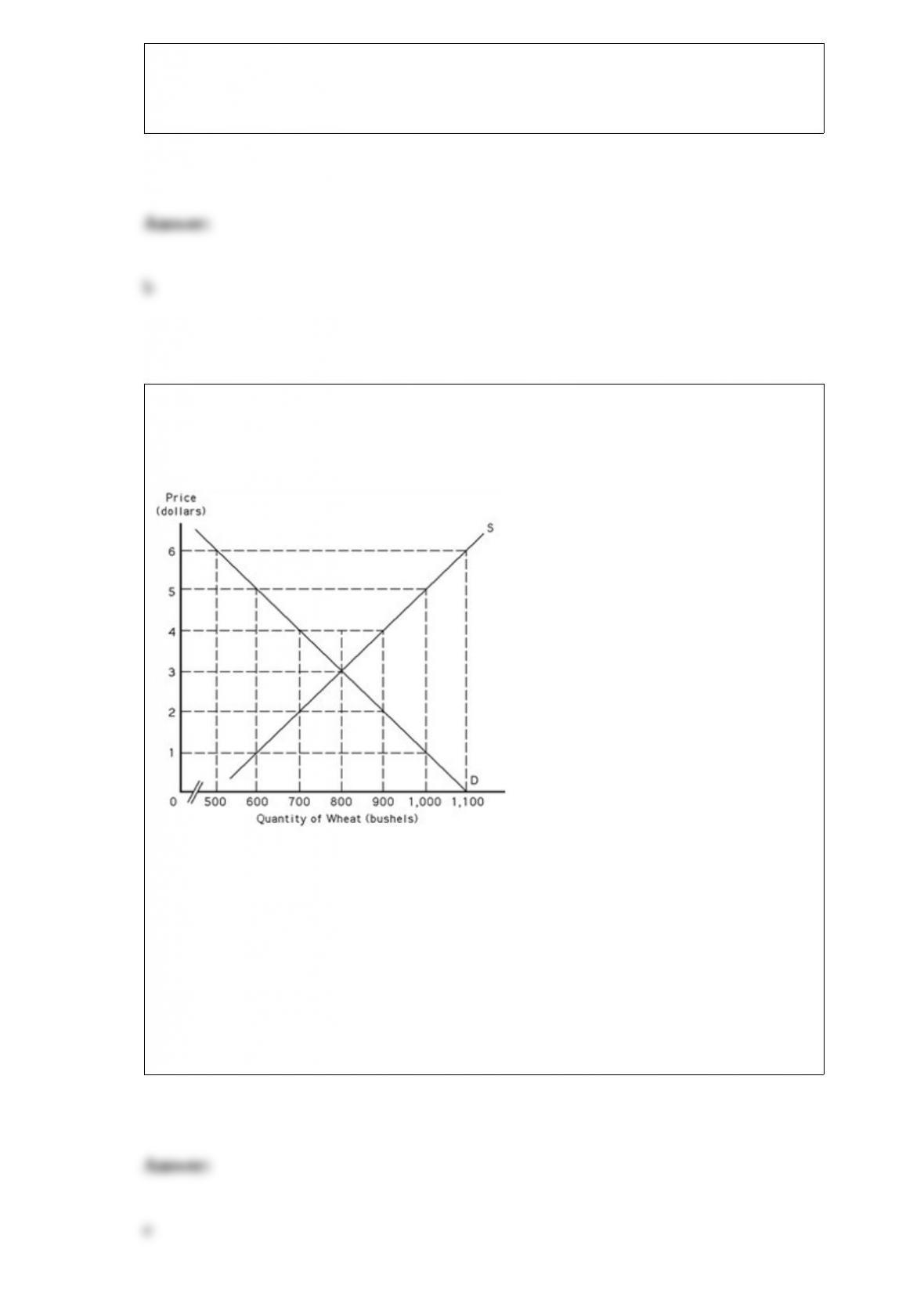
Refer to Exhibit 39-4. If the government sets a target price at $5 per bushel, the quantity
of wheat produced will be
Exhibit 39-4
a. 600 bushels.
b. 700 bushels.
c. 800 bushels.
d. 900 bushels.
e. 1,000 bushels.

If the minimum wage law sets a wage floor below the equilibrium wage in the market
for unskilled labor, then the
a. minimum wage will create a surplus of unskilled labor.
b. minimum wage will create a shortage of unskilled labor.
c. minimum wage will not impact the unskilled labor market.
d. unskilled labor market will change, but we cannot be certain how.
If a single-price monopolist has to lower price to sell an additional unit of its good, and
it charges the same price for all units of its good, it follows that
a. its demand curve will be its marginal revenue curve.
b. it will maximize profits by maximizing revenue.
c. it will sell its good for a price above average total cost.
d. b and c
e. none of the above
Suppose health-care reform Y makes it unlawful for insurance companies to deny
insurance to persons with a preexisting disease and sets a fine for those people who do

not buy insurance.It follows that if the fine is
a. larger than the benefits derived from not buying insurance right away, then people
will not buy the insurance and pay the fine.
b. smaller than the benefits derived from not buying the insurance right away, then
people will not buy the insurance and pay the fine.
c. larger than the benefits derived from not buying insurance right away, then people
will buy the insurance right away and not pay the fine.
d. b and c
e. none of the above
The profit-maximizing monopolistic competitive firm produces a level of output at
which marginal revenue equals marginal cost.
a. True
b. False
Consumers will pay the full tax that is placed on the sellers of a good if demand is
__________ or supply is __________.
a. perfectly inelastic; perfectly inelastic
b. elastic; inelastic

c. perfectly inelastic; unit elastic
d. perfectly elastic; perfectly inelastic
e. perfectly inelastic; perfectly elastic
Abigail has a high rate of time preference while Cynthia has a low rate of time
preference. If the interest rate payable on savings accounts increases from 5 percent to 7
percent, then
a. Abigail would find it easier than Cynthia to cut back on consumption and increase
her savings.
b. Cynthia would find it easier than Abigail to cut back on consumption and increase
her savings.
c. neither Abigail nor Cynthia would decrease her consumption and increase her savings
because relative time preferences have little to do with the interest rate.
d. Abigail and Cynthia would probably decrease their consumption and increase their
savings by the same amount because the higher interest rate will affect them both to the
same degree regardless of their time preferences.
Which of the following statements is true?
a. All persons have a high rate of time preference.

b. People with a high rate of time preference are more likely to be borrowers than
people with a low rate of time preference.
c. People with a high rate of time preference are more likely to be lenders than people
with a low rate of time preference.
d. A high interest rate is the cause of a high rate of time preference.
e. none of the above
Which of the following is not a condition of long-run competitive equilibrium?
a. Economic profits are zero.
b. Marginal revenue is greater than marginal cost.
c. Price is equal to marginal cost.
d. Firms do not have an incentive to change plant size.
e. none of the above
Consider the area between the line of perfect income equality and the Lorenz curve. In
country A this area is larger than in country B. It follows that
a. the bottom 20 percent income group receives a lower percentage of total income in

country A than in country B.
b. the bottom 20 percent income group receives a lower percentage of total income in
country B than in county A.
c. the top 20 percent income group receives a higher percentage of total income in
country B than in country A.
d. the top 20 percent income group receives a higher percentage of total income in
country A than in country B.
e. none of the above
Which of the following would result in higher price elasticity of good X?
a. more substitutes for good X
b. a shorter period of time has passed since the change in the price of good X
c. lower costs of labor in the production of good X
d. good X is more of a necessity than a luxury
Critics of government frequently assert that special interest groups favor transfer
policies rather than economic growth policies.
a. True

b. False